Monday, June 1st 2026

The Intel Arc G3 Series Inside Story: How Intel Created a Purpose-built Gaming Handheld Silicon That Isn't a Hamstrung U-Segment Chip
During the Q&A session with Intel detailing its new Arc G3 series processors for handheld game consoles, we've learned some of the interesting design choices Intel had to make in order to create the perfect chip for the form-factor that doesn't compromise in areas where it's most needed to shine in. For starters, Intel doesn't believe that the Arc G3 is a "processor with integrated graphics," but rather a "GPU with an integrated CPU." Such a philosophy was needed to serve as a bedrock for this chip. Beyond the marketing shift, the session revealed fascinating, previously under-the-radar engineering workarounds Intel is using to challenge AMD's dominance in the portable space.
Fitting Panther Lake into a handheld thermal design power (TDP) required more than just tweaking clock speeds. Intel is employing an aggressive silicon harvesting strategy, utilizing "fallout" dies that don't validate for the full Panther Lake specification. To hit the required power and thermal constraints of a handheld device, Intel has systematically disabled key IP blocks. The Arc G3 cuts the P-core count from four down to just two, drops the number of display engines from three to two, and halves the Thunderbolt capability from four ports to two. This surgical reduction brings the die into a manageable TDP, prioritizing GPU performance and securing supply for the burgeoning handheld market.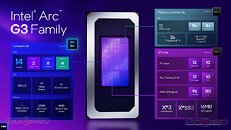
 Power Management v3.5: The "P-Core Parking" Solution
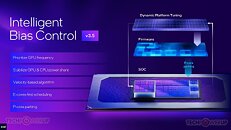
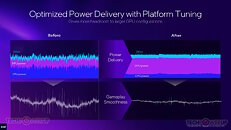
Perhaps the most significant revelation involves how Intel fixed the aggressive power-sloshing behavior that plagued early Lunar Lake iterations. In previous designs, the CPU and GPU would constantly fight for the power budget sub-frame by sub-frame. This caused massive frequency spikes, oscillation, and noisy frame pacing as P-cores spiked power demand only to rapidly hand it back to the GPU.
With the G-Series, Intel is introducing Power Management v3.5, which implements a brute-force but effective solution: P-core parking. When a handheld device drops to an overall SoC power envelope of 12 W or lower, the scheduler completely shuts off the P-cores. All processing is handed to the E-cores, ensuring the GPU receives a steady and predictable power flow. The result is a drastically smoother frame delivery and eliminated power oscillation.
The XeSS Frame Gen Tax and Endurance Limitations
While Intel touted massive efficiency gains using AI frame generation, noting it takes less than a quarter of the energy of a rasterized frame, they were remarkably candid about its overhead. Injecting multi-frame generation to hit ultra-high refresh rates imposes a significant "tax" on native rendering. For instance, scaling a game to 199 smoothed frames drops the native rasterization baseline from 73 FPS down to 50 FPS.
Furthermore, Intel's impressive "Endurance Gaming" mode: a feature that can cap frame rates to drop total system power down to a mere 4 W to 13 W in games like Team Fortress 2 currently does not support Frame Generation. Intel is working to bridge this gap, aiming to allow third-party OEMs to integrate these toggles natively into their quick-settings overlays.
Cloud-Powered Shader Compilation
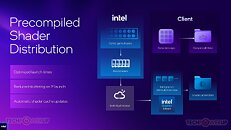
To combat the dreaded shader compilation stutter and long initial load times, Intel has deployed a proprietary cloud-based solution. Because a universal Windows fix is still on the horizon, Intel maintains internal teams dedicated to compiling shaders for new releases. These pre-compiled shaders are uploaded to an Intel cloud network, which the client-side Intel Graphics Software (IGS) silently downloads in the background before the game is even launched. In titles like "God of War Ragnarok," this approach has reduced initial load wait times by a staggering 26x.
Intel's Arc G-Series represents a calculated, highly specific approach to portable gaming. By cleverly repurposing fallout silicon, aggressively parking P-cores, and leveraging cloud infrastructure to smooth out software pain points, Intel is building a formidable, purpose-built challenger to the Ryzen Z-series.
Fitting Panther Lake into a handheld thermal design power (TDP) required more than just tweaking clock speeds. Intel is employing an aggressive silicon harvesting strategy, utilizing "fallout" dies that don't validate for the full Panther Lake specification. To hit the required power and thermal constraints of a handheld device, Intel has systematically disabled key IP blocks. The Arc G3 cuts the P-core count from four down to just two, drops the number of display engines from three to two, and halves the Thunderbolt capability from four ports to two. This surgical reduction brings the die into a manageable TDP, prioritizing GPU performance and securing supply for the burgeoning handheld market.


Perhaps the most significant revelation involves how Intel fixed the aggressive power-sloshing behavior that plagued early Lunar Lake iterations. In previous designs, the CPU and GPU would constantly fight for the power budget sub-frame by sub-frame. This caused massive frequency spikes, oscillation, and noisy frame pacing as P-cores spiked power demand only to rapidly hand it back to the GPU.
With the G-Series, Intel is introducing Power Management v3.5, which implements a brute-force but effective solution: P-core parking. When a handheld device drops to an overall SoC power envelope of 12 W or lower, the scheduler completely shuts off the P-cores. All processing is handed to the E-cores, ensuring the GPU receives a steady and predictable power flow. The result is a drastically smoother frame delivery and eliminated power oscillation.
The XeSS Frame Gen Tax and Endurance Limitations
While Intel touted massive efficiency gains using AI frame generation, noting it takes less than a quarter of the energy of a rasterized frame, they were remarkably candid about its overhead. Injecting multi-frame generation to hit ultra-high refresh rates imposes a significant "tax" on native rendering. For instance, scaling a game to 199 smoothed frames drops the native rasterization baseline from 73 FPS down to 50 FPS.
Furthermore, Intel's impressive "Endurance Gaming" mode: a feature that can cap frame rates to drop total system power down to a mere 4 W to 13 W in games like Team Fortress 2 currently does not support Frame Generation. Intel is working to bridge this gap, aiming to allow third-party OEMs to integrate these toggles natively into their quick-settings overlays.
Cloud-Powered Shader Compilation
To combat the dreaded shader compilation stutter and long initial load times, Intel has deployed a proprietary cloud-based solution. Because a universal Windows fix is still on the horizon, Intel maintains internal teams dedicated to compiling shaders for new releases. These pre-compiled shaders are uploaded to an Intel cloud network, which the client-side Intel Graphics Software (IGS) silently downloads in the background before the game is even launched. In titles like "God of War Ragnarok," this approach has reduced initial load wait times by a staggering 26x.
Intel's Arc G-Series represents a calculated, highly specific approach to portable gaming. By cleverly repurposing fallout silicon, aggressively parking P-cores, and leveraging cloud infrastructure to smooth out software pain points, Intel is building a formidable, purpose-built challenger to the Ryzen Z-series.
26 Comments on The Intel Arc G3 Series Inside Story: How Intel Created a Purpose-built Gaming Handheld Silicon That Isn't a Hamstrung U-Segment Chip
Currently, Intel has zero presence in server-side AI, which is why for some time now it has appeared to be the only company still seriously focusing on the PC market in all its forms. After all, it still maintains significant advantages there, as OEMs depend on Intel and its x86 processor production capabilities.
The creation of a chip specifically for handheld consoles was a rather expected development. Unlike AMD and Nvidia, Intel seems to continue investing heavily to offer new features and avoid falling behind Nvidia. Furthermore, XeSS is considered superior to FSR 3.x and now ARC even supports Multi-Frame Generation. AMD has practically abandoned the market, with its announcements revolving around products that are already available. Neither the 9070 GRE nor the 5800 X3D is anything new. FSR 4 is notably delayed for RDNA 2 and 3, while Multi-Frame Generation is nowhere to be found. On the other hand, even Nvidia—which we often say has abandoned the gaming market—continues to offer some updates. However, in classic Nvidia fashion, it doesn't bring new features to older generations that would allow owners to keep their cards longer. For someone owning an RTX 20x0, for example, the upgraded DLSS 4.5 is more likely to push them toward buying a 50x0 series card rather than holding onto the 20x0. This behavior from AMD and Nvidia creates an opening for Intel.
While it’s based on panther lake, it seems that they’ve disabled stuff on the silicon that allow the GPU to get more power. The chip would have probably been needlessly more expensive if they had a dedicated production for it.
Amd Z2 extreme got the same die size as the Ryzen AI HX470, while using the same GPU. They’ve just disabled a few cores.
This method is just for lightweight games though. Not as effective for 3D games, even with some older ones: My testing with Dark Souls 2 (both original and SOTFS) exhibits frame drops down to 25 FPS from 60 FPS but it works fine with 2 P-cores, but that is 10W TDP PL1, 14W total system.FG is not needed in older games. This is not something anyone asked for. Why would you need frame gen in Team Fortress 2? I can run it at 2160p120 on a RTX 3060 12GB.
But I hear ya. A 16 Xe3 GPU with maybe a 4P/4LPe CPU config sounds better.
ll
a. Higher base power draw (that might not tradeoff nicely for improved performance in the target TDP)
b. Memory bandwidth is a limiting factor for such integrated designs, bigger is not always better, more cores will require more bandwidth to keep them "fed" well.
As for "Purpose-built Gaming Handheld Silicon" it's probably combination of binning and firmware to optimize for gaming.
If it's a normal chip with special binning, then it's not a "purpose built gaming silicon", is it?
About smaller CPU chip and bigger GPU chip, what will it give you? From power standpoint, the CPU already shutdown parts it does need to achieve better efficiency, so smaller die would not necessary improve efficacy, bigger GPU horsepower as I said in my earlier reply have its downsides, and might fit the design goals. Plus it all will be much more expensive as you create entirely new dies for relatively small volume product.
Also a note: LNL E-cores were not part of the ring bus and thus didn't have any access to L3 cache limiting their effective performance.This isn't on Intel so much as it's a side effect of the mempocalypse. You'll find that pretty much every newly manufactured product is carrying a large premium because of it.