Thursday, April 30th 2026

Intel Arc G3 Extreme CPU Shows Promising Performance in Benchmark Leak
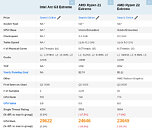
With retail leaks revealing a new MSI Claw handheld slated to arrive soon with Intel's Arc G3 Extreme dedicated handheld CPU onboard, it's no surprise to see the CPU, and its Arc B380 iGPU, appear in early benchmarks. According to a recent PassMark run, the Intel Arc G3 Extreme will put up impressive numbers in terms of both CPU and GPU performance, with multicore CPU tests resulting in 29,622 points and single-core tests coming in at 4,288 points.
In comparison, the AMD Ryzen Z2 Extreme that has become ubiquitous in the handheld gaming space, manages 23,649 in multicore CPU testing and 3,964 points in single-core tests—just over 20% slower than Intel's upcoming chip. To be fair, the TDP of the 14-core Intel chip during the test is unknown, and performance at lower power has been one of Intel's weaknesses when it comes to gaming handhelds. GPU tests have not yet been recorded by PassMark, but the Arc B380 is slated to be built on the same 12-core Xe3 silicon with a minor 200 MHz decrease in GPU clock, so performance is expected to be quite similar to the Arc B390, which we tested to be significantly faster than AMD's Radeon 890M.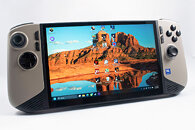
Source:
PassMark
In comparison, the AMD Ryzen Z2 Extreme that has become ubiquitous in the handheld gaming space, manages 23,649 in multicore CPU testing and 3,964 points in single-core tests—just over 20% slower than Intel's upcoming chip. To be fair, the TDP of the 14-core Intel chip during the test is unknown, and performance at lower power has been one of Intel's weaknesses when it comes to gaming handhelds. GPU tests have not yet been recorded by PassMark, but the Arc B380 is slated to be built on the same 12-core Xe3 silicon with a minor 200 MHz decrease in GPU clock, so performance is expected to be quite similar to the Arc B390, which we tested to be significantly faster than AMD's Radeon 890M.


18 Comments on Intel Arc G3 Extreme CPU Shows Promising Performance in Benchmark Leak
That is my take from owning their first-generation handheld, I don't mind owning it because I mostly use it to play very old game and emulate PS1/PS2 games so TDP stays sub 15W at most, so it has usable 4-5 hours of battery. When playing Cyberpunk, it can only last about 45 minutes at full power. Performance for a handheld is great though, coupled with frame gen I can see that Intel could compete well in handheld market with these newer chips. They need more Linux support though because most people asking for that and moving away from Windows.
Also, with rumours about Intel stopping, or delaying GPU development, I would worry about support longevity.
Linux instead does make a better case for support longevity to AMD thanks to the community and open source driven RADV without much AMD involvement apart from providing GPU documentation, albeit Intel support longevity for GPUs in Linux is not bad either and it does come from Intel directly, what they still just need to workaround to extents in Linux is Vulkan game compatibility and performance.
I didn't expect much from AMD Z2E but seeing this from Intel is disappointing.
Especially on those power constraint setting that should made the G3E shine.
Intel already reduced driver efforts on their dGPUs so I would be worried as well over long term. The promised updates didn't materialize and the performance optimizations are lot less than it used to.That's why Steam Deck is still king of handhelds, because it is still shoulder-to-shoulder at the 15W TDP level compared to 890M and 140V. Pantherlake is better, but there's a price point issue and not having SteamOS available.
All that to say, I think you can be more confident in Intel's long-term support for handheld/APU driver support than in their dGPU support, because the market prospects are significantly better. And it's not like AMD's history of driver support (especially for APUs) is a shining beacon of reliability lol. Intel might well be better than the only alternative.
I'm pretty sure all the manufacterers will try to find a fine balance between performance and power usage for the optimal user experience.
More performance than needed (with increased power usage) will result in diminishing battery life, logically thinking.
So an overkill on computing power is most likely no to be expected, but if they do, for the marketing departments it is great ammunition to shoot at the competition :D .
They'll have the time of their life by advertising and smooth talking possible disadvantages into great features that the competition doesn't have :roll:(and that works both ways).
Ignorant consumers will fall for it as usual and the manufacterers just want a (big) piece of the pie 💲💲💲.
Personally I'm not a 'handheld' gaming device kind of guy.
I had 2 (in 1), my first one was also my last one :laugh::laugh::laugh:, the original Sony PSP.
It didn't rock my boat :ohwell:
But I do realise the modern handhelds are waaay waay better as technology proceeds and looking at my son's Steam Deck..., well, maybe in the future there's a slight chance I'll give it another go.
A bigger concern that I haven't seen Techpowerup talking about yet is that they recently pulled and shut down their open source repositories. They also all but closed their open source evangelism program. (Link for info)
A lot of these were useful for open source development on intel hardware. So where does that leave Intel GPU Drivers on linux which already have second class support?
For Race to Idle by itself to be effective the following scenarios have to be met:
-The CPU is the majority consumer at load. If the CPU is only using 2W and the whole system power is 20W, then race to idle doesn't work. If the CPU TDP is 20W and system is using 25W, then it can.
-If the CPU is the majority consumer, the CPU must also be able to idle low to a point where the whole system power in idle is a small fraction of whole system power in idle. If the Load power - Idle power difference is small, then race to idle is ineffective.
-The majority use case must be bursty and eventually finish. In constant load scenarios race to idle has zero benefit. Such as games and rendering, where you need CPU active all the time.
So after 20 years or so Intel realized that race to idle itself is ineffective. So in 6th Gen Core "Skylake" they introduced a not so well known concept called "eARTH" or "energy Aware Race to Halt". In Skylake it monitors the entire system power. It recognizes that if the CPU is a minority consumer then there's little to no benefit for race to idle. It recognizes if the idle power is high then there's no benefit to race to idle.
The SpeedShift settings and numbers set the aggressiveness of the eARTH algorithm. Higher number means it's more performance oriented, and lower number means more power savings oriented, and when before it only cared about the CPU, Speedshift cares at the platform level.
Many people who do battery life optimizations on their laptops often conclude they should have Turbo Boost off. That is also contrary to Race to Idle/Halt. Because what happens with Turbo is that sometimes a rogue process or unexpected event keeps the CPU at Turbo and you cannot control it all the time. In such scenarios higher Turbo clocks are just burning watts. Since Turbo clocks require much higher power, it saves battery by having it off and keeping it at base clocks.
To add to the topic, how relevant is race to idle in a mobile device? I would some not very, considering that in most cases, it's the display that consumes the most power, not the CPU.
You shouldn't underestimate the numerous power savings brought to just display related stuff. This is for Meteorlake: www.techpowerup.com/review/intel-meteor-lake-technical-deep-dive/5.html
The 4th Gen U laptop I have consumes 0.8-1W just to have display active. Meaning, even if display power is zero, it adds nearly a watt. And the display even at relatively low brightness settings adds 2W easily on top of that. On my 7th Gen Y device, I think it adds less than half that. In total, on my 7th Gen Y device, the display is only 1.5-2W, compared to 3W-plus. The screen is smaller but significant part of the savings are on the compute side. And on Pantherlake, it might be at 700-800mW. The LED backlight itself is quite efficient. But it requires compute resources and necessary driver circuitry to do the wonders of displaying something more than just a white light on the screen. Remember, Intel was talking about "1W display" back with 6th Gen Skylake.
Race to Halt is still important. But to get meaningful power savings, it requires engineering advances in all areas. It's not just save power on display and that's it. That's why it's challenging, because there's no one answer solution.
hmc-tech.com/tablets/ipad-air-11-gen-3-m4-early-2026-vs-ipad-pro-11-gen-6-m5-late-2025
some contemporary handheld devices seem to start having semi-decently powerful SoCs, able to deliver substantial performance levels
however, today's www and today's games tend to be so erroneously, defectively and bloatly designed, that experiences can vary
currently you can have 4x Core i7-980X performance in a 12 watts CPU, which is impressive by standards of the past
as well as you can have double PS4's Liverpool GPU performance in a 12 watts GPU, which is also kinda impressive
worst part is when some devices are limited by low ram/storage capacity, low ram/storage speeds or small batteries