News Posts matching #Asahi Linux

Return to Keyword Browsing

Omarchy 4.5 Arrives with Support Beyond x86-64 and New Desktop Features

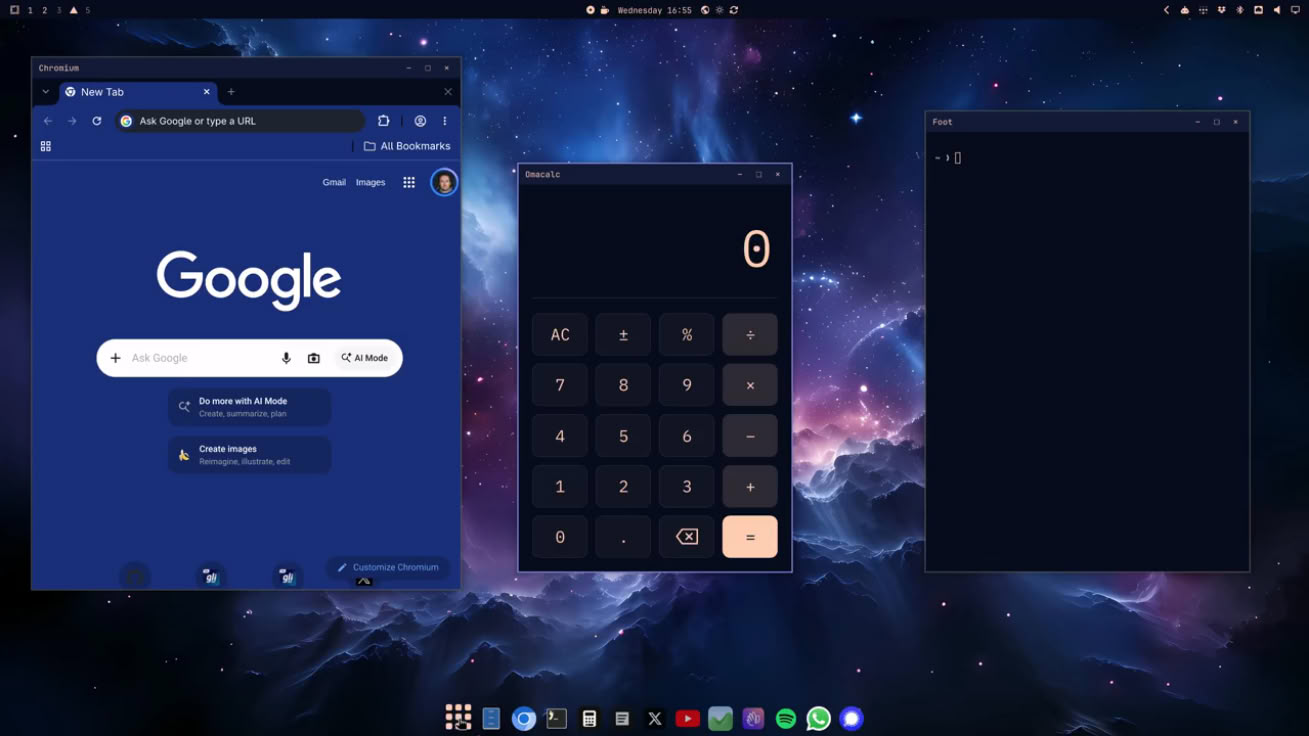
The Arch Linux-based distribution Omarchy 4.5 has been released, the project's first expansion beyond x86-64. It adds Apple Silicon support, a new floating desktop mode, and a few other updates. Omarchy now runs on Apple M1, M2, M3, and Neo MacBooks. The Apple Silicon support builds on work by the Asahi Linux project and other contributors. It also adds preliminary support for NVIDIA's Arm-based N1X laptops and the DGX Spark systems. However, support for newer Apple M4, M5, and M6 models and Qualcomm Snapdragon X-based laptops is still in development. According to project creator David Heinemeier Hansson, the release includes more than 740 merged pull requests from over 180 contributors during a 12-week development cycle.

The desktop experience remains based on the Hyprland compositor. Users can now switch individual workspaces between tiling, scrolling, and floating layouts using the Super + L shortcut. Floating workspaces have conventional window title bars and a dock with pinned applications, running programs, and an application launcher. Windows can be minimized to the dock with Super + M. Also, applications can be pinned or rearranged via drag and drop to the dock. Users can mix different layouts across workspaces.
Linux Kernel Patch Expands USB4 Support for Apple Silicon SoCs

The Asahi Linux project development team has long been working on bringing Linux to Apple Silicon MacBooks and desktops, going so far as to show off games on the Arm-powered laptops. The latest patches to Asahi add proper support for USB4 and Thunderbolt on MacBooks with the M1, M2, and M3 SoCs, and that support is now making its way to the mainline Linux kernel, as per an upstream patch by prominent Asahi developer, Sven Peter.
This series adds initial USB4/Thunderbolt support for Apple Silicon M1, M2 and M3 SoCs. Each USB4 capable Type-C port comes with an ACIO ("Apple Converged I/O") block which contains a Cortex-M3 coprocessor and the hardware implementing the USB4 router.

Former Asahi Linux GPU Driver Lead Jumps Ship to Intel GPU Driver Development

We've reported a handful of times about the Asahi Linux project, which aimed to bring Linux support to Apple Silicon MacBooks and desktops. A huge part of that mammoth task involved reverse engineering low-level items, like graphics drivers. Alyssa Rosenzweig was previously in charge of developing the open-source Mesa OpenGL/Vulkan drivers for the Asahi Linux project, but she recently announced her departure from the project and teased her involvement with the Intel HPG team.

Now, Rosenzweig has updated her resume with an entry titled "Designing open source graphics drivers for Intel GPUs." Rosenzweig's role at Intel will involve developing both Vulkan and OpenGL drivers for Intel GPUs on Linux, and there appears to be a specific focus on gaming. This could be an indication that Intel is planning to ramp up the development and performance of its graphics drivers on Linux, which has been slightly inconsistent on Intel's Arc dGPUs. The B580, for example, easily holds its own against GPUs like the AMD Radeon RX 7600 XT and NVIDIA GeForce RTX 4060 on Windows in our review, but on Linux, the B580 falls behind its peers by a significant margin in many instances. There have also been significant improvements in many games since the B580 launched, but it seems as though Intel is working on taking that even further with driver improvements.

Linux Kernel May Soon Support USB 3.x on Apple M1 and M2 MacBooks and Desktops

The Asahi Linux project has been working on Linux support for Apple's Arm-based Apple Silicon Macs, and the latest success to come out of the mammoth task is support for the USB 3.1 Gen 2 ports on M1 and M2 SoCs. While this support has been available to Asahi Linux for a while, the feature may soon be merged into the Linux kernel, since the feature addition has been submitted for comments via the Linux kernel public inbox.

The implementation still doesn't have support for DisplayPort or Thunderbolt alt modes, with the developer behind the driver stating that "there's also some preparations to eventually enable DisplayPort AltMode and Thunderbolt but those need future work." The driver is clearly still a work in progress, and the comments by the developers suggest that they are effectively fighting against the USB controller firmware to get some of the features to work, but that this implementation is so far the best that they could come up with. So far, Asahi Linux only supports M1 and M2 series Apple Silicon, and the only items missing in the hardware support section are USB-C Displays, USB4 and Thunderbolt connectivity, and TouchID support.
Return to Keyword Browsing
Nov 14th, 2026 08:31 CST change timezone

New Forum Posts

Popular Reviews

TPU on YouTube

Controversial News Posts