Friday, October 2nd 2026

NVIDIA Launches DGX Spark 64 GB Desktop AI Systems
Local AI is becoming more useful by the token. As AI agents move from experiments into everyday development, increasingly capable open models are shrinking to fit on more devices, giving builders more to run locally.
Coming this month, NVIDIA DGX Spark will be available with 64 GB of unified memory from top manufacturer partners—Acer, ASUS, Dell, Gigabyte, HP and MSI—giving developers, researchers and AI enthusiasts a new configuration with DGX OS and the NVIDIA AI software stack ready to use from day one.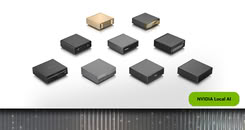 The new SKU runs capable local agents on device—privately, without cloud dependency. And when workloads grow, two units can cluster together via NVIDIA Sync Cluster Assistant without any additional setup.
A New Starting Point for Personal AI Supercomputing
DGX Spark combines NVIDIA Grace Blackwell compute, unified memory, NVIDIA ConnectX-7 networking and an NVIDIA CUDA-accelerated AI software stack in one system. It's a complete local AI platform for agents, inference, fine-tuning, data science and edge development.
The compact, personal AI supercomputer provides a place to experiment with models and developers' own data without turning to a cloud instance for every task.
The new 64 GB configuration, available exclusively from manufacturer partners, keeps the platform at an accessible price point while retaining the GB10 Grace Blackwell Superchip, DGX OS and full NVIDIA AI software stack—same as the 128 GB model. It supports up to 100-billion-parameter models and the agentic applications built on them, fully on device.
Two 64 GB units clustered together don't just double the memory. In NVIDIA's Qwen 3.8 27B test, two clustered 64 GB systems delivered up to 1.7x performance compared with a single system, with room to keep scaling as workloads demand.
DGX Spark ships ready for agent development from day one—NVIDIA Agent Toolkit, CUDA-X AI libraries, Nemotron open models, and popular runtimes like Ollama, vLLM, and PyTorch with CUDA are all supported out of the box. Developers can go from power-on to running models in minutes.
Blender is among the first major creator application providers to support the platform, with a prebuilt, downloadable installer coming soon.
Scale Up With NVIDIA Sync Cluster Assistant
Developers can start with the memory their projects need today and build on a platform designed to seamlessly scale multi-node clusters for larger workloads as their pipelines grow.
Every DGX Spark ships with a built-in NVIDIA ConnectX-7 NIC right out of the box. Plus, two units can connect directly with a QSFP cable, pooling their memory to 128 GB and expanding model support to up to 200 billion parameters while delivering twice the memory bandwidth and up to 1.7x the performance.
The NVIDIA Sync app configures this multi-node cluster seamlessly. The cluster assistant feature detects connected units, validates device configuration and configures the ConnectX-7 network, so developers can focus on their work rather than the infrastructure. Every node runs the same NVIDIA software stack, so nothing needs to be reconfigured when scaling from one unit to two.
And coming at the end of the month, NVIDIA Sync Model Launcher makes running local AI as simple as clicking a few buttons. Developers can download and launch Qwen3.8 27B on a single DGX Spark system or a cluster, with NVIDIA Sync configuring the model to run across connected devices and making it accessible from users' laptops. The launcher will also set up OpenCode to use the model, so developers can start coding in their browser.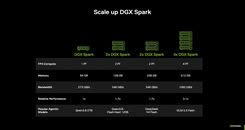 Developer Use Cases on DGX Spark
The new DGX Spark 64 GB configuration supports practical work from day one. With up to 100-billion-parameter models running entirely on device, developers and enthusiasts can start with a single system for models that fit within its memory, or connect multiple DGX Spark systems with NVIDIA Sync Cluster Assistant for workloads that need more memory and compute.
Here are three workflow examples:
DGX Spark 64 GB is available from Acer, ASUS, Dell, Gigabyte, HP and MSI on Friday, Oct. 23, starting at $4,999.
To get started:
#ICYMI: More Updates From NVIDIA Local AI
Explore playbooks on build.nvidia.com/spark for DGX Spark. The following playbooks are coming soon to 64 GB devices:
Alibaba's Qwen-Image-2.1 brings image generation and editing together in a lightweight, open-weight model. It runs locally on NVIDIA RTX GPUs, DGX Spark and DGX Station, giving creators more ways to create and refine images on their own hardware.
Source:
NVIDIA
Coming this month, NVIDIA DGX Spark will be available with 64 GB of unified memory from top manufacturer partners—Acer, ASUS, Dell, Gigabyte, HP and MSI—giving developers, researchers and AI enthusiasts a new configuration with DGX OS and the NVIDIA AI software stack ready to use from day one.

A New Starting Point for Personal AI Supercomputing
DGX Spark combines NVIDIA Grace Blackwell compute, unified memory, NVIDIA ConnectX-7 networking and an NVIDIA CUDA-accelerated AI software stack in one system. It's a complete local AI platform for agents, inference, fine-tuning, data science and edge development.
The compact, personal AI supercomputer provides a place to experiment with models and developers' own data without turning to a cloud instance for every task.
The new 64 GB configuration, available exclusively from manufacturer partners, keeps the platform at an accessible price point while retaining the GB10 Grace Blackwell Superchip, DGX OS and full NVIDIA AI software stack—same as the 128 GB model. It supports up to 100-billion-parameter models and the agentic applications built on them, fully on device.
Two 64 GB units clustered together don't just double the memory. In NVIDIA's Qwen 3.8 27B test, two clustered 64 GB systems delivered up to 1.7x performance compared with a single system, with room to keep scaling as workloads demand.
DGX Spark ships ready for agent development from day one—NVIDIA Agent Toolkit, CUDA-X AI libraries, Nemotron open models, and popular runtimes like Ollama, vLLM, and PyTorch with CUDA are all supported out of the box. Developers can go from power-on to running models in minutes.
Blender is among the first major creator application providers to support the platform, with a prebuilt, downloadable installer coming soon.
Scale Up With NVIDIA Sync Cluster Assistant
Developers can start with the memory their projects need today and build on a platform designed to seamlessly scale multi-node clusters for larger workloads as their pipelines grow.
Every DGX Spark ships with a built-in NVIDIA ConnectX-7 NIC right out of the box. Plus, two units can connect directly with a QSFP cable, pooling their memory to 128 GB and expanding model support to up to 200 billion parameters while delivering twice the memory bandwidth and up to 1.7x the performance.
The NVIDIA Sync app configures this multi-node cluster seamlessly. The cluster assistant feature detects connected units, validates device configuration and configures the ConnectX-7 network, so developers can focus on their work rather than the infrastructure. Every node runs the same NVIDIA software stack, so nothing needs to be reconfigured when scaling from one unit to two.
And coming at the end of the month, NVIDIA Sync Model Launcher makes running local AI as simple as clicking a few buttons. Developers can download and launch Qwen3.8 27B on a single DGX Spark system or a cluster, with NVIDIA Sync configuring the model to run across connected devices and making it accessible from users' laptops. The launcher will also set up OpenCode to use the model, so developers can start coding in their browser.

The new DGX Spark 64 GB configuration supports practical work from day one. With up to 100-billion-parameter models running entirely on device, developers and enthusiasts can start with a single system for models that fit within its memory, or connect multiple DGX Spark systems with NVIDIA Sync Cluster Assistant for workloads that need more memory and compute.
Here are three workflow examples:
- Run an AI agent around the clock: Keep a coding or research agent running on DGX Spark, ready to review code, analyze documents or carry out multistep tasks. A cluster provides additional capacity for larger models, longer context windows or multiple agents working at once.
- Power AI apps on your everyday PC: Run a language- or image-generation model on DGX Spark while using an agent or creative application on laptops or desktops. DGX Spark handles the model inference, freeing PCs for other work.
- Scale when the work grows: When a single task outgrows one unit—running a larger model, a longer context window or concurrent agent requests—two DGX Spark 64 GB systems connected over the 200 GbE fabric via NVIDIA Sync Cluster Assistant pool their memory to 128 GB. The same workflow that ran on one unit scales to two without reconfiguring the software environment.
DGX Spark 64 GB is available from Acer, ASUS, Dell, Gigabyte, HP and MSI on Friday, Oct. 23, starting at $4,999.
To get started:
- Download a supported inference framework—llama.cpp, Ollama, vLLM or LM Studio.
- Download the recommended local model for the workflow.
- To scale to two units, connect them via their NVIDIA ConnectX-7 ports and launch NVIDIA Sync Cluster Assistant—it configures the network and routes workloads automatically.
#ICYMI: More Updates From NVIDIA Local AI
Explore playbooks on build.nvidia.com/spark for DGX Spark. The following playbooks are coming soon to 64 GB devices:
- Serve LLMs With vLLM
- Run OpenClaw With a Local LLM
- Connect Multiple DGX Sparks for Distributed Workloads
Alibaba's Qwen-Image-2.1 brings image generation and editing together in a lightweight, open-weight model. It runs locally on NVIDIA RTX GPUs, DGX Spark and DGX Station, giving creators more ways to create and refine images on their own hardware.
16 Comments on NVIDIA Launches DGX Spark 64 GB Desktop AI Systems
are these all soldered on the mainboard?
"so much expensive RAM in these things..."
People bought them up because of this "make everything into an agent" psychosis but they're really not worth the money, you are better off just paying for subscriptions if you have 7000$ dollars on hand, which is what these things cost now, absolutely ludicrous, they are not worth even a fifth of that for what they can do.
1. Their stock will be dry soon
2. The higher buying cost of RAM will eat into their the margin
"Advantage", my ass.
is decent and 4 sparks would allow you to run a Q4 of GLM 5.3 at acceptable speeds.
Wish there were better options though.
Don't forget, either, that Nvidia buys memory in massive volumes. That means they enjoy the lowest possible pricing from day one and lock in protection against future memory price hikes for years through pre-negotiated contracts. But don't expect Nvidia to be honest and tell you they're paying $10 when you're paying $25 and other major tech companies, even huge OEMs, are paying $15 or $20.