
News Posts matching #Data Analysis

Return to Keyword Browsing

Valve Adds Steam Deck FPS Data To Game Compatibility Screen in Latest Update

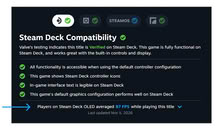
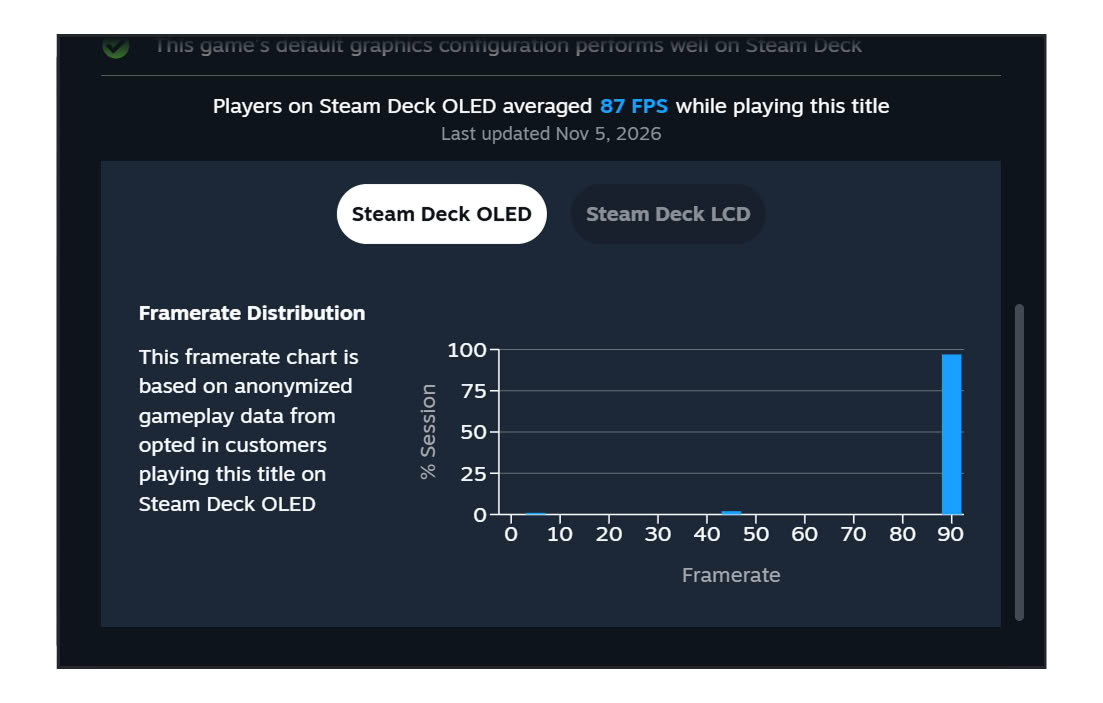
Valve recently announced that it was adding an opt-in toggle to enable data collection in Steam for the Steam Deck, with the idea behind the new feature being that developers could analyze the reported framerate data using Steam's built-in tools to better optimize their games for the handheld's hardware. In a new Steam Client update, however, Valve has confirmed that it will start sharing that same average Steam Deck framerate data with players before they buy the game, so that they can get a relatively accurate idea of what to expect from the gameplay experience before spending money on the game.

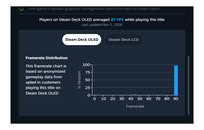
The framerate data will be displayed as an average at the bottom of the Steam Deck compatibility screen as an FPS figure specific to the player's current hardware. The figure will also cite the date the average was last updated. Clicking or tapping the dropdown arrow next to the framerate note will expand a histogram showing the game's average framerate distribution across gaming sessions as a percentage. This should, with relative certainty, convey how often players ran into gameplay hitching.
Leaked GTA Online Sales Figures Spur Confidence in Rockstar for GTA VI Launch

By now, it's no secret that Rockstar Games has suffered a data breach by way of malicious hacking group ShinyHunters, which threatened to release the data gathered during the breach if Rockstar did not meet its demands. Now, as Kotaku reports, ShinyHunters has followed through with its threat and published some of the information it managed to gobble up during the breach. One figure in particular that stands out among the leaked data is the GTA Online earnings, which have apparently amounted to around $1.3 million per day between September 2025 and April 2026. The actual amount cited is $9,592,109 per week, with some weeks spiking to as high as $27,889,791.

These revenue totals, which were reported by Lexiture on the GTA Forums, are thanks to a total of 9,937,747 weekly active users and an average of 393,402 weekly paying users. These numbers painted such a positive picture of Rockstar and the promise of GTA VI's commercial performance that Take-Two Interactive's share prices increased by nearly 5%, adding an alleged $1 billion to the publishing company's market cap in a single day.

Marathon Sales Estimated at 1.2 Million—Steam Leads the Pack With Two Thirds of Sales

Marathon launched almost exactly three weeks ago, with a mix of both fanfare and criticism, but given its reasonably strong player counts—with a stable 28,000-40,000 daily concurrent players—it's not surprising to learn that the game has sold an estimated 1.2 million units across the three platforms where it is available. According to Alinea Analytics, Marathon has earned $55 million in revenue across PC, PlayStation, and Xbox platforms. The analytics firm estimates that Steam holds around 800,000 of those players, while Marathon sold 217,000 units on PlayStation 5 and 133,000 on Xbox Series platforms.

The researchers also looked into the correlation between Bungie's previous games and Marathon, and it seems as though the developer's reputation may have been a substantial driving force for Marathon players. As many as 78.2% of Marathon's Steam players had previously played Destiny 2, while 62.7% had played Helldivers 2, and 55.9% played Arc Raiders—although it should be noted that all three titles had colossal player counts, so some of this may be pure coincidence, and some of it could also be attributed to Steam's recommendation algorithms, which would be more likely to show Marathon to fans of similar Bungie games. There have also been rumors of Marathon potentially launching on last-gen Xbox and PlayStation consoles, but nothing has been confirmed regarding that release just yet.

Mindfactory Reports AMD Radeon RX 9070 XT Still Tops Sales Charts but GPU Sales Plummet

German retailer Mindfactory indicates that AMD's Radeon RX 9070 XT is its top-selling GPU for weeks 9-11 of 2026 (meaning March 1-15), although it also indicated that there is a dramatic decrease in GPU sales during the same time period. According to the retailer data (shared by TechEpiphanyYT on X), AMD made up 55.6% of the outlet's sales for that time period, with the AMD Radeon RX 9070 XT in the lead as top seller with 25.6% market share and the RX 9060 XT following that up with 20.3%. The next five spots, though, are all NVIDIA GPUs—namely the RTX 5080 at 11.8%, the RTX 5070 Ti at 9%, the RTX 5060 and 5070 at 7% each, and the RTX 5090 at 5.3%.

The next-most-popular AMD GPU at Mindfactory was the Radeon RX 7600 in the eighth spot, with the RX 7900 XTX, 7900 XT, and 7700 XT following in 10th, 11th, and 12th place. Curious as it may seem to see AMD in the lead where NVIDIA usually dominates in most other markets, it follows trends set by previous Mindfactory reports. More concerning, GPU sales have also reportedly fallen to roughly a third of their usual numbers, likely as a result of stock shortages and skyrocketing hardware prices across the board. While recent reports indicate that GPU prices might be correcting slightly, at least on the AMD side, other component supply issues and the resulting high prices may be dissuading people from platform upgrades or fresh PC builds altogether.

US Gaming Hardware Sales Reach 35-Year Low As Prices Soar

Ask any gamer, and you'll hear anecdotes of sky-high hardware prices, especially with the recent developments in the system memory market, but now we also have data to back up those conclusions, thanks to Matt Piscatella and Circana Retail Tracking Service. Piscatella, the Senior Director and Video Game Industry Thought Leader at Circana, recently posted a graph on Bluesky revealing the average monthly US video game hardware unit sales and sale price per unit in November of every year starting in 1995.

According to the data, gaming hardware sales are at the lowest they've been since November 1995, sitting at 1.6 million sales, down from 3.39 million units in November 2019. Meanwhile, the average price per unit is at an all-time high, with the price per unit coming in at $439, up from a mere $235 in November 2019. Compared to November 2024 alone, video game hardware spending declined by a whopping 27%, compared to a 1% increase in sales volume for gaming content and a 13% decline in video game accessory sales. The year-over-year sales reportedly still saw a 10% increase. It's worth noting that this data isn't necessarily representative of global sales or pricing trends, since only US sales were measured. At the same time, it seems as though subscriptions are paying off, with the data analyst claiming a 16% increase in subscription spending since November 2024. In general, it seems as though gamers are spending similar amounts of money on game content as they were just a year prior.

ADATA Industrial Releases A+ Analyzer Data Analysis Tool Customizing the Best SSD Solutions

ADATA Technology, the world's leading brand for industrial-grade embedded storage, has released the "A+ Analyzer" data analysis tool, which features technology developed by ADATA's independent R&D team integrating software and hardware to analyze user behavior. This innovative solution aims to accurately depict terminal device usage behavior through in-depth collection and analysis of customer host system data, thereby enabling the selection of the most suitable SSD products for customers.

Since industry customers are widely distributed in disparate fields such as transportation, medical care, automation, network communications, and security, there are significant differences in data patterns, write cycles, and SSD read/write requirements for associated applications (such as sequential read/write, random read/write). The lifespan of flash memory decreases with each write cycle. Therefore, the read/write behavior of specific applications directly affects the durability of SSD flash memory. The ADATA "A+ Analyzer" tool was created to meet these challenges. It not only analyzes customer behavior to gain in-depth insight into their usage patterns, but also provides personalized SSD selection recommendations or customized firmware solutions based on different routines.

Steam Will End Google Analytics Integration By July

Valve's Steamworks Development team has reaffirmed, in an announcement earlier on this week, that the company is committed to protecting the privacy of its userbase: "Steam will continue to not share personally identifiable information. This approach to privacy means that some trade-offs have been made along the way that limits how specific some reporting can be. In most cases, it simply means that any traffic sources that are below a threshold of volume will get reported as "other". We intentionally don't collect or store demographic information about users such as age, gender, or race."

Valve has decided to drop its usage of Google Analytics as part of Steam's traffic monitoring package: "As of this coming July, Google will no longer operate Universal Analytics (UA), which is a third-party traffic reporting system that we've had available for measuring traffic sources to Steam store pages. Their announced replacement will be a system called Google Analytics 4 (GA4). You can read Google's help article about the topic." Valve has chosen to develop their own system instead of upgrading to the latest version of third-party software: "As time has gone on we've come to realize that Google's tracking solutions don't align well with our approach to customer privacy, and so with the migration to GA4 we've made the decision to end our support of Google's analytics systems on Steam. Instead, we're focused on building the most useful parts of aggregated reporting into Steam itself, as described above."
Return to Keyword Browsing
Nov 14th, 2026 02:56 CST change timezone

New Forum Posts

Popular Reviews

TPU on YouTube

Controversial News Posts