Monday, February 2nd 2026
Memory Price Outlook for 1Q26 Sharply Upgraded; QoQ Increases of All Product Categories to Hit Record Highs
TrendForce's latest memory industry survey indicates that persistent AI and data center demands in 1Q26 are further worsening the global memory supply and demand imbalance, thereby increasing suppliers' pricing power. As a result, TrendForce has significantly raised its 1Q26 price forecasts for both DRAM and NAND Flash products. The quarter-over-quarter increase in conventional DRAM contract prices has been revised upward, from a previous estimate of 55-60% to now 90-95%. Similarly, NAND Flash contract prices are now expected to rise from 33-38% to 55-60%. Further upward adjustments may still occur.
TrendForce reports that PC shipments in 4Q25 exceeded expectations, resulting in a widespread shortage of PC DRAM. Even tier-1 PC OEMs with secured allocations from memory suppliers are experiencing declining inventory levels. In a market dominated by sellers, which is driving contract prices higher, PC DRAM prices in 1Q26 are projected to increase by over 100% QoQ, setting a new record for a quarterly surge.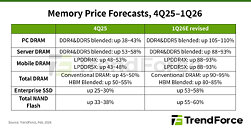 For server DRAM, major CSPs and server OEMs in North America and China have continued to negotiate annual long-term DRAM agreements (LTA) with memory suppliers as of January. Intense competition among buyers for the limited supply is expected to drive server DRAM prices up by around 90% QoQ in 1Q26, marking the largest quarterly increase on record. Suppliers must carefully allocate capacity based on assessments of customers' actual demand while maintaining balance across strategic accounts.
The widening supply-demand gap in the DRAM market has led end-device segments to compete more aggressively for allocations. Contract prices for LPDDR4X and LPDDR5X are both expected to surge by around 90% QoQ in 1Q26, also representing the steepest increases in their history. Most contracts with U.S.-based smartphone brands were finalized starting late last year, while negotiations with Chinese vendors are anticipated to make significant progress toward the end of February, after completing 4Q25 contracts and the Lunar New Year holiday.
On the NAND Flash side, despite 1Q26 order volumes greatly surpassing suppliers' production capacity, memory manufacturers remain optimistic about DRAM profitability and are proactively reallocating parts of their production lines to DRAM. This shift further limits the expansion of NAND Flash capacity. Gains in output can be achieved only through incremental process upgrades, making short-term capacity tightness difficult to resolve.
The demand for high-performance storage has far surpassed initial expectations as AI applications driven by inference continue to grow. Since late 2025, leading North American CSPs have been rapidly increasing their procurement, resulting in a surge of enterprise SSD orders. As the supply gap widens and buyers actively stockpile inventory, enterprise SSD prices are expected to rise by 53-58% QoQ in 1Q26, marking a new record for quarterly price increases.
Source:
TrendForce
TrendForce reports that PC shipments in 4Q25 exceeded expectations, resulting in a widespread shortage of PC DRAM. Even tier-1 PC OEMs with secured allocations from memory suppliers are experiencing declining inventory levels. In a market dominated by sellers, which is driving contract prices higher, PC DRAM prices in 1Q26 are projected to increase by over 100% QoQ, setting a new record for a quarterly surge.

The widening supply-demand gap in the DRAM market has led end-device segments to compete more aggressively for allocations. Contract prices for LPDDR4X and LPDDR5X are both expected to surge by around 90% QoQ in 1Q26, also representing the steepest increases in their history. Most contracts with U.S.-based smartphone brands were finalized starting late last year, while negotiations with Chinese vendors are anticipated to make significant progress toward the end of February, after completing 4Q25 contracts and the Lunar New Year holiday.
On the NAND Flash side, despite 1Q26 order volumes greatly surpassing suppliers' production capacity, memory manufacturers remain optimistic about DRAM profitability and are proactively reallocating parts of their production lines to DRAM. This shift further limits the expansion of NAND Flash capacity. Gains in output can be achieved only through incremental process upgrades, making short-term capacity tightness difficult to resolve.
The demand for high-performance storage has far surpassed initial expectations as AI applications driven by inference continue to grow. Since late 2025, leading North American CSPs have been rapidly increasing their procurement, resulting in a surge of enterprise SSD orders. As the supply gap widens and buyers actively stockpile inventory, enterprise SSD prices are expected to rise by 53-58% QoQ in 1Q26, marking a new record for quarterly price increases.
30 Comments on Memory Price Outlook for 1Q26 Sharply Upgraded; QoQ Increases of All Product Categories to Hit Record Highs
Start taking in order of magnitude instead: ram cost is projected to shoot 15x more.
% is good only when the change is but small.
Give us the real thing already
Fuck AI and all the greed it has spawned.
A lot of companies will definitely go under - if you don't cater to server, AI, you'll have basically no business. But those are mainly AIB partners that noone will miss overmuch. Everybody that has his own research and production facilities will gladly shift to where the money is.
AI bubble burst? We'll sacrifice everything else so we can shift everything to cloud - and the there's no going back.
I bet the plan was laid long ago, the AI's sudden "usefulness" have surprised many and the timeline has been changed - but the calls for end of personal computing and shift to subscription hardware has been made before, and are now repeated as inevitable.
I'm moving everything I can to local storage and I'm just glad I invested in a couple of big drives when I did, as I don't feel the need to pay these companies that are forcing "ai" crap down my throat everywhere and using my data for training their models, largely without my consent.
Though, I'm taking my words back(partially) on DDR3 - finally our local retailers ate a giant portion of excrement with zero sales and finally after 2-3 months of stagnant inventory they dropped the price of my go-to generic DDR3 SODIMMs. Used to be around $8 apiece in bulk for 8GB sticks, then it went up all the way to nearly $27/ea, and now it's down to around $12.
DDR3L is still kina pricey(~$18-20 for the cheapest 8 gig stick), but it means it's a perfect time to play around with flashing SPD profiles on cheaper 1.5v variant.
"The quarter-over-quarter increase in conventional DRAM contract prices has been revised upward, from a previous estimate of 55-60% to now 90-95%. Similarly, NAND Flash contract prices are now expected to rise from 33-38% to 55-60%. Further upward adjustments may still occur."
And I truly think these numbers are wishful thinking, not any analysis. Even products that don't have large chain from bulk ordering to OEMs and are making the whole thing themselves (Samsung,) etc. are jacking up prices just the same, or in case of Micron outright cancelling their consumer business.
Sandisk crushes wallets with up to 2.8X SSD price hikes as NAND shortage strangles the market — WD Black SN8100 8TB skyrockets past $2,500, more than a high-end gaming PC
If it all unravels, there's going to be massive, massive overcapacity in the semi space, massive resource misallocation. Which is why i think there could be a technology "nuclear winter" incoming. They could even end up bulldozing a lot of the infrastructure that's been started because it'll just burn money indefinitely if they don't.
And speaking against it will soon be seen as a dangerous "insurgency" - all social media channels will slowly start to "manage" it, forums will link it to "political messages" and ban it etc.
What a crazy period it is for this hobby.
I really hope the AI bubble bursts fast; between OpenAI reportedly not having enough money to maintain operations and other datacenters being vaporware for the next 5 years, leading to a price collapse.
Desktop PC is coming to an end, it's all mobile now. Millions of young people are growing up never seeing a PC or a laptop. BTW, Bezos said that home PCs are "antiquated" and all computing should be in the cloud now. Preferably, in Amazon cloud, of course. So, they can see everything we do and shove ads without any means to block them.
So yeah, this future is gonna suck for old school computer nerds.