News Posts matching #FSR

Return to Keyword Browsing

Senua's Saga: Hellblade II Enhanced Is Out Now, Patch Brings NVIDIA DLSS 4, Performance Improvements, and Bug Fixes

Ninja Theory has released Senua's Saga: Hellblade II Enhanced, with Enhanced Update for PC bringing NVIDIA DLSS 4 with Multi Frame Generation, new Very High graphics preset, support for Dolby Atmos and DualSense controller, Steam Deck verification with performance improvements, and plenty of other improvements and bug fixes.

The new Enhanced Update also adds the new Dark Rot game mode, new Enhanced Photo mode, fixes various bugs with graphics and gameplay, and more. The Senua's Saga: Hellblade II Enhanced is also launched for PlayStation 5. Ninja Theory was also keen to note that the team has been working hard on optimizing the game for the Steam Deck, getting the Steam Deck Verified badge.


New AMD Radeon GPU Tool Allows Users to Force-Enable FSR 4 in More Games

AMD Radeon GPU owners can now attempt to enable FSR 4 in more games, thanks to a new "AMD GPU Profile Manager" community tool that overrides the driver whitelist. Published on GitHub by developer Mikhail and demonstrated by content creators including Ancient Gameplays, the utility exposes AMD Adrenalin profile databases. It allows users to add or modify entries that typically require official driver support. The manager targets Radeon RX 9000 series cards and works by allowing titles that already support FSR 3.1 to try FSR 4. Users can enable FSR 3 first, either in the game or before launch, and then watch Adrenalin for signs that FSR 4 injection is active. The tool also offers quick add buttons for recent test builds and a one-click option to import profiles from AMD tech preview drivers, which is particularly handy for those who have reverted to older drivers and lost newly added entries. It aims to restore functionality and give power users a way to experiment while AMD completes its official whitelisting process.

There are important cautions alongside the convenience. The utility does not guarantee success in every title, and forcing FSR 4 into games with anti-cheat protections or online multiplayer can cause crashes, false positives, or account penalties. Community-maintained lists, demonstrations, and project notes highlight which games are confirmed to work and which are incompatible. Users are advised to back up driver profiles before making changes and to avoid applying forced profiles in competitive environments until developers add official support. The developer says more profile editing features are planned, and the project could grow into a general profile manager similar to well-known tools in other GPU ecosystems.

AMD Releases Software Adrenalin Edition 25.8.1 WHQL Drivers

AMD has released its latest AMD Software Adrenalin 25.8.1 WHQL drivers, adding support for the upcoming Radeon RX 9060 graphics card, as well as bringing game support for several new games, game support for AMD FidelityFX Super Resolution (FSR) in new games, and several other updates and improvements.

In addition to the official support for Radeon RX 9060 non-XT, the latest AMD Software Adrenalin 25.8.1 WHQL drivers also add support for several new games, including Mafia: The Old Country, Battlefield 6 Open Beta, Mecha Break, WUCHANG: Fallen Feathers, Valorant (Unreal Engine 5 release), The Alters, and F1 25. The new drivers also added FSR 4 support for Mafia: The Old Country, WUCHANG: Fallen Feathers, Arena Breakout: Infinite, Game of Thrones: Kingsroad, Wreckfest 2, Lies of P, and finally, Cyberpunk 2077. AMD has also expanded Vulkan API extension support, as well as added support for AMD ROCm on WSL for the AMD Radeon RX 7700 XT graphics card, with Forward Attention 2 (FA2) decode kernel and Deepseek R1 Distilled (7B, 32B, 70B) and Qwen 2.5 7B models.

DOWNLOAD:AMD Software Adrenalin 25.8.1 WHQL

Mafia: The Old Country PC System Requirements and Features Detailed

2K Games and Hangar 13 have detailed the full PC features and graphics settings, as well as official system requirements for the upcoming Mafia: The Old Country game that will launch on August 8th. It is interesting to see that the game will support AMD's FSR 4, NVIDIA's DLSS 4, and Intel's XeSS 2 with Frame Generation FSR, DLSS, and XeSS on supported hardware, but there is no ray tracing. It will also support Unreal Temporal Super Resolution (TSR), have uncapped frame rate during gameplay, ultrawide monitor and HDR support.

The list includes minimum, recommended and epic preset requirements, and all are using Unreal TSR set to either Balanced or Quality mode. The minimum requirements target 1080p resolution with graphics settings set at Medium and Unreal TSR set at Balanced. You will need at least an AMD Ryzen 7 2700X or Intel Core i7-9700K CPU, 16 GB of RAM, and either an AMD Radeon RX 5700 XT or NVIDIA RTX 2070 graphics card. The recommended requirements target 1440p resolution with graphics quality preset set to High and Unreal TSR set to Quality. These settings require an AMD Ryzen 7 5800X or Intel Core i7-12700K CPU, 32 GB of RAM, and either an AMD Radeon RX 6950 XT or an NVIDIA RTX 3080 Ti graphics card.

Wuchang: Fallen Feathers Dev Seemingly Disabled Native Render Resolution on Certain Hardware To Fix Performance Issues

Last week, we reported on Wuchang: Fallen Feathers and its launch that was ruined by poor optimization and abysmal performance on even high-end PCs. In response to the plummeting Steam review score, 505 Games put out a patch that was supposed to improve performance by reducing RAM and VRAM usage, optimizing performance on low-end GPUs, and addressing performance and stability bugs. This patch was followed by Patch 1.4, which supposedly addressed performance on "certain hardware models." A recent analysis by Daniel Owen on YouTube has revealed that the Wuchang: Fallen Feathers 1.4 patch may have removed native rendering from the game entirely, effectively forcing players to use upscaling, even when the resolution scale is set to 100%.

As Owen demonstrates in his YouTube video, the only change in the patch notes that mentions sampling resolutions reads: "Supersampling resolution limits have been adjusted on select GPU models to prevent unintended performance degradation." This seems to imply that the option to enable higher resolution scaling options was removed for lower-end GPUs, but that may not be the case. As Owen demonstrates, before the 1.4 update, performance scales predictably with the oversampling resolution slider—if you drop the resolution below 100%, the performance increases, regardless of whether the game is using FSR, DLSS, or TSR. After updating the game to the 1.4 patch, there is a significant performance boost at the same 100% resolution scale, and the running theory is that the developers are simply capping the render resolution at somewhere below native, regardless of which settings the player enables in the graphics options. This is demonstrated when Owen drops the resolution scale to similar levels as he tested prior, and performance is just 2 FPS higher than what was observed before the update on TSR and FSR, with DLSS getting identical performance in one instance.

AMD FSR 4 Now Available in Any DX11/12 Title via OptiScaler

AMD's AI-driven FSR 4 upscaler has been limited to the relatively small number of titles released alongside the RX 9000 series until now. A weekend patch to the open-source utility OptiScaler changes this by adding full redirection support for FSR 4 in version 2025.7.19. Any DirectX 11 or DirectX 12 game that originally shipped with FSR 2, DLSS 2, or Intel XeSS can now utilize AMD's latest libraries instead. Early adopters can take advantage of FSR 4 enhancements, provided they have an RDNA 4 GPU and are willing to follow a few manual steps. You simply drop OptiScaler's FSR 4 proxy DLL into the game's installation folder, open OptiScaler's interface or its configuration tool to select "fsr4" as the backend, and turn off any built-in anti-lag or frame-generation module to prevent timing conflicts between two low-latency systems.

Once these steps are complete and you are running on DirectX 11 or 12 without an incompatible anti-cheat or a Vulkan render path, you can launch the game, and OptiScaler will seamlessly drive FSR 4 in place of the original upscaler. There are still some caveats. OptiScaler does not yet support Vulkan render paths, and online titles protected by Easy Anti-Cheat or BattlEye will refuse to launch when they detect the proxy DLL. Additionally, there is no universal installer, so each game directory must be modified individually. Even so, for single-player or LAN-only releases, this tool immediately extends FSR 4's reach from the current 65 native titles to potentially hundreds of legacy games.

Cyberpunk 2077 Update v2.3 Brings FSR 4, XeSS Frame Generation, VRR for Consoles, and Much More

Tomorrow at 10:00 CET, CD Projekt Red will release Cyberpunk 2077 Update 2.3 across PC, PlayStation 5, and Xbox Series X|S, bringing a renewed pulse to Night City. Players on compatible hardware can now activate AMD FSR 4 and FSR 3.1 frame generation, Intel XeSS 2 with frame generation, Intel HDR10+ Gaming, and, for the first time, Variable Refresh Rate on consoles. A native Apple Silicon build also debuts on the Mac App Store. Four new vehicles arrive through narrative side jobs: the Yaiba ARV-Q340 Semimaru, Rayfield Caliburn "Mordred," Yaiba ASM-R250 Muramasa, and Chevillon Legatus 450 Aquila. Once earned, each can be piloted hands-free with the new AutoDrive system or summoned as a self-driving Delamain cab after completing "Don't Lose Your Mind."

Rayfield's CrystalCoat technology now coats partner-brand cars and motorcycles, supported by twin-tone paint packages and a community cracked variant for budget builds. Photo Mode expands with twenty-seven additional NPC spawns, wardrobe swapping, new stickers, frames, and colour balance tools. Quality of life updates include inverted-mouse detection, replayable tutorials, quieter radio balance, and a host of quest, gameplay, and stability fixes. The complete list of changes is very long, and you can check it out here.

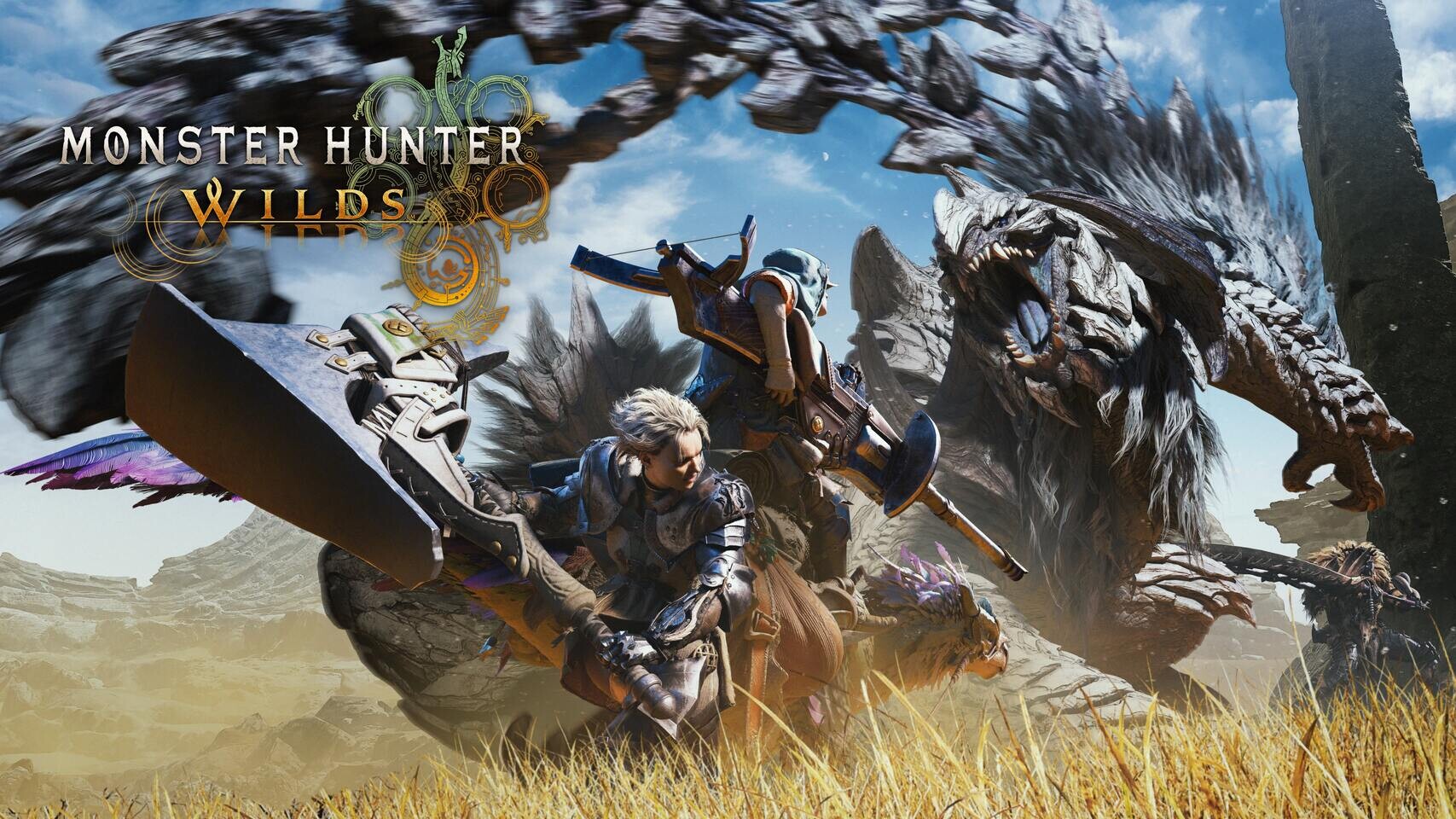
New Monster Hunter Wilds Patch Lands To Address PC Performance Issues

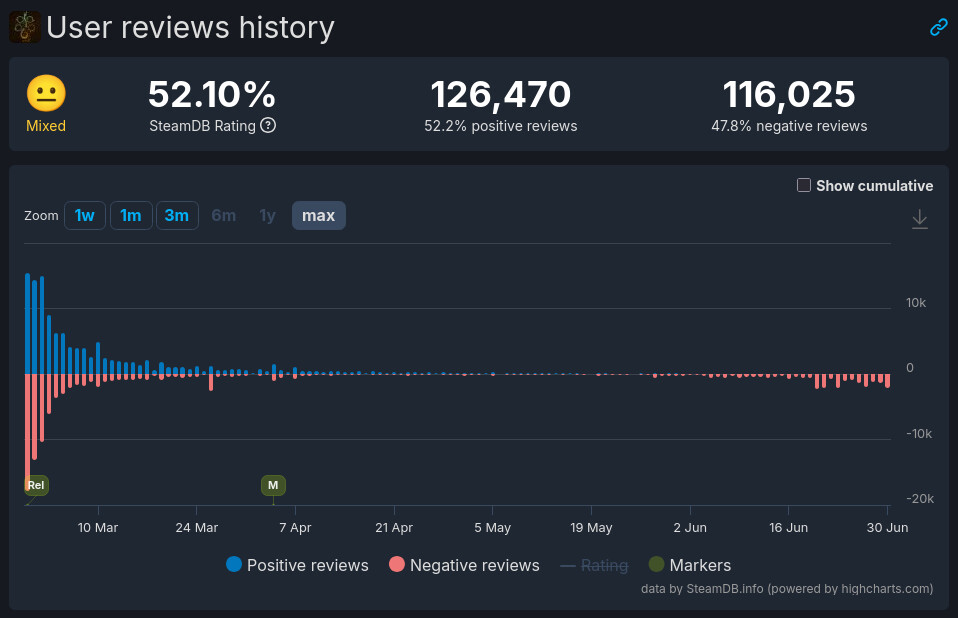
Monster Hunter Wilds players on PC have recently had a bit of a rough time of things when it comes to performance, with the game's recent Steam reviews seeing a number of players complaining about random stutters, FPS drops, and a general lack of optimization. Even gamers playing on relatively high-end recent GPUs, like the AMD Radeon RX 7900 XT report that their experience has been tainted by poor performance, even if the actual game content is good. With the latest Monster Hunter Wilds patch, though, Capcom is attempting to address those performance issues—and the resulting slew of negative reviews—as announced today in a post on X.

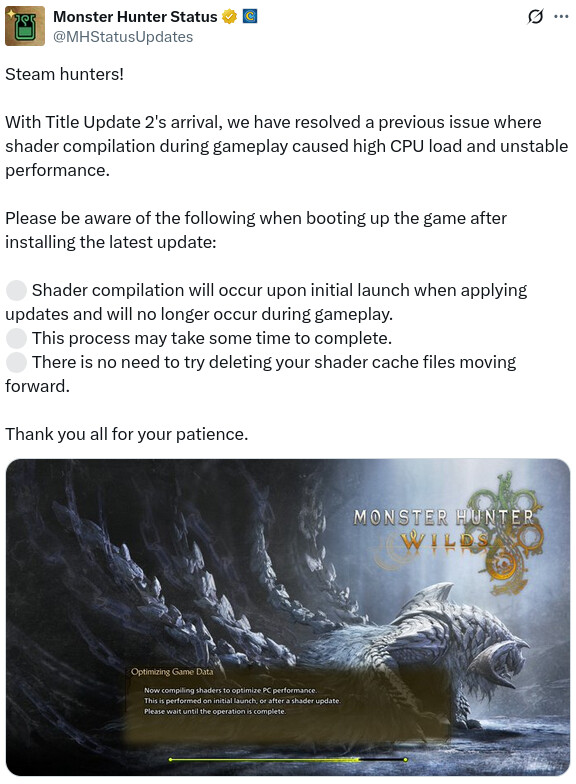
While there are new monsters, weapons, cosmetics, equipment, and other in-game content, the majority of the focus of the 1.020.00.00 update (full notes here) is on those performance updates. Capcom has changed the way shader compilation works, now making the CPU-intensive task take place the first time you run the game after an update as well updated a slew of upscaler and frame generation changes, primarily adding DLSS 4 and FSR 4 support for GPUs newer than the GeForce RTX 2000 series and AMD Radeon RX 9000 series. The new fix also allows players to mix upscaling and frame generation methods, which should allow players to better tune the game's visuals and performance. Additional fixes to the game include reduced VRAM usage from texture streaming and a more accurate calculation of estimated VRAM consumption. Steam users also now get a notification upon launching Monster Hunter Wilds if they are running an unsupported operating system or out-of-date GPU drivers, or if they are running the game in compatibility mode.

Steam Adds In-Game Performance Monitor Overlay with Expanded Metrics

Valve has rolled out a significant upgrade to its in-game performance tools with the June 17 Beta client update. Instead of a simple FPS counter, Steam now offers a full Performance Monitor that tracks frame rate alongside CPU and GPU utilization, clock speeds, temperatures, and memory usage. Players can view real-time graphs for each metric or opt for a pared-down display showing only FPS. The overlay also flags when frame-generation features like DLSS or FSR are active, clearly separating true rendered frames from those created by upscaling technology. This clarity helps gamers understand whether a smooth experience results from extra generated frames or genuine improvements in rendering.

Competitive and detail-focused users will appreciate knowing both the true game-frame counts and upscaled FPS so they can fine-tune settings based on actual performance. If the monitor shows full GPU memory, reducing texture quality becomes an obvious fix, and if CPU usage is maxed out, dialing back physics or draw distance may be the answer. Currently, the Performance Monitor is only available to Steam Beta participants. Valve plans to roll out additional metrics over time and notes that not every feature will be compatible with every system from the start. Anyone curious to try the new tools should switch to the beta client and explore the updated overlay options. Once these features reach full release, millions of PC gamers will have powerful diagnostics at their fingertips, making it easier than ever to balance visual quality with smooth performance.

Lossless Scaling 3.1 Update Brings 2x Performance Increase and More Visual Fidelity

The developer of the Lossless Scaling utility has released version 3.1, introducing both visual enhancements and significant performance improvements, up to 2x in "Performance Mode" depending on hardware and settings. Although there may be a slight dip in image fidelity, users with older graphics cards or integrated solutions will appreciate the ability to boost frame rates without lowering resolution. In addition to this new mode, the v3.1 update improves timestamp filtering for sharper details during rapid motion and refines border handling to eliminate jagged edges. Ghosting and object flicker have been reduced, and smarter interface detection keeps menus and heads-up displays stable under scaling. Frame generation is powered by LSFG, while scaling options include LS1, AMD FidelityFX Super Resolution, NVIDIA Image Scaling, Integer Scaling, Nearest Neighbor, xBR, Anime4K, Sharp Bilinear and Bicubic CAS.

Version 3.1 also expands localization support to include Finnish, Georgian, Greek, Norwegian, Slovak, and even the constructed language Toki Pona, reflecting the tool's growing international audience. Developed and maintained by a single creator, Lossless Scaling competes directly with proprietary upscalers, such as NVIDIA DLSS and AMD FSR, without requiring dedicated machine-learning hardware and is offered at a one-time price of $6.99. Its built-in algorithms are tailored to different content types: LS1 or AMD FSR is recommended for modern games, Integer Scaling or xBR works best for pixel-art titles, and Anime4K excels with cartoons or anime. For optimal results, users should cap their game at a stable frame rate to provide the utility with sufficient resources to operate and run their titles in windowed mode on Windows 10 version 1903 or later.

Shadow Launches Neo: The Next Generation Cloud Gaming PC

SHADOW, the Global leader in high-performance cloud computing, is proud to announce the launch of Neo, a brand-new cloud gaming PC offering designed to deliver next-level RTX experiences for gamers, creators, and professionals alike. Neo will officially roll out in Europe and North America starting June 16, 2025.

Building on the success of the company's previous offers, Neo replaces its widely adopted "Boost" tier and delivers major performance leaps—up to 150% more in gaming and 200% more in pro software performance. All existing Boost users are being upgraded to Neo at no additional cost while new users rates will start at $37.99 per month.

Stellar Blade Coming to PC Platform on June 11 - Shift Up CTO Discusses Graphical Features

On June 11, the PC version of Stellar Blade will be released. The PC version of Stellar Blade will support several new features and introduce exciting additional content. This additional content will also be available on the PS5 console version, This additional content will also be available on the PS5 console version. PS5 users will receive the free update content through a patch download. It will deliver the best experience to everyone - both users who couldn't join Eve's mission due to platform limitations, and fans who have already witnessed the end of Eve's protocol. With this in mind, we are pleased to share detailed information about the Stellar Blade PC version.

NVIDIA DLSS 4 & AMD FSR 3 upscaling and unlocked frame rate
Blade, blood, and beauty. Eve is a ruthless executioner and an elegant liberator. The PC version of Stellar Blade supports NVIDIA DLSS 4 resolution scaling and frame generation, NVIDIA DLAA image enhancement, and NVIDIA Reflex latency reduction features. AMD FSR 3 is also supported. Additionally, it supports unlocking the frame rate, allowing you to maximize your PC's potential. With these enhancements, Eve's action will transcend its limits, becoming even more merciless and all the more mesmerizing.

AMD Software Adrenalin 25.4.1 Beta Drivers Released

Yesterday, AMD released Radeon Software Adrenalin Edition 25.4.1 Optional Beta drivers that add FidelityFX Super Resolution 4 to The Elder Scrolls IV: Oblivion Remastered, Assassin's Creed Shadows, Kingdom Come Deliverance 2, Dynasty Warriors Origin, Civilization 7, and Naraka Bladepoint. It also brings Amuse 3 support and AMD-optimized models to Radeon RX 9000 and RX 7000 series graphics cards alongside Ryzen AI 300 series processors. Among the many fixes you'll find corrected lighting artifacts in Topaz Photo AI's Adjust Lighting features on RX 9000 series cards, removed flicker when using AMD FreeSync, improved DirectML and GenAI performance in Amuse 3.0 on RX 7000 GPUs and Ryzen AI 300 series chips, and patched image corruption in certain diffuser models on RX 9000 hardware.

The update also smooths out stutter and performance drops in World of Warcraft's Western Plaguelands, restores integrated camera detection after factory resets on Ryzen AI Max devices, and addresses AMD Chat installation hangs. Since this is still an optional beta with some known issues, like FSR 4 not activating in Naraka Bladepoint on Windows 10, crashes in The Last of Us Part 2, memory leaks in SteamVR on RX 9000 cards, or intermittent launch and stability hiccups in games like Cyberpunk 2077, Fantasy VII Rebirth, Battlefield 1, Monster Hunter Wilds and Marvel's Spider-Man 2, AMD recommends using the suggested workarounds such as disabling motion smoothing or integrated graphics in your BIOS and holding out for your system vendor's certified driver to ensure full compatibility.

DOWNLOAD: AMD Software Adrenalin 25.4.1 Beta

Frogwares Teases Upcoming Launch of The Sinking City: Remastered on PC & Modern Consoles

Charles Reed returns to Oakmont, a city drowning in supernatural mystery and eldritch terror—now fully remastered with Unreal Engine 5! Coming soon to PC, PS5 and Xbox Series, including a free upgrade for existing owners. Check out some more comparison screenshots in 4K! In the 1920s, on the East Coast of the United States, a half-submerged city is gripped by supernatural forces. You're a private investigator, uncovering the truth of what has possessed the city and corrupted the minds of its inhabitants... and yours.

Don't Forget!
The Kickstarter for The Sinking City 2 is ending in just five days! Help us reach our next exciting stretch goal: introducing a brand new, terrifying version of the Shoggoth. You can also grab The Sinking City as an add-on through our campaign. Your support makes a huge difference!

Arm Releases Open-Source ASR Upscaler Based on AMD FSR 2 Technology

Arm has officially unveiled its Accuracy Super Resolution (ASR) upscaling technology at Game Developer Conference 2025, delivering an open-source upscaling solution for mobile and low-power devices. Built upon AMD's FidelityFX Super Resolution 2 (FSR 2) framework, ASR promises up to 53% higher frame rates while reducing power consumption by 20% on devices utilizing the Immortalis-G720 GPU. This technology addresses a critical performance gap in the Android ecosystem, which has historically lagged behind Apple's MetalFX implementation. The temporal upscaling approach employed by ASR combines information from multiple frames to generate higher-quality images, offering superior visual fidelity compared to Qualcomm's Game Super Resolution (GSR), which relies on the older spatial-based FSR 1 technique. In benchmark testing with complex scenes, Arm demonstrated that ASR helps maintain stable device temperatures, preventing thermal throttling that can compromise user experience.

Collaboration with MediaTek confirmed significant power savings on Dimensity 9300 chipsets, directly addressing battery life concerns for mobile gamers. Arm plans to release pre-built plugins for Unity and Unreal Engine by year-end, streamlining integration for developers working with these widely-used game engines. During GDC demonstrations, Arm showcased the "Mori" demo running in Unreal Engine 5, where ASR delivered 30% performance improvements without visual compromises. Licensed under MIT open-source terms, ASR's accessibility extends across the entire Arm ecosystem, potentially benefiting smartphones running MediaTek Dimensity, Qualcomm Snapdragon, Samsung Exynos, and even Arm-powered laptops featuring Snapdragon X series SoCs.

AMD "Medusa Point" APU with Zen 6 Confirmed to Use RDNA 3.5, RDNA 4 Reserved for Discrete GPUs

AMD's next-generation Zen 6-based "Medusa Point" mobile APUs will not feature RDNA 4 graphics as previously speculated, according to recent code discoveries in AMD GPUOpen Drivers on GitHub. The Device ID "GfxIp12" associated with RDNA 4 architecture has been reserved only for discrete GPUs, confirming that the current Radeon RX 9000 series will exclusively implement AMD's latest graphics architecture. Current technical documentation indicates AMD will instead extend RDNA 3.5 implementation beyond the Zen 5 portfolio while potentially positioning UDNA as the successor technology for integrated graphics.

The chiplet-based Medusa Point design will reportedly pair a single 12-core Zen 6 CCD manufactured on TSMC's 3 nm-class node with a mobile client I/O die likely built on N4P. This arrangement is significantly different from current monolithic mobile solutions. Earlier speculation indicates the Medusa Point platform may support 3D V-Cache variants, leveraging the same vertical stacking methodology employed in current Zen 5 implementations. The mobile processor's memory controllers and neural processing unit are expected to receive substantial updates. However, compatibility limitations with AMD's latest graphics features, like FSR 4 technology, remain a concern due to the absence of RDNA 4 silicon. The Zen 6-powered Medusa Point processor family is scheduled for release in 2026, targeting premium mobile computing applications with a performance profile that builds upon AMD's current Strix Halo positioning.

PlayStation 5 Pro to Receive FSR 4-Based Upscaling Technology in 2026

Sony has confirmed plans to implement an advanced AI upscaling solution for PlayStation 5 Pro in 2026, based on AMD's newly released FSR 4 technology. PlayStation lead architect Mark Cerny revealed to EuroGamer that the next evolution of PlayStation Spectral Super Resolution (PSSR) will leverage the neural network architecture co-developed with AMD through Project Amethyst. "Our target is to have something very similar to FSR 4's upscaler available on PS5 Pro for 2026 titles as the next evolution of PSSR," Cerny stated. This implementation aims to maintain compatibility with existing frameworks while delivering significantly enhanced image quality. The collaborative initiative between Sony and AMD, which began in late 2023, has already yielded measurable results. FSR 4 represents the first tangible output from Project Amethyst, with Cerny noting that the technology "can exceed the crispness of PSSR" currently deployed on PS5 Pro hardware.

Sony's PS5 Pro features custom ML hardware delivering 300 8-bit TOPS of computing power without sparsity, which Cerny believes will be sufficient to handle the computational demands of the new upscaling algorithm. While the reimplementation process is described as "ambitious and time-consuming," the underlying architecture appears capable of supporting the technology without significant modifications. For 2025, Sony's priority remains to encourage developers to integrate the current PSSR technology into their titles while the enhanced version undergoes development. Cerny indicated that console-specific optimizations will be necessary, as "technical targets for console game development and PC game development tend to be slightly different," particularly regarding frame rate consistency. Project Amethyst extends beyond upscaling technology, with indications that ray tracing enhancements may also be part of the collaboration. The partnership aims to establish a hardware architecture optimized for machine learning in graphics processing, giving us a hint of what the future hardware will be like.

Rockstar Games Launches Free Upgrade for Grand Theft Auto V on PC

The upgrade for Grand Theft Auto V on PC is now available to play from the Rockstar Games Launcher, and also via Steam or Epic Games. Introducing features previously only available on the latest generation of consoles, this upgrade also optimizes the game experience and performance on modern PCs. Players who already own GTAV on PC can upgrade to this new version for free, with the ability to migrate your Story Mode and Online progress, while anyone jumping into GTAV and GTA Online on PC for the first time will get this new version (GTAV Enhanced) along with the original version (GTAV Legacy) when purchased.

GTA ONLINE FEATURES
Get access to powerful new vehicles, stunning Chameleon Paints, high-performance modifications, and much more—all from Hao's Special Works. Newly added vehicles for PC include the Pegassi Weaponized Ignus and Coil Cyclone II supercars, the Karin S95 sports car, the Imponte Arbiter GT muscle car, and the Pfister Astron Custom SUV, which join a fleet of 20 vehicles already available in GTA Online, and all are now available for tuning from HSW. Plus, GTA+ Members can claim a Principe Deveste Eight (Super) for free through May 28 as part of a special Classics Collection to commemorate GTA+ arriving on PC. Anyone looking to take in the fauna can also now relish in the animal ecosystem, with Ambient Animals encounters and a daily Wildlife Photography Challenge available from the LS Tourist Board at Chiliad Mountain State Wilderness.

AMD Radeon RX 9070 and 9070 XT Official Performance Metrics Leaked, +42% 4K Performance Over Radeon RX 7900 GRE

AMD's internal benchmarks of its upcoming RDNA 4-based RX 9070 series graphics cards have been leaked, thanks to VideoCardz. The flagship RX 9070 XT delivers up to 42% better performance than the Radeon RX 7900 GRE at 4K resolution across a test suite of over 30 games, with the standard RX 9070 showing a 21% improvement in the same scenario. The performance data, encompassing raster and ray-traced titles at ultra settings, positions the RX 9070 series as a direct competitor to NVIDIA's RTX 4080 and RTX 5070 Ti. Notably, AMD's testing methodology focused on native rendering and ray tracing capabilities rather than upscaling technologies like FSR. The RX 9070 XT demonstrated large gains at 4K resolution, achieving a 51% performance uplift compared to the two-generations older RX 6900 XT. Meanwhile, the base RX 9070 model showed a 38% improvement over the RX 6800 XT at 4K with maximum settings enabled.

While AMD confirms its new cards are designed to compete with NVIDIA's RTX 50 series, specific comparative benchmarks against the RTX 5070 Ti were absent from the presentation. AMD acknowledges it has yet to acquire the competitor's hardware for testing. The company is expected to provide a comprehensive performance overview, potentially including additional GPU comparisons, during its official announcement on February 28. Both RX 9070 series cards will feature 16 GB of VRAM, matching the memory configuration of the RX 7900 GRE used as a primary comparison point. By the official launch date, AMD will have time to push final driver tweaks for optimal performance. Nonetheless, more information will surface as we near the official release date.

Rockstar Reveals Free Upgrade for Grand Theft Auto V PC Version, Coming March 4

On March 4, Grand Theft Auto V on PC is getting a free upgrade with sought-after features previously only available in the PS5 and Xbox Series X|S versions of GTA Online—including all the latest vehicles and performance upgrades available at Hao's Special Works, animal encounters, and access to purchase a GTA+ Membership—along with improved graphics options, faster loading times, and more. All players who currently own GTAV on PC will be able to upgrade to this new version for free, with the ability to migrate your Story Mode and Online progress.

New Features on PC
Once upgraded, current PC players—along with anyone playing the game for the first time—will have access to a full suite of much-requested GTA Online upgrades previously only available on the latest consoles. This upgraded version of GTA V on PC also features all of our recent player experience improvements for GTA Online, including kernel-based anti-cheat protections and proactive voice chat moderation to help keep GTA Online fun for everyone.

FFmpeg Gets AMD AMF Accelerated Decoding Support, FSR Video Super Resolution Upscaler

FFmpeg, the popular open-source multimedia library for compressed video and audio formats, just introduced a component to libavcodec that integrates AMD Accelerated Media Framework (AMF) SDK. This component is called AMFDEC, and it allows libavcodec to utilize hardware-accelerated decoding features on AMD Radeon RX GPUs and the integrated graphics of AMD Ryzen processors. On machines with compatible hardware, AMFDEC provides libavcodec with hardware acceleration for decoding of H.264, H.265 or HEVC, and AV1. FFmpeg also introduced filters that implement AMD FSR Video Super Resolution. This lets applications that use FFmpeg to take advantage of VSR features on Radeon RX GPUs to provide superior upscaling quality. The filter is labelled "ar_amf." The commit can be accessed here.

AMD Radeon 9070 XT Rumored to Outpace RTX 5070 Ti by Almost 15%

It would be fair to say that the GeForce RTX 5080 has been quite disappointing, being roughly 16% faster in gaming than the RTX 4080 Super. Unsurprisingly, this gives AMD a lot of opportunity to offer excellent price-to-performance with its upcoming RDNA 4 GPUs, considering that the RTX 5070 and RTX 5070 Ti aren't really expected to pull off any miracles. According to a recent tidbit shared by the renowned leaker Moore's Law is Dead, the Radeon RX 9070 XT is expected to be around 3% faster than the RTX 4080, if AMD's internal performance goals are anything to go by. MLID also notes that RDNA 4's performance is improving by roughly around 1% each month, which makes it quite likely that the RDNA 4 cards will exceed the targets.

If it does turn out that way, the Radeon RX 9070 XT, according to MLID, should be roughly around 15% faster than its competitor from the Green Camp, the RTX 5070 Ti, and roughly match the RTX 4080 Super in gaming performance. The Radeon RX 9070, on the other hand, is expected to be around 12% faster than the RTX 5070. Of course, these performance improvements are limited to rasterization performance, and when ray tracing is brought to the scene, the performance improvements are expected to be substantially more modest, as per tradition. Citing our data for Cyberpunk 4K with RT, MLID stated that his sources indicate that the RX 9070 XT falls somewhere between the RTX 4070 Ti Super and RTX 3090 Ti, whereas the RX 9070 should likely trade blows with the RTX 4070 Super. Considering AMD's track record with ray tracing, this sure does sound quite enticing.

The Last of Us Part I Updated with Support for FSR 3.1

The Last of Us Part I (PC version) was updated to version 1.1.4 last Friday—at the time, patch notes revealed that Iron Galaxy Studios/Nixxes Software had added support for AMD FidelityFX Super Resolution (FSR) 3.1 Super Resolution and FSR 3.1 Frame Generation. Several popular first-party PlayStation titles received similar updates mid-way through last year, so industry watchdogs have questioned the timing of this latest upgrade—up until late last week, The Last of Us Part I was ticking along with support for FSR 3.0 (super resolution and frame generation).

Naturally, Team Red is in the process of preparing FSR 4.0 for an upcoming product launch—now delayed, due to the engineering team requiring: "extra time to optimize the software stack for maximum performance and enable more titles." AMD's latest graphics technology was showcased at CES earlier this month, alongside their new (RDNA 4) Radeon RX 9070 XT and 9070 (non-XT) graphics cards. According to Team Red, it is relatively easy to go from version 3.1 up to 4.0. The Last of Us Part I's development team (for PC platforms) could have everything ready to go in a couple of weeks, and be prepared well in advance for the game's sequel (due in April).

Ubisoft Unveils Assassin's Creed Shadows Recommended PC Specs

Hi everyone, Assassin's Creed Shadows is launching March 20, inviting you to experience the intertwined stories of Naoe, an adept shinobi Assassin, and Yasuke, a powerful African samurai. Today, you can pre-order the game on console and PC, and read up on Shadows' upcoming expansion, Claws of Awaji, which brings 10 hours of additional content free with your pre-order.

For those of you playing on PC, we've got all of Assassin's Creed Shadows' recommended PC specs listed in this article. Assassin's Creed Shadows will support raytraced global illumination and reflections, and will feature an in-game benchmark tool for performance analysis, ultra-wide resolutions, an uncapped framerate, and more. Check out all the specs chart below.

AMD is Taking Time with Radeon RX 9000 to Optimize Software and FSR 4

When AMD announced its upcoming Radeon RX 9000 series of GPUs based on RDNA 4 IP, we expected the general availability to follow soon after the CES announcement. However, it turns out that AMD has scheduled its Radeon RX 9000 series availability for March, as the company is allegedly optimizing the software stack and its FidelityFX Super Resolution 4 (FSR 4) for a butter smooth user experience. In a response on X to Hardware Unboxed, AMD's David McAfee shared, "I really appreciate the excitement for RDNA 4. We are focused on ensuring we deliver a great set of products with Radeon 9000 series. We are taking a little extra time to optimize the software stack for maximum performance and enable more FSR 4 titles. We also have a wide range of partners launching Radeon 9000 series cards, and while some have started building initial inventory at retailers, you should expect many more partner cards available at launch."

AMD is taking its RDNA 4 launch more cautiously than before, as it now faces a significant problem with NVIDIA and its waste portfolio of software optimization and AI-enhanced visualization tools. The FSR 4 introduces a new machine learning (ML) based upscaling component to handle Super Resolution. This will be paired with Frame Generation and an updated Anti-Lag 2 to make up the FSR 4 feature set. Optimizing this is the number one priority, and AMD plans to get more games on FSR 4 so gamers experience out-of-the-box support.
Return to Keyword Browsing
Nov 17th, 2026 13:53 CST change timezone

New Forum Posts

Popular Reviews

TPU on YouTube

Controversial News Posts