News Posts matching #GDDR7

Return to Keyword Browsing

NVIDIA Reportedly Narrows Down GeForce RTX 5060 Ti Launch to April 16

Last week, we heard rumors about NVIDIA delaying its launches of GeForce RTX 5060 Ti and RTX 5060 by a couple of weeks. Initially, PC hardware watchdogs anticipated a product unveiling before GTC 2025 kick-off time. Industry insiders did not fully disclose the reasons behind Team Green's revised release schedules for more "budget-friendly" GB206 GPU-based offerings, but supply chain moles posited that GeForce RTX 5060 Ti graphics cards would reach retail by mid-April. As noted by VideoCardz last Saturday, a specific date was leaked by a reliable source: wxnod.

The tenured PC hardware soothsayer reckons that NVIDIA's GeForce RTX 5060 Ti "will be released on April 16th at 9 pm" in 16 GB and 8 GB forms. According to VideoCardz's insider network, "briefings" regarding this alleged launch date were not yet distributed to key figures (i.e. board partners). An upcoming Wednesday rollout could be legitimate, given that Team Green and AIBs let loose GeForce RTX 5070 cards on March 5. A recent leak of GeForce RTX 5060 Ti "full specifications" indicates the laying of groundwork; leading to a potential launch in the coming weeks.

Japanese Retailer Reportedly Prepping NVIDIA RTX PRO 6000 96 GB Stock For Sale in May, Leak Indicates $8435+ Pricing

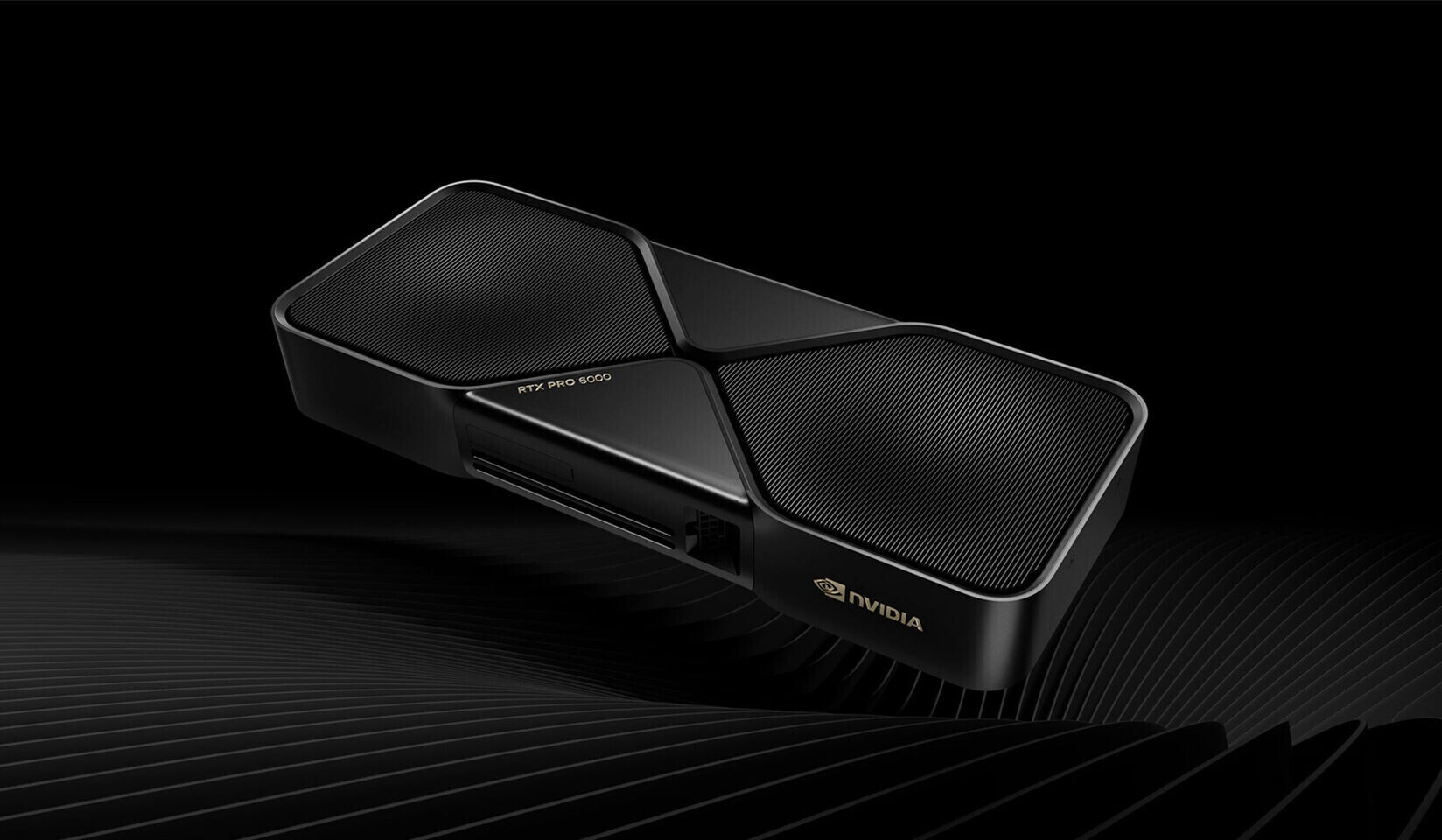
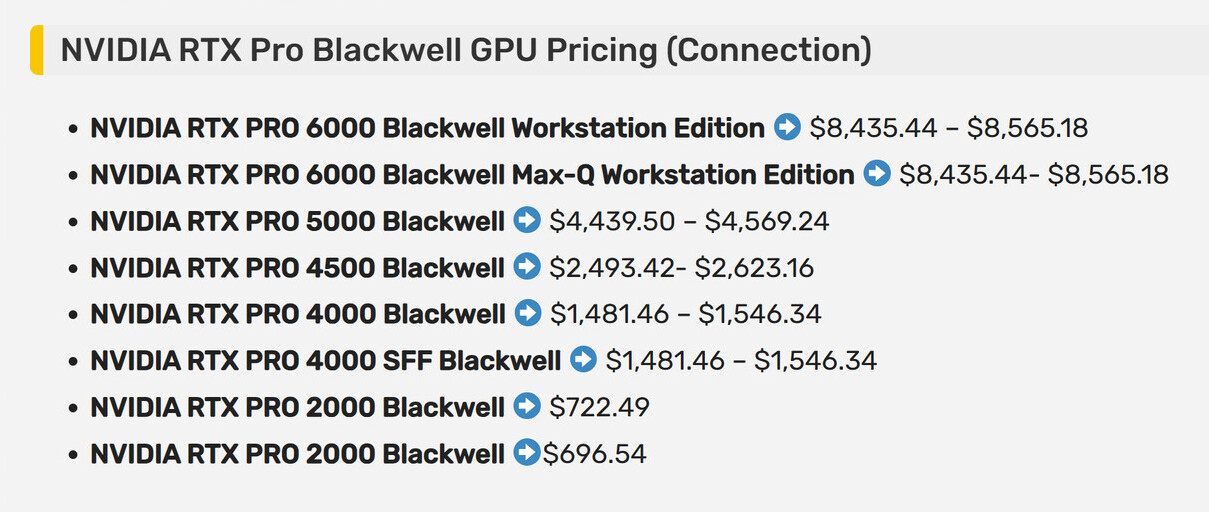
During GTC 2025, NVIDIA unveiled the professional (PRO) side of its "Blackwell" GPU line—headlined by a monstrous GDDR7 96 GB option, that unleashes the full potential of their GB202 die. Industry watchdogs anticipated sky-high pricing, as befits such a potent specification sheet/feature set. As reported by VideoCardz over the past weekend, a North American enterprise PC hardware store—Connection—has populated its webshop with several of Team Green's brand-new RTX PRO Blackwell Series SKUs. The publication received tip-offs from a portion of its readership; including some well-heeled individuals who have already claimed pre-orders. Starting off, the investigation highlighted upper crust offerings: "the flagship model, called the RTX PRO 6000 with 96 GB of VRAM, will launch at $8435 (bulk) to $8565 (box), and this price seemingly applies to both models: the Workstation Edition and a sub-variant called Max-Q. Both are equipped with the same specs, but the latter is capped at 300 W TDP while retaining 88% of the Al performance, claimed NVIDIA."

Connection has removed its RTX PRO 6000 Blackwell and RTX PRO 6000 Blackwell Max-Q product pages, but the rest of Team Green's professional stack is still visible (see relevant screenshot below). The RTX PRO 5000 Blackwell 48 GB card is priced at $4569.24 (or $4439.50 for bulk). The cheapest offering is a $696.54 RTX PRO 2000 Blackwell 8 GB model. Officially, NVIDIA and its main professional series board partner—PNY—only revealed 4500, 5000 and 6000 product tiers. VideoCardz put a spotlight on some of these unannounced options, including: "the RTX 4000 non-SFF version, while this retailer has six listings for such SKUs (two SFF and two non-SFF, both in bulk and box variants). Presumably, this would suggest that NVIDIA may launch a non-SFF version later. However, the company didn't put 'SFF' in the official card's name, so perhaps this information is no longer valid, and there's only one model." According to a GDM/Hermitage AkiHabara Japan press release, a local reseller—Elsa—is preparing NVIDIA RTX PRO 6000 Blackwell Workstation Edition and RTX PRO 6000 Blackwell Max-Q Workstation Edition stock for scheduled release "in May 2025, while the other models are scheduled for release around summer." Additionally, another retailer (ASK Co., Ltd.): "has stated that the price and release date are subject to inquiry."

Downstream Inventory Reduction Eases DRAM Price Decline in 2Q25

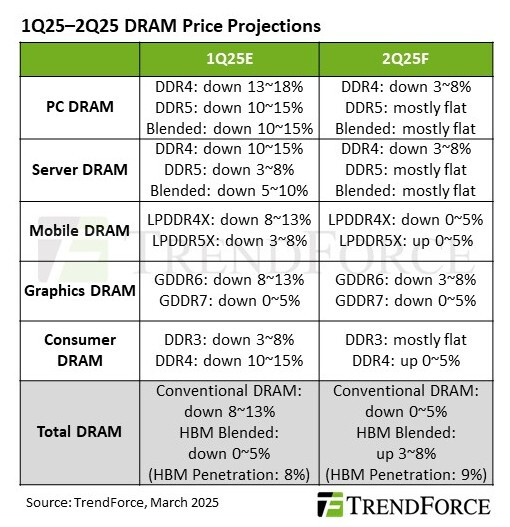
TrendForce's latest findings reveal that U.S. tariff hikes prompted most downstream brands to frontload shipments to 1Q25, accelerating inventory reduction across the memory supply chain. Looking ahead to the second quarter, conventional DRAM prices are expected to decline by just 0-5% QoQ, while average DRAM pricing including HBM is forecast to rise by 3-8%, driven by increasing shipments of HBM3e 12hi.

PC and server DRAM prices to hold steady
In response to potential U.S. tariff hikes, major PC OEMs are requesting ODMs to increase production, accelerating DRAM depletion in their inventories. OEMs with lower inventory levels may raise procurement from suppliers in Q2 to ensure stable DRAM supply for the second half of 2025.

MSI Typos Hint at 24GB Variant of RTX 5080

MSI made at least two typos and corrections spaced apart from each other that hint at the possibility of a 24 GB variant of the NVIDIA GeForce RTX 5080. The first instance was on the side of the retail box of an RTX 5080 Vanguard OC Launch Edition, which had "24 GB GDDR7" printed on top of the RTX 5080 label. The second instance was in the VGA Support list in the product page of the MAG X870 Tomahawk motherboard, where the memory size is displayed as 24,576 MB (24 GB). There are two possible interpretations of this.

One possibility is that NVIDIA originally planned the RTX 5080 to feature 24 GB of memory, using 3 GB (24 Gbit) GDDR7 memory chips across the 256-bit wide memory bus of the "GB203" silicon, and initially communicated this to its board partners, but revised the specs in the months leading up to the launch, with the card ending up with 16 GB (8x 16 Gbit). The other possibility is that there is actually a 24 GB variant in the works, which NVIDIA could end up calling the "RTX 5080 24 GB." The RTX 5080 in the market already maxes out the "GB203" silicon it's based on, so the variant could just offer a 50% increase in memory size at the same or similar memory bandwidth. The additional memory could come in handy with 4K Ultra HD + ray tracing + DLSS 4 MFG scenarios where a gamer is looking to turn their roughly 60 FPS framerates to match the 120 Hz refresh rates of their displays.

NVIDIA Pushes GeForce RTX 5060 Ti Launch to Mid-April, RTX 5060 to May

NVIDIA is reportedly pushing the launch dates of its upcoming mid-range GeForce RTX 5060-series graphics cards by a couple of weeks, each. The faster RTX 5060 Ti is now expected to launch some time in mid-April 2025, while the RTX 5060 is now slated for a month later in mid-May, just before the media gears up for the 2025 Computex later that month. The RTX 5060 Ti comes in 16 GB and 8 GB memory variants, and both are expected to launch around the same time, if not on the same day; while the RTX 5060 is expected to come in just 8 GB.

Both SKUs are expected to be based on the "GB206" silicon, which probably features 36 or 40 streaming multiprocessors, from which the RTX 5060 Ti is configured with 36, to yield 4,608 CUDA cores. The RTX 5060 is significantly cut down, enabling 30 SM for 3,840 CUDA cores. The silicon features a 128-bit GDDR7 memory interface, and both SKUs are expected to be configured with 28 Gbps memory speeds, giving them 448 GB/s memory bandwidth.

PNY Announces Support for the New NVIDIA RTX PRO Blackwell Graphics Card Family

PNY announced today it is adding the new NVIDIA RTX PRO 6000 Blackwell Workstation Edition, RTX PRO 6000 Blackwell Max-Q Workstation Edition, RTX PRO 5000 Blackwell, RTX PRO 4500 Blackwell, and RTX PRO 4000 Blackwell graphics cards to its lineup of NVIDIA RTX PRO GPU offerings for professionals.

Built for professionals and the future of work, NVIDIA RTX PRO Desktop GPUs based on the revolutionary NVIDIA Blackwell architecture deliver exceptional performance for AI-enhanced creative, design, and engineering workflows. Featuring the latest generation Tensor Cores, RT Cores, and up to 96 GB of ultra-high-speed GDDR7 memory, they enable groundbreaking advancements in AI, ray tracing, and neural graphics technology. Supercharge workstations for the next era of AI-driven workflows with the ultimate tools for professionals.

Micron Innovates From the Data Center to the Edge With NVIDIA

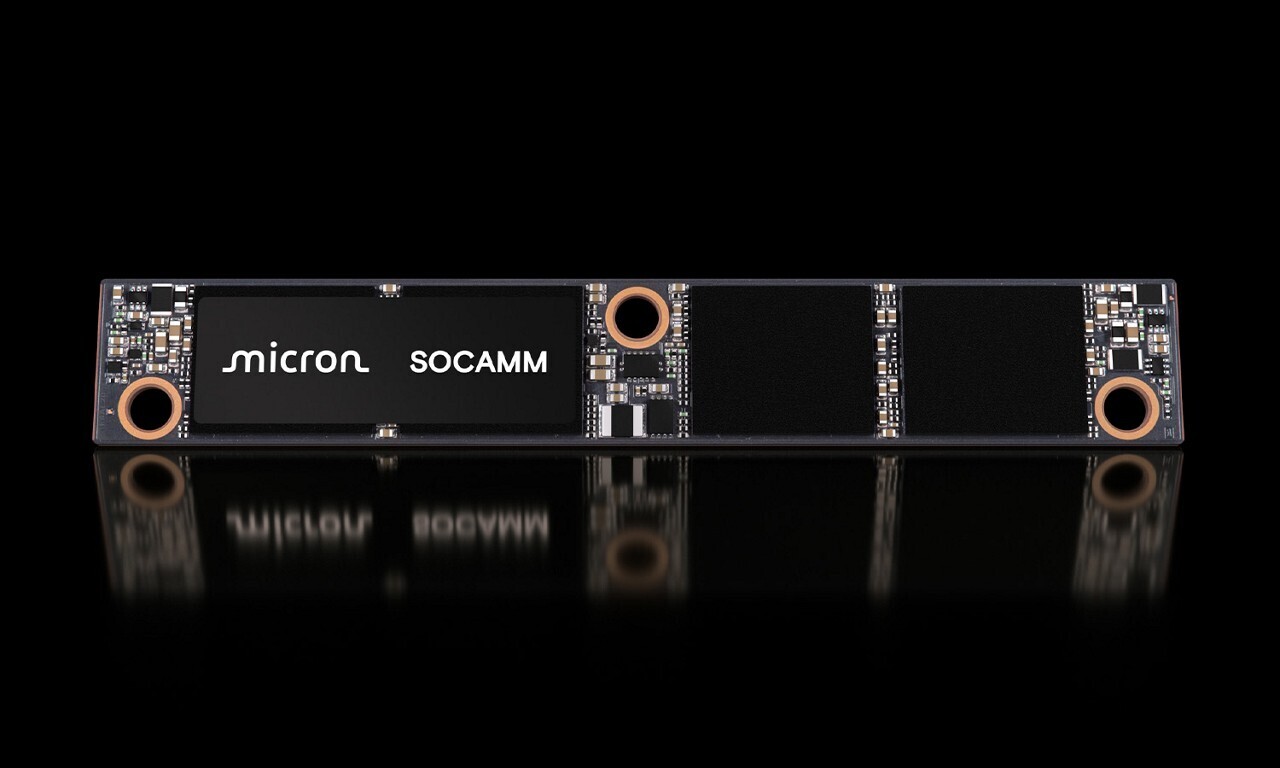
Secular growth of AI is built on the foundation of high-performance, high-bandwidth memory solutions. These high-performing memory solutions are critical to unlock the capabilities of GPUs and processors. Micron Technology, Inc., today announced it is the world's first and only memory company shipping both HBM3E and SOCAMM (small outline compression attached memory module) products for AI servers in the data center. This extends Micron's industry leadership in designing and delivering low-power DDR (LPDDR) for data center applications.

Micron's SOCAMM, a modular LPDDR5X memory solution, was developed in collaboration with NVIDIA to support the NVIDIA GB300 Grace Blackwell Ultra Superchip. The Micron HBM3E 12H 36 GB is also designed into the NVIDIA HGX B300 NVL16 and GB300 NVL72 platforms, while the HBM3E 8H 24 GB is available for the NVIDIA HGX B200 and GB200 NVL72 platforms. The deployment of Micron HBM3E products in NVIDIA Hopper and NVIDIA Blackwell systems underscores Micron's critical role in accelerating AI workloads.

BOXX Workstations Upgraded With New NVIDIA RTX PRO 6000 Blackwell Workstation Edition GPUs

BOXX Technologies, the leading innovator of high-performance computers, rendering systems, and servers, announced that as a supplier of NVIDIA-Certified Systems, BOXX workstations will feature the new NVIDIA RTX PRO 6000 Blackwell Workstation Edition and NVIDIA RTX PRO 6000 Blackwell Max-Q Workstation Edition GPUs. Designed for creative professionals, these NVIDIA Blackwell architecture GPUs combine breakthrough AI inference, ray tracing, and neural rendering technology with major performance and memory improvements to drive demanding creative, design, and engineering workflows. BOXX will be among the first computer hardware manufacturers offering the new GPUs inside multiple workstation form factors.

"From our desk side APEXX workstations to our FLEXX and RAXX data center platforms, BOXX is taking our record-setting performance to new heights with NVIDIA RTX PRO 6000 Blackwell Workstation Edition GPUs," said BOXX CEO Kirk Schell. "Our systems equipped with these groundbreaking GPUs are purpose-built for creative professionals who demand the best, so whether its architects, engineers, and content creators, or data scientists and large scale enterprise deployments, BOXX accelerates mission critical work while maintaining unparalleled performance, reliability, and support."

NVIDIA Launches RTX PRO 6000 Blackwell Series Professional Graphics Cards

NVIDIA today launched the RTX PRO 6000 Blackwell series of professional graphics cards. These cards are based on the latest GeForce "Blackwell" graphics architecture, and the three chips the company already launched on it. Leading the pack, is the RTX PRO 6000, a card that completely maxes out the massive "GB202" silicon, featuring more shaders than even the GeForce RTX 5090, albeit at lower clock speeds. The idea behind this product is to give pro-vis users more shader power, driving a large amount of GDDR7 ECC memory. Specifically, the card comes with 24,064 CUDA cores across all 192 SM physically present on the silicon, besides 768 Tensor cores, 192 RT cores, 768 TMUs, and 192 ROPs. The card gets a humungous 96 GB of ECC GDDR7 memory across the chip's 512-bit wide memory interface, probably using 48 Gbit density memory chips. The card has a TGP of 600 W, making out the 12V2x6 power input. It comes with a board design resembling the RTX 5090.

Next up, is the RTX PRO 6000 Blackwell Max-Q. This card has essentially the same core-configuration as the RTX PRO 6000, but with a reduced TGP, and a simpler 2-slot board design that uses a lateral-blower. This card is meant for machines with multiple such cards installed, though something that isn't quite a rendering server. Lastly, there's the RTX PRO 6000 Server Edition. This card, again, has identical core-config to the others in the lineup, but with a board design optimized for rackmount servers and large rendering farms. The cooler relies on the rack's airflow for cooling.

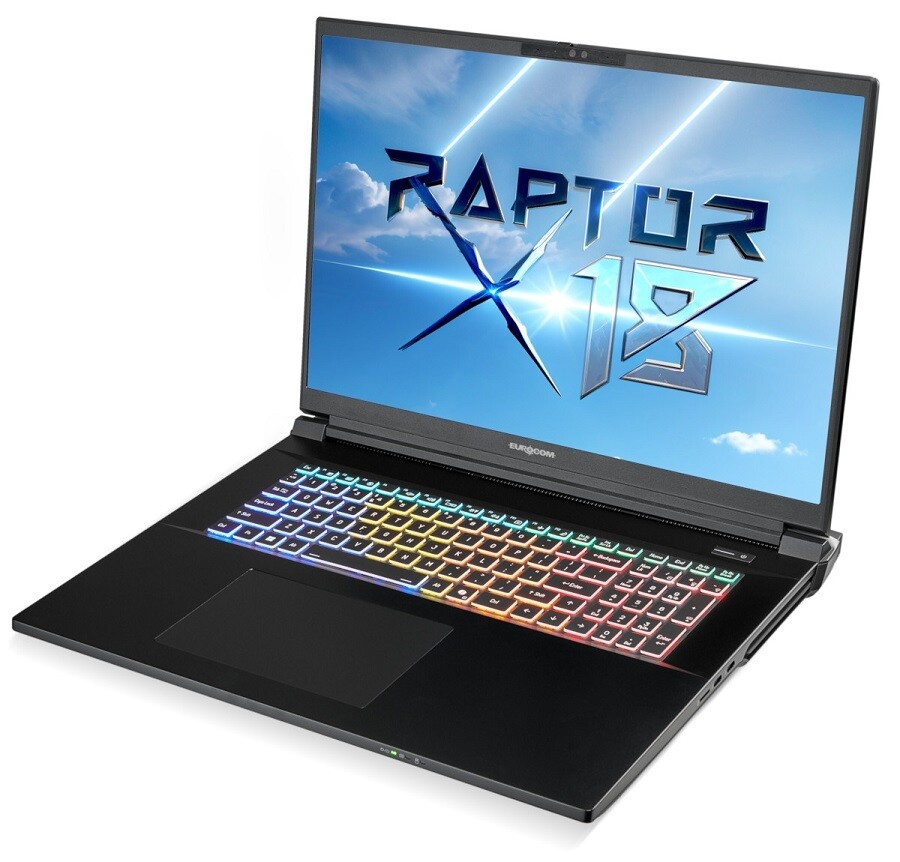
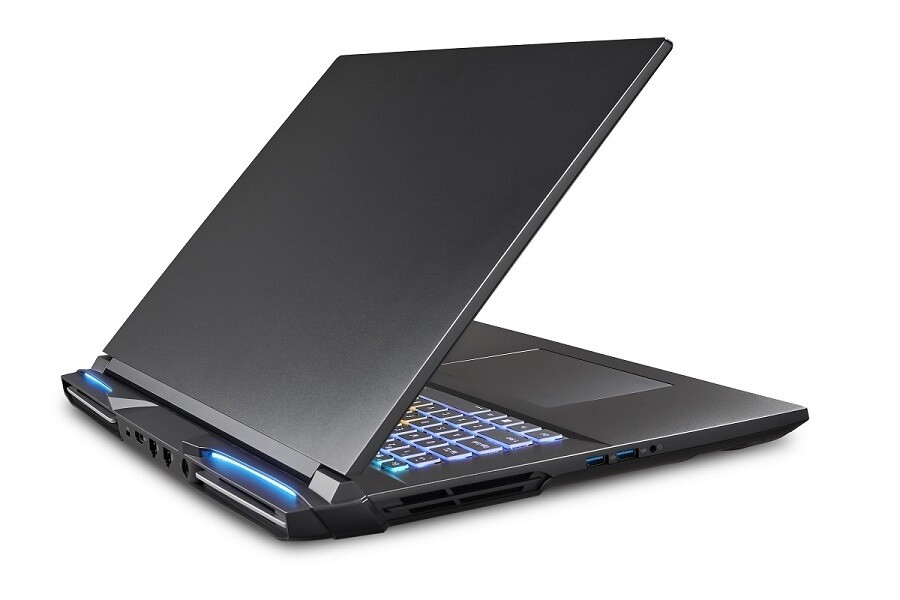
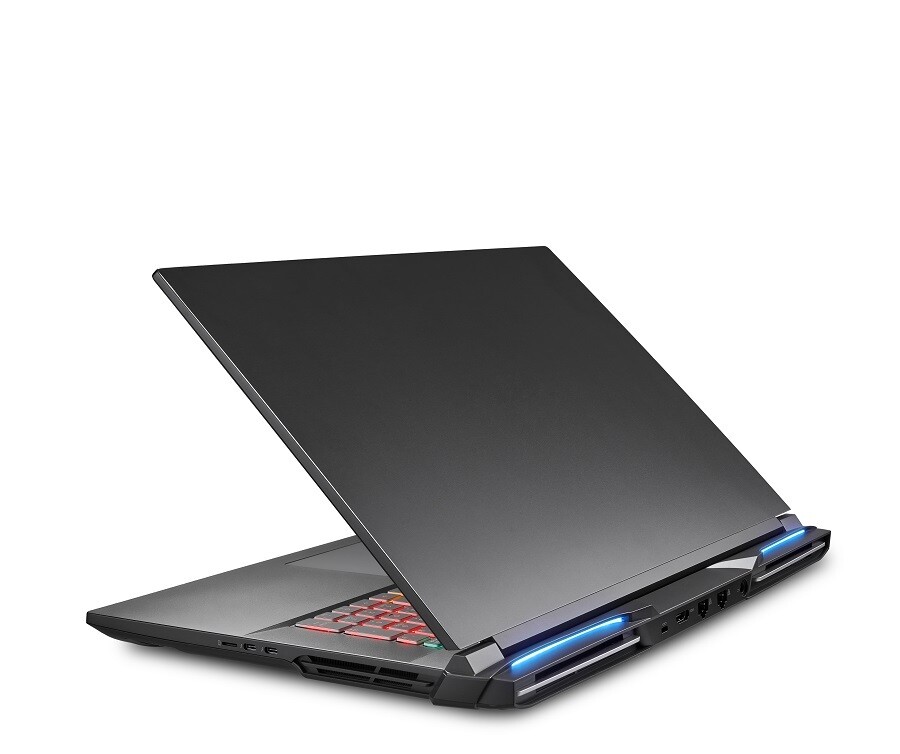
Eurocom Unleashes New 18-inch Raptor X18 Laptop With NVIDIA GeForce RTX 5090

Eurocom is launching the Raptor X18, the world's first customized 18" laptop powered by the newest 24 GB GDDR7 680 Tensor AI cores NVIDIA GeForce RTX 5090, 256 GB of DDR5 memory, 32 TB of RAID 0/1/5 four NVMe SSDs, and the Intel Core Ultra 9 275HX processor with 24 cores, 24 threads, and a massive 36 MB cache. Eurocom is pushing the boundaries of portable high-performance computing with the launch of the Raptor X18 Mobile Supercomputer, designed for those who demand extreme computational power—whether for AI development, deep learning, scientific simulations, engineering, content creation, or gaming at the highest levels.

Unparalleled Performance and Display
The Raptor X18 is the first laptop ever to feature an astonishing 256 GB of DDR5 memory, ensuring seamless multitasking for the most memory-intensive operations, including running large-scale LLM models offline and locally. Combined with 24 GB of next-gen GDDR7 VRAM from the NVIDIA GeForce RTX 5090 GPU (680 Tensor AI cores), this mobile supercomputer dominates AI processing, 3D modeling, complex simulations, and ultra-high-performance gaming. With up to 32 TB of NVMe SSD storage in RAID 0/1/5, users can store and access massive datasets with blazing speed, eliminating bottlenecks in high-end workflows. The Raptor X18 features an 18-inch UHD 200 Hz (3840x2400) display, offering impeccable clarity and smoothness for gaming, scientific visualization, and content creation.

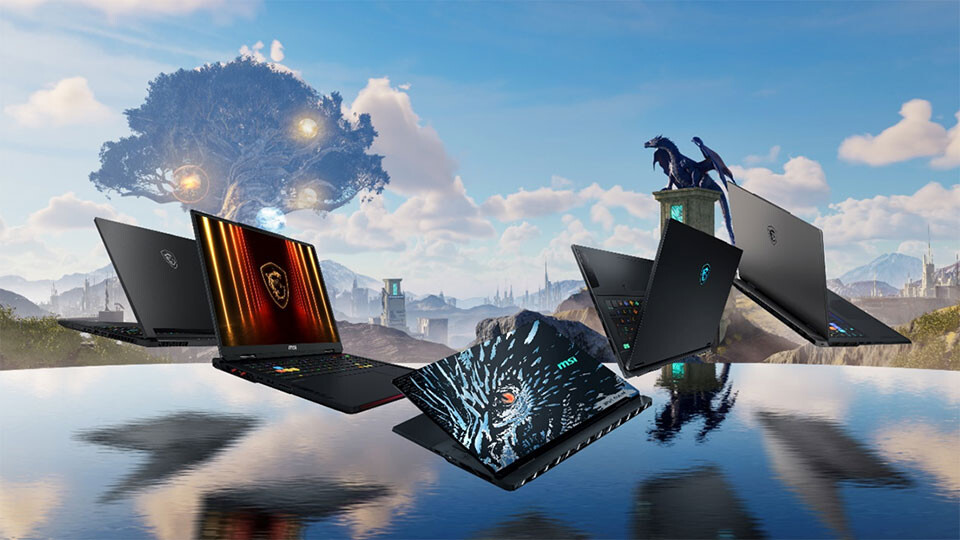
MSI GeForce RTX 50 Laptops Are Prepped for High-end Gaming & Local AI Applications

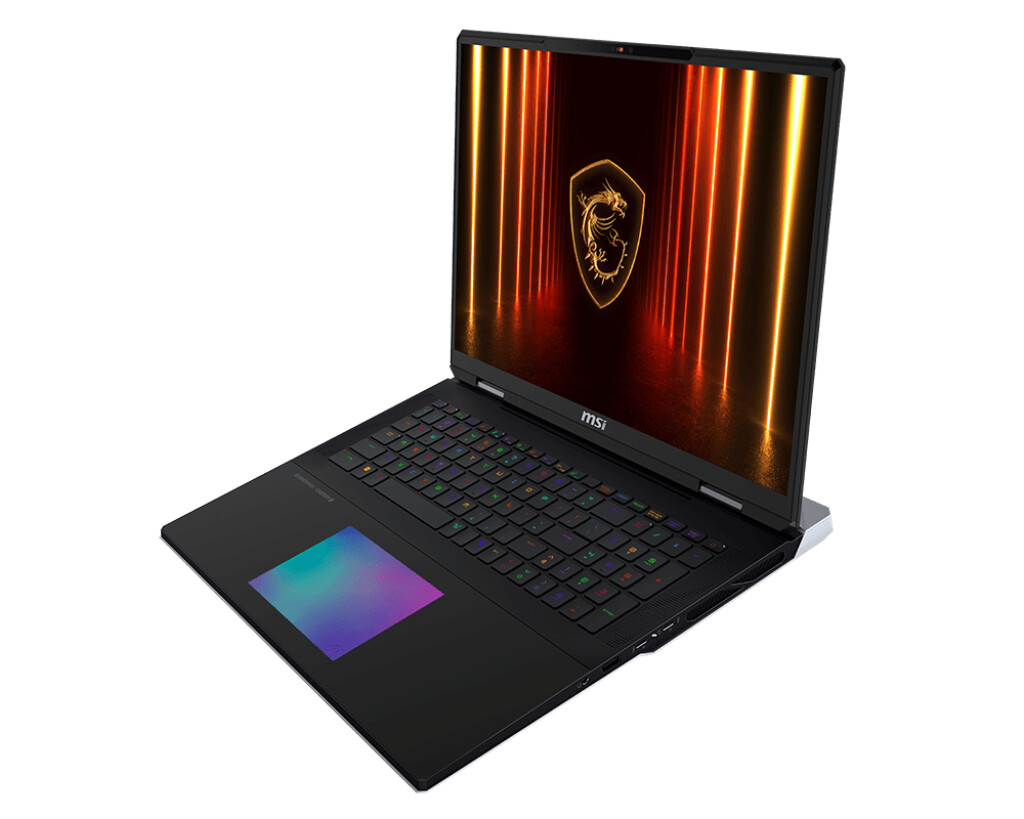
MSI's latest high-end gaming laptops, including the Titan 18 HX AI, Raider 18 HX AI, and Vector 16 HX AI, feature Intel Core Ultra 200 HX series CPUs and NVIDIA RTX 50 series GPUs, while Raider A18 HX and Vector A18 HX run on AMD Ryzen 9000 series. With NVIDIA's last major GPU upgrade in over two years, these laptops deliver top-tier performance for ultra-high-resolution gaming. Beyond gaming, MSI's Titan, Raider, Vector, and Stealth series excel in AI applications, particularly Small Language Models (SLM), making them ideal for both gaming and AI-driven tasks.

Next-Gen GPUs: A Breakthrough for AI Applications
NVIDIA's latest RTX 50 series GPUs, built on the cutting-edge Blackwell architecture, introduce 5th-generation Tensor Cores, 4th-generation RT Cores, and Neural Rendering technology for the first time. With expanded memory capacity and GDDR7, these GPUs optimize AI-enhanced neural computations, reducing memory usage while boosting graphics rendering and AI processing efficiency. This results in unmatched performance for both gaming and creative workloads, enabling smoother, more efficient execution of complex tasks.

NVIDIA GeForce RTX 5050 Laptop Might Sport GDDR7 Memory, Prices Likely To Remain Sky-High

As we have witnessed in the past few weeks, leaked retailer listings are undoubtedly an interesting way to gain more information regarding upcoming hardware. A set of recent listings by the retailer PC21, as well as Acer Hong Kong, have revealed some details regarding the upcoming NVIDIA GeForce RTX 5060 Laptop and RTX 5050 Laptop GPUs. First of all, it appears that we now have concrete information regarding the launch date for the RTX 5060 laptop GPU. According to Acer, the RTX 5060 Laptop-equipped producs will start shipping sometime in May. Moreover, as the leaked listing has revealed, RTX 5060 and RTX 5050 Laptop GPUs will arrive with 8 GB of VRAM, both based on the new GDDR7 spec.

This is quite an interesting development, considering that the RTX 5050 Desktop GPU is expected to ship with GDDR6 memory, so it does appear that the Laptop variant will have superior memory speeds. Considering that the RTX 5070 laptop GPU will also boast 8 GB of GDDR7 memory, it is clear that the primary differences between the RTX 5050, RTX 5060, and RTX 5070 Laptop variants will be limited to core counts. Those who demand more than just 8 GB of VRAM will have to shell out extra for the RTX 5070 Ti Laptop, which is expected to ship with 12 GB of GDDR7 memory on a 192 bit bus. As for pricing, the leaked MSI VenturePro 16 with a Core 7 240H CPU, 16 GB DDR5 memory, 512 GB SSD and an RTX 5050 Laptop GPU is seemingly priced at €1580, or roughly $1720. Clearly, even the lowest-end of Blackwell GPUs are all set to boast price tags lofty enough to make even those with deep pockets weep.

NVIDIA Reportedly Prepares GeForce RTX 5060 and RTX 5060 Ti Unveil Tomorrow

NVIDIA is set to unveil its RTX 5060 series graphics cards tomorrow, according to VideoCardz information, which claims NVIDIA shared launch info with some media outlets today. The announcement will include two desktop models: the RTX 5060 and RTX 5060 Ti, confirming leaks from industry sources last week. The upcoming lineup will feature three variants: RTX 5060 Ti 16 GB, RTX 5060 Ti 8 GB, and RTX 5060. All three cards will utilize identical board designs and the same GPU, allowing manufacturers to produce visually similar Ti and non-Ti models. Power requirements are expected to range from 150-180 W. NVIDIA's RTX 5060 Ti will ship with 4608 CUDA cores, representing a modest 6% increase over the previous generation RTX 4060 Ti. The most significant improvement comes from the implementation of GDDR7 memory technology, which could deliver over 50% higher bandwidth than its predecessor if NVIDIA maintains the expected 28 Gbps memory speed across all variants.

The standard RTX 5060 will feature 3840 CUDA cores paired with 8 GB of GDDR7 memory. This configuration delivers 25% more GPU cores than its predecessor and marks an upgrade in GPU tier from AD107 (XX7) to GB206 (XX6). The smaller GB207 GPU is reportedly reserved for the upcoming RTX 5050. VideoCardz's sources indicate the RTX 5060 series will hit the market in April. Tomorrow's announcement is strategically timed as an update for the Game Developers Conference (GDC), which begins next week. All models in the series will maintain the 128-bit memory bus of their predecessors while delivering significantly improved memory bandwidth—448 GB/s compared to the previous generation's 288 GB/s for the Ti model and 272 GB/s for the standard variant. The improved bandwidth stems from the introduction of GDDR7 memory.

NVIDIA GeForce RTX 5050, RTX 5060, and RTX 5060 Ti Specifications Leak

NVIDIA's upcoming GeForce RTX 50 series mainstream lineup has been leaked, thanks to the well-known leaker kopite7kimi, revealing the complete specification profile of the RTX 5050, RTX 5060, and RTX 5060 Ti graphics cards. The entry-level RTX 5050 features GB207-300-A1 silicon on a PG152-SKU50 board with 2,560 CUDA cores and 8 GB of the older GDDR6 memory across a 128-bit interface at 130 W, while the mid-tier RTX 5060 utilizes GB206-250-A1 silicon on a PG152-SKU25 board housing 3,840 CUDA cores with 8 GB of the latest GDDR7 memory at 150 W. The more powerful RTX 5060 Ti implements GB206-300-A1 silicon with two board versions, PG152-SKU10/15, presumably for two memory configurations. It features 4,608 CUDA cores paired with either 8 GB or 16 GB of GDDR7 memory and a 180 W power envelope.

Most notable is the adoption of next-generation GDDR7 memory technology in both RTX 5060 variants while maintaining the 128-bit memory bus across all three models. While the entry-level RTX 5050 model utilizes GDDR6 memory, the RTX 5060 and RTX 5060 Ti are awarded with the faster GDDR7. The consistent 128-bit interface suggests NVIDIA is leveraging memory compression technologies and GDDR7's increased bandwidth to deliver performance improvements without widening the memory bus. Each tier features a slight increase in CUDA core count, a modest boost over the previous generation RTX 40 series. With the RTX 5050 targeting 1080p gaming, the RTX 5060 is positioned for high-refresh 1080p and entry-level 1440p, and the RTX 5060 Ti is likely aimed at solid 1440p performance across most titles. While we don't know the exact release date, we can expect to hear more about the availability in the coming weeks.

NVIDIA RTX PRO 6000 "Blackwell" Features 24,064 Cores Paired with 96 GB GDDR7 ECC Memory

NVIDIA has prepared a "Blackwell" Titan equivalent—RTX PRO 6000 Blackwell GPU for professional visualization and local AI solutions. Based on the GB202 silicon, the RTX PRO 6000 is the closest solution to the full power of NVIDIA's prosumer-oriented Blackwell SKUs. With 24,064 CUDA cores on board, this configuration is just 512 CUDA cores shy from the complete GB202 24,576-core configuration. This is likely due to the yield defects, meaning that this is perhaps the highest CUDA core count model we will see based on GB202. Additionally, at 24,064 core RTX PRO 6000 Blackwell is carrying 2,340 more cores than the top-end consumer GeForce RTX 5090 with 21,760 CUDA cores. Based on the 600 W TGP, the new RTX PRO 6000 Blackwell should have lower clocks, given its bigger core count to maintain the TGP for its massive memory configuration. Remember, GDDR7 memory modules consume power, too.

With 96 GB of GDDR7 memory and ECC memory correction on board, it will primarily target professionals in 3D rendering, simulations, and local AI development. To cool the beastly configuration, NVIDIA opted for a double-flow-through cooler used on the RTX 5090, with an open-air design. Operating on a PCIe 5.0 x16 interface with four DisplayPort 2.1 connectors, the design remains double-slot in thickness. VideoCardz obtained pictures of it, which you can see below. Interestingly, the color accents of the new cooler are darker. We can expect to see more from NVIDIA and its new RTX PRO 6000 Blackwell GPU from the upcoming GTC 2025 on March 17.

Manli Announces the GeForce RTX 5070 12GB Series Lineup

Manli Technology Group Limited is proud to announce the Manli GeForce RTX 5070 graphics card. Get game-changing performance with the GeForce RTX 5070, powered by NVIDIA Blackwell. Game at high frame rates with DLSS 4, supercharge your creativity with NVIDIA Studio, and enable new experiences with the power of AI.

Manli Design
There are 6,144 CUDA cores onboard powering the RTX 5070. It also has 12 GB of memory, and GDDR7 memory speeds of up to 28 Gbps, with 5th Gen Tensor Cores, AI TOPS 988.

NVIDIA GeForce RTX 5070 Goes on Sale

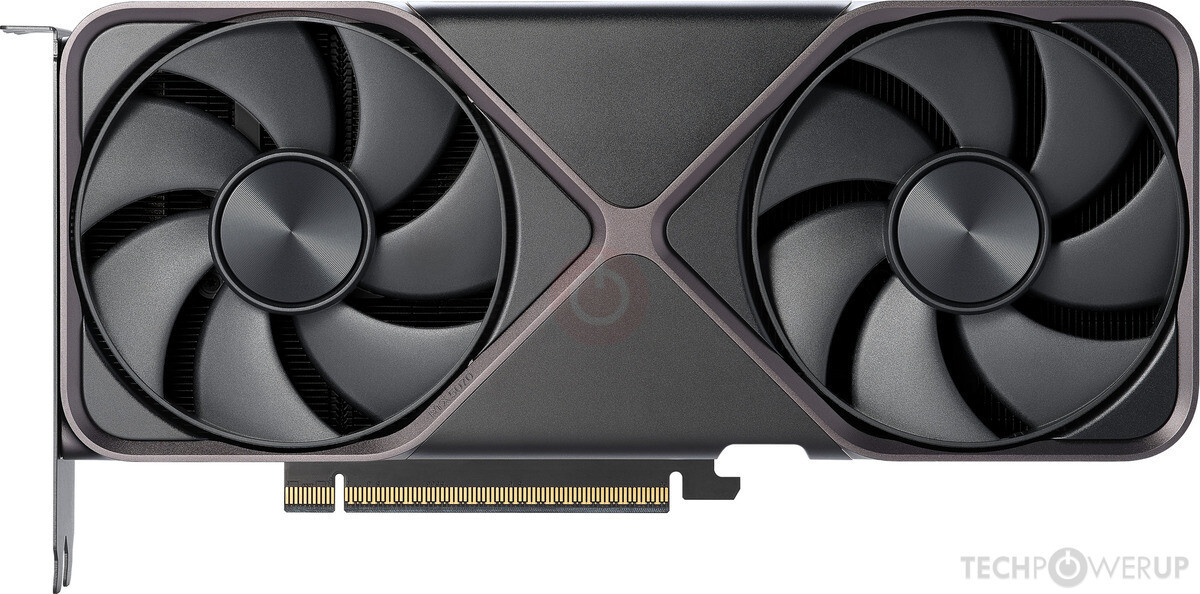
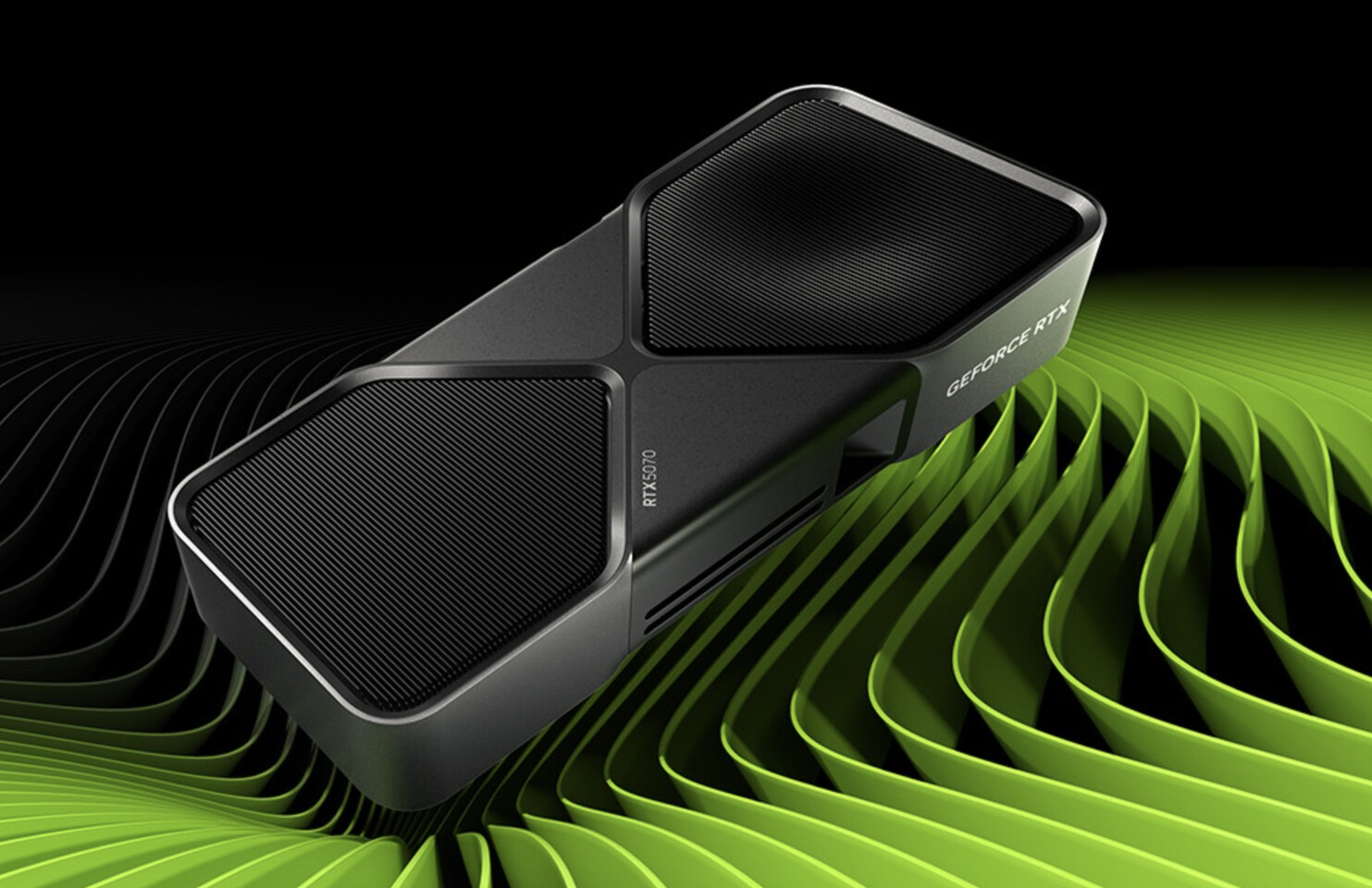
NVIDIA today released to market the GeForce RTX 5070 performance segment graphics card for maxed out gaming at 1440p with ray tracing. Based on the "Blackwell" graphics architecture, the RTX 5070 gets a few of the latest features, including Neural Rendering, DLSS 4 with Multi Frame Generation, and an updated ray tracing hardware that's ready for Mega Geometry. The RTX 5070 debuts the new 5 nm "GB205" silicon, a mid-sized GPU featuring a well-rounded 50 SM or 6,400 CUDA cores. The RTX 5070 almost maxes this out, with 48 SM or 6,144 CUDA cores on tap.

Other key specs of the RTX 5070 include 192 Tensor cores, 48 RT cores, 192 TMUs, and 80 ROPs. The SKU also gets all 48 MB of L2 cache present on the silicon. When compared to the previous generation RTX 4070, these counts see a numerical increase. The RTX 4070 has 64 ROPs and 36 MB of cache. While the memory size is unchanged at 12 GB, the memory bandwidth sees an increase by 33% thanks to the new 28 Gbps GDDR7 memory being used. The RTX 5070 has a starting price of $550, but real-world pricing could easily reach $700, if not more.

NVIDIA GeForce RTX 5070 Founders Edition GPU Available Late March, AIB Designs on March 5

We have just published our in-depth review of NVIDIA's latest GeForce RTX 5070 Founders Edition (FE) GPU, coming in at $550 MSRP. The first cohort of GeForce RTX 5070 GPUs is expected tomorrow with AIB partner designs, and NVIDIA confirmed that its special FE card will arrive a little later, in late March. While AIB designs are hitting shelves on March 5, NVIDIA's GeForce RTX 5070 FE GPU is going on shelves a few weeks later. NVIDIA's GeForce RTX 5070 arrives with a $550 MSRP--$50 cheaper than the RTX 4070's launch price—positioning it as a compelling value for its ray tracing, DLSS 4, and efficiency gains.

The 5070 comes with 6,144 cores enabled, vs 8,960 on its bigger brother, the RTX 5070 Ti. Other unit counts have been scaled accordingly, and you get 80 ROPs. Yes, we checked. Also included are 192 TMUs and 48 RT cores. The memory subsystem uses GDDR7, too, like the other RTX 50 cards, but you only get 12 GB VRAM, and it uses a 192-bit wide memory bus, clocked at 28 Gbps. While the MSRP of the FE card is known, AIB partners will price their customized designs at a 20-40% premium. We are yet to see the supply of these cards at NVIDIA's partner retail stores and the supply that NVIDIA dedicated to its AIB partners, but scalpers could drive pricing even higher if the initial supply is tight. A Swedish retailer, Inet AB, forewarned customers about the lack of stock, but this is yet to be confirmed by other stores.

NVIDIA GeForce RTX 5070 and RTX 5060 Reportedly Faced Production Issues

NVIDIA's GeForce RTX 5070 Ti today goes on sale, and we have reviewed a few of them. However, the RTX 5070 non-Ti variant has reportedly faced some production issues. According to CTEE reports, volume production was pushed back by one month, with manufacturing expected to reach full capacity by mid-March. Given that RTX 5070 is officially coming on March 5, we are left to wonder if enough capacity will be available for the launch day or if it will follow the same footsteps of scarcity that current RTX 5090 and RTX 5080 have experienced.

The unannounced RTX 5060's mass production has been pushed to mid-April, with both models requiring additional debugging due to unexpected issues. NVIDIA's engineers are ironing out all bugs to ensure stable GPU and drivers arrive on time. With the RTX 5070 using the GB206 GPU, the RTX 5060 is expected to implement a GB206 variant, with the in-development RTX 5060 Ti featuring a slightly larger GB205 GPU. For memory, RTX 5070 is expected to utilize 12 GB of GDDR7, and RTX 5060 should come with an 8 GB GDDR7 configuration.

NVIDIA GeForce RTX 5070 Ti Allegedly Scores 16.6% Improvement Over RTX 4070 Ti SUPER in Synthetic Benchmarks

Thanks to some early 3D Mark benchmarks obtained by VideoCardz, NVIDIA's upcoming GeForce RTX 5070 Ti GPU paints an interesting picture of performance gains over the predecessor. Testing conducted with AMD's Ryzen 7 9800X3D processor and 48 GB of DDR5-6000 memory has provided the first glimpse into the card's capabilities. The new GPU demonstrates a 16.6% performance improvement over its predecessor, the RTX 4070 Ti SUPER. However, benchmark data shows it is falling short of the more expensive RTX 5080 by 13.2%, raising questions about the price-to-performance ratio given the $250 price difference between the two cards. Priced at $749 MSRP, the RTX 5070 Ti could be even pricier in retail channels at launch, especially with limited availability. The card's positioning becomes particularly interesting compared to the RTX 5080's $999 price point, which commands a 33% premium for its additional performance capabilities.

As a reminder, the RTX 5070 Ti boasts 8,960 CUDA cores, 280 texture units, 70 RT cores for ray tracing, and 280 tensor cores for AI computations, all supported by 16 GB of GDDR7 memory running at 28 Gbps effective speed across a 256-bit bus interface, resulting in an 896 GB/s bandwidth. We have to wait for proper reviews for the final performance conclusion, as synthetic benchmarks tell only part of the story. Modern gaming demands consideration of advanced features such as ray tracing and upscaling technologies, which can significantly impact real-world performance. The true test will come from comprehensive gaming benchmarks tested over various cases. The gaming community won't have to wait long for detailed analysis, as official reviews will be reportedly released in just a few days. Additional evaluations of non-MSRP versions should follow on February 20, the card's launch date.

NVIDIA GeForce RTX 5070 Ti Edges Out RTX 4080 in OpenCL Benchmark

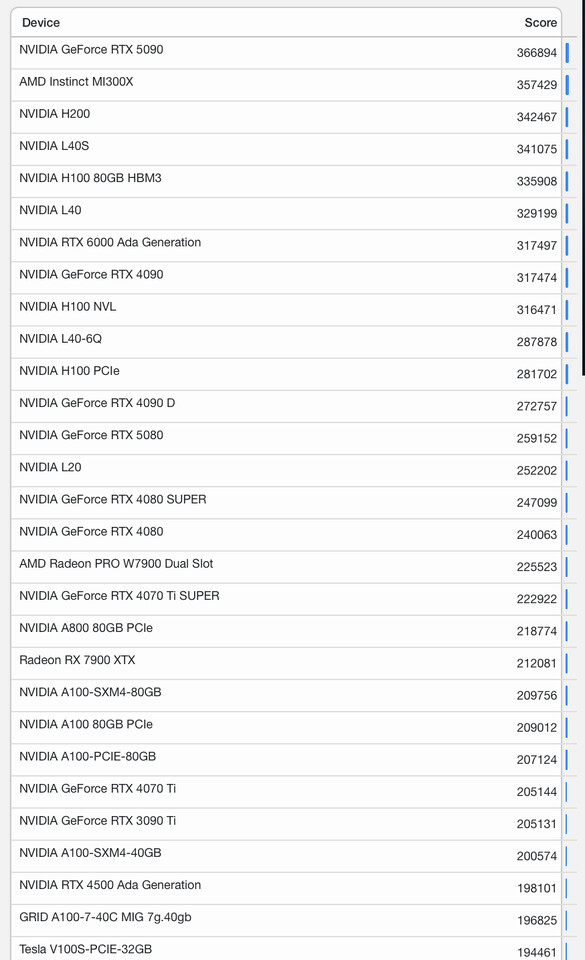
A recently surfaced Geekbench OpenCL listing has revealed the performance improvements that the GeForce RTX 5070 Ti is likely to bring to the table, and the numbers sure look promising - that is, coming from the disappointment of the GeForce RTX 5080, which manages roughly 260,000 points in the benchmark, portraying a paltry 8% improvement over its predecessor. The GeForce RTX 5070 Ti, however, managed an impressive 248,000 points, putting it a substantial 20% ahead of the GeForce RTX 4070 Ti. Hilariously enough, the RTX 5080 is merely 4% ahead, making the situation even worse for the somewhat contentious GPU. NVIDIA has claimed similar performance improvements in its marketing material, which does seem quiet plausible.

Of course, an OpenCL benchmark is hardly representative of real-world gaming performance. That being said, there is no denying that raw benchmarks will certainly help buyers temper expectations and make decisions. Previous leaks and speculations have hinted at a roughly 10% improvement over its predecessor in raster performance and up to 15% improvements in ray tracing performance, although the OpenCL listing does indicate the RTX 5070 ti might be capable of a larger generational jump, neck-and-neck with NVIDIA's claims. For those in need of a refresher, the RTX 5070 Ti boasts 8960 CUDA cores paired with 16 GB of GDDR7 memory on a 256-bit bus. Like its siblings, the RTX 5070 is also rumored to face "extremely limited" supply at launch. With its official launch less than a week away, we won't have much waiting to do to find out for ourselves.

NVIDIA GeForce RTX 5070 Ti AIB Card Listed Online for $1,212

The NVIDIA RTX 5070 Ti gaming GPU is expected to be available starting February 20, although whether gamers are going to be able to purchase one anytime soon is a different story entirely. That said, a recent listing on an Austrian retailer's website has revealed the pricing details for the MSI RTX 5070 Ti Gaming Trio card - a cool €1169 (inclusive of 19% VAT), roughly equivalent to $1212. Compared to NVIDIA's official pricing for the RTX 5070 Ti in most parts of the EU, a 33% increase in price can be observed. Of course, the MSI GAMING TRIO is quite a high-end card, but the price delta is quite surprising regardless. Depending on supply, the prices may further inflate, if the events of the RTX 5090 and RTX 5080 launch are repeated.

The RTX 5070 Ti is expected to boast 8690 CUDA cores paired with 16 GB of GDDR7 memory on a 256-bit bus. Recent leaks have hinted at very mediocre performance improvements, similar to what we witnessed with the RTX 5080. As of this writing, there seems to be a decent possibility that the RX 9070 and RX 9070 XT will beat the RTX 5070 family, not just in raster performance, but also in value. Of course, since NVIDIA is clearly going to fire first, gamers will not have much of a choice before RDNA 4 hits the scene. That said if the RTX 5070 series witnesses similarly atrocious availability at launch as its siblings, a lot of folks will have no option but to wait.

NVIDIA GeForce RTX 5060 16 GB Variants Deemed Fake, Insiders Insist SKU is 8 GB Only

According to early February reportage, Team Green's GeForce RTX 5060 and RTX 5060 Ti graphics cards are expected to launch onto market next month. Very basic technical information has leaked online; insiders reckon that both product tiers will be utilizing the NVIDIA "Blackwell" GB206 GPU. Rumors have swirled regarding intended VRAM configurations—loose online declarations point to variants being prepared with 8 or 16 GB of GDDR7 VRAM, on a 128-bit bus. Regulatory filings indicate two different configs with the eventual arrival of GeForce RTX 5060 Ti models, but certain industry watchdogs insist that the GeForce RTX 5060 SKU will be an 8 GB-only product.

A curious-looking ZOTAC Trinity OC White Edition GeForce RTX 5060 16 GB variant surfaced via a TikTok video—post-analysis, expert eyes declared that the upload contained doctored material. A BenchLife.info report pointed to a notable inconsistency on the offending item's retail packaging: "DLSS 3 should not appear on the GeForce RTX 50 series box, because the Blackwell GPU architecture focuses on DLSS 4." The publication presented evidence of ZOTAC RTX 4070 Ti SUPER Trinity OC White Edition box art being repurposed in the TikToker's video. Hardware soothsayer MEGAsizeGPU added their two cents: "this is fake. There is no plan for a GeForce RTX 5060 16 GB, and the box is photoshopped from the last-gen ZOTAC box." At the end of their report, BenchLife reckons that NVIDIA has not sent a "GeForce RTX 5060 color box template" to its board partners.

NVIDIA RTX 5080 Laptop Defeats Predecessor By 19% in Time Spy Benchmark

The NVIDIA RTX 50-series witnessed quite a contentious launch, to say the least. Hindered by abysmal availability, controversial generational improvement, and whacky marketing tactics by Team Green, it would be safe to say a lot of passionate gamers were left utterly disappointed. That said, while the desktop cards have been the talk of the town as of late, the RTX 50 Laptop counterparts are yet to make headlines. Occasional leaks do appear on the interwebs, the latest one of which seems to indicate the 3D Mark Time Spy performance for the RTX 5080 Laptop GPU. And the results are - well, debatable.

We do know that the RTX 5080 Laptop GPU will feature 7680 CUDA cores, a shockingly modest increase over its predecessor. Considering that we did not get a node shrink this time around, the architectural improvements appear to be rather minimal, going by the tests conducted so far. Of course, the biggest boost in performance will likely be afforded by GDDR7 memory, utilizing a 256-bit bus, compared its predecessor's GDDR6 memory on a 192-bit bus. In 3D Mark's Time Spy DX12 test, which is somewhat of an outdated benchmark, the RTX 5080 Laptop managed roughly around 21,900 points. The RTX 4080 Laptop, on an average, rakes in around 18,200 points, putting the RTX 5080 Laptop ahead by almost 19%. The RTX 4090 Laptop is also left behind, by around 5%.

ASUS ROG Takes a Closer Look at Astral GeForce RTX 5090 & 5080 Models

The next generation of graphics performance has arrived. We've prepared an all-new series of cards: ROG Astral. Featuring a new, sophisticated design and an outstanding cooling solution, the ROG Astral GeForce RTX 5090 and ROG Astral GeForce RTX 5080 are your premium picks for supercharging the performance of your gaming PC. All this new hardware in the ROG Astral GeForce RTX 5090 requires no small amount of power so that it can stretch its legs and run. Your PSU should be capable of at least 1000 W to run this card—more on that later. The circuitry that delivers this power is just as important, and it's one reason why many enthusiasts prefer ROG graphics cards. We've equipped the ROG Astral GeForce RTX 5090 and 5080 for premium power delivery with 80-amp MOSFETs that can supply over 35% more headroom than standard designs. A massive 24-phase VRM array for the GPU and a seven-phase VRM for the GDDR7 memory chips distribute the work of supplying power, ensuring rock-solid stability and long-lasting performance. To give you peace of mind that your 16-pin PCIe power connector is seated properly, we provide monitoring through Power Detector+ in the GPU Tweak III app so that you can verify that the connector is fully seated. The app can even tell you exactly which pin is not seated properly, if that ever becomes a concern.

Ada, meet Blackwell
With the GeForce RTX 50 Series, NVIDIA debuts its latest Blackwell architecture. Armed with fifth-gen Tensor cores, new streaming multiprocessors optimized for neural shaders, and fourth-gen Ray Tracing cores built for Mega Geometry, the new graphics cards unlock access to the next generation of graphics technologies. For many gamers, the highlight of the new architecture is DLSS 4. DLSS is a revolutionary suite of neural rendering technologies that uses AI to boost FPS, reduce latency, and improve image quality. The latest breakthrough, DLSS 4, brings new Multi Frame Generation and enhanced Ray Reconstruction and Super Resolution. But there's more. NVIDIA Reflex 2 with Frame Warp provides game-winning responsiveness, and these cards are equipped to give you the best experience with ray-traced graphics yet.
Return to Keyword Browsing
Nov 17th, 2026 20:50 CST change timezone

New Forum Posts

Popular Reviews

TPU on YouTube

Controversial News Posts