News Posts matching #GDDR7

Return to Keyword Browsing

NVIDIA To Prioritize RTX 5060 at Expense of Rest of 50 Series

It's been predicted for a while now that the looming DRAM crisis would have an effect on GPU prices in 2026, with previous stories we've covered indicating that cards like the RTX 5090 would see increases up to $5,000 before the end of the year. Now, an industry insider has claimed on Board Channels, via Wccftech, that NVIDIA would prioritize production and logistics for the GeForce RTX 5060 series, specifically referring to the RTX 5060 and 5060 Ti 8 GB models. This comes after NVIDIA has supposedly cut shipments of the 5060 Ti 16 GB and 5070 Ti models. This means that higher-end models will become more scarce and prices will likely become even more inflated as a result of the scarcity.

The switch-up in the logistics pipeline is supposedly a direct response to the shortage of consumer memory, which has resulted in higher density GDDR7 modules becoming more difficult to procure. These supply chain struggles are not limited to GPU add-in-board partners or NVIDIA, as there have been rumors about prominent laptop and smartphone manufacturers potentially delaying 2025 launches as a result of the DRAM crisis or even trimming the RAM on flagship devices in order to keep costs somewhat lower. Even the next-gen console generation is said to be caught in the crossfire, with delays apparently being discussed by the likes of Microsoft and Sony.
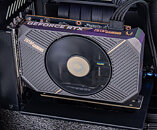
Full Lineup of RTX 50 Blower-type Cards Available in China, Including Banned RTX 5090

Last year, curious-looking custom GeForce RTX 5090D 32 GB card designs emerged from China—at the time, these unofficial designs were based on the region specific GeForce RTX 5090D GPU. Apparently, a mix of AI research firms, DIY enthusiasts, and bootleggers had created blower-style cooling solutions for the best available "Blackwell" hardware. Many months later, a surprisingly comprehensive stack of similarly outfitted GeForce RTX 50-series products have popped up for sale on the Taobao shopping platform. A recent VideoCardz news piece highlights that these offerings are not produced locally by mainstream AIBs; instead unnamed AI companies have reportedly managed to produce blower-style products based on the entire range of "Blackwell" gaming GPUs, including the regionally banned GeForce RTX 5090 32 GB flagship model. An even more nerfed "V2" variant—making do with only 24 GB of GDDR7 VRAM—was released late last summer as a Chinese market exclusive, replacing its older 32 GB sibling.

In early 2026, Taobao listings advertise available stock of all GeForce RTX 5090 variants: standard, D V1, and D V2. Additionally, GeForce RTX 5080, RTX 5070 Ti, and RTX 5060 Ti (all) 16 GB options were included. According to VideoCardz's past weekend article, the cheapest model is listed at 3999 RMB (~$573 USD), with the range-topper (RTX 5090 standard) coming in at a whopping 28,999 RMB (~$4158 USD). Product photos likely show off higher-end cards. Smaller cooling solutions could be present on the less potent GB206 GPU-based model. Further rumors point to involved AI hardware manufacturers readying greater VRAM capacity blower-style custom cards—VideoCardz has picked up on whispers of GeForce RTX 5090 96 GB and RTX 5080 32 GB variants. The former could be enabled by a use of 3 GB GDDR7 memory modules, reflecting work done on NVIDIA's very official RTX PRO 6000 Blackwell range.

The 5 Biggest No-Shows of CES 2026

As the Consumer Electronics Show of 2026 comes to an end, our field crew has done of a lot of work to keep readers updated. However, pre-CES expectations were high for several product launches, that sadly didn't happen. In today's piece we are ranking the top five things we didn't get at CES 2026, even with hopes of a product launch occurring during the show.

1) First on our non-weighted ranking is NVIDIA's GeForce RTX 50-series "Blackwell" SUPER refresh. This mid-cycle was originally planned for late Q1 to early Q2 2026, with a possible announcement at CES 2026. The "SUPER" treatment was planned with denser GDDR7 memory modules with 3 GB of capacity per chip, increasing the memory configuration of the standard GeForce RTX 5070, RTX 5070 Ti, and RTX 5080. Initially, the RTX 5070 SUPER was planned with an upgrade to offer 18 GB, while the RTX 5070 Ti SUPER and RTX 5080 SUPER would each provide 24 GB of GDDR7 memory.

MSI GeForce RTX 5090 Lighting Z Hands On: 40-Phase VRM and 2,500 W XOC BIOS

At the 2026 International CES show, MSI unveiled its most powerful GPU creation to date: GeForce RTX 5090 Lightning Z GPU. Coming as a fully custom PCB design, the board carries an GB202 GPU of the RTX 5090 with a factory boost clock of 2,730 MHz, and an "Extreme Performance" OC profile of 2,775 MHz. This results in the fastest LN2 GeForce RTX 5090 GPU ever, reaching as high as 3,742 MHz when put thought the hands of professional overclockers. Fully enabling this is the 40-phase VRM design that can provide smooth voltage curve needed to feed the GPU, with a maximum power rating of 800 W out of the box, while the "Extreme" power preset mode gives it a 1000 W power envelope on the 360 mm AIO water cooling. The card is powered by dual 16-pin 12V-2x6 power connectors, each giving the maximum of 600 W.

MSI has used the 28 Gbps Samsung GDDR7 modules, which can be overclocked to 36 Gbps on LN2, and probably at 30+ Gbps on the standard watercooling. In its regular form factor that comes from the factory, MSI has made the GPU appear as a small tablet device with its big screen. All you see is the yellow theme of the card and two tubes connected to the 360 mm radiator that dissipates a kilowatt of heat. In addition to the massive radiator, the GPU is covered in full-copper cold plate that entirely covers the 3 oz copper PCB, cooling the GPU, VRMs, and memory for a true all-in-one cooling. The pictures follow below.

MSI GeForce RTX 5090 Lighting Z Comes with 2,500 W XOC BIOS and Dual 12V-2x6 Connectors

Last week, MSI teased the return of its famous MSI Lightning GPU brand, last seen in the now distant MSI GeForce RTX 2080 Ti Lightning Z. Thanks to the CES 2026 Innovation Awards, we now have more details ahead of the official launch, as the MSI GeForce RTX 5090 Lightning Z has been showcased. Documentation confirms a liquid-cooled AIO system featuring a 360 mm radiator and dual 12V-2×6 power connectors, each capable of delivering 600 W, totaling 1600 W. One of its most notable features is a front-mounted display that covers nearly the entire surface of the card. MSI has equipped the card with a reinforced PCB, premium voltage regulation modules, and a companion mobile app for remote monitoring and overclocking adjustments.

Elite overclockers worldwide are already submitting HWBOT results showcasing the RTX 5090 Lightning Z variant reaching 3,742 MHz, making it the highest-clocked RTX 5090 GPU globally. These benchmarks, conducted with exotic cooling methods such as liquid nitrogen or custom water loops instead of the retail AIO solution, show memory operating at 36 Gbps in various tests. This indicates that the memory modules used in this GPU are also suitable for overclocking. Samsung GDDR7 modules are now sampling at 36 Gbps speeds straight out of the box, but it requires LN2 for older modules to achieve these speeds. Of course, MSI has reportedly readied a XOC VBIOS that allows the card to consume 2,500 W of power, which will require additional PCB modification to the power input. With 40-phase power delivery, 2,500 W of load seems like a good choice for extreme overclocking runs.

Update Jan 6th: At MSI's CES booth we went hands-on with the Lightning Z and also got photos of its PCB, too.

LG Introduces 2026 LG gram Lineup Elevated by Aerominum

LG Electronics (LG) will unveil its 2026 LG gram lineup at CES 2026, extending the brand's decade-long leadership in ultra-portable laptops. The new lineup debuts an ultra-light Aerominum material for a more portable, durable and premium design. The new models also prioritize productivity with advanced dual AI capabilities, combining on-device intelligence with cloud-based AI for more flexible work and creativity on the go.

The LG gram's evolution as the ultra-portable laptop is accelerated by Aerominum, a composition developed by LG. This innovative material reduces the laptop's weight while reinforcing its structural strength. The resulting chassis is built for life on the move, offering improved scratch resistance, meeting military-grade standards and ensuring long-lasting resilience for everyday use. Aerominum's aeroplate structure and refined atelier brushing deliver a sleek metallic finish, elevating the design without adding bulk.

NVIDIA Announces General Availability of RTX PRO 5000 72 GB GPU

The NVIDIA RTX PRO 5000 72 GB Blackwell GPU is now generally available, bringing robust agentic and generative AI capabilities powered by the NVIDIA Blackwell architecture to more desktops and professionals across the world.

The new GPU configuration offers AI developers, data scientists and creative professionals the hardware for modern, memory-hungry workflows—and arrives at a time when demand for NVIDIA Blackwell-class compute is higher than ever.

NVIDIA Plans to Reduce RTX 50 Production by Up to 40% in Early 2026

Reports from Asian supply chain sources suggest that NVIDIA might cut back on making GeForce RTX 50 series GPUs in the first six months of 2026, Videocardz reports. According to Board Channels, overall supply during H1 2026 could be down by roughly 30-40% compared to the same period in 2025, although the information remains unconfirmed. The report points out that the issue is not entirely related to GPU VRAM alone, but also to tight availability across GDDR6, GDDR7, and other memory components, including motherboard-related memory such as DDR5/DDR4. Board Channels also claims NVIDIA may adjust allocation strategies for add-in board (AIC) partners in Mainland China to better align supply with changing DIY market conditions.

Benchlife appears to support parts of the rumor, though without specifying a percentage reduction. Instead, it reports that two models (best value models in the Blackwell RTX 50 lineup), the GeForce RTX 5070 Ti and RTX 5060 Ti 16 GB are likely to see the earliest supply adjustments. While both Board Channels and Benchlife have long and good track records, the reports are based on regional sources and may not reflect global supply conditions. We will have to wait for NVIDIA or its partners to provide more information. However, it's worth noting that just a month ago, reports from Korean and Taiwanese outlets said AMD and NVIDIA were already considering GPU output cuts, while ASUS and other vendors were slowing motherboard plans due to memory shortages. In the end, this could end up being a broader, global production adjustment by NVIDIA rather than a region specific move.

SK Hynix Forecasts Tight Memory Supply Lasting Through 2028

SK Hynix held an internal company meeting, where the company reportedly presented some tough pills to swallow for many gamers. The company now forecasts the tight memory supply to last through 2028 for the commodity DRAM, which includes DDR5/DDR4, GDDR6/GDDR7, and LPDDR5x/LPDDR6. All the aforementioned DRAM variants are essential for PC and console components, making millions of gamers at risk of absorbing a massive price increase as a result. As memory supplier inventories deplete, production capacity will not increase to meet demand as it has in the past. This marks a departure from the usual response by memory manufacturers, who typically ramp up capacity in response to demand.

However, an interesting thing that SK Hynix has noted is that this situation will exclude the company's most advanced memory solutions—HBM and SOCAMM. These products are expected to get an additional capacity expansion, without tight supply impacting this part of the DRAM supply chain. These products are even in high demand as they are mostly consumed in higher volume than the regular commodity DRAM, due to their integration into AI products such as GPUs and servers.

Samsung Develops 40 Gbps GDDR7 Memory with 3 GB Capacity

During the 2025 Korea Tech Festival in Seoul, Samsung's 40 Gbps GDDR7 memory received a presidential recognition medal. This next-generation memory chip is built on Samsung's 12 nm (10 nm class) DRAM node and operates at 40 Gbps with a 3 GB (24 Gb) capacity. This announcement follows Samsung's recent sampling of its fastest-ever GDDR7 memory, which runs at 36 Gbps. With a 24 Gb capacity per chip, this translates to 3 GB of capacity, designed for the next generation of graphics cards. These are not Samsung's only 3 GB modules. The South Korean company is also producing 28 Gbps 3 GB modules, which are now in mass production, likely for NVIDIA's upcoming mid-cycle SUPER refresh.

As 3 GB modules are uncommon, the confirmation of mass production, especially starting at 28 Gbps, is a welcome addition to faster VRAM options. However, with Samsung already testing 40 Gbps GDDR7 memory modules with 3 GB capacity, it will be interesting to see where these modules will be used. For NVIDIA's mid-cycle SUPER refresh of the GeForce RTX 50-series GPUs, the company is likely to use chips that are already in mass production, as the sampling stage alone is not sufficient for a product rollout. Ensuring a proper supply is crucial, so a proper stock of GDDR7 chips must pile up first.

Aetina Unveils MXM Accelerator Module with NVIDIA RTX PRO Blackwell Embedded GPUs

Aetina Corporation, a leading provider of Edge AI solutions, has announced the launch of its next-generation MXM AI Accelerator Module series accelerated by NVIDIA RTX PRO Blackwell Embedded GPUs, which is part of its CoreEdge MXM AI Module family. This new series is accelerated by the NVIDIA Blackwell GPU platform to deliver up to 3X the AI performance uplift of its predecessor, establishing a new benchmark for advanced AI computing at the edge.

These modules are designed to be compact, efficient, and rugged, adhering to the MXM 3.1 industrial standard. They are purpose-designed for high-precision, high-density workloads in critical applications such as autonomous mobile robots (AMRs), unmanned vehicles (UAVs/UGVs), smart manufacturing equipment, and medical and surgical assistance systems. This series brings the computing power of generative AI and physical AI closer to the edge, facilitating a comprehensive upgrade of smart applications.

Samsung Could Convert Some HBM3E Capacity to Regular DRAM to Meet Demand

As Samsung transitions from its HBM3 and HBM3E variations of HBM memory to HBM4, the company is reportedly reallocating some of its HBM production capacity to regular DRAM to meet demand. Discussions within the company focus on converting approximately 30-40% of the current capacity from the 10 nm-class, fourth-generation 1a DRAM process to the 10 nm-class, fifth-generation 1b lines used for general-purpose DRAM. This includes DDR5, LPDDR5X, LPDDR6, and GDDR7 memory. With additional investment to repurpose mature process nodes like 1z, Samsung expects to free up the equivalent of about 80,000 wafers per month of 1b capacity.

While HBM typically offers higher margins for companies like Micron and SK Hynix, Samsung's internal estimates show that the operating profit for a 12-hi HBM3E stack is around 30%. In contrast, the near-term expectations for general-purpose DRAM exceed 60%. These margin differences, along with forecasts of a significant decline in average selling prices for 12-hi HBM3E and limited incremental demand from the largest HBM customer, have reduced the incentive to expand HBM3E production.

NVIDIA Refills GeForce RTX 5090 Founders Edition GPU Stock in Europe

NVIDIA has officially restocked its GeForce RTX 5090 graphics card in European stores, as reported by recent updates from online marketplaces. NVIDIA operates its own online market across various countries, allowing gamers to purchase the GPU at the manufacturer's suggested retail price (MSRP). In September, NVIDIA quietly removed the GeForce RTX 5090 and RTX 5080 Founders Edition graphics cards from its online marketplace. This removal affected all international online stores, including those in the US, Germany, the UK, and France. However, the company later confirmed that the GeForce RTX 50 series Founders Editions continue to be in production. They are limited edition products, so they occasionally go out of stock on the website and return when available again.

It seems that today is the day again, as NVIDIA has released a fresh batch of GeForce RTX 5090 Founders Edition SKUs on European marketplaces. This makes the holiday season more appealing for gamers who have saved up to buy the highest-performing GPU currently available. The RTX 5090 FE SKU is currently priced at 2,099 EUR, but stock could run out quickly since it's unclear how many units NVIDIA has allocated for its European markets. With GDDR prices on the rise, there are concerns about the long-term sustainability of the current MSRPs. Therefore, purchasing this GPU at the current price and availability might not be as easy in the future.

2,000 W XOC BIOS for ASUS GeForce RTX 5090 GPU Appears

The GPU vBIOS designed for extreme overclocking is generally intended for professional overclockers, but sometimes these versions become accessible to the public. Recently, a 2,001-watt XOC BIOS for ASUS GeForce RTX 5090 GPUs has emerged, enabling unprecedented power limits. This development offers multi-kilowatt-class overclocking opportunities to enthusiasts eager to experiment with their ASUS GeForce RTX 5090 cards. The XOC BIOS sets the core voltage to 1.15 V by default, regardless of the software voltage slider's position, even if the slider is at zero.

Previously, we only saw the 2,001-watt XOC BIOS for the China-exclusive ASUS ROG Astral RTX 5090D and Galax GeForce RTX 5090D HOF. This XOC BIOS allowed Galax to achieve a GPU core speed of 3,570 MHz and a GDDR7 memory speed of 2,250 MHz, boosting the effective memory speed to 36 Gbps with a bandwidth of 2.304 TB/s, nearly 29% above the standard specification. Such extreme overclocking requires multiple fused 12 V-2×6 cables or custom power delivery to bypass the connector's 600-watt limit. Additionally, custom water or LN2 cooling is necessary to prevent overheating. Installing this BIOS automatically voids the warranty, so enthusiasts should exercise caution when experimenting. This time, the XOC BIOS is compatible with the regular RTX 5090, but caution is advised when dealing with third-party BIOS, so we don't recommend it.

SK Hynix to Showcase 48 Gb/s 24 Gb GDDR7 Memory at ISSCC 2026

SK Hynix is gearing up to demonstrate its next wave of high-speed DRAM at ISSCC 2026, headlined by a 24 Gb GDDR7 chip rated for 48 Gb/s. According to ZDNet Korea the device uses a symmetric dual-channel design and updated internal interfaces to push past the 32 to 37 Gb/s speeds the industry previously expected from GDDR7. Korean outlet Global Economic News reports the per-pin rate represents more than a 70 percent jump over today's 28 Gb/s parts, raising per-chip bandwidth from 112 GB/s to 192 GB/s. At 24 Gb density, each package provides 3 GB of VRAM. That allows configurations such as 24 GB with eight chips, 36 GB with twelve, or 48 GB with sixteen. A 256-bit GPU using these devices could deliver around 1.5 TB/s of bandwidth, while a 512-bit interface would reach about 3 TB/s.

The GDDR7 paper listed for ISSCC positions the chip for mid-range AI inference hardware. SK Hynix joins Samsung and Micron in pushing GDDR7 speeds, but on paper it now targets the highest data rate of the three. Actual product clocks will likely land lower; GPU vendors routinely tune memory speeds to meet yield and power targets. GDDR7 at 24 Gb is still new to the market. Only NVIDIA's RTX PRO 6000, the 72 GB variant of the RTX PRO 5000, and the RTX 5090 Laptop currently use 3 GB modules. ISSCC papers typically appear a year or more before commercial availability, so this generation may reach data center or AI accelerator boards first. SK hynix is also introducing LPDDR6 on the same stage. The new mobile DRAM reaches 14.4 Gb/s, up sharply from LPDDR5's 9.6 Gb/s. The company is positioning it for high-performance smartphones, AI PCs, and edge devices running on-device generative AI.

Revised NVIDIA RTX 6000D Accelerator Leaks Ahead of Possible Launch in China

Mid-September news reports placed NVIDIA's Chinese market exclusive RTX PRO 6000D model in a dubious position. Insiders believed that this "Blackwell" architecture-based AI accelerator was banned by the nation's Cyberspace Administration (CAC), in favor of boosting the prospects of domestic equivalents. Team Green has gingerly navigated these choppy waters for a number of years; an encouraging stack of sanction-conforming products have been released during trying times. These variants often feature lesser specifications—for example, the aforementioned RTX PRO 6000D is rumored to be a spin-off of the familiar RTX PRO 6000 Blackwell card. Despite facing an uncertain future in China, a curious Geekbench browser entry shines a ray of hope for the latest workstation-grade "D"-affixed product.

Team Green's upcoming NVIDIA RTX 6000D Blackwell GPU—now missing a "PRO" designation—seems to sport 156 compute units (CUs)/SMs; translating to 19,968 CUDA cores. An "AIC CB502-NM" test system was running this 84 GB GDDR7-laden card in conjunction with an AMD EPYC 9654 CPU. In comparison, the unpasteurized RTX PRO 6000 Blackwell model harnesses a largely uncompromised GB202 chip. 24064 CUDA cores are on tap, alongside 96 GB GDDR7 of video memory. The weaker 6000D makes do with a reduced 2430 MHz clock frequency (versus its sibling's 2600+ MHz credentials). Expert analysis posits that the cut-down card makes use of a 448-bit bus interface, rather than the standard unit's 512-bit avenue. VideoCardz has kindly formulated a comparison table of NVIDIA's RTX 6000 "Blackwell" products. The latest addition managed to generate an OpenCL score of 390656 points in Geekbench's 6.5 gauntlet (for Linux AVX2). The evaluated AIC computer was operating on Rocky Linux 9.4 (Blue Onyx).

Samsung Starts Sampling 3 GB GDDR7 Running at 36 Gbps

Samsung has reportedly started sampling its fastest-ever GDDR7 memory running at 36 Gbps. Coming in 24 Gb capacity per chip, this translates to 3 GB of capacity ready for next generation of graphics cards. However, these are not Samsung's only 3 GB modules. The South Korean giant is also making 28.0 Gbps 3 GB modules as of now, and has put them in mass production for what we assume is NVIDIA's next-generation mid-cycle SUPER refresh. As 3 GB modules are rare, we have first confirmation that they are in mass production. Especially starting at 28 Gbps, it is a welcome addition to the faster VRAM.

The middle-end 32 Gbps 3 GB GDDR7 modules are also being sampled, but we assume that manufacturers will opt for solutions that are at 28 Gbps for the time being. Faster 32 and 36 Gbps modules will be most likely exclusive to professional-level cards like NVIDIA's Pro-Viz. NVIDIA's RTX PRO 6000 "Blackwell" GPU already includes the 3 GB modules, and NVIDIA recently updated the RTX PRO 5000 "Blackwell" GPU to feature 72 GB of GDDR7 ECC memory, up from 48 GB. This update also uses 24 modules, meaning each module has a 3 GB capacity to achieve the 72 GB total.

Olares to Launch a Personal AI Device Bringing Cloud-Level Performance Home

Olares, a technology startup dedicated to open and local AI, today announced the upcoming launch of its debut product, Olares One, a personal AI cloud that delivers cloud-level AI performance with local processing and data ownership by design. The company is backed by a $45 million Series A funding round led by SIG. Engineered for AI enthusiasts, content creators, developers, and privacy-conscious businesses, Olares One packs server-grade strength into a whisper-quiet desktop form factor. It features an NVIDIA GeForce RTX 5090 Mobile GPU (24 GB GDDR7), an Intel Core Ultra 9 275HX processor, and 96 GB of RAM.

"Our goal is to return control of AI to the individual," said Peng Peng, Founder of Olares. "With Olares One, we are providing the powerful hardware and open software needed to run advanced AI models locally. This empowers users to leverage the benefits of AI with the confidence that their privacy is protected."

GDDR7 Shortage Could Stop NVIDIA GeForce RTX 50-Series SUPER Rollout

NVIDIA's rumored GeForce RTX 50 series "Blackwell" SUPER graphics cards might face delays due to the ongoing DRAM shortage affecting the industry. These GPUs are expected to feature more dense GDDR7 memory modules with 3 GB per module. The current DRAM shortage could impact the planned release date and potentially lead to the cancellation of the entire rollout. According to Uniko's Hardware, there is speculation that the SUPER refresh cycle might be scrapped entirely, leaving only the standard NVIDIA GeForce RTX 50 series in production. This regular series uses earlier GDDR7 memory with 2 GB per module, which is likely more readily available as the new AI developments are consuming the higher-density modules first.

According to BenchLife.info, NVIDIA was reportedly planning a mid-lifecycle refresh for late Q1 to early Q2 2026, with a possible announcement at CES 2026. Earlier speculation suggested three new SKUs that would replace existing models: the RTX 5070 SUPER, RTX 5070 Ti SUPER, and RTX 5080 SUPER. The main improvement seemed to be in memory capacity, with all three cards expected to have 50% more memory than their non-SUPER counterparts. The RTX 5070 SUPER was said to offer 18 GB, while the RTX 5070 Ti SUPER and RTX 5080 SUPER would each provide 24 GB. However, the latest rumor leaves us with no clues about whether these GPUs will actually appear. The only thing we can anticipate is CES, where NVIDIA might reveal more information.
NVIDIA GeForce RTX 5080 SUPER

Inno3D Intros GeForce RTX 5060 LP Low-profile Graphics Card

Inno3D today rolled out the GeForce RTX 5060 LP, a low-profile graphics card capable of maxed out gaming at 1080p, including with ray tracing. The card is strictly half-height (low-profile), and is 2 slots thick. It uses an aluminium fin-stack heatsink with a tightly packed fin-stack sitting on top of a copper baseplate, with copper heat pipes spreading heat across. This heatsink is ventilated by three 50 mm fans.

The card draws power from a single 8-pin power connector, and display outputs include two standard DisplayPort 2.1b and one full-size HDMI 2.1b. The power connector points toward the tail end, to ensure clearance along the top edge. In all, the Inno3D RTX 5060 LP measures 17.8 cm x 6.9 cm x 4.1 cm (WxHxD). It sticks to NVIDIA-reference clock speeds, boosting up to 2497 MHz. Based on the 5 nm GB206 silicon and the Blackwell graphics architecture, the RTX 5060 offers 3,840 CUDA cores, 30 RT cores, 120 Tensor cores, 120 TMUs, and 48 ROPs. It comes with 8 GB of 28 Gbps GDDR7 memory across a 128-bit wide memory bus. Inno3D did not announce pricing, and availability for now is limited to the Chinese market.

Console Wars: Next-Generation Xbox Could Outperform PlayStation 6

Microsoft and Sony are quietly setting the stage for what could become one of the most intriguing console battles in years. Recent leaks suggest an ambitious, PC-like Xbox "Magnus" boasting significant hardware advantages, while Sony seems to be refining the PlayStation 6 with a focus on a more traditional console design. Interestingly, Microsoft appears to be aiming for top-tier performance and versatility, offering a system that blurs the line between console and gaming PC. Both platforms are expected to launch in 2027, but early leaks suggest the Magnus leads on paper in several key metrics. The Xbox Magnus reportedly features the largest APU ever aimed at a consumer console, with a 408 mm² chiplet design. Of this, 144 mm² is dedicated to the SoC built on TSMC's N3P node, while the GPU takes up 264 mm².

An AMD chip combines up to 11 CPU cores—three Zen 6 and eight Zen 6c—with a massive GPU setup featuring 68 RDNA 5 / UDNA compute units, four shader engines, and at least 24 MB of L2 cache. Memory could expand to 48 GB of GDDR7 on a 192-bit bus, and a dedicated NPU is rumored to provide significant on-device AI performance, with reports suggesting up to 110 TOPS. In contrast, the PlayStation 6 is expected to have a more compact, monolithic design of about 280 mm², with 52-54 RDNA 5 CUs, a smaller L2 cache, and an estimated GPU throughput of around 34-40 TFLOPS. Sony's console focuses on efficiency, proven backward compatibility with PS4/PS5, and tighter integration between hardware and software.

DRAM Prices to Continue Rising in 4Q25, Server Demand Surges Ahead While Legacy Process Products See Steeper Increases

TrendForce's latest investigations reveal that the three major DRAM suppliers continue to allocate advanced process capacity primarily to high-end server DRAM and HBM, crowding out capacity for PC, mobile, and consumer applications. Combined with diverging demand across end products, this dynamic is keeping legacy-process DRAM price hikes pronounced, while newer-generation products are seeing more modest gains. Overall, conventional DRAM prices are expected to rise 8-13% QoQ in 4Q25, and when HBM is included, the increase could widen to 13-18%.

PC DRAM prices edge up slightly, U.S. CSPs consider early server DRAM procurement
Shipments of finished PCs are projected to decline with PC promotions and restocking momentum slowing in 4Q25, leading major OEMs to cut DRAM bit procurement. Meanwhile, as the three suppliers aggressively shift capacity toward server DDR5, the supply of both PC DDR5 and DDR4 remains constrained. As a result, PC DRAM prices are forecast to continue edging upward through the quarter.

MSI Preparing RTX 5090 Extreme OC GPU with Triple-Channel Voltage Control

According to the developer behind MSI Afterburner, Alexey Nicolaychuk, MSI is testing an overclocking upgrade arriving in a new beta and aimed at setting up the stage for a new MSI RTX 50-series Extreme OC SKU. Called triple-channel voltage control, the feature adds memory and auxiliary (MSVDD) voltage adjustments alongside core voltage tuning, and it exposes direct PWM access with an extended ±100 mV window on compatible designs. MSI is working on new GPU engineering samples that expose the MP2988 and MP29816A PWM controllers, providing VRM telemetry, allowing the utility to adjust voltages and monitor VRM temperature. However, these capabilities rely on board firmware and hardware choices. NVIDIA's Founders Edition designs lock I2C access on reference cards, so the functionality will initially be limited to upcoming custom MSI Extreme OC cards, which will allow controller access.

Memory voltage control is the most significant change, as many workloads are memory-bound and benefit as much from GDDR tuning as from higher GPU clocks. With access to the memory rail, MSI's boards could support higher memory clocks and improved stability under aggressive timings, boosting bandwidth-sensitive benchmarks and some games. Core voltage is more flexible via direct PWM, yet GPU boost logic, thermals and silicon variance will still cap practical gains for most users. These Extreme OC designs require more robust VRMs and cooling, as well as improved power delivery. Extreme overclockers using custom cooling will likely extract the biggest wins, while mainstream users should be cautious of warranty and stability tradeoffs when experimenting. The beta is expected before the cards reach retail, but it will give us an idea of what the GDDR7 memory and other "Blackwell" characteristics are capable of.

NVIDIA GeForce RTX 50-Series SUPER GPUs Could Arrive at CES 2026

Widespread speculation surrounding the possible launch of the NVIDIA GeForce RTX 50 SUPER series has shifted, with industry sources confirming that the official timeline for the enhanced GPU variants has been moved by a few months. According to Hongxing2020 hardware leaker, known for his ties with GPU AIBs, he claims that the RTX 50 SUPER series has been delayed. Recent online reports have claimed Christmas as the release date; however, these may not be accurate. NVIDIA remains committed to its current RTX 50 Blackwell series for the following months, which continues to operate at full production capacity with no discontinuation plans in sight.

According to VideoCardz, a possible mid-cycle "Blackwell" refresh in the form of SUPER GPUs could hit at CES 2026, when the announcement is expected. NVIDIA plans to increase the memory sizes of key performance-segment and high-end graphics card SKUs to boost their performance in higher resolutions, particularly with ray tracing and neural rendering enabled. Specifically, the company plans to leverage new 24 Gbit density GDDR7 memory chips, which allow it to create memory sizes such as 18 GB over a 192-bit wide memory bus or 24 GB across a 256-bit wide memory bus. Besides the added memory, NVIDIA is expected to increase shader counts and GPU clock speeds marginally.

NVIDIA Unveils "Rubin CPX" GPU: Single-Die, 30 PetaFLOPS, and 128 GB of GDDR7 Memory

During the AI Infra Summit, NVIDIA announced the "Rubin CPX" GPU, a specialized accelerator derived from the upcoming "Rubin" family, specifically made for massive-context AI models. The chip delivers 30 PetaFLOPS of NVFP4 compute performance on a monolithic die, accompanied by 128 GB of GDDR7 memory. The monolithic die configuration represents a departure from the dual-GPU packages characteristic of NVIDIA's current Blackwell and Blackwell Ultra architectures, as well as the design path that the rest of the Rubin family will follow. The Rubin CPX addresses computational bottlenecks in extended-context scenarios where AI models process millions of tokens simultaneously. This capability proves critical for applications including comprehensive software codebase analysis and hour-long video content processing, which can require up to one million tokens.

The processor integrates four NVENC and four NVDEC video encoders directly on-chip, enabling streamlined multimedia workflows without external processing dependencies. Performance metrics suggest that the Rubin CPX is delivering three times the attention processing speed of NVIDIA's current best GB300 Blackwell Ultra accelerator systems. The architecture employs a cost-optimized single-die approach, rather than multi-chip modules, which potentially reduces manufacturing complexity while maintaining computational density. Memory bandwidth specifications remain undisclosed, though a 512-bit interface could yield approximately 1.8 TB/s throughput when using 30 Gbps GDDR7 memory chips. NVIDIA plans integration of Rubin CPX processors within the Vera Rubin NVL144 CPX platform, which combines traditional Rubin GPUs with the specialized CPX variants. This hybrid configuration targets 8 ExaFLOPS of aggregate compute performance, with 1.7 PB/s of memory bandwidth, across a complete rack deployment. The "Kyber" rack will include ConnectX-9 network adapters capable of 1600G networking, Spectrum6 doing 102.4T switching, as well as co-packaged optics. NVIDIA plans this to arrive in late 2026, after the regular Rubin GPU launch in early 2026.
Return to Keyword Browsing
Nov 17th, 2026 20:51 CST change timezone

New Forum Posts

Popular Reviews

TPU on YouTube

Controversial News Posts