News Posts matching #GPU

Return to Keyword Browsing

Bug in HDMI 2.1 Chipset May Cause Black Screen on Your Xbox Series X Console or NVIDIA GPU

A German website, Heise.de, has discovered a bug in HDMI 2.1 chipset that causes black screen issues on specific hardware. On AV chipsets sourced by Panasonic, and used by Denon, Marantz, and Yamaha HDMI 2.1 AV receivers, the chipset experiences a specific issue of a black screen. More specifically, the bug happens once you connect Microsoft's newest console, Xbox Series X, or NVIDIA's Ampere graphics cards. When connecting these sources at resolutions like 4K/120 Hz HDR and 8K/60 Hz HDR to Panasonic HDMI 2.1 chipsets, the black screen happens. This represents a major problem for every manufacturer planning to use the Panasonic HDMI 2.1 chipset in its AV receivers, meaning that the issue has to be addressed. The Audioholics website has reached out to Sound United and Yamaha to see what their responses were, and you can check them out below.


Raja Koduri to Present at Samsung Foundry Forum amid Intel's Outsourcing Efforts

Intel's chief architect and senior vice president of discrete graphics division, Mr. Raja Koduri, is said to be scheduled to present at Samsung Electronics Event day. With a presentation titled "1000X More Compute for AI by 2025", the event is called Samsung Foundry SAFE Forum. It is a global virtual conference designed to be available to everyone. So you might be wondering what is Mr. Koduri doing there. Unless you have been living under a rock, you know about Intel's struggles with node manufacturing. Specifically, the 10 nm node delays that show the company's efforts to deliver a node on time. The same is happening with the 7 nm node that also experienced significant delays.

Intel has a contract to develop an exascale supercomputer at Argonne National Laboratory, called Aurora. That supercomputer is using Intel's CPUs and the company's upcoming Xe GPUs. Since the company has problems with manufacturing and has to deliver the products (it is bound by several contracts) to its contractors and customers, it decided to look at external manufacturers for its products, specifically Xe graphics. Being that Mr. Koduri tweeted an image of him visiting Samsung Giheung Fab in Korea, and now presenting at the Samsung Foundry event, it is possible that Intel will tap Samsung's semiconductor manufacturing process for its Xe GPU efforts and that Samsung will be the contractor in charge.

AMD Radeon "Big Navi" GPU Benchmarked in Firestrike Ultra

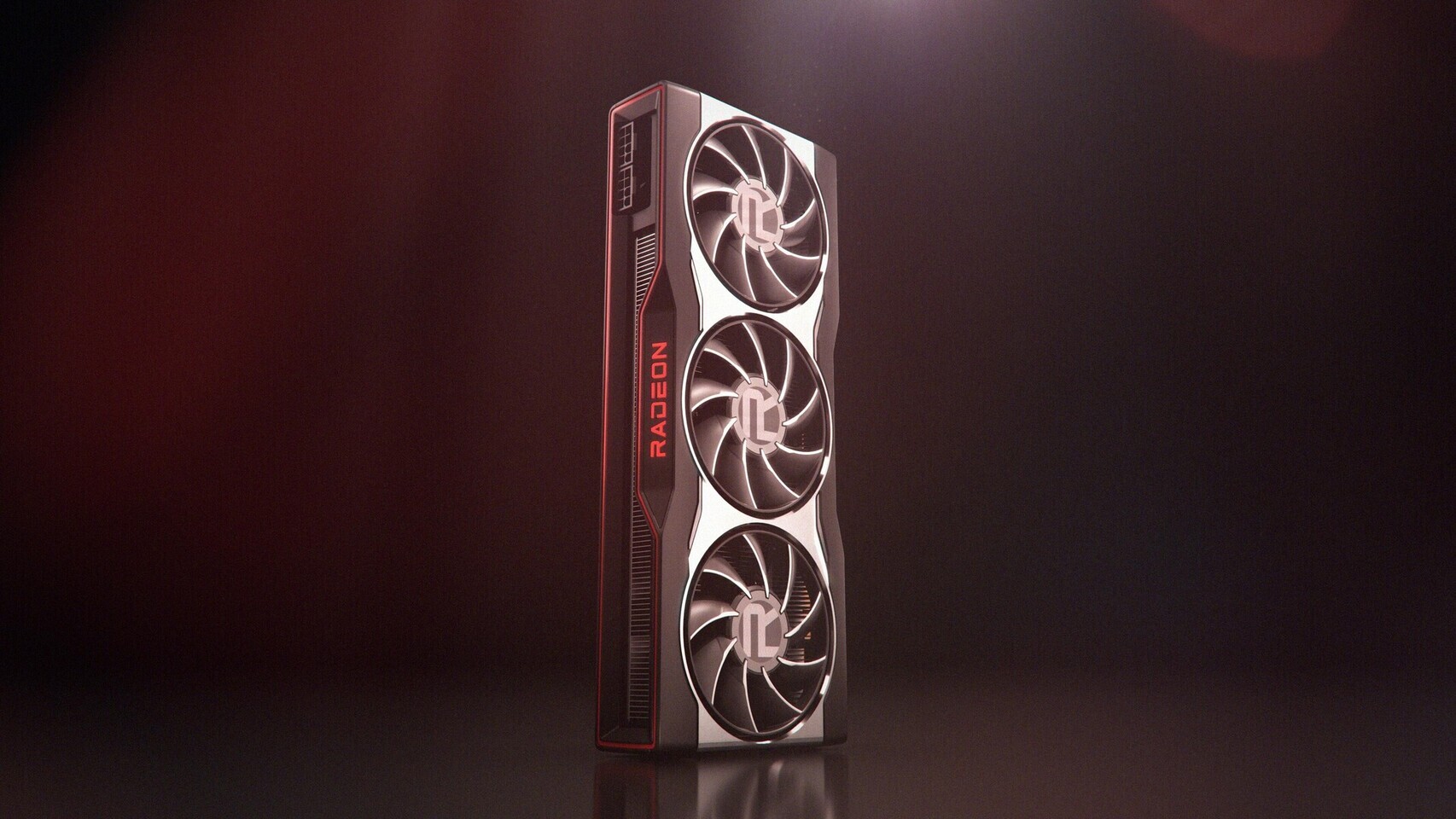
AMD's "Big Navi" GPU is nearing the launch on October 28th, just a few days from now. This means that benchmarks of the card are already appearing across the internet, and we get to see how the card performs. Being divided into two different versions, Big Navi comes in Navi 21 XT and Navi 21 XTX silicon. While the former is available to AMD's AIBs, the latter is rumored to be exclusive to AMD and its reference design, meaning that at least in the beginning, you can only get Navi 21 XTX GPU if you purchase one from AMD directly.

Today, thanks to the Twitter account of CapFrameX, a frame time capturing tool, we have benchmark results of the Big Navi GPU in Firestrike Ultra. According to the people behind this account, the card scores about 11500 points in the benchmark. Compared to NVIDIA's offerings like GeForce RTX 3080, which scores about 10600, the AMD card is 8.5% faster. It is not known whatever this is Navi 21 XT or Navi 21 XTX silicon, however, we can assume that it is the former, and AMD is keeping the XTX revision to themselves for now. This result could be a leak from some of the AIBs, so it could not be the final Big Navi performance. All of this information should be taken with a grain of salt.

Intel Xe-HPG DG2 GPU is in the Labs

In its Q3 earnings, Intel disclosed that it is now shipping Intel's first discrete GPU - DG1. Codenamed Intel Iris Xe MAX, the GPU is set to arrive in ultraportable laptops and designs. It is based on Xe-LP design, which is Intel's GPU configuration for iGPUs and low-power models. However, to satisfy the needs of gamers, Intel will not be good with just this GPU configuration. The company would need something faster and ore power-hungry to power the highest framerates and highest resolutions. Enter the world of Xe-HPG DG2 GPU. Made for gamers, it features all the hardware-enabled features you would expect in such a GPU, like raytracing, etc. This GPU is manufactured outside Intel's fabs, most likely at TSMC's facilities. Right now, this GPU is in the alpha phase and is booting in Intel's labs, meaning that the final silicon is just a few months away.

Intel Confirms Iris Xe MAX Brand for Company's Next-Gen Discrete Graphics

Intel in its Q3-2020 earnings release unveiled the Iris Xe MAX brand under which it will launch its first discrete GPUs in over two decades. The company also disclosed that it has started shipping the product (i.e. commenced mass production and started shipping volumes to its partners). The first Iris Xe MAX discrete GPU is expected to be based on the Xe LP architecture, and we expect it to target the mobile market, as the likes of ASUS has already developed ultraportables featuring the discrete GPU. Intel unveiled a proof-of-concept of an asymmetric explicit multi-GPU technology which could see the Iris Xe iGPU of the 11th Gen Core "Tiger Lake" processor work in tandem with a discrete GPU based on the same architecture, which is now turning out to be the Iris Xe MAX. We expect the Iris Xe MAX to make life miserable to entry-level mobile dGPUs from NVIDIA and AMD.

Intel's First Discrete Graphics Solution, Iris Xe MAX, Debuts in Acer's Swift 3X Featuring Intel 11th Gen Tiger Lake

Acer today announced the Swift 3X, a new laptop which will give consumers the first taste of Intel's discrete graphics solution powered by Xe. Remember that Intel's Xe is Intel's first discrete-class graphics architecture, whose development was helmed by former AMD graphics head Raja Koduri after Intel hired him just a week after he tendered his resignation with AMD. This is the first materialization of an Intel-developed, discrete graphics product for the consumer market, and thus should blow the lid on Intel's Xe performance. Whether or not the blue giant cements itself as a third player in the discrete graphics accelerator space - at first try - depends on the performance of this architecture.

The Swift 3X features the new Intel Iris Xe MAX discrete graphics solution paired with 11th Gen Intel Core processors "in order to offer creative professionals such as photographers and YouTubers unique capabilities and powerful on-the-go performance for work and gaming." The Swift 3X comes in at 1.37 kg (3.02 lbs), and Acer quotes up to 17.5 hours of up time in a single charge; if necessary, the Swift 3X can also be fast-charged to provide four hours of use in just 30 minutes.

EVGA Unleashes XOC BIOS for GeForce RTX 3090 FTW3 Graphics Card

EVGA has today published the "XOC" BIOS version for its GeForce RTX 3090 FTW3 graphics cards. The XOC BIOS version is designed for "extreme overclocking" purposes, as it boosts the power limit of the card by very a few additional Watts. This allows the overclockers to use the card to its full potential so the GPU core is not limited by power. To run XOC BIOS on your GeForce RTX 3090 FTW3 GPU card, you need to have an adequate cooling solution and sufficient power supply. For power, EVGA recommends that you use at least 850w+ Gold PSU, at minimum. This is a sign that shows that XOC bios will boost the system power consumption by quite a bit. The XOC BIOS is enabling the GPU to have a power limit of 500 Watts. It is important to note that EVGA does not guarantee any performance increase or overclock while using this BIOS update.

You can download the EVGA XOC BIOS for GeForce RTX 3090 FTW3 graphics card here. To install it, unzip the file, run Update.exe, and after updating restart your PC. That is the complete update process for the BIOS update. EVGA uploads both the normal BIOS (so you can revert) and XOC BIOS there so be careful when choosing the right files. You can use TechPowerUp GPU-Z tool to verify the BIOS install.

AMD Radeon RX 6000 Series "Big Navi" GPU Features 320 W TGP, 16 Gbps GDDR6 Memory

AMD is preparing to launch its Radeon RX 6000 series of graphics cards codenamed "Big Navi", and it seems like we are getting more and more leaks about the upcoming cards. Set for October 28th launch, the Big Navi GPU is based on Navi 21 revision, which comes in two variants. Thanks to the sources over at Igor's Lab, Igor Wallossek has published a handful of information regarding the upcoming graphics cards release. More specifically, there are more details about the Total Graphics Power (TGP) of the cards and how it is used across the board (pun intended). To clarify, TDP (Thermal Design Power) is a measurement only used to the chip, or die of the GPU and how much thermal headroom it has, it doesn't measure the whole GPU power as there are more heat-producing components.

So the break down of the Navi 21 XT graphics card goes as follows: 235 Watts for the GPU alone, 20 Watts for Samsung's 16 Gbps GDDR6 memory, 35 Watts for voltage regulation (MOSFETs, Inductors, Caps), 15 Watts for Fans and other stuff, and 15 Watts that are used up by PCB and the losses found there. This puts the combined TGP to 320 Watts, showing just how much power is used by the non-GPU element. For custom OC AIB cards, the TGP is boosted to 355 Watts, as the GPU alone is using 270 Watts. When it comes to the Navi 21 XL GPU variant, the cards based on it are using 290 Watts of TGP, as the GPU sees a reduction to 203 Watts, and GDDR6 memory uses 17 Watts. The non-GPU components found on the board use the same amount of power.

ASUS Showcases GeForce RTX 3090 ROG STRIX GUNDAM Edition

ASUS has held its Republic of Gamers (ROG) day, and at the event, there was a special graphics card. Spotted there was a GeForce RTX 3090 GPU in the form of ASUS ROG STRIX GUNDAM edition. With an appeal based on a famous anime series GUNDAM, ASUS has decided to launch a new product line made up of a motherboard and a graphics card. The new ASUS GeForce RTX 3090 ROG STRIX GUNDAM Edition features the same specifications as the regular RTX 3090 edition, just with an increased clock speed of 1890 MHz, three 8-pin power connectors, and a maximum power limit of 480 Watts.

The card features a white triple slot body with three fans cooling the heatsink. When it comes to the availability of this card, it is said to be a limited edition only sold to the Asian market. The price tag will carry a premium over the regular ROG STRIX model, with a cost of 16,999 Yuans (~2530 USD). The standard ROG STRIX model comes at a 1799 USD price tag, meaning that you will pay 730 USD more for this limited edition product. The availability is supposedly going to be even worse than with current cards, meaning that only a few people will get their hands on these if the current situation is any reference.
More pictures follow.

NVIDIA Updates Video Encode and Decode Matrix with Reference to Ampere GPUs

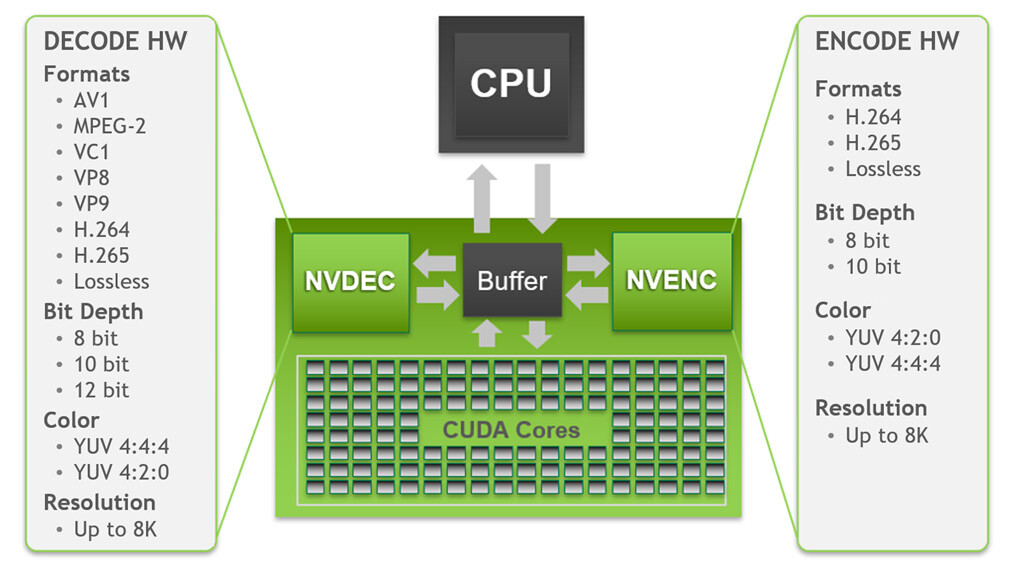
NVIDIA has today updated its video encode and decode matrix with references to the latest Ampere GPU family. The video encode/decode matrix represents a table of supported video encoding and decoding standards on different NVIDIA GPUs. The matrix has a reference dating back to the Maxwell generation of NVIDIA graphics cards, showing what video codecs are supported by each generation. That is a useful tool for reference purposes, as customers can check if their existing or upcoming GPUs support a specific codec standard if they need any for video reproduction purposes. The update to the matrix comes in a form of Ampere GPUs, which are now present there.

For example, the table shows that, while supporting all of the previous generations of encoding standards, the Ampere based GPUs feature support for HEVC B Frame standard. For decoding purposes, the Ampere lineup now includes support for AV1 8-bit and 10-bit formats, while also supporting all of the previous generation formats. For a more detailed look at the table please go toNVIDIA's website here.
NVIDIA Encoding and Decoding Standards

NVIDIA and Atos Team Up to Build World's Fastest AI Supercomputer

NVIDIA today announced that the Italian inter-university consortium CINECA—one of the world's most important supercomputing centers—will use the company's accelerated computing platform to build the world's fastest AI supercomputer.

The new "Leonardo" system, built with Atos, is expected to deliver 10 exaflops of FP16 AI performance to enable advanced AI and HPC converged application use cases. Featuring nearly 14,000 NVIDIA Ampere architecture-based GPUs and NVIDIA Mellanox HDR 200 Gb/s InfiniBand networking, Leonardo will propel Italy as the global leader in AI and high performance computing research and innovation.

Basemark Launches GPUScore Relic of Life RayTracing Benchmark

Basemark is pioneer in GPU benchmarking. Our current product Basemark GPU has been improving the 3D graphics industry since 2016. After releasing GPU 1.2 in March Basemark development team has been really busy developing brand new benchmark - GPUScore. GPUScore benchmark will introduce hyper realistic, true gaming type of content in three different workloads: Relic of Life, Sacret Path and Expedition.

GPUScore Relic of Life is targeted to benchmark high end graphics cards. It is completely new benchmark with many new features. The key new feature is real-time ray traced reflections and reflections of reflections. The benchmark will not only support Windows & DirectX 12, but also Linux & Vulkan raytracing.

Imagination Launches IMG B-Series: Doing More with Multi-Core, up to 6 TeraFLOPs of Compute

Imagination Technologies announces IMG B-Series, a new expanded range of GPU IP. With its advanced multi-core architecture, B-Series enables Imagination customers to reduce power while reaching higher levels of performance than any other GPU IP on the market. It delivers up to 6 TFLOPS of compute, with an up to 30% reduction in power and 25% area reduction over previous generations and up to 2.5x higher fill rate than competing IP cores.

With IMG A-Series Imagination made an exceptional leap over previous generations, resulting in an industry-leading position for performance and power characteristics. B-Series is a further evolution delivering the highest performance per mm² for GPU IP and offering new configurations for lower power and up to 35% lower bandwidth for a given performance target, making it a compelling solution for top-tier designs.

Ubisoft Updates Watch Dogs: Legion PC System Requirements

Ubisoft has today updated the PC system requirements for its Watch Dogs: Legion game. Set to release on October 29th this year, we are just a few weeks away from its release. With the arrival of NVIDIA's GeForce RTX 3000 series Ampere graphics cards, Ubisoft has decided to update the official PC system requirements with RTX-on capabilities. The inclusion of raytracing in the game requires a faster CPU, as well as an RTX-capable GPU. At 1080p resolution, you need at least an RTX 2060 GPU to play with high settings, and raytracing turned to the medium, including DLSS. Going up to 1440p, Ubisoft recommends gamers to use at least an RTX 3070 GPU for very high preset, raytracing on high, and DLSS set to quality. If you want to max everything out and play with the highest settings at 4K resolution, you will need an RTX 3080 GPU.
Watch Dogs: Legion Watch Dogs: Legion PC System Requirements

AMD Project Quantum Resurfaces in the Latest Patent Listing

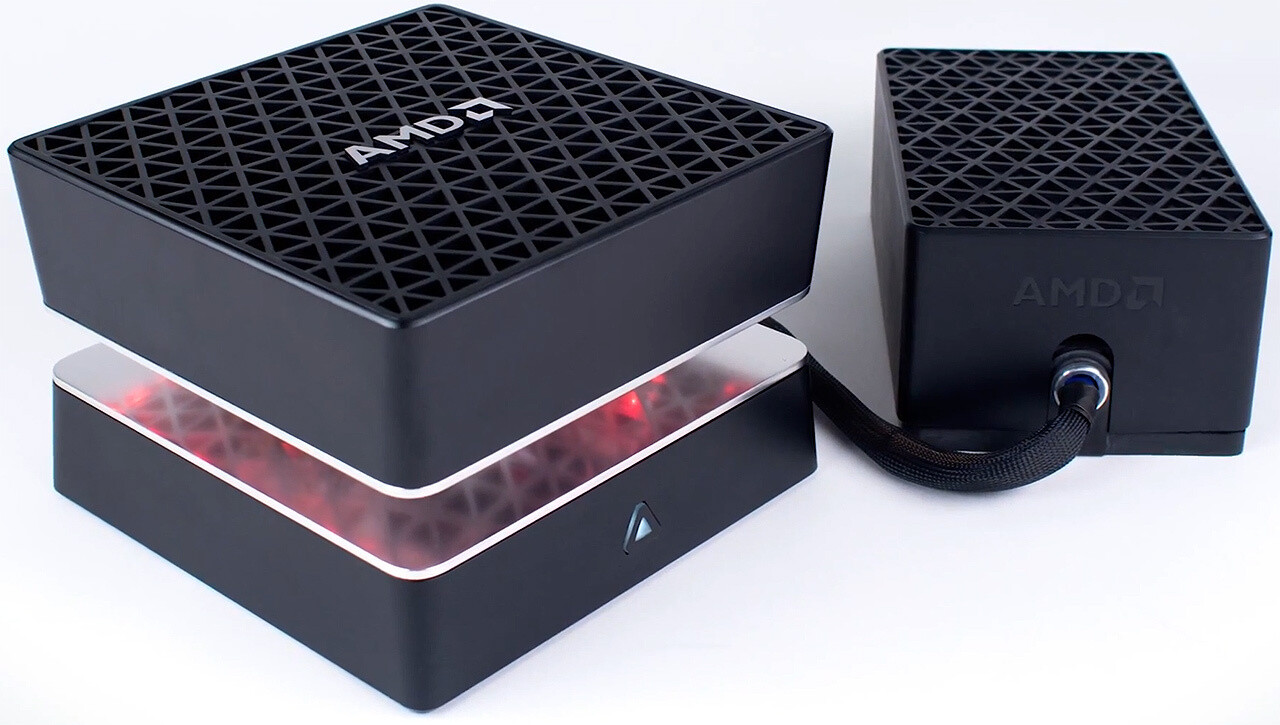
AMD Project Quantum has been quite a mysterious product. While we knew that is was an ITX sized, water-cooled case that would feature an Intel CPU with AMD GPU, we never knew if it was coming or not. Featuring a unique, two-chamber design, AMD managed to develop two sections, where one is used for all the compute components, and the other one contains the radiator and fan for dissipating the heat produced by the compute chamber. Four years ago, we got the news that the project isn't dead and that it will get an update with AMD's upcoming Zen CPU and Vega GPU back then. However, since that announcement, there was no word on it.

Until today. Thanks to a Twitter user PeteB(@Pete_2097) who found a newly listed patent, the hope of Project Quantum is not yet dead it seems. On September 15th, AMD filed a patent for the Project Quantum, now protecting the unique design and possibly saving it for some time in the future. It is almost certain that the company has not abandoned the project, and it could be just waiting for the right time to launch it.
AMD Project Quantum AMD Project Quantum Patent

AMD Graphics Drivers Have a CreateAllocation Security Vulnerability

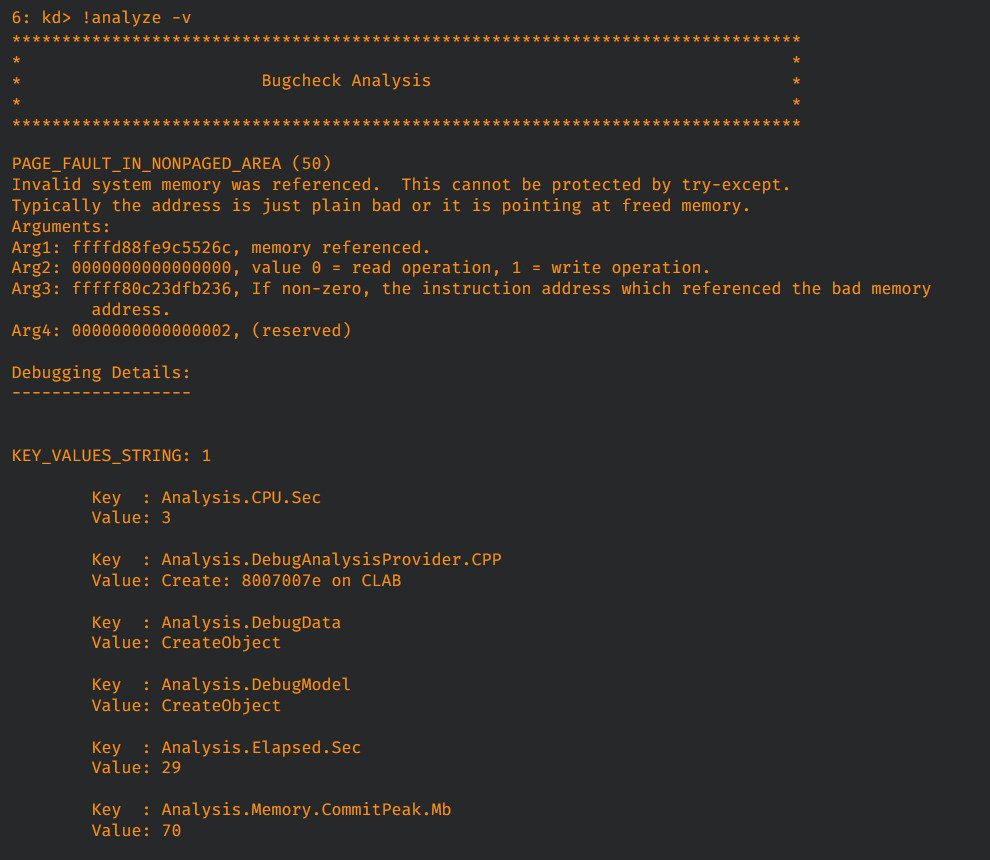
Discovering vulnerabilities in software is not an easy thing to do. There are many use cases and states that need to be tested to see a possible vulnerability. Still, security researchers know how to find those and they usually report it to the company that made the software. Today, AMD has disclosed that there is a vulnerability present in the company graphics driver powering the GPUs and making them work on systems. Called CreateAllocation (CVE-2020-12911), the vulnerability is marked with a score of 7.1 in the CVSSv3 test results, meaning that it is not a top priority, however, it still represents a big problem.

"A denial-of-service vulnerability exists in the D3DKMTCreateAllocation handler functionality of AMD ATIKMDAG.SYS 26.20.15029.27017. A specially crafted D3DKMTCreateAllocation API request can cause an out-of-bounds read and denial of service (BSOD). This vulnerability can be triggered from a guest account, " says the report about the vulnerability. AMD states that a temporary fix is implemented by simply restarting your computer if a BSOD happens. The company also declares that "confidential information and long-term system functionality are not impacted". AMD plans to release a fix for this software problem sometime in 2021 with the new driver release. You can read more about it here.

Fractal Design Releases Flex B-20 GPU Riser Bracket

Fractal Design have recently unveiled their new Flex B-20 GPU riser accessory for vertical GPU mounting. The Fractal Design Flex B-20 was designed specifically for the Define 7 and the Define 7 XL to ensure sufficient clearance between the cooler and side panel. The Flex B-20 bracket is compatible with other ATX cases which feature bridgeless expansion slots and supports full-length GPUs with single or dual-slot brackets and coolers of any size. The cable used supports PCIe 3.0 x16 and features a heavy-duty double sided wiring design to allow for maximum power draw.

AMD Big Navi GPU Features Infinity Cache?

As we are nearing the launch of AMD's highly hyped, next-generation RDNA 2 GPU codenamed "Big Navi", we are seeing more details emerge and crawl their way to us. We already got some rumors suggesting that this card is supposedly going to be called AMD Radeon RX 6900 and it is going to be AMD's top offering. Using a 256-bit bus with 16 GB of GDDR6 memory, the GPU will not use any type of HBM memory, which has historically been rather pricey. Instead, it looks like AMD will compensate for a smaller bus with a new technology it has developed. Thanks to the new findings on Justia Trademarks website by @momomo_us, we have information about the alleged "infinity cache" technology the new GPU uses.

It is reported by VideoCardz that the internal name for this technology is not Infinity Cache, however, it seems that AMD could have changed it recently. What does exactly you might wonder? Well, it is a bit of a mystery for now. What it could be, is a new cache technology which would allow for L1 GPU cache sharing across the cores, or some connection between the caches found across the whole GPU unit. This information should be taken with a grain of salt, as we are yet to see what this technology does and how it works, when AMD announces their new GPU on October 28th.

NVIDIA Building UK's Most Powerful Supercomputer, Dedicated to AI Research in Healthcare

NVIDIA today announced that it is building the United Kingdom's most powerful supercomputer, which it will make available to U.K. healthcare researchers using AI to solve pressing medical challenges, including those presented by COVID-19.

Expected to come online by year end, the "Cambridge-1" supercomputer will be an NVIDIA DGX SuperPOD system capable of delivering more than 400 petaflops of AI performance and 8 petaflops of Linpack performance, which would rank it No. 29 on the latest TOP500 list of the world's most powerful supercomputers. It will also rank among the world's top 3 most energy-efficient supercomputers on the current Green500 list.

NVIDIA GeForce RTX 3070 Launch Postponed to October 29th

When NVIDIA introduced its Ampere consumer graphics cards, they launched three models - the GeForce RTX 3070, RTX 3080, and RTX 3090 GPUs. Both the RTX 3080 and RTX 3090 have seen the light of the day as they are now available for purchase, however, one card has remained. The GeForce RTX 3070 launch was originally planned for October 15th launch, but it has officially been postponed by NVIDIA. According to the company, the reason behind this sort of delay in the launch is the high demand expected. Production of the cards is ramping up quickly and the company is quickly stocking up the cards. Likely, NVIDIA AIBs are taking their time to stock up on cards, as the mid-range is usually in very high demand.

As a reminder, the GeForce RTX 3070 graphics card features 5888 CUDA cores running at a base frequency of 1.5 GHz and boost frequency of 1.73 GHz. Unlike the higher-end Ampere cards, the RTX 3070 uses older GDDR6 memory on a 256-bit bus with a bandwidth of 448 GB/s. The GPU features a TDP of 220 W and will be offered in a range of variants by AIBs. You will be able to purchase the GPU on October 29th for the price of $499.

EK Releases Vertical GPU Mounting Bracket

EK, the leading computer cooling solutions provider, is introducing a very special vertical GPU mounting bracket. The EK-Loop Vertical GPU Holder stands out for the way it uses two ATX motherboard mounting points to additionally secure the graphics card. This unique holder is not just implementing patent-pending technologies, but also thicker materials than other similar solutions available on the market.

Displaying your liquid-cooled graphics card or even the standard massive air cooler is something that has become more and more popular over the years. One way to do this is to use the special aftermarket brackets that allow mounting the GPU vertically if the case is not already equipped with vertical PCIe slots. However, the user is often facing issues with how these solutions work since they don't offer enough support, allowing the GPU to move around. Things can be even more challenging when dealing with liquid cooling and installing fittings and tubing to a vertically placed GPU, not to mention trying to ship a PC with a vertically mounted GPU.

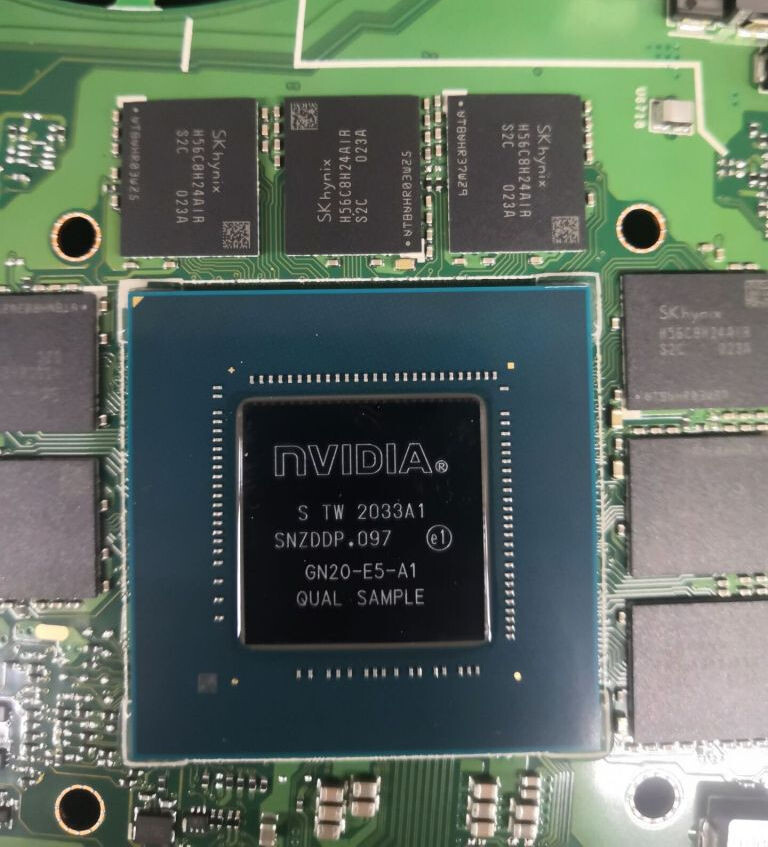
NVIDIA RTX 3070 Mobile Qualification Sample Pictured

NVIDIA still hasn't released their desktop RTX 3070 graphics cards (those are set for October 15th), and availability for the already-launched RTX 3080 and RTX 3090 is spotty at best. However, the company is obviously gearing up for release of mobile versions of their RTX 30-series; NVIDIA's graphics solutions are manufacturers' usual top picks, after all. The RTX 3070 Mobile (Max Q) has thus been pictured already in its Qualification Sample state, and there are some details that can be gleaned already.

Markings on the chip place this as GN20-E5-A1, which allegedly refers to the GA104 GPU which is expected to power the RTX 3070 and RTX 3060 Ti graphics cards. GDDR6 memory is confirmed (naturally), since markings on the memory chips, which are placed quite close towards the actual NVIDIA silicon, are Sk Hynix identified as H56C8H24AIR - the same employed on AMD's Radeon Pro 550M. The full GA104 GPU features 6,144 CUDA cores however, the desktop version has been confirmed as being shipped with 5,888 cores enabled out of those. It could be that NVIDIA plans to release the mobile version with the same cores (and likely at a reduced frequency for improved power efficiency), which would obviously equate to lower performance; or maybe NVIDIA will employ the full GA104 silicon with even more reduced frequencies for the same performance - with substantial power savings as the proverbial cherry on top. These last ideas are pure speculation, though; we'll have to wait a little while to confirm specs.

New Arm Technologies Enable Safety-capable Computing Solutions for an Autonomous Future

Today, Arm unveiled new computing solutions to accelerate autonomous decision-making with safety capability across automotive and industrial applications. The new suite of IP includes the Arm Cortex -A78AE CPU, Arm Mali -G78AE GPU, and Arm Mali-C71AE ISP, engineered to work together in combination with supporting software, tools and system IP to enable silicon providers and OEMs to design for autonomous workloads. These products will be deployed in a range of applications, from enabling more intelligence and configurability in smart manufacturing to enhancing ADAS and digital cockpit applications in automotive.

"Autonomy has the potential to improve every aspect of our lives, but only if built on a safe and secure computing foundation," said Chet Babla, vice president, Automotive and IoT Line of Business at Arm. "As autonomous decision-making becomes more pervasive, Arm has designed a unique suite of technology that prioritizes safety while delivering highly scalable, power efficient compute to enable autonomous decision-making across new automotive and industrial opportunities."

Folding @ Home Bakes in NVIDIA CUDA Support for Increased Performance

GPU Folders make up a huge fraction of the number-crunching power of Folding@home, enabling us to help projects like the COVID Moonshot open science drug discovery project evaluate thousands of molecules per week in their quest to produce a new low-cost patent-free therapy for COVID-19. The COVID Moonshot (@covid_moonshot) is using the number-crunching power of Folding@home to evaluate thousands of molecules per week, synthesizing hundreds of these molecules in their quest to develop a patent-free drug for COVID-19 that could be taken as a simple 2x/day pill.

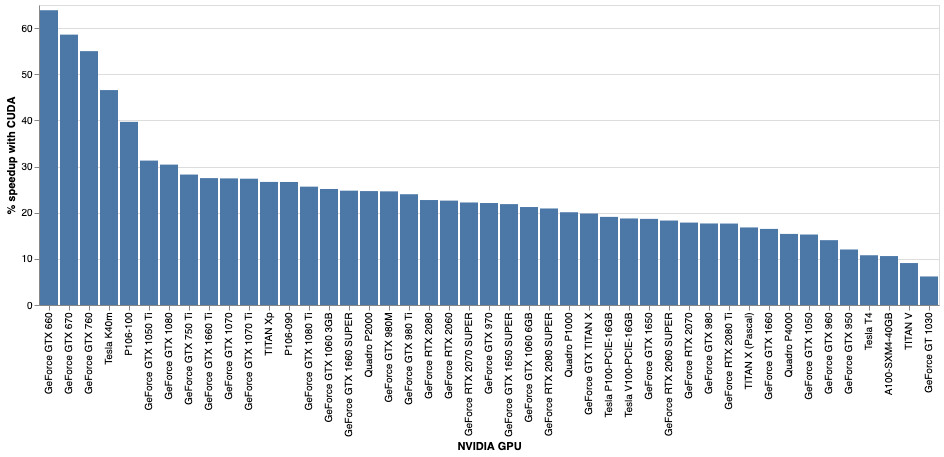
As of today, your folding GPUs just got a big powerup! Thanks to NVIDIA engineers, our Folding@home GPU cores—based on the open source OpenMM toolkit—are now CUDA-enabled, allowing you to run GPU projects significantly faster. Typical GPUs will see 15-30% speedups on most Folding@home projects, drastically increasing both science throughput and points per day (PPD) these GPUs will generate.

Editor's Note:TechPowerUp features a strong community surrounding the Folding @ Home project. Remember to fold aggregated to the TPU team, if you so wish: we're currently 44# in the world, but have plans for complete world domination. You just have to input 50711 as your team ID. This is a way to donate efforts to cure various diseases affecting humanity that's at the reach of a few computer clicks - and the associated power cost with these computations.

NVIDIA AIC Partners Clarify RTX 3080/3090 Crash to Desktop Issues, Capacitor Choices

(UPDATE 28SEPT 16H31 GMT: Updated the MSI section with changes in the RTX 3080 Gaming X Trio store page).

Compounding the limited availability with the crash to desktop issues users have been experiencing with NVIDIA's recent RTX 3080/3090 graphics cards have led to rivers of digital ink being run on NVIDIA's latest RTX-30 series. After we've reported on NVIDIA's PG132 "Base Design" and manufacturer-specific capacitor choices and circuitry, we've now seen many of NVIDIA's AIC partners actually respond to this issue, clarifying their choices in this specific part of RTX 30-series board design, as well as the steps they've taken (if any) so as to help solve the issues (which are thus confirmed as being somewhat related to these capacitor choices, even if they are not the root cause.)
Return to Keyword Browsing
Nov 22nd, 2026 17:16 CST change timezone

New Forum Posts

Popular Reviews

TPU on YouTube

Controversial News Posts