News Posts matching #GPU

Return to Keyword Browsing

AMD Reportedly Rebranding RX 460 to RX 560D

In a bid to better make use of what could be a respectable stock of RX 460 graphics cards, AMD is reportedly rebranding these to the RX 500 series under the RX 560D name. Apparently, this is a straight rebrand, with no increased clocks or other revisions to the GPU die whatsoever. As such, this RX 560D would bring a lesser performance level than the current RX 560 already offers. Remember that the RX 560 is currently a rebrand of the RX 460 already, only with that card's full stream processor count (1,024) unlocked, whereas the original RX 460 only enabled 896 of the total 1,024 stream processors available on-die.

AMD already toyed with this additional "D" in the nomenclature in the past, with its RX 470 / RX 470D graphics cards, of which we've heard some rumblings lately. Considering that the RX 470D was a relatively limited release, only really being seen in the wild towards the Asian market, it is likely a safe bet that this RX 560D will follow the same path. Another option for the unwary miners to pick up?


AMD Readies Radeon Pro WX 9100: Vega for Professionals

After releasing the Vega Frontier Edition, AMD's take on a "prosumer" GPU which straddles the line between a professional and gaming graphics card, with somewhat mixed results, AMD is apparently now working on the fully professional version of the Vega silicon. Identified as the Radeon Pro WX 9100 (which is in line with AMD's current professional nomenclature), this professional graphics card will look to fully accelerate professional workloads, with a driver specifically crafted for such.

Recently rearing its head on CompuBench, the GPU features a low 1200 MHz clock speed, which is around 402 MHz lower than the Frontier Edition, and supposedly lower still than the Gaming RX Vega variant of the GPU. The Vega-based WX 9100 joins the Polaris-based WX 7100, WX 5100 and WX 4100 professional graphics cards, thus apparently topping out AMD's professional line-up for the year.

EVGA Confirms Release Date for GTX 1080 Ti Hybrid FTW3: July 10th

EVGA's product manager Jacob Freeman has just confirmed the launch day of EVGA's upcoming end-all-be-all GTX 1080 Ti Hybrid FTW3 video card: it's now a relatively set in stone July 10th. Expect immediate availability for the video card on that day, though for now, not even Freeman has an idea if it will be available for ordering outside of EVGA's own online website.

The GTX 1080 Ti Hybrid FTW3 makes use of a hybrid, air and water-cooling solution. The GPU die itself is cooled by an Asetek all-in-one closed-loop liquid cooler, while memory and VRM make do with a traditional heatsink and fan combination. This provides the benefit of liquid cooling on the GPU core without the added expense of a full-cover waterblock, thus bringing the pricing a little lower than full-coverage waterblocks, but with increased performance over a purely air-cooled part. The GTX 1080 Ti HYBRID FTW3 shares the same specs as the 1080 Ti SC2 HYBRID, Hydro Copper, and Hydro Copper SC2 graphics cards, with a 1,556 MHz base and 1,670 MHz boost clock, 11 Gbps GDDR5X memory and 2x 8-pin power connectors. Pricing or overclocking headroom weren't detailed at all.

AMD Radeon Vega Frontier Edition Launched: Starting at $999

It's here. The Radeon Vega that's not for gamers, that is. After what seems like a year of waiting forward to AMD's next generation GPU architecture, so it has finally appeared. As we all knew was going to be the case, Vega's first foray in the market is geared at the more profitable professional sector of the market. The good news for professionals: the pricing is lower than previously reported. Instead of the expected $1,199 and $1,799 for an air cooled or water-cooled version of the card respectively, AMD is commanding a much less demanding price tag of $999 for the air cooled version (available now) and $1,499 for the water-cooled one (to be available in Q3.)

One thing that deserves to be placed before the break is a software feature of the new Vega Frontier Edition graphics cards: AMD has changed their driver scheme into a single-package installer (available in the source), with both the professional-geared drivers, and the gaming ones as well. This means that after all that Raja Koduri told us to wait for AMD's consumer, gaming-oriented RX Vega graphics cards, these will probably work just as well for gaming as for professional workloads.

AMD RX Vega AIB Cards to Ship in Late July / Early August

A report from HWBattle is making the rounds claiming that new information has surfaced on AMD's upcoming high-performance, consumer versions of the Vega architecture. According to these reports, Vega graphics cards will (at least initially) come in two different performance tiers. A top of the line GPU, Vega 10 (being identified as Vega XT), and a cut-down version of it, based on Vega 11 (which is being called Vega Pro). Graphics chips for graphics card integration are supposedly being shipped to partners as of this week.

HWBattle goes on to say that there will be a myriad of approaches to AMD's AIB partner designs around the Vega graphics chips, with multiple cooling solutions being worked on (which isn't surprising, really; graphics cards nowadays can see upwards of 4 different cooling designs for the same GPU, according to the use case the company is designing it for. HWBattle is also saying that Vega will be faster than the GTX 1080, though there's no information on whether this only applies to the top-tier GPU or no. Other details are scant, scarce, or nonexistent; it would seem that the launch delay from AMD has sapped some of the interest surrounding Vega.

ETH Mining: Lower VRAM GPUs to be Rendered Unprofitable in Time

Hold on to your ETH hats: you will still be able to cash in on the ETH mining craze for a while. However, you should look towards your 3 GB and 4 GB graphics cards with a slight distrust, for reasons that you should know, anyway, since you have surely studied your mining cryptocurrency of choice. Examples are the GTX 1060 3 GB, or one of those shiny new 4 GB RX 480 / RX 580 which are going at ridiculously premium prices right now. And as a side note, don't you love the mechanisms of pricing and demand?

The problem here stems from ETH's own design for its current PoW (Proof of Work) implementation (which is what allows you to mine the currency at all.) In a bid to make ETH mining unwieldy for the specialized silicon that brought Bitcoin difficulty through the roof, ETH implements a large size data set for your GPU to work with as you mine, which is stored in your GPU's memory (through the DAG, which stands for Directed Acyclic Graph). This is one of the essential differences between Bitcoin mining and Ethereum mining, in that Ethereum mining was designed to be memory-intensive, so as to prevent usage of ASICs and other specialized hardware. As a side-note, this also helps (at least theoretically) in ETH's decentralization, which Bitcoin sees more at risk because of the inherent centralization that results from the higher hardware costs associated with its mining.

New NVIDIA Specialized Pascal 1060-based Cryptocoin Mining GPUs Photographed

Pictures of the new Pascal 1060-based Cryptocoin-specific mining GPUs have surfaced on the Chinese tech site expreview.com. They look markedly different than their gaming variety, not only lacking any display outputs (as expected), but also lacking any fan or active cooling at all and merely having a passive aluminum heatsink to cool it. It is likely that it could expect external active cooling or high airflow cases to function properly.
The design also seems to sport a custom PCB, and a single PCI-e power connector, suggesting a reasonably low power draw. The site also hints at a 1080 "mining edition" GPU being in the works, but has no photographic evidence on that front.

Expreview appears to have a lot of them already set up in a good quality rack-miner style setup, so feel free to oogle over this article's photographs if you happen to be interested in the Cryptocoin "wave" as of late.

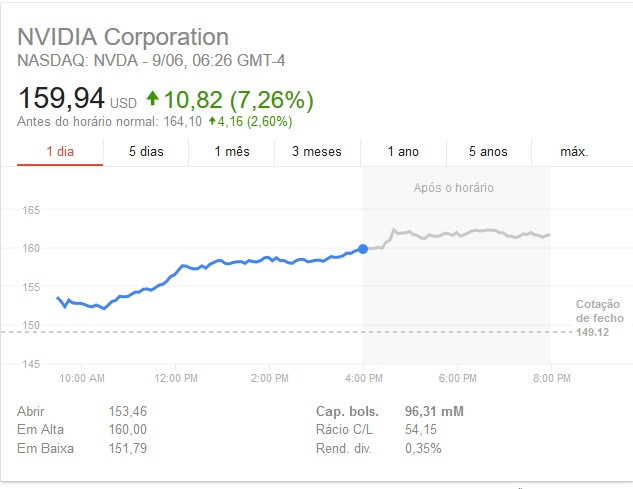
NVIDIA's Market Cap to Reach $100 billion Soon; Grew ~$25 billion Since May 2017

NVIDIA has been on a roll lately with their market capitalization and share valuation, which could very well send the company soaring past the $100 billion dollar mark today. Whether or not that happens (and if it does, it will be a historical milestone for the company), NVIDIA's growth of almost $25 billion dollars since May 13th is nothing short of jaw-dropping.

The "sudden" market valuation on NVIDIA comes on the heels of the company's strong graphics execution and increasingly entrenched position in the high performance GPU computing market for machine learning. The company's Volta architecture, which was showcased by Jensen Huang at their GTC keynote on May 10th, boosted confidence in the company significantly. Since then, the company's market cap has increased from the $75 billion dollar it was at shortly after GTC, towards its $96.31 billion rated market cap today. More recently, with the recent rise of the crypto wave craze, NVIDIA's GPUs have been talked about as real alternatives to AMD's previously (and perhaps hurtful for the company) grasp on this kind of workloads.

NVIDIA, AMD to Launch Mining-Oriented Versions of Their GPUs

You must've heard the news of increasingly tighter supply on AMD's video cards. This is kind of a "hello darkness my old friend" kind of moment, since we've seen this happening before. However, these days, the problem looks to be exacerbated with the increase in digital currencies - it's not just Bitcoin now. Ethereum and Zcash have come in to fill customer's desire for a lower entry, ASIC-resistant mineable cryptocurrency. And with the currencies' exploding pricing, people are once again looking to enter the mining craze - to ride the crypto wave, so to speak. All higher-performance graphics cards since the R200 series are flying off the shelves and second hand markets, and as we speak, virtually all RX 580 models are out of stock on Newegg. And while AMD graphics cards have historically been leagues better than their NVIDIA counterparts in mining environments, recently some specialized miners have surfaced, tailored for the Pascal architecture (more oriented to Zcash, though.)

COLORFUL Reveals the GT1030 2G Graphics Card

Colorful Technology Company Limited, professional manufacturer of graphics cards and motherboards, announces its latest addition to the Colorful family of graphics cards with the COLORFUL GT1030 2G graphics card suited for office/home use.

The Colorful GT1030 2G ships with 384 Streaming Multiprocessors (SMs), and runs at a base clock frequency of 1227 MHz while the GPU Boost clock speed is rated for 1468 MHz and is based on the Pascal GP108 silicone. This card has been outfitted with GDDR5 memory at 2GB capacity and is wired to a 64-bit bus. The GPU has 24 TMUs, 8 ROPs and has a rated draw of 30 watts power consumption making the card a highly efficient choice. With an all-solid-state capacitor power delivery design, COLORFUL provides customers better and more stability while maintaining excellent performance. It has a 90mm fan and a solid cooler featuring compact thermal fins keeping the card cool even under extreme loads. No pricing information was disclosed at the time.

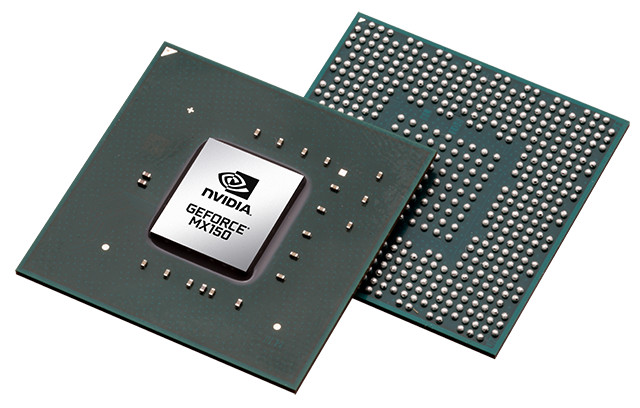
NVIDIA Announces GeForce MX150 Laptops: Supercharged For Work and Play

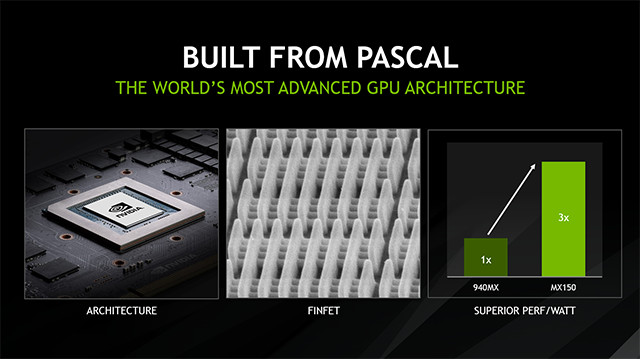
Remember that MX150 mobile graphics card we covered recently? NVIDIA has just let the cat out of the bag, with an announcement that seemingly confirms the specs we were expecting. NVIDIA is selling this mobile GPU's space as the expected IGP-upgrade, citing up to 3x superior performance-per-Watt compared to previous-generation Maxwell-based GeForce 940MX laptops. In other words, GeForce MX150 enables thinner laptops that run applications faster while sipping less power.

JPR: GPU Shipments Decrease -4.5% YoY; Desktop Decreases -13.5%, Mobile Rises 2%

Jon Peddie Research has released another of their interesting GPU market analysis, which the analyst firm pegs as currently gearing up to a strong Q3. However, this gearing-up comes on the back of a "moderate" quarter, which in reality means there was a seasonal decrease of -17.5% in overall GPU shipments compared to last quarter. This -17.5% decrease takes from a -25% decrease in AMD products, Nvidia decreased -26%, and -14% in Intel's products. This translates into a YoY decrease of -4.5% in overall GPU shipments, with a whole -13.5% in desktop platforms and the saving grace in the 2% rise in mobile GPU shipments. Overall discrete GPU market share is increasing compared to their iGPU counterparts, for the third consecutive quarter.

Intel showed the highest gain in the quarter, in a market that seems to have to have returned to normal seasonal cycles. This quarter was appropriately down (normally it is flat to down), and the Gaming PC segment, where higher-end GPUs are used, was once again the bright spot in the overall PC market for the quarter. JPR sets the tablet craze as ending, bringing much needed stability to the PC market, as users realize a tablet is useful for a lot of things, but can never replace a PC for performance, screen size, or upgradability.

Raja Koduri: You Can Use Vega Frontier Edition for Gaming; But You Should Wait

In a blog post detailing AMD's Vega Frontier Edition graphics card, which we covered in-depth at the time of its announcement in AMD's Financial Analyst Day 2017, AMD's Radeon Technologies Group head Raja Koduri clarified that current machine learning poster child, the Vega Frontier Edition GPU, can also be used for gaming (who's to say some researchers, or pioneers, as AMD is so fond of calling them, won't be visiting Talos 1 themselves between coffee breaks?)

However, it is Raja Koduri's opinion that you should wait for Vega's gaming GPUs, since the Frontier Edition is "optimized for professional use cases (and priced accordingly)", and that if you want to game on AMD hardware, you should wait "just a little while longer for the lower-priced, gaming-optimized Radeon RX Vega graphics card." He then threw in a free "You'll be glad you did," as if Vega hasn't been a long, long time coming already.

Entire AMD Vega Lineup Reportedly Leaked - Available on June 5th?

Reports are doing the rounds regarding alleged AMD insiders having "blown the whistle", so to speak, on the company's upcoming Vega graphics cards. This leak also points towards retail availability of Vega cards on the 5th of June, which lines up nicely with AMD's May 31st Computex press conference. An announcement there, followed by market availability on the beginning of next week does sound like something that would happen in a new product launch.

On to the meat and bones of this story, three different SKUs have been leaked, of which no details are currently known, apart from their naming and pricing. AMD's Vega line-up starts off with the RX Vega Core graphics card, which is reportedly going to retail for $399. This graphics card is going to sell at a higher price than NVIDIA's GTX 1070, which should mean higher performance. Higher pricing with competitive performance really wouldn't stir any pot of excitement, so, higher performance is the most logical guess. The $399 pricing sits nicely in regards to AMD's RX 580, though it does mean there is space for another SKU to be thrown into the mix at a later date, perhaps at $329, though I'm just speculating on AMD's apparent pricing gap at this point.

Gigabyte Announces Its RX 550 Line of Graphics Cards

Gigabyte has thrown its hat on the RX 550 line of graphics cards, offering two 2 GB versions of the cards. These sport slight overclocks on their core clock speed, at 1,219MHz (for the OC 2G version) and 1,195MHz (for the D5 2G version.) Like all other RX 550, these carry a 128-bit bus and lack any auxiliary power connectors.

Being entry-level, IGP-substitute cards does not mean AIBs can skimp on cooling - especially not considering these graphics cards now carry more performance (and higher TDP) than some aeons-old enthusiast-level GPUs. As such, these include Gigabyte's Windforce cooler with a patented Blade Fan design and 3D active fan functionality. The company claims an air flow improvement of 23% over traditional fans due to the 3D stripe curve on the fan surface. The semi-passive feature, which is something most AIBs now include in their designs (even if these do somewhat impact the longevity of the fans, due to higher pressure on their mechanisms whenever they start spinning again) allows the fans to remain off at lower temperatures and spin when the GPU is under heavy load. Both cards feature Gigabyte's Ultra Durable construction, which includes solid capacitors and metals chokes. As for software and user control, Gigabyte is bundling the Aorus Graphics Engine software utility with both cards, allowing for one-click overclocking as well as the ability to control clock speeds, voltage, power target, and fan profiles. The Radeon RX 550 D5 2G and the Radeon RX 550 Gaming OC 2G are available now for $80 and $90, respectively.

AMD Says Vega is "On Track" for Q2 2017 Release

During its Q1 reports for fiscal year 2017 (which saw AMD's stock tumbling about, even if this Q1 only considers a single Ryzen sales-month on its accounts), AMD CEO Lisa Su referred that AMD's high-performance Vega architecture is still on track for a Q2 2017 release. The words, specifically, are these: "AMD's "Vega" GPU architecture is on track to launch in Q2, and has been designed from scratch to address the most data- and visually-intensive next-generation workloads with key architecture advancements including: a differentiated memory subsystem, next-generation geometry pipeline, new compute engine, and a new pixel engine."

So yes, AMD confirms what we suspected. This leaves a launch time-frame for Vega products until, at most, the end of June. Confirmation after confirmation, it's still a long time to wait, if you'll ask me, with little to no information in the last few months. But it's better than nothing, and I'd much prefer a real launch with retail availability than a glorified paper launch. Here's hoping Vega answers our questions and our needs. It's been a long time coming already.

ASUS Announces Its Take on the RX 550 Graphics Cards

ASUS has announced its take on the RX 550, the graphics card that is meant to bridge the gap between IGPs and the power reserved to discrete GPUs. Not much differs from other AIB offerings, since this is the same GPU paired with either 2 or 4 GB of GDDR5 memory ticking at 7,000 MHz over a 128-bit memory bus, but ASUS dis manage to add an IP5X-certified dust-proof fan. According to ASUS, this fan design extends the lifespan of the graphics card by 25% through increased dust and particle resistance, as well as efficient heat dissipation. The cards will come clocked at 1,100 MHz stock, and 1,183MHz boost clocks, with no auxiliary power connectors.

The ASUS Radeon RX 550 is a dual-slot design measuring 182 (length) x 112 (height) x 43mm (width), which delivers 1x Dual-Link DVI-D, 1x HDMI, and 1x DisplayPort connectors. These cards are produced using ASUS' Auto-Extreme manufacturing technology, which fully automates every step of PCB manufacturing and dispenses with human intervention. ASUS also bundles its GPU Tweak II and Xsplit Gamecaster software suites with the Radeon RX 550. These include the new "Gaming Booster"for automated overclocking, while XSplit Gamecaster lets gamers stream or record gameplay right from the in-game overlay. The ASUS Radeon RX 550 2GB / 4GB are available now from a variety of retailers for $90 / $100, respectively.

NVIDIA to Support 4K Netflix on GTX 10 Series Cards

Up to now, only users with Intel's latest Kaby Lake architecture processors could enjoy 4K Netflix due to some strict DRM requirements. Now, NVIDIA is taking it upon itself to allow users with one of its GTX 10 series graphics cards (absent the 1050, at least for now) to enjoy some 4K Netflix and chillin'. Though you really do seem to have to go through some hoops to get there, none of these should pose a problem.

The requirements to enable Netflix UHD playback, as per NVIDIA, are so:
  • NVIDIA Driver version exclusively provided via Microsoft Windows Insider Program (currently 381.74).
  • No other GeForce driver will support this functionality at this time
  • If you are not currently registered for WIP, follow this link for instructions to join: insider.windows.com/
  • NVIDIA Pascal based GPU, GeForce GTX 1050 or greater with minimum 3GB memory
  • HDCP 2.2 capable monitor(s). Please see the additional section below if you are using multiple monitors and/or multiple GPUs.
  • Microsoft Edge browser or Netflix app from the Windows Store
  • Approximately 25Mbps (or faster) internet connection.

KFA2 Announces the Fastest GTX 1080 Ti - The HOF "8 Pack" Edition

Premium graphics cards these days are a dime a dozen, and KFA2 seems to be a well-regarded AIB for some more exquisite designs based on NVIDIA graphics chips. Together with OverclockersUK, KFA2 is announcing the most premium of premium GTX 1080 Ti, the Hall of Fame "8 Pack Edition", which features a full custom design with KFA2's trademark aesthetics, triple 8-pin power connectors, triple-fan and triple-slot cooler an LCD display, and the highest stock clocks from any GTX 1080 Ti model so far - a base 1645 MHz with 1759 MHz boost and 1425 MHz memory clocks.

According to OverclockersUK, due to low yields of the cherry-picked GPUs that power these graphics cards, only 5 to 10 units are expected to be sold each month. The cards are currently available for pre-order with expected shipping date of May 26th... For the clean sum of £950. A premium pricing for a premium solution, indeed. If that pricing is a little to bold for you, you can opt for an "8 Pack Approved" graphics card, which is essentially the same package on a GPU with a lower 1607 MHz base, 1721 MHz boost, and 1376 MHz memory clocks. This one should retail for a more respectful £859.99.

AMD Confirms Vega is Launching this Quarter

Via Facebook, AMD has confirmed that Vega is nearly here - at least, as nearly here as a "this quarter" can be. This means Vega will launch in two-months time (Q2 extends through the months of April, May and June, after all.) Through a post on its Facebook page, AMD replied that Vega will be coming "when it's ready... And it will be this quarter."

According to previous leaks (and our own deep dive on Vega's architecture), Vega should go a long way towards bridging the power/performance gap between AMD and NVIDIA's GeForce series. It will be the first time since Fury that AMD will have a competitive, high-performance graphics design (expectedly, and hopefully, since no-one likes to buy over-priced graphics cards.) The fact that AMD has teased Vega in two different pieces of media that come out in May (Arkane Studios' Prey, which comes out on May 5th, and Alien: Covenant, which also comes out during the month of May.) I've previously posited that AMD wouldn't tease Vega's launch alongside one of the most promising games of the year without giving us the chance to power it through Vega come launch day, but as Prey's release date approaches and there is no more information on Vega (much less an announcement), it's looking increasingly likely that we'll have to wait until we can see that universe in all of its Vega-rendered glory.

VisionTek Announces Its RX 500 Series Graphics Cards

VisionTek, a company whose last graphics card announcement we've posted here was on June 2015 with its Fury X and R9 300 line of graphics cards, has announced its vision for the RX 500 series graphics cards. This one seems a throwback to the RX 400 series, though, with Visiontek's "Overclocked Edition" GPUs carrying clockspeeds more in line with the prevous AMD series: 1,366 MHz for the RX 580, and 1264 MHz for the RX 570, respectively.

The VisionTek Radeon RX 580 8 GB comes with a slightly unoriginal take on the AIB partner design, sporting custom dual-fan cooler with a black-nickel aluminum shroud with 2x 8 mm and 2x 6 mm heatpipes for increased cooling capacity. The Radeon 570 4GB makes use of what is basically AMD's RX 480 reference design cooler, with a blower-style fan that ensures the GPU's heated air output exits the back of your case instead of lingering inside your system. VisionTek's Radeon RX 500 Series cards are now available through the company's website, with retailer availability to follow.

Radeon RX 540 Surfaces on AMD Website

It isn't unusual for AMD or NVIDIA to launch OEM-specific graphics chips, and it would seem that AMD is doing just so with its rebranded yet improved RX 500 series. Now, it's time for the RX 540 to surface, which, like the name implies, flies right below the RX 550 in terms of specs, though you wouldn't know it without a closer look.

The chip packs the same 8 CUs as the RX 550 (512 stream processors), but its memory bandwidth (in 2 GB or 4 GB flavors) peaks at 96 GB/s (lower than the RX 550's 112 GB/s.) However, its core clocks see an interesting boost from the RX 550's 1183 MHz boost clocks to a "up to 1219 MHz" value, which should alleviate the performance impact from the stunted memory bandwidth. This is a GPU that's likely to be used by OEMs and system integrators, whether on desktop computers or in laptops, though I do have to wonder regarding this configuration. I'd expect higher clocks on the core to increase power consumption more than the offset allowed by the reduced memory clocks, but then again, I'm not an AMD engineer.

AMD's RX 500 Series Launch Confirmed on April 18th

AMD is on a roll with product launches lately, having just pushed out what is probably the most significant update in mainstream CPUs in years: the Ryzen 5 line of desktop processors. You can look over TPU's review of the 1500X and 1600X here and here. AMD is looking towards powering another central part of your desktop processor, though, with the impending launch of the RX 500 line of GPUs.

Confirmed as rebrands of previous-generation Polaris 10, the new RX 500 series will carry the new Polaris 20 XTX and Polaris 20 XL chips, which are expected to feature higher clocks (in the range of 1300-1400 MHz) from AIBs, before your own overclocking. PowerColor has officially confirmed the launch date as April 18th through social media with a tease for their new Red Devil graphics card. Now if only we could see Vega on this new horizon...

Unigine Superposition 1.0 Benchmark Released

(Re)member that dazzling-looking Superposition benchmark from Unigine - the one that was supposed to have arrived late 2016? The one that apparently wasn't good enough for Steam? Well it has been released, and you can now gobble up all of those realistic graphics for yourself and your GPU of choice. Some standout features include the ability to scale rendering resolution all the way up to 8K, so... Go on ahead, click that link below, make your graphics cards scream, and elbow one another for the top result. I will be with you in a little while. Go on after the break for some more features and a little teaser on what the benchmark is all about.

Download Link: Unigine Superposition Benchmark 1.0Can I just say I love me some Nicola Tesla on the walls?
Return to Keyword Browsing
Nov 22nd, 2026 16:54 CST change timezone

New Forum Posts

Popular Reviews

TPU on YouTube

Controversial News Posts