News Posts matching #Launch

Return to Keyword Browsing

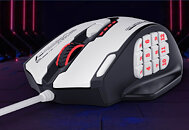
Redragon Announces Impact M908 SE MMO Gaming Mouse with 18 Macro Buttons

Redragon has just announced its latest MMO-oriented gaming mouse, the Impact M908 SE, which has a symmetrical ergonomic design with a pinky rest, RGB lighting, and 12 programmable side buttons. With the main clicks, additional customizable top buttons, and the scroll click, the M908 features a total of 18 buttons. The M908 SE doesn't feature any wireless connectivity and uses an optical SG8960 sensor and Huano switches on the main buttons—although Redragon doesn't specify which model. The sensor is capable of up to 24,000 DPI and tracking up to 80 G acceleration, and the polling rate tops out at 1,000 Hz. The mouse is designed as an MMO mouse, and, as such, it focuses more on ergonomics and customization, rather than chasing light weight, like modern FPS mice. Instead, the M908 has an adjustable weight system with 8 small 2.4 g weights—theoretically, this allows you to tune the weight and center of gravity of the mouse.

In terms of ergonomics, the Redragon Impact M908 SE appears to be similar to the Razer Naga, although the Naga weighs significantly less than the 165 g Redragon contender. That weight is presumably with all of the weights installed, meaning it could be reduced by around 20 g. That's still quite heavy for a gaming mouse, but it isn't meant as an FPS mouse, so this may not be a concern. Redragon provides a custom software solution for programming the mouse on Windows, although there is no customization on macOS or Linux. Fortunately, the M908 SE does include onboard memory, so once you've customized the buttons and any macros, those will be saved to the mouse and can be used on other operating systems. The Redragon M908 is available from Redragon directly for $32.99.

Epic Games Store Adds Gifting 7 Years After Launch

The Epic Games Store launched in late 2018 as an alternative to Valve's Steam, and Epic Games has been steadily adding features to its storefront and game launcher to lure buyers away from Valve. The latest feature to come to the Epic Games Store is gifting, specifically in preparation for the 2025 holiday season, it seems. The announcement by Epic Games explains that you simply need to select "Buy as a Gift" and then select someone from your friends list to gift the game to. Currently, gifting on Epic Games is limited to web browsers and the Epic Games Store Launcher on PC, and paid games, special editions, add-ons, and bundles can all be gifted. You cannot gift free games, pre-purchase offers, subscriptions, and in-game items or currency.

For those of you looking for an alternative to Steam to gift games to friends or family in a different country or currency—something Steam does not allow—Epic Games isn't your savior, either, at least not yet. Unfortunately, at launch, if you attempt to gift a game to a friend in another country, you will be met with an error. According to Epic Games, though, cross-region gifting is planned for the future, although when exactly it will land is unclear. The basic restrictions on gifting on Epic Games include that you can only send gifts after having been friends with the recipient for at least two days. Recipients can also reject gifts, and rejected gifts and gifts that have not been accepted within 14 days will be refunded. Gifts will also be refunded if the recipient already has the intended gift in their library.

Keychron Launches 3 New Aluminium TMR Gaming Keyboards with 8K Polling

Keychron has just expanded its line-up of analog gaming keyboards, launching three new all-aluminium Q HE series gaming keyboards with 8K polling and new TMR sensors. The new Q HE 8K series keyboards will kick off with the launch of the Keychron Q6 HE 8K, a full-size all aluminium gaming keyboard, and the Q3 HE 8K, which adopts a TKL layout, instead. The Q3 HE 8K ($229.99) and Q6 HE 8K ($239.99) will both be available on Keychron's site starting November 18, 2025, while the Keychron Q1 HE 8K, with a 75% layout, will be available from December 11. All of the new TMR keyboards are available in black and white with purple accent keys on the enter and escape keys. As the name suggests, the new Keychron Q HE 8K keyboards feature 8 kHz polling rate, but that comes at the cost of wireless connectivity. The new Q HE 8K keyboards use USB Type-C connections exclusively, although the connection mode switch typically found on Keychron keyboards has been replaced by a hardware profile selection switch.

The Keychron Q HE 8K keyboards have similar designs to previous Keychron Q HE keyboards, with the same aluminium switch plate and double-shot PBT keycaps in OSA profile. However, Keychron has swapped out the Gateron Double-Rail Magnetic switches found in its previous Hall effect and TMR keyboards with the Keychron Ultra-Fast Magnetic Lime switches, which are a lightweight (26-40 gf) linear switches with a standard orientation, making the Q HE 8K keyboards compatible with most other magnetic switches currently available. The new Q HE 8K series keyboards are powered by QMK firmware and are configurable and customizable through Keychron Launcher, a web app that is very similar to something like VIA but with a few additional features, like easy firmware updates.

Keychron Launches M2 Mini 8K: 50 g Gaming Mouse With PAW 3950 Sensor

Keychron has silently expanded its range of lightweight gaming mice with the new M2 Mini 8K. The new M2 Mini 8K features many of the same features as the M2 8K but in a more compact design ideal for users with smaller hands looking for a somewhat more affordable gaming mouse with top-tier hardware and a moderately asymmetrical ergonomic design. The Keychron M2 Mini 8K is available for $59.99 from the Keychron online store. The updated version of the Keychron M2 Mini 8K updates the polling rate from 1 kHz to 8 kHz and upgrades the sensor of the existing M2 Mini from the PixArt PAW 3395 to the PAW 3950 for reduce input latency and improved tracking features.

The sensor upgrade also means that the Keychron M2 Mini 8K is capable of up to 30,000 DPI sensitivity and tracking at up to 750 IPS and 50 G acceleration, even on glass, as long as it's thicker than 4 mm. The Keychron M2 Mini 8K has the same tri-mode wireless connectivity—Bluetooth 5.3, 2.4 GHz, and wired, with 8 kHz polling available over 2.4 GHz and USB-C connections—powered by a 600 mAh battery that Keychron estimates will deliver 140 hours of use when connected via Bluetooth. The Keychron M2 Mini 8K weighs in at just 50 g and has PTFE feet. The main click switches are Keychron's typical Huano Transparent Blue Shell Pink Dot switches, which are rated for 80 million clicks. The M2 Mini 8K measures in at just 177 × 64 mm and 38 mm tall, compared to the regular M2's 121.5 × 66.7 × 40.60 mm. The regular M2 8K also weighs 55 g, so the weight difference is almost negligible.

Leaked Steam Controller May Launch Alongside Mystery Reveal

A new VR headset apparently isn't the only thing Valve is planning, with new leaks indicating once again that the gaming giant is working on an updated version of the Steam Controller. Frequent leaker, @SadlyItsBradley on X, recently posted a mockup of what he was told the upcoming Valve Steam Controller would look like when it launches. The updated Steam Controller will deviate from the old design significantly, with the new design supposedly bringing the dual trackpads down to the space between the analog joysticks. The new Steam Controller will also supposedly feature a new feature that would be able to detect how close your hands are to the controller's handles, although an exact use case for this feature remains a mystery.

A recent post by ubiquitous leaker, Moore's Law Is Dead, also suggests that Valve is planning a sizeable launch "in around 16 hours" after the time of publication. That would make the launch time sometime around midday EST on November 12. Speculation suggests that this alleged launch might be related to the Steam Frame (also commonly referred to as the Valve Deckard) VR headset that previously leaked. There are, as is always the case with an imminent Valve launch, those Half Life fans who can't help but hold out hope for Half-Life 3. To be fair, the idea that Valve may reveal Half-Life 3 isn't entirely unsubstantiated. For one, @Sphechal_Nick on X posted a rumor that suggested that GTA 6 may "have its thunder stolen" by an upcoming game announcement.

Wooting Launches 60HE v2 Gaming Keyboard Pre-Orders, Reveals First Batch Shipment Date

As previously revealed, Wooting has officially launched the founder's campaign (read: pre-order campaign) for the Wooting 60HE v2. Pricing has remained at the predicted $179.99 starting price, with the most expensive version coming in at $239.99, and the keyboard maker has also confirmed the actual start of shipping date for the 60HE v2 as December 4. Previously, only the plastic case's shipment date was confirmed, but it seems as though Wooting is confident that it will have enough interest to be able to start delivering the first batch within a month of launching the pre-order campaign.

One of the biggest changes to the 60HE v2 is the optional split space layout, and Wooting has put up a tracker on the pre-order page showing the share of split space and traditional pre-orders. At the time of writing, Wooting 60HE v2 buyers are leaning heavily towards the traditional layout rather than split spaces, with split spaces only occupying 20% of the pre-orders, while the remaining 80% of the 60HE v2 pre-orders feature the traditional space bar. This isn't entirely unsurprising, since split space bars are generally limited to enthusiast and ergonomic keyboards, which are by far a minority, and mostly separate from the gaming keyboard market altogether. Pre-built 60HE v2 keyboards will also ship with the new closed-bottom Lekker Tikken Medium switches pre-installed by default, although these can be swapped out if buyers have their own switches.

Quantinuum Announces Commercial Launch of New Helios Quantum Computer

Quantinuum, the world leader in quantum computing, today announced the launch of Helios, the world's most accurate general-purpose commercial quantum computer, designed to accelerate quantum computing adoption by enterprises. With the highest fidelity of any commercial system and a first-of-its-kind real-time control engine, Helios enables developers to program a quantum computer in much the same way they program heterogeneous classical computers. A new, modern Python-based programming language called Guppy allows developers to seamlessly combine hybrid compute capabilities—quantum and classical—in a single program. Helios is now available to customers through Quantinuum's cloud service and on-premise offering.

"The next computing inflection point starts today," said Dr. Rajeeb Hazra, President & CEO of Quantinuum. "For the first time enterprises can access a highly accurate general purpose quantum computer to drive real world impact, transforming how industries innovate - from drug discovery to finance to advanced materials."

Wooting Reveals 60HE v2 Gaming Keyboard Pricing and Availability

Wooting previously revealed a bunch of details about the upcoming 60HE v2 Hall effect gaming keyboard and announced the November 6 pre-order date for the updated 60HE v2, but pricing and exact shipping dates have remained a mystery until now. In a new blog post, Wooting has revealed that the orders for the aluminium Wooting 60HE v2 will start shipping as early as December 2025, while the ABS plastic case will only start shipping in April 2026. The Wooting 60HE V2 will be available as both a pre-built keyboard, with either the plastic case or an aluminium case, and as a standalone PCB module, which is compatible with the original 60HE case—for those who want to supply their own switches, keycaps, and case. It might also be reassuring to keyboard enthusiasts to know that there appears to be no price difference between the split space and traditional space bar versions of the 60HE v2. New details about the plastic case were also revealed, including the addition of an aluminium reinforcement plate in the bottom of the case, which should help structural rigidity and help dampen the keyboard's sound somewhat.

Wooting also revealed a new add-on for the plastic case to replace the somewhat divisive strap. Owners of the plastic 60HE v2 case will also get a swappable translucent silicone wing to replace the strap mount, for a bit of visual flair. Both versions of the 60HE v2 will be available in black, with an additional "Shiny Silver" colorway in the case of the aluminium case, and both come with OEM profile shine-through PBT keycaps and the new Wooting Lekker Tikken switches by default. Aside from the aluminium case and the new switches, the 60HE v2 steps up the 60HE's design by swapping out the plate for a white FR4 plate, which should improve the sound characteristics over the original steel plate. The 60HE v2 also separates the PCB and plate assembly from the case with a friction fit gasket mount, removing any direct contact between the plate and case to reduce reverberation.

ARC Raiders Sees Strong Launch, More than 260,000 Players on First Day

Arc Raiders launched less than 24 hours ago, and it has already become a smash hit, beating out many of the top free-to-play games currently topping Steam charts, despite its $39.99 price tag on Steam. At the time of writing, around seven hours after Arc Raiders launched, the game had peaked at 264,673 players, putting it in fourth place in SteamDB's real-time concurrent player tracker and in the number-one spot in the trending games category. For comparison, The Finals, a free-to-play shooter from the same developer, Embark Studios, launched almost two years ago, and it similarly hit high player counts as early as day one, topping out at 242,619 concurrent players, according to SteamDB. Given that Arc Raiders launched on a Thursday and reached such heights already, it stands to reason that the weekend may see player counts rise even further.

Arc Raiders still has a way to go to catch up to some of its more popular peers in the shooter genre, though. Battlefield 6, which launched earlier this month, has recorded concurrent players counts as high as 747,440 players, while PUBG: Battlegrounds peaked at over 3 million players in January 2018. Arc Raiders's popularity comes with a rather impressive "Very Positive" (89% positive) rating on Steam, despite the developer's use of divisive generative AI tech in the game's development. As is the case with The Finals, Arc Raiders only offers a Windows installer package and uses Easy Anti-Cheat, but Embark Studios is not hostile towards Linux users, and many users on ProtonDB have reported that the game works on Linux with Valve's Proton compatibility layer, even without any tweaks, earning it a "Gold" rating on the database.

MSI Launches NVIDIA GeForce RTX 5050 Inspire Dual-Slot GPU for SFF PC Builds

MSI has officially announced the latest entries in its Inspire GPU line-up, the NVIDIA GeForce RTX 5050 Inspire ITX and the RTX 5050 Inspire ITX OC. As the name suggests, the RTX 5050 Inspire ITX line-up is designed for small form-factor PC builds, so both models feature the same compact two-slot design as the RTX 5060 version we recently reported on, measuring in at just 147 × 120 × 45 mm. Both versions of the GPU also feature the same cooling solution, with a single-fan cooler design with a Torx Fan 5.0 and a single heat pipe.

The only notable difference between the two versions is the clock speed, with the vanilla RTX 5050 Inspire ITX topping out at 2587 MHz in Extreme Performance mode (2572 MHz regular boost clocks), while the OC version is capable of 2617 MHz in Extreme Performance mode while boosting to 2602 MHz ordinarily. Both ITX cards feature three DisplayPort 2.1b ports and a single HDMI 2.1b port and have a rated power consumption of 130 W, supplied via a single 8-pin power connector. Users can select between Gaming and Silent modes in MSI Center or dive deeper into customization and overclocking in MSI Afterburner. No pricing information has been announced for the new ITX GPUs.

Microsoft Gaming Head Confirms First-Party Xbox Design for Next-Gen Console Launch

Recently, after ASUS launched the ROG Xbox Ally series and rumors popped up about Xbox potentially abandoning its long line of first-party console designs, Xbox president, Sarah Bond clarified that Microsoft is "100% looking at making things in the future," and commented that next-gen hardware is in development, although her words seem to have been carefully chosen, seemingly to avoid making any concrete proclamations about the next-gen gaming console before everything was finalized. In a recent interview with Famitsu, however, head of Microsoft Gaming, Phil Spencer, confirmed that the next-generation Xbox would be Xbox's in-house design.

In the interview, when asked about what comes after the Xbox Series X|S, Spencer responded that, while the ASUS ROG Ally would be the next Xbox hardware launch, the next first-party hardware launch out of Microsoft would be the next-gen Xbox. Not only does this confirm that the next-gen Xbox will still be an in-house design, but it suggests that there will be no first-party Xbox-branded handheld gaming PCs until at least 2027, when the next-gen Xbox is expected to launch. Conveniently, this doesn't discount any potential successors to the ASUS ROG Xbox Ally before that date. Previous rumors indicated that Microsoft was developing an in-house gaming handheld, only to later offload that engineering effort onto ASUS. While there has been no word on whether Xbox is planning another handheld console to align with the next-gen console launch, Sony looks to be developing both handheld and home console systems, each with its own APU co-developed by AMD.

Battlefield: RedSec Revealed As Free-To-Play BF6 Battle Royale Mode Coming on October 28

It has long been rumored that Battlefield 6 would be accompanied by a new battle royale game mode to replace the aging Firestorm, however there has been no official announcement of a PVP battle royale mode two weeks after the new shooter launched. New information from online data miners, however, now suggests that this radio silence may be intentional. According to @ModernWarzone on X, DICE and EA will launch the free-to-play Battlefield: RedSec battle royale game mode on October 28. The launch strategy here is rather curious, since EA apparently won't release any trailers or marketing material ahead of the launch, making it essentially a shadow drop alongside the Battlefield 6 Season 1 update.

Aside from the official name, which is getting heavily criticized online, the free-to-play battle royale game mode will closely follow the same formula as its predecessor. Previous supposed leaks from the same source indicated that Battlefield: RedSec would feature a highly destructible map with 100 players competing for first prize, and that matches would last "around 25 minutes." Of course, these rumors are from earlier this year, so they should be taken with a grain of salt. Internal Battlefield Labs update changelogs also leaked earlier this month, confirming that RedSec players will each have two slots for armor plates and that the battle royale game mode will feature both ground vehicles and helicopters for aerial combat, with the requisite countermeasures also available for players. Players will also be able to talk to one-another with proximity chat.

Epomaker Launches Luma40: Low-Profile 40% Ortholinear Wireless Mechanical Keyboard With Aluminium Case and Focus on RGB and Customization

Epomaker already has a comprehensive line-up of wireless mechanical, Hall-effect, and even inductive keyboards, but some of the company's more interesting launches have been in the low-profile space, with recent examples including the carbon fiber Carbon 60 mechanical keyboard. Now, though, Epomaker has officially launched the Luma40, which may turn out to be far more controversial for regular users than any previous releases. Not only does the Luma40 take the small form factor to the extreme, slashing the key count to just 47 keys—similar to the Comaker TH40 we previously reviewed—it also features an ortholinear layout, meaning the keys are not staggered, or horizontally offset from one another. The Luma40 is available on the Epomaker online store for $115.99, with a launch discount bringing the price down to $98.59. It is only available in one color, with a single switch option: Kailh White Rain low-profile switches with a full POM construction and middle-weight 50 gf actuation force.

Despite the unorthodox layout and form factor, the Luma40 uses a standard qwerty layout in its stock form, although ortholinear layouts are famous for allowing customization. The Luma40 opens up customization with the open-source VIA web app, which allows you to remap keys, create macros, and select different backlighting modes and colors. The same is true for the keycaps. With the exception of the dual 2U space bars, the Luma40's keycaps feature the LAK profile, meaning they're all interchangeable, so remapping the entire keyboard to your liking, or even testing exotic layouts like Dvorak is made easy. Those keycaps are also made of transparent PC with screen-printed legends. This will allow for full RGB shine-through using the north-facing backlighting, but it also means the keycap legends will likely not be as durable as something like double-shot PBT. Those keycaps sit atop Kailh low-profile switches mounted in a PC plate and CNC-cut aluminium case. The Luma40 has both Bluetooth and 2.4 GHz connectivity options, with a diminutive 1,450 mAh battery delivering an estimated 7 hours of battery life with the RGB at full brightness and 75 hours with no backlight. There's also the option of running it off the USB Type-C wired connection instead.

New AGESA BIOS Code Rekindles Hope For Strix Point Desktop APUs for AMD Ryzen 9000G Series

We recently reported on a rumor that AMD would soon be launching desktop APUs based on its Krackan Point architecture that has until now only been featured in mobile parts. At first, it seemed as though Strix Point and its more powerful AMD Radeon 890M iGPU would be limited to the mobile side of things, however a well-known leaker, @9550pro on X, has recently pointed out that AMD's AGESA update version 1.2.7.0 does make mention of Strix Point in its code. This observation is backed up by further evidence shown in a post by @xgfancz on X, who pointed out that the list of architectures in the latest 1.2.7.0 AGESA beta update makes clear reference to "STX," presumably "Strix Point," alongside "PHX," which would be Phoenix Point, AMD's current Ryzen 8000G series of desktop APUs.

All of this suggests that AMD Ryzen 9000G desktop APUs may launch with Strix Point architecture instead of being limited to Krackan Point, as was previously the assumption. Stepping up from Krackan Point to Strix Point would mean that iGPUs in the Ryzen 9000G series may feature up to 16 CUs and RDNA 3.5 instead of RDNA 3 in the current APUs, which could mean gaming and iGPU performance right around the level of the likes of the AMD Ryzen Z2 Extreme now making its way to swathes of gaming handhelds. The AMD Ryzen 9000G desktop APUs aren't expected to launch until closer to the end of this year, and even if they do, there's no telling if they will launch at the same time as what is essentially the 8000G refresh we have seen in rumors before.

Physics-driven Co-op Action-RPG Cloudheim Launches on Early Access December 4th

Noodle Cat Games is thrilled to reveal that Cloudheim, its physics-based action-RPG built for online co-op, will launch on Steam Early Access and Epic Game Store on December 4th. Get ready to gather loot and combine wild weapon traits with physics for endless emergent experimentation! To commemorate this launch, Noodle Cat has released an all new trailer revealing the release date as part of the Galaxies Showcase today.

The Cloudheim demo was among the most played during Steam Next Fest, so due to popular demand, it will remain available for a while longer so more players can whet their appetite by experimenting with Cloudheim's cavalcade of combos!

Assassin's Creed Shadows Gets Official Switch 2 Port This Year Alongside More Free Story Content

Assassin's Creed Shadows has been out since March already, but now Ubisoft is bringing Naoe and Yasuke's story to the Nintendo Switch 2, with an all-new trailer revealing that the latest installment in the Assassin's Creed franchise will arrive for the Switch 2 on December 2, 2025. The trailer is accompanied by a fall roadmap and an official press release with more details about what to expect from both the Switch 2 version of the game and the rest of the game's content updates. Ubisoft confirmed in the announcement that Assassin's Creed Shadows on the Switch 2 will have all of the game's current title updates and free content at launch, with the exception of the Claws of Awaji update. The aforementioned update will arrive in an update in 2026.

[Editor's note: Our in-depth performance review of Assassin's Creed Shadows is now live]

Assassin's Creed Shadows will also feature cross save for those playing on multiple systems, and Ubisoft has implemented some tweaks to the game's UI for the Switch 2's touch screen. Ubisoft also announced Title Update 10 and 11, slated for October 28 and November 25, respectively. The most notable changes coming to the game with Title Update 10 are the parkour changes, which will unlock more freedom by removing parkour barriers and tweaking parkour moves to work in more scenarios. The November Title Update 11 will be the game's third free story drop, called "A Puzzlement," which will take "a more humorous, silly tone" that Ubisoft says is more reminiscent of Assassin's Creed Odyssey. It will also adapt one of each protagonist's moves for the other character. Naoe will learn a version of Yasuke's war kick and Yasuke will learn how to "stealthily dispatch enemies in a non-lethal way." Ubisoft also teased a special collaboration coming in November, but declined to provide further details.

Elden Ring Becomes Latest Game To Fall Victim to Nintendo Switch 2 Performance Issues

It appears as though Elden Ring Tarnished Edition, the version of the game being developed exclusively for the Nintendo Switch 2, has continued to be rather punishing to the handheld console's rather low-end hardware. According to a recent announcement on the official Elden Ring account on X, the Switch 2 port will be delayed to 2026, with the developer citing a need for "time for performance adjustments." This is not the firs time a Switch 2 game port has been delayed, with Borderlands 4 developer, Gearbox, previously announcing an indefinite delay for the launch of the Switch 2 version of the looter shooter earlier this year.

When IGN got hands-on time with Tarnished Edition at Gamescom 2025, performance was so bad that the publication called it "a disaster in handheld mode" and game journalists and influencers in attendance were banned from recording clips of the game running on the Switch 2. The performance issues were largely reported to be frame rate dips, even during actions as simple as panning the camera, but there were also complaints about confusing button mapping making the notoriously difficult game even less intuitive. As was the case for Borderlands 4, a new release date has not yet been announced, but fans have largely responded positively to the announcement, with the sentiment being that Bandai Namco should take its time to deliver a polished game that performs well enough to enjoy at launch.

Becastled Launches on PC, PlayStation, Xbox, and Nintendo Switch

Mana Potion Studio and Pingle Studio are proud to announce that Becastled is now available on PC (Steam), PlayStation 5 & 4, Xbox Series X|S & Xbox One, and Nintendo Switch. Following yesterday's 1.0 release on PC, Becastled makes its console debut today, introducing a fully overhauled UI, mighty bosses, road-building mechanics and other refinements designed for both newcomers and seasoned defenders of the Sun Kingdom.

Becastled combines the relaxing rhythm of city-building games with intense, RTS-like siege defense. By day, players manage and expand their settlement, gathering resources, building farms, and fortifying the castle. By night, they will defend the walls against waves of attackers as rams, siege towers, and even dragons batter their gates until dawn.

Ticktype DP104 Retro Full-Size Mechanical Keyboard Launches As First Product from OwLab Subsidiary

OwLab is known for its premium enthusiast DIY mechanical keyboards, like the $499 PT750, with sister company Qwertykeys bringing up the rear with midrange enthusiast DIY kits. Now, however, OwLab has announced a new sub-brand called Ticktype, which appears to fill the pre-built keyboard niche. While the new keyboard brand has only just been given a name, two keyboards that previously fell under the Qwertykeys brand, the Evo75 and Evo80, will now be sold under Ticktype. That said, Ticktype has also debuted the DP104, a new full-size wireless mechanical keyboard that takes inspiration from retro gaming—much like the QK65 MK3 we covered recently—and the custom mechanical keyboard scene, but with the benefits of a pre-built keyboard.

The Tick type DP104, aside from being a full-size mechanical keyboard with a proper num pad and an aluminium case, boasts a number of features that make it both fun to use and easy to mod for beginners just looking at their first mechanical keyboard. For starters, the DP104 has a quick-release ball-catch top case, meaning the top case releases by applying only a little pressure in the correct direction, allowing you full access to the keyboard's interior for stuff like modifications, cleaning, or changing out the gasket mounting system for something stiffer or with more give. The other neat feature is the colorful "interactive pixel display" located above the num pad. This small landscape display can be used for fun features, like the reactive fireworks mode, real-time typing mode, and an "audio reactive mode" that displays an equalizer that reacts to nearby sounds, or you can make it display keyboard status, like battery charge, OS mode, the time, and caps lock status. The DP104 also has a customizable RGB light bar and two volume control buttons just above the arrow keys.

Heart Electric: Colorful New Team-Based Shooter From Star Wars Battlefront Dev Gets October Playtest

Modoyo is a new game studio out of Stockholm, Sweden, and its first game is Heart Electric, a fast-paced elimination hero shooter that pits 16 players against one another in teams of four, with the added twist of the "Flux" maglev traversal mechanic that adds verticality to the map. Heart Electric is still under development, with Niklas Fegraeus—who served as design director on Star Wars: Battlefront II and lead designer on Battlefield V—at the helm as creative director, but it seems as though a release date might not be too far off. No launch date has been announced, but the game has a Steam Store page, and Modoyo recently opened applications for a play test scheduled for October 24-26.

Modoyo says that Heart Electric is being developed "with player feedback at its core," suggesting that the game will change significantly ahead of its launch based on community feedback after this play test. Currently, it features a colorful, cartoonish art style somewhat reminiscent of that of Paladins or Fortnite. There are four playable heroes currently announced, each with a unique design, and Modoyo has put a lot of emphasis on the importance of tactics, teamwork, and synergy, with mods, perks, mods, and different weapons serving those goals. The minimum system requirements call for a 4th-Gen Intel Core i5, 8 GB of RAM, and at minimum an NVIDIA GeForce GTX 1080 or AMD Radeon RX 6700 XT, although this is subject to change.

ChatGPT Atlas Launches as an AI-Powered Alternative to Regular Browsers

OpenAI has introduced a new web browser called ChatGPT Atlas, designed to serve as the ultimate AI experience center. This browser is a fork of Google's open-source Chromium and aims to compete with Google Chrome, Microsoft Edge, and Firefox. While challenging the dominant trio in the browser space is difficult for most companies, OpenAI is determined to make its mark. Initially launching on macOS, Atlas opens searches with answers generated by ChatGPT, while still providing quick access to traditional search results, images, and other views. A persistent Ask ChatGPT sidebar allows users to interact with the assistant without leaving the page. Advanced agent features, which can perform web tasks, are initially available to paid users, though the basic browsing experience is accessible to everyone from the start.

Atlas is designed to streamline the transfer of information between tabs and chat windows. The assistant can summarize pages, compare products, answer questions about on-screen content, and assist with editing or checking code by having contextual access to the active tab. The browser also includes a memory function to tailor responses over time, a Cursor Chat tool for inline editing, and an Operator agent that can handle small tasks like making reservations, creating shopping lists from recipes, and filling out forms. Familiar browser tools such as tabs, bookmarks, history, and password management are also included, presented in a straightforward layout.

Zotac Boards Powerful Mini PC Hype Train With NVIDIA RTX 5060 Ti-Powered ZBOX MAGNUS

In light of the recent flood of AI-ready mini PCs coming from the likes of Framework and GMKtec, Zotac has announced its own competitor, this time opting for a slightly different approach than the hyped AMD Ryzen AI Max+ 395 APU. Instead, the component company known for its mini PCs and discrete NVIDIA GPUs has equipped the Zbox Magnus (stylized as ZBOX MAGNUS) with an NVIDIA GeForce RTX 5070 Ti and up to a 20-core (8 performance, 12 efficiency cores) Intel Core Ultra 7 255HX CPU paired with dual memory slots for up to 96 GB of DDR5-6400 CSODIMM or DDR5-5600 SODIMM RAM—all in a mere 2.65-liter chassis. By default, however, the Magnus doesn't ship with RAM or storage, with a barebones variant currently listed on the company's Chinese site at a converted price of around $1,966 (13,9999 Yuan).

The product page lists the cooling solution as a heatsink and fan, but it's unclear whether there are separate heatsinks and fans for the CPU and GPU, raising questions about potential thermal throttling, given the tiny chassis. Zotac says that the Zbox Magnus is the first mini PC of its size to offer a desktop-class GeForce RTX 5060 Ti 16 GB GPU in a chassis that small, with the chassis measuring in at just 210 × 203 × 62.2 mm. That small chassis comes with the caveats that the Zbox Magnus needs a 330 W external AC-DC adapter, and that it features a soldered laptop-class CPU. Despite the small chassis, the Zbox Magnus has a decent selection of ports, with five USB Type-A ports, dual front USB Type-C ports, and dual Ethernet ports. It also comes with wall mount hardware and Wi-Fi antennae in the box.

Motion Twin Addresses Dead Cells 2 Demand: "We Are Driven by What We Want To Make"

Dead Cells has been one of the most talked-about indie games in the seven years since its launch, with fans clamoring for a sequel that seems to never be coming—despite plenty of other content having recently been added to the game. In a recent interview with PCGamesN, Motion Twin, the developer behind the smash-hit roguelite, has addressed the demand for a sequel to Dead Cells. The co-creative director and game designer at Motion Twin, Yannick Berthier, explained that Motion Twin is "a collective of individuals that are creative and want to create stuff," and that the company's unorthodox structure allows it to follow creativity instead of pursuing profits.

Berthier went on to say that part of the reason Motion Twin made Windblown instead of Dead Cells 2 is that the team wanted to create something in "a new universe, super bright, that could be co-op." He also supposed that the company's indie nature allows it to continue exploring things that the creative team want instead of appealing to shareholders or the internal pressures of a parent company. Windblown launched nearly a year ago, on October 24, and although it's still in Early Access on Steam, it's still notable that it has not yet surpassed Dead Cells when it comes to player counts, at least according to SteamDB. Despite this and the continued pressure from fans for the sequel to the beloved roguelite, Berthier says that Motion Twin doesn't regret pursuing Windblown instead of Dead Cells 2, going on to say that the eight-person, employee-owned studio "followed its heart." Windblown has changed greatly since its launch, with frequent updates mostly based on player feedback, but it still seems to be fighting a bit of an uphill battle to be able to compete with its predecessor. Currently, Windblown is only available in Early Access on Steam, and a full 1.0 launch date has not yet been announced.

Second Sun is Launching on PC on the 5th of November

Iceberg Interactive and Grey Wolf Entertainment are proud to announce the release date of Second Sun, a beautiful, fast-paced FPS that masterfully blends several genres into one. Second Sun is set to release on the 5th of November 2025 on PC (Steam) with a 15% launch discount.

Inspired by old-school shooters and ARPGs, Second Sun is a loot-and-shoot game that blends open-world elements with RPG-style progression and storytelling. Though it has fixed landmarks, the game offers a fresh experience at every new start by procedurally generating new dungeons. The movement-based action is the key to making all of these elements work in symbiosis.

Intel's "Panther Lake" Microarchitecture Deep Dive Set for October, Full Launch in 2026

The story of Intel's first 18A product, "Panther Lake," remains shrouded in mystery, at least for a few more days. According to earlier reports, Intel was expected to start shipping the first PTL-U and PTL-H SKUs by the end of 2025, with additional SKUs to follow in 2026. However, that situation could be subject to change, according to Golden Pig Upgrade. The rumored October 9 launch date is reserved only for the microarchitecture deep dive, and the launch and final specifications of specific models will occur at CES 2026. Being Intel's first big bet with the 18A node, Panther Lake is a product of years of Intel's manufacturing innovation, which needs to demonstrate that the investment in advanced manufacturing was worthwhile. Reportedly, Intel started limited shipments of its 18A nodes to U.S. customers in Q3, with these wafers already in production and initial output of its own CPUs expected in Q4.

Given that Panther Lake is the first 18A node product, we could expect that to be a large part of those shipped wafers, most likely going to OEMs for testing before integration. As a reminder, the low-power PTL-U models are designed for a 15 W TDP and are expected to come in 6-core and 8-core versions. Some SKUs will feature four high-performance P-cores paired with four LPE-cores, while others will have only two LPE-cores complementing four P-cores. Both families will utilize Xe3-based integrated graphics, with entry models featuring four GPU cores. The more powerful PTL-H line will scale up to around 16 CPU cores, comprising four P-Cores, eight E-cores, and four LPE-cores. Some H-series parts might include up to 12 GPU Xe3 cores for integrated graphics, but the final configurations will be revealed when Intel officially launches the Panther Lake product family.
Return to Keyword Browsing
Nov 17th, 2026 20:41 CST change timezone

New Forum Posts

Popular Reviews

TPU on YouTube

Controversial News Posts