News Posts matching #Leak

Return to Keyword Browsing

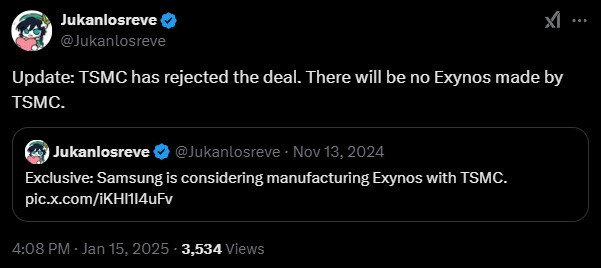
TSMC Reportedly Rejects Samsung's Proposed Exynos Mass Production Request

Samsung's native foundry operations have wrestled with the 3 nm Gate-All-Around (GAA) process—these problems have persisted since the first reports of "missed production targets" emerged late last year—online speculators floated a very disappointing yield figure: only 20%. Last December, industry moles proposed that the South Korean technology giant had devised plans to form an Exynos-centric "multi-channel partnership" with rival chipmakers. Speculation pointed to TSMC being the only valid ally. Semiconductor industry tipster—Jukanlosreve—believes that negotiations have taken place, and the answer was a firm "no." TSMC's most advanced node process order books are likely filled up with more important customers—industry watchdogs reckon that Apple usually gets first dibs.

Taiwan's top semiconductor manufacturer leads the market with its cutting-edge lithography techniques. Insiders believe that Samsung was impressed by TSMC's 2 nm trial production runs achieving (rumored) 60% yields. The higher-end Exynos chipsets are normally produced with the best node process available, but missed manufacturing goals have caused Samsung to drop in-house tech. In the recent past, Qualcomm's most powerful Snapdragon mobile chipsets have been deployed on flagship Galaxy S smartphones. Jukanlosreve believes that TSMC rejected Samsung's proposed Exynos deal due to a fear of revealing too many "trade secrets." Potentially, the South Koreans could have learned a thing or two about improving yields—courtesy of TSMC's expert knowledge.

AMD Ryzen Z2 Go APU Compared to Z1 Extreme: 10% Slower Overall

Fps Vn—a gaming hardware YouTube channel—has managed to get their hands on an early sample of Lenovo's Legion Go S handheld system. This lower cost model was officially introduced at last week's CES trade event—with a notable specification shared across SteamOS and Windows 11 variants: AMD's Ryzen Z2 Go APU. This processor sits at the bottom of Team Red's latest line of "Strix Point" and "Phoenix Point" gaming-oriented SoCs. The Ryzen Z2 Go chipset—featuring Zen 3 processor and RDNA 2 graphics technologies—is based on Team Red's older "Phoenix 2" silicon. Fps Vn decided to compare this lower-end 4-core/8-thread APU with a widely available sibling: the AMD Ryzen Z1 Extreme (a Zen 4 and RDNA 3-based processor).

Their Lenovo Legion Go S sample model (Ryzen Z2 Go) was lined up against the ASUS ROG Ally X (Ryzen Z1 Extreme)—tests were performed in Black Myth: Wukong, Cyberpunk 2077 and Ghost of Tsushima Director's Cut. Gaming benchmarks indicate an overall 9 to 10% performance deficit for the budget-friendly APU. The results are quite impressive; given that the Ryzen Z2 Go SoC utilizes an older processor technology (Zen 3 vs Zen 4), sports a lower core count (four vs. eight), and is only capable of boosting up to 4.3 GHz (Z1 Extreme hits a maximum clock of 5.1 GHz). Reflecting on these early performance results, potential customers are invited to inspect the gulf in pricing. Leaks indicate that the Legion Go S SteamOS model being priced at $499, while an alleged $100 upcharge grants access to a Windows 11 variant ($599). The price-to-performance ratio favors Lenovo's upcoming entry-level models, but ASUS could reduce the ROG Ally X's entry fee in the coming months—this flagship device originally launched with an MSRP of $799.

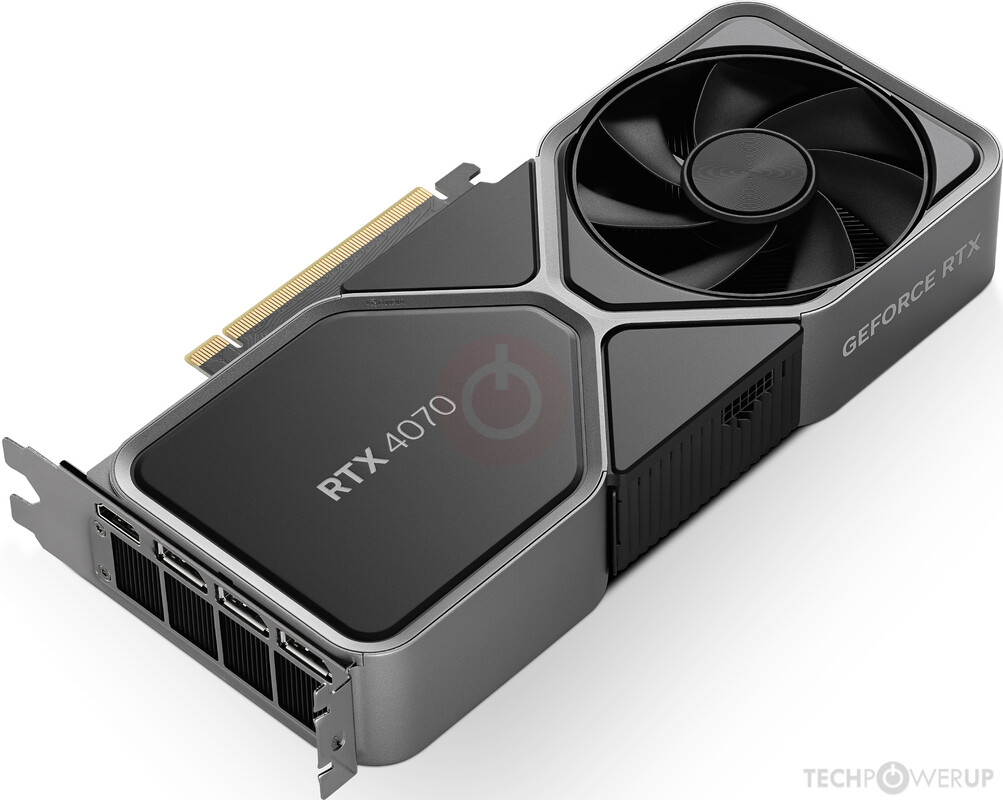
NVIDIA GeForce RTX 4070 End of January Stock Depletion Predicted

Supply chain insiders reckon that stock of NVIDIA's "Ada Lovelace" generation GeForce RTX 4070 GPU will be depleted by the end of this month. This revelation emerges on the cusp of Team Green's GeForce RTX 5000 series of "Blackwell" GPUs heading to market (on January 30). The popular Chinese hardware forum—Board Channels—is a reliable source of product "supply and demand" information. Industry insiders believe that Team Green's mid-tier SKU will be completely sold—by the closing of this month—across several unnamed regional markets. NVIDIA's incoming GeForce RTX 5070 SKU (baseline $549 MSRP) appears to be the natural alternative, given that GeForce RTX 4070 SUPER offerings are priced within the range of $550 to $600—according to market research performed by VideoCardz.

A board member disclosed details and prophesized changes up and down NVIDIA's current-gen product stack: "The inventory for NVIDIA RTX 4070 and higher models is expected to be completely cleared by January. Starting from February, major AIC brands are anticipated to have stock remaining only for the RTX 4060 Ti and RTX 4060 series, which still need to be digested. However, since NVIDIA's Q1 begins in February, these two models will essentially enter the final stock phase." VideoCardz anticipates a March launch window for the GeForce RTX 5060 series—this could be well-timed given circumstances surrounding Team Green's (alleged) limiting of GeForce RTX 4060 Ti GPU supplies and the insider's predicted cessation of RTX 4060 (non-Ti) production.

AMD Radeon RX 9070 XT & RX 9070 Custom Models In Stock at European Stores

AMD's board partners flaunted their new Radeon RX 9070 XT and RX 9070 custom models at last week's CES trade event, but no one expected to see retail units pop up anytime soon after the concluded Las Vegas showcase. Earlier today, a brave soul uploaded compelling new evidence on Team Red's subreddit—they claim that they were surprised to see the "early" delivery of Radeon RX 9070 XT and RX 9070 graphics card stock. Uploaded photos seem to show several boxed Sapphire Pulse models sitting in an Israeli computer store's stockroom. This leak has semi-ruined Sapphire's staggered Pulse-oriented marketing campaign—yesterday, a teaser image emerged via an official social media post.

Industry watcher, momomo_us, has gathered proof of GIGABYTE Radeon RX 9070 XT GAMING OC 16G and Radeon RX 9070 GAMING OC 16G model stock reaching Danish shores. According to VideoCardz, Føniks Computer's online store had at least four units available for purchase and immediate shipping (same business day). Entries for the two models have also appeared on Geizhals—this German price comparison engine lists January 24 as a market launch date. This information could be subject to change—AMD is likely still working on finalizing release window parameters. After all, recent pre-launch leaks have contained incomplete data and errors. It should be noted that NVIDIA's GeForce RTX 50 series is set to hit international markets on January 30—is Team Red planning to pre-empt this rollout?

Apple's Custom "Hidra" SoC Reportedly Exclusive to Next-gen Mac Pro

Apple's top-end M4 Ultra desktop-class chipset is allegedly going to feature on upcoming Mac Pro and Mac Studio refreshes—new product unveilings could be on the company's schedule (WWDC 2025). Bloomberg's Mark Gurman has divulged intriguing M4-series information within his latest newsletter. The M4 Ultra SoC—codenamed "Hidra"—was previously believed to be the most powerful processor option available on both next-gen Mac Pro and Mac Studio platforms. Now, Gurman believes that Apple engineers have created a distinct custom chipset design—exclusively designed for the Mac Pro workstation product stack—that sits above their M4 Ultra SoC.

Somewhat confusingly he suggests that "Hidra" is the codename for this top-of-the-line processor. Rumors swirled last month about the cancellation of an alleged "Extreme" model, so there is a degree of uncertainty surrounding unannounced M4 SKUs. Potential customers could choose Apple's (potentially) more powerful "Hidra-equipped" Mac Pro workstation over the highest-end M4 Ultra-based Mac Studio model. Industry experts propose that "Hidra" will arrive with an increased number of CPU and GPU cores—exceeding the M4 Ultra's speculated makeup of a 32-core CPU and an 80-core GPU.

UK Retailer Inadvertently Posts Radeon RX 9070 XT & 9070 GPU Specs

The majority of AMD Radeon RX 9070 XT GPU-related leaks have emerged thanks to insiders playing around with pre-launch PowerColor RDNA 4 sample models. During and since CES, Team Red and its board partners have kept mum about specifications and performance figures—but happy accidents have allowed tech enthusiasts to pore over NDA-busting information. As reported by VideoCardz yesterday, Overclockers UK (OCUK) published a landing page that provided a brief look at basic Radeon RX 9070 XT and RX 9070 (non-XT) specs—the British retailer has since scrubbed this entry from its site.

Leaks have revealed alleged core counts—4096 for XT, and 3584 for non-XT—but Overclockers UK's charts listed a count of 4096 for both Navi 48 GPUs. They both sport 16 GB GDDR6 VRAM and 256-bit memory buses, and the leak reveals another shared trait: a 260 W TDP rating. VideoCardz reckons that this is an error—based on previous clock speed insider info, the Radeon RX 9070 non-XT's power consumption figure should be rated lower. The accidentally published clock speeds appear to be sourced from overclocked examples—AMD is reportedly not going to release full/finalized information until closer to launch, so OCUK could have relied on preliminary product guides. The FAQ section states that Team Red's RDNA 4 generation is sticking with a PCI-Express 4.0 x16 host interface—PCIe 5.0 systems are "thankfully" backwards compatible. NVIDIA's GeForce RTX 50 series will be leading the way into PCIe 5.0 spec territories.

Guerrilla's Decima Engine Reportedly in Use at Other PlayStation Dev Teams

The Decima Engine has not been widely utilized outside of Guerrilla Games-developed titles—their Horizon series has mostly showcased this (Sony Interactive Entertainment-owned) proprietary technology. Kojima Productions (Death Stranding 1 & 2) and Supermassive Games (Until Dawn) are notable development houses that have licensed Guerrilla's very capable engine—naturally, both outfits are very invested in the PlayStation eco-sphere. Twisted Voxel has combed through Guerrilla staff profiles on LinkedIn and a certain job description caught their investigative eye. The online publication's reportage focused on a senior producer's role of: "managing communication and relations with other PlayStation Studios interested in or using the Decima engine."

Industry insiders believe that Guerrilla Games is deeply involved in overseeing development at other first-party PlayStation development studios—the Netherlands-based outfit is well-versed in creating epic open world adventures, and this expertise is a hot commodity given current market trends. It is not very surprising to hear about the possible sharing of proprietary engine tech between internal PlayStation teams—Decima would be an ideal candidate for other open world PlayStation projects. Twisted Voxel mentioned Bend Studio—this developer is located in Oregon, USA—best known for producing Days Gone (2019). A former senior game designer's LinkedIn profile lists experience of using the Decima toolset. Bend Studio's unannounced "open world" title is apparently due for launch this year.

Apple Reportedly Due to Receive First Batch of "Made in USA" TSMC Chips

The latest news reports suggest that Apple is currently verifying the quality of TSMC Arizona-made chips—the process has reached a "final test stage" with samples from an initial batch being compared to "Made in Taiwan" product. TSMC's native foundries—utilizing the latest cutting-edge technologies—are accustomed to pumping out plenty of high-quality and advanced chips. Nikkei Asia believes that an approval—if USA-made silicon passes muster—will result in commercial mass-produced chips being delivered as soon as Q1 2025. This would be a significant victory for TSMC's relatively new Arizona fab—reported teething problems have caused delays and budgets to balloon. Apple could be the first of TSMC's customers to send products to market that have Arizona-manufactured silicon onboard.

Taiwan's chip-making industry is facing an uncertain future due to regional political tensions—in reaction, the nation's government has started shifting its stance on guarding TSMC's most advanced production processes. Leading-edge process technologies could be heading overseas, with new investments being considered at the Arizona campus. TSMC and Amkor are working on setting up advanced packaging and test facilities at the Peoria location, so current logistics are not ideal—US-made product has to be sent to an Amkor packaging facility in Taiwan. TSMC USA's future looks quite promising—AMD and NVIDIA are reportedly the next in line to receive locally produced samples for verification. Industry moles reckon that Team Green's advanced "Blackwell" AI GPUs could be produced in Peoria—based on alleged partnership negotiations from late last year.

Yeston Unveils Radeon RX 9070 XT 16 GB "Sakura Atlantis" Card Design

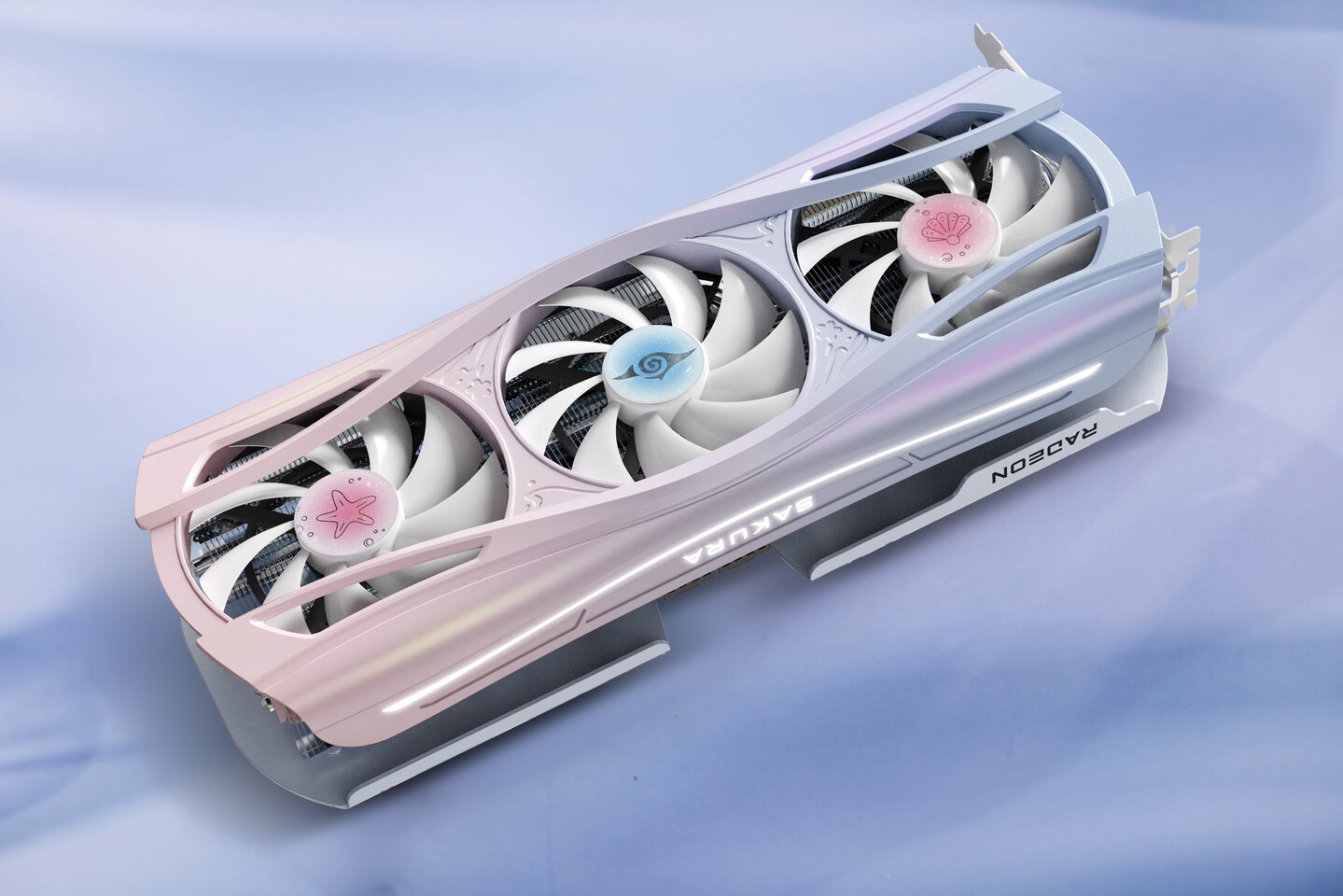
AMD's official announcement of new RDNA 4 generation of GPUs—comprised of Radeon RX 9070 XT and Radeon RX 9070—listed several manufacturing partners. YESTON did not join the likes of ASRock, PowerColor, Sapphire and XFX in showcasing custom designs "in-person" at CES, but their official social media accounts have unveiled a new Team Red GPU-based Sakura Atlantis edition card. YESTON has once again deployed its signature baby blue and pink color scheme—quite refreshing when compared to the slew of black/gray custom designs presented at last week's trade show.

Yeston was the first AMD AIB to publicly reveal Radeon RX 9070 XT's video memory allocation online—their social media post confirms the presence of 16 GB VRAM. Team Red partners in attendance at CES 2025 were not allowed to divulge this information, but a number of press outlets read model/name text on certain sticker attachments—corroborating previous leaks that listed 16 GB. Yeston's post outlines a white-lit breathing effects, as well as support for ARGB lighting. The new Sakura Atlantis shroud design is quite unconventional—breaking away from boxy aesthetics. Flowing lines and curved surfaces attract the eye, along with a pleasant pearlescent finish. Shell and starfish motif stickers adorn the card's three cooling fans. VideoCardz reports that Yeston has provided additional details—their Radeon RX 9070 XT-16G Sakura Atlantis model will feature an all-white PCB design and a white-colored I/O bracket. No surprises here, given the company's past choices.

PowerColor Radeon RX 9070 XT Red Devil & HellHound Reportedly Boost Beyond 3.0 GHz

AMD enforced strict conditions upon its manufacturing partners at the recently concluded CES trade event—various custom Radeon RX 9070 XT and RX 9070 (non-XT) models were showcased, but technical details were not revealed. The TechPowerUp team had a hands-on look at PowerColor's selection of Red Devil, Hellhound cards and newly debuted Reaper design—certain information could be pertained from labels and stickers (cough: 16 GB VRAM) yet brand reps remained tight-lipped about technical nitty gritty under-the-hood. News outlets have relied upon less-than-official sources—such as the Chiphell forum—to obtain performance figures. VideoCardz's working weekend session has produced alleged details about PowerColor's planned boost clock speeds—the headline being that a 3.0 GHz barrier has been broken.

The site's insider network proposes that PowerColor's top-flight Radeon RX 9070 XT Red Devil model is ready for launch with an OC BIOS set to boost matters up to 3060 MHz, while the silent performance mode shaves off fifty—bringing things down to a (still impressive) 3010 MHz. The more middle-of-the-pack Hellhound design is reported to achieve a 3010 MHz boost via its OC BIOS mode, and its silent operation is reported to be 2970 MHz. Additionally, a VideoCardz source reckons that game clocks are somewhere in the region of 2460 to 2520 MHz for both models. The "more affordable" PowerColor Radeon RX 9070 XT Reaper variant seems to lack BIOS switching, so its single operational mode is allegedly capable of boosting up to 2970 MHz.

ASRock Arc B570 Challenger 10 GB OC Cards Sell Ahead of Jan 16 Embargo

Over the past weekend, an Intel Arc GPU enthusiast has picked up a pair of embargo-busting ASRock Arc B570 Challenger 10 GB OC graphics cards. Intel has mandated an official launch at retail on January 16, yet Redditor genxontech presented photo proof of his two Arc Battlemage purchases and claimed that their local Micro Center store had stock available on shelves. The lucky customer stated that he was not willing to experience post-Thursday shortages or dreaded price gouging over limited supply: "I'm upgrading my son's PC from a GTX 1080 and the other one is for me. I work, I don't need to scalp it."

Team Blue's Arc B580 GPU series (starting price: $249) launched mid-December and retail units were snapped up swiftly—budget-conscious hardware enthusiasts have oft complained about a lack of choice/value within their market segment of choice. The incoming Intel Arc B570 GPU family is priced $30 below the slightly more capable B580, so it will be interesting to see how the two tiers perform against each other in 2025. Meanwhile, genxontech has toyed around with the latest Arc Drivers—official software is not available until this Thursday, so mixed results have been documented: "My workstation/server/gaming rig now sees the Arc B570 as a B80. Crazy, right?"

Halo 5: Guardians Steam Entry Spotted on Lenovo Legion Go S Promo

Halo 5: Guardians has remained exclusive to Microsoft Xbox gaming systems since launching back in October 2015, during the Xbox One era—an approaching ten-year anniversary has fans wishing for a possible port over to PC platforms. Hopes were elevated late last week due to an intriguing image popping up on Lenovo's Legion Go S product page. A certain promo image depicts screen content featuring a Steam menu session with an entry for Halo 5. This discovery (courtesy of Rebs Gaming) prompted much online chatter about the possible PC port being unveiled at the next Xbox Developer_Direct—scheduled for broadcast on January 23.

343 Industries (now Halo Studios) has ported five titles over to PC—neatly compiled in the form of Halo: Master Chief Collection—but the absence of Guardians has been a lingering sore spot. Over the past weekend, Lenovo senior community manager—Ben Green—dampened expectations. In a curt response to a query (on social media) regarding the alleged leak, he shot down the notion that Lenovo had inadvertently leaked the existence of a Halo 5: Guardians PC port. It is possible that Lenovo's marketing department had mocked-up the image in error. Microsoft's gaming division has committed to spreading its most visible IPs to "rival" platforms, so the upcoming Xbox Developer_Direct could harbor a surprise or two.

GameSir Presents New "G7 Pro" Xbox Controller at CES 2025

GameSir has showcased its brand new G7 Pro wireless gaming controller at this week's CES trade event, where they teased a very compelling sub-$100 price point. It seems that a lucky few have already playtested early sample units—leaks from late last year revealed the existence of Xbox and Steam variants. During a showroom visit, the TechPowerUp team discovered that GameSir had left the oft-rumored Valve-licensed "prototype" back at HQ. Fortunately, their Xbox G7 Pro model was available for close up inspection in Las Vegas—reports suggest that a launch is lined up around Spring time.

Highlights from the G7 Pro's feature list include: TMR analogue sticks (first introduced via their Tarantula series), 1000 Hz polling rate (wired on Xbox, wireless on PC), optical microswitch face buttons, two rear programmable back buttons + two programmable shoulder triggers, swappable faceplate system, and a new tactile D-pad. TechPowerUp also spent time with some other new controller models—GameSir has another affordable-tier Nova controller (white example is pictured below) incoming, as well as a retro-gray Tarantula model.

AMD Radeon RX 9070 XT Pricing Leak: More Affordable Than RTX 5070?

As we reported yesterday, the Radeon RX 9070 XT appears to be all set to disrupt the mid-range gaming GPU segment, offering performance that looks truly enticing, at least if the leaked synthetic benchmarks are anything to go by. The highest-end RDNA 4 GPU is expected to handily outperform the RTX 4080 Super despite costing half as much, with comparison to its primary competitor, the RTX 5070, yet to be made.

Now, a fresh leak has seemingly hinted at how heavy the RDNA 4 GPU is going to be on its buyers' pockets. Also sourced from Chiphell, the Radeon RX 9070 XT is expected to command a price tag between $479 for AMD's reference card and roughly $549 for an AIB unit, varying based on which exact product one opts for. At that price, the Radeon RX 9070 XT easily undercuts the RTX 5070, which will start from $549, while offering 16 GB of VRAM, albeit of the older GDDR6 spec. There is hardly any doubt that the RTX GPU will come out ahead in ray tracing performance, as we already witnessed yesterday, although traditional rasterization performance will be more interesting to compare.

NVIDIA GeForce RTX 5080 Laptop GPU Challenges RTX 4090 Laptop in Leaked Benchmark

Once every two years or so, technology enthusiasts like ourselves have our sights pinned on what the GPU giants have in store for us. That moment is here, with both NVIDIA and AMD unveiling their Blackwell and RDNA 4 products respectively. NVIDIA has also announced its laptop offerings, with the RTX 5080 Laptop attempting to rule the mainstream high-performance segment. Now, barely a day or two after launch, we already have a rough idea of how mobile Blackwell is going to perform.

The leaked Geekbench OpenCL results, which comes courtesy of the Alienware Area-51 laptop, reveals how well the RTX 5080 Laptop GPU performs in a 175-watt configuration. According to the numbers, the RTX 5080 Laptop managed to barely exceed the 190,000-points barrier, putting it miles ahead of its predecessor which managed around 160,000. Interestingly, as the headline notes, the RTX 4090 Laptop was also left behind, which scores around 180,000 points on average, although systems with beefier cooling setups can post higher numbers.

Leak Reveals Lenovo ThinkBook Plus 6th-Gen As World's First Production Rollable Display Laptop

Flexible OLED tech has come a long way and started sharking up the smartphone and tablet market, but Lenovo now apparently wants to use rolling OLED displays to increase screen real-estate on its laptops without actually making them much bigger. According to notorious leaker, Evan Blass, in a post on X, Lenovo will launch the sixth-generation of its ThinkBook Plus line-up with a rollable OLED display that can extend upwards to give it significantly more screen real-estate. Blass claims that the new ThinkBook Plus will launch at CES 2025, which is slated to take place between January 7 and January 10, 2025.

Looking at the renders that were shared alongside the leaks, and based on the size of the keyboard, the new ThinkBook will have a tall—it looks like 3:4 aspect ratio—screen that's somewhere in the neighborhood of 14 inches before the screen is fully unrolled. After unrolling, though, it appears to be able to fit two 16:9 windows on top of each other. Previous iterations of the ThinkBook Plus 17 had a small secondary display on the keyboard deck to the right of the keyboard, and the ThinkBook Plus 13 models consisted of the Gen 5 hybrid model with a detachable display and the Gen 4 variant, which had a 360° hinge and a color e-ink display on the back of the main OLED. While these designs all made compromises, whether in the suboptimal ergonomics of the mini screen of the 17 or the fact that you could only use one display at a time on the e-ink version. Previous ThinkBook versions were also compatible with an MPP stylus for handwriting, note-taking, and even image editing or sketching. It's unclear if the new ThinkBook Plus will be compatible with pen input, but there do not seem to be any images online showing the leaked laptop with a stylus in the same image.

AMD Ryzen AI 7 350 Benchmark Tips Cut-Back Radeon 860M GPU

AMD's upcoming Ryzen AI Kraken Point APUs appear to be affordable APUs for next-generation thin-and-light laptops and potentially even some gaming handhelds. Murmurings of these new APUs have been going around for quite some time, but a PassMark benchmark was just posted, giving us a pretty comprehensive look at the hardware configuration for the upcoming Ryzen AI 7 350. While the CPU configuration in the PassMark result confirms the 4+4 configuration we reported on previously, it seems as though the iGPU portion of the new Ryzen AI 7 is getting something of a downgrade compared to previous generations.

While all previous mobile Ryzen 7 and Ryzen 9 APUs have featured the Radeon -80M or -90M series iGPUs, the Ryzen AI 7 350 steps down to the AMD Radeon 860M. Although not much is known about the new iGPU, it uses the same nomenclature as the Radeon iGPUs found in previous Ryzen 5 APUs, suggesting it is the less performant of the new 800 series iGPUs. This would be the first time, at least since the introduction of the Ryzen branding, that a Ryzen 7 CPU will use a cut-down iGPU. This, along with the 4+4 (Zen 5 and Zen 5c) heterogenous architecture, suggests that this Ryzen 7 APU will prioritize battery life and thermal performance, likely in response to Qualcomm's recent offerings. Comparing the 760M to the single 860M benchmark on PassMark reveals similar performance, with the 860M actually falling behind the average 760M by an average of 9.1%. Take this with a grain of salt, though, since there is only one benchmark result on PassMark for the 860M.

ASUS ROG Flow Z13 Leaks With AMD Ryzen AI Max "Strix Halo" APUs and 180 Hz Display

Just recently, we covered a juicy new leak regarding the Geekbench performance of the upcoming Ryzen AI Max+ 395 "Strix Halo" APU. It is no secret that AMD plans on launching the Strix Halo lineup at CES 2025, which happens to be less than a month away. Unsurprisingly, leaked listings of upcoming laptops and other products have been steadily popping up on the internet, with the ASUS ROG Flow Z13 being the rumor mill's latest victim.

As revealed by the product listings by retailers, the ASUS ROG Flow Z13 will indeed pack some truly impressive specifications. Needless to say, the product will feature a variant with the highest-end Ryzen AI Max+ 395 APU with 16 cores and 32 threads, along with an RDNA 3.5-based iGPU with 40 CUs, likely named the Radeon 8060S, which is expected to match mid-range discrete graphics in performance. A slightly lower-tier variant is also listed, with a 12-core Ryzen AI Max 390 APU.

NVIDIA GeForce RTX 5070 Ti Leak Tips More VRAM, Cores, and Power Draw

It's an open secret by now that NVIDIA's GeForce RTX 5000 series GPUs are on the way, with an early 2025 launch on the cards. Now, preliminary details about the RTX 5070 Ti have leaked, revealing an increase in both VRAM and TDP and suggesting that the new upper mid-range GPU will finally address the increased VRAM demand from modern games. According to the leak from Wccftech, the RTX 5070 Ti will have 16 GB of GDDR7 VRAM, up from 12 GB on the RTX 4070 Ti, as we previously speculated. Also confirming previous leaks, the new sources confirm that the 5070 Ti will use the cut-down GB203 chip, although the new leak points to a significantly higher TBP of 350 W. The new memory configuration will supposedly run on a 256-bit memory bus and run at 28 Gbps for a total memory bandwidth of 896 GB/s, which is a significant boost over the RTX 4070 Ti.

Supposedly, the RTX 5070 Ti will also see a bump in total CUDA cores, from 7680 in the RTX 4070 Ti to 8960 in the RTX 5070 Ti. The new RTX 5070 Ti will also switch to the 12V-2x6 power connector, compared to the 16-pin connector from the 4070 Ti. NVIDIA is expected to announce the RTX 5000 series graphics cards at CES 2025 in early January, but the RTX 5070 Ti will supposedly be the third card in the 5000-series launch cycle. That said, leaks suggest that the 5070 Ti will still launch in Q1 2025, meaning we may see an indication of specs at CES 2025, although pricing is still unclear.

Update Dec 16th: Kopite7kimi, ubiquitous hardware leaker, has since responded to the RTX 5070 Ti leaks, stating that 350 W may be on the higher end for the RTX 5070 Ti: "...the latest data shows 285W. However, 350W is also one of the configs." This could mean that a TBP of 350 W is possible, although maybe only on certain graphics card models, if competition is strong, or in certain boost scenarios.

Nintendo Switch Leak Tips LCD, Hall Effect Joysticks

With the upcoming Nintendo Switch 2 all but a given, much has been said about the new handheld gaming console in leaks and rumors. Now, a new set of supposed leaks from Decky Wizard on X have caused a bit of consternation among the Switch community, given the seemingly random mix of upgrades and perceived downgrades coming to the next-gen Switch. Minor details include larger buttons, a redesigned dock, and three colorways at launch, however, details around the new display and controls are more significant. For starters, the leaks suggest that the Switch 2 will have larger buttons and Hall-effect joysticks, both of which would likely be a massive upgrade in the eyes of most gamers, however it also seems as though the Switch 2 will use an LCD, as opposed to an OLED display, for the base model.

It seems as though most Switch fans were expecting an OLED panel right out the gate, given the Nintendo Switch OLED has been available for quite some time, now. Hall-effect joysticks will also likely solve one of the community's biggest complaints about the Switch controls—that being stick drift—but Nintendo would have to also provide a calibration tool in the Switch software to correct for wear and tear on the joysticks. Larger buttons may also be a welcome change for most Switch gamers, since cramped controls are a fairly common criticism of the original Switch. In addition to the news of the physical and technical specifications, Decky Wizard also claims that the Switch 2 will be lighter than the Steam Deck and be launched as soon as January 2025. In a subsequent post, Decky Wizard uploaded leaked images of the new Switch 2, showing off not only a fresh looking chassis with smaller screen bezels and a new built-in kickstand design, but also the design of the new first-party dock and two new, larger Joycon release buttons on the backs of each Joycon.

Lenovo Legion Go S Leak Details €600 MSRP, AMD Ryzen Z2 SoC, and Bigger Battery for Affordable Gaming Handheld

It's been public knowledge for a while now that Lenovo is planning an imminent successor to its Legion Go handheld that has proven rather popular among handheld gamers. Previous leaks and rumors indicated that the Legion Go S 8ARP1, as it will apparently be named, will be a more affordable version of the current Legion Go. Now, thanks to Roland Quandt, Windows Central, and WinFuture, more details about the upcoming Legion Go S have leaked, including images of the device, supposed specifications, and a potential price.

According to the leaks, the new affordable handheld gaming PC will feature some substantial hardware changes, including a slightly smaller eight-inch display, this time with a much lower 1920 × 1200p resolution and a slightly lower 120 Hz refresh rate. Gone, too, are the Nintendo Switch-style detachable controllers, with the Legion Go S instead featuring a white unibody design. What's more interesting than the leaked images of the Legion Go S or the hardware changes—detachable controllers or not, the Legion Go is still intended to be used as a handheld—is the new AMD APU that will seemingly power the Go S. The as-yet unannounced AMD Ryzen Z2G looks like it will be an odd core configuration featuring an AMD Radeon 680M iGPU and Zen 3+ cores. Ultimately, the APU seems like it will put the Legion Go S somewhere between the current-generation Legion Go and devices featuring the AMD Ryzen Z1 (non-extreme), which is a good place to be if Lenovo hopes to compete with the likes of the Steam Deck OLED, which will seemingly cost around the same as the Legion Go S, depending on which region you are in.

Intel Arc B580 Card Pricing Leak Suggests Competitive Pricing

Earlier this week, details of two Intel Arc B580 "Battlemage" graphics cards from ASRock leaked, but there was no indication of any pricing, which lead to some speculations in the comments section. Now, serial leaker @momomo_us on X/Twitter has leaked the pricing for Intel's own card, which will apparently be known as the Intel Arc B580 Limited Edition Graphics card. The leaker suggests a retail price of US$250 for the 12 GB graphics card, which seems like a competitive starting point for what is expected to be a lower mid-tier GPU. However, this will most likely be the cheapest option on the market, since AIB's tend to charge higher pricing due to customised PCB and cooling, plus some extra bling over the Intel cards.

In addition to the pricing leak above, Videocardz did some digging and found an etailer that has listed the Intel Arc B580 card on its site, albeit without any details, for US$259.55, although the site didn't reveal the details of the etailer, beyond the fact that it's a US company. The question is how the B580 will compare in terms of performance against both Intel's own Arc A750 and A770—which comes with either 8 or 16 GB of VRAM—especially as you can pick up an Acer Predator BiFrost Arc A770 or a couple of different ASRock Challenger Arc A770 cards for as little as US$230.

MSI Claw 8 AI+ To Get Massive Battery and Lunar Lake CPU With Full Unveiling at CES 2025

MSI previously gave us a teaser of what to expect from its upcoming Claw 8 AI+ gaming handheld with Intel's Lunar Lake Core Ultra CPUs, calling it "the most advanced 8-inch gaming handheld in the market," but a recent CES listing has divulged more details about the upcoming challenger to the likes of the Lenovo Legion Go. For starters, the upgraded battery capacity has been revealed, along with an estimated battery life and performance figures. Supposedly, more information will be revealed about the Claw 8 AI+ at CES 2025, which starts on January 7, 2025.

According to the CES page, the new MSI Claw 8 AI+ will have an 8-inch display and an 82 WHr battery, which will supposedly be able to deliver "4+ hours of gameplay for AAA titles." However, these manufacturer claims are generally to be taken with healthy helpings of salt, especially in when it comes to claims as nebulous as "AAA titles" without any proposed quality settings, specific games, or frame rates. Regarding the display, it wouldn't be surprising to see MSI use the same display as the one found in the Lenovo Legion Go, since there is a somewhat limited selection of 8-inch displays for handheld gaming devices. The MSI Claw 8 AI+ will also use Intel's 2nd-generation ARC iGPUs in conjunction with AI-enhanced graphics, which should provide a healthy uptick in both performance and efficiency, with the CES listing touting 48 TOPS of compute power.

Assassin's Creed Shadows Animus Hub Rumors Quashed As Ubisoft Breaks Silence, Denies Paid Battle Pass Allegations

Assassin's Creed Shadows is seemingly not out of hot water with gamers just yet, although this time, the flak seems to have been mostly unwarranted. Earlier this week, rumors popped up on Reddit claiming to reveal the Assassin's Creed Shadows Animus Hub, which was supposedly the upcoming RPG's dedicated launcher, and a host of in-game season passes and rewards. The leak purports to detail the first free battle pass, which is referred to as "Eye in the Dark" and will consist of 20 reward tiers. Completing the battle pass allegedly rewards 9,050 Isu coins, which can be used to purchase various cosmetics in the form of character, weapon, and mount customization options. Somewhat comically, there appear to be in-game collaborations with the likes of VISA, Red Bull, Intel, BAPE Clothing and Sprecher, although how these will play out in the game is a mystery. This news made quite a stir when it was first announced, since Ubisoft was very clear when it confirmed the game's delay last month that there would be no season passes in Assassin's Creed Shadows.

As it turns out, though, the rumors were kicking up enough speculation about the return of paid subscriptions, battle passes, and season passes that Ubisoft took to its official Discord server to address the rumors directly. Although Ubisoft confirmed that the Animus Hub is a piece of software it has been working on, all the content and rewards offered in the Animus Hub will be free content. Ubisoft was, however, careful with its words, not denying the existence of season passes and battle passes, instead only commenting that those passes will not be paid. Additionally, Ubisoft confirmed that there will be additional in-game content available for free in the Animus Hub.

Leak Exposes Seven New Intel Core Ultra 200S Processors, Including T & F Series

Intel is expanding its Core Ultra 200S lineup with seven new SKUs, a recent leak by @momomo_us shows. The leak gives details on non-K, T, and F versions across the Core Ultra 5 7, and 9 families. The top-end Core Ultra 9 285 will come in 65 W and 35 W versions. These match the 285K's 24-core setup but run at lower speeds. The 285T keeps the 4-core Xe built-in graphics.

The Core Ultra 7 series adds three models: 265 265F, and 265T. All share a 30 MB L3 cache being differentiated by different clock speeds. The T version has much lower base clocks. For the Core Ultra 5 series, the leak shows two models: 225 and 225F. Both have 10 cores running at 3.3/4.9 GHz (P-cores) and 2.7/4.4 GHz (E-cores), with 2 Xe GPU cores and a 65 W TDP. Unlike their higher-end models, this tier doesn't plan to have a T version right now.
Return to Keyword Browsing
Nov 24th, 2026 04:27 CST change timezone

New Forum Posts

Popular Reviews

TPU on YouTube

Controversial News Posts