News Posts matching #Leak

Return to Keyword Browsing

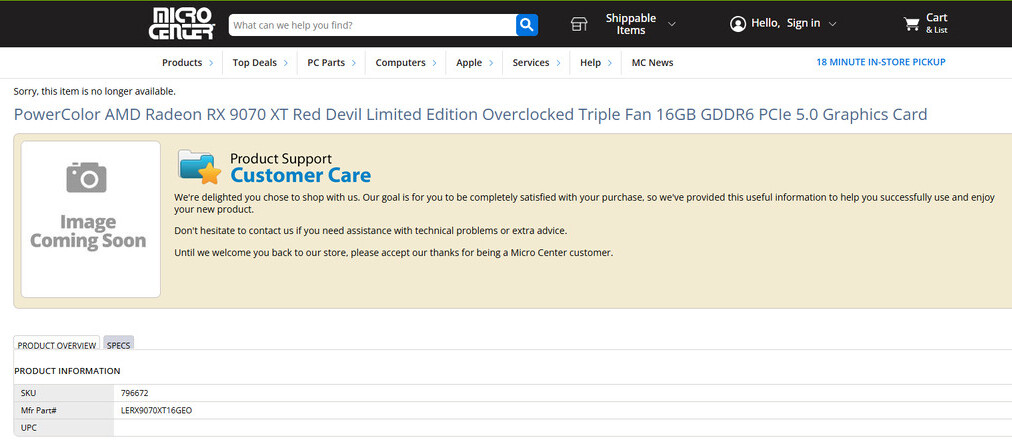
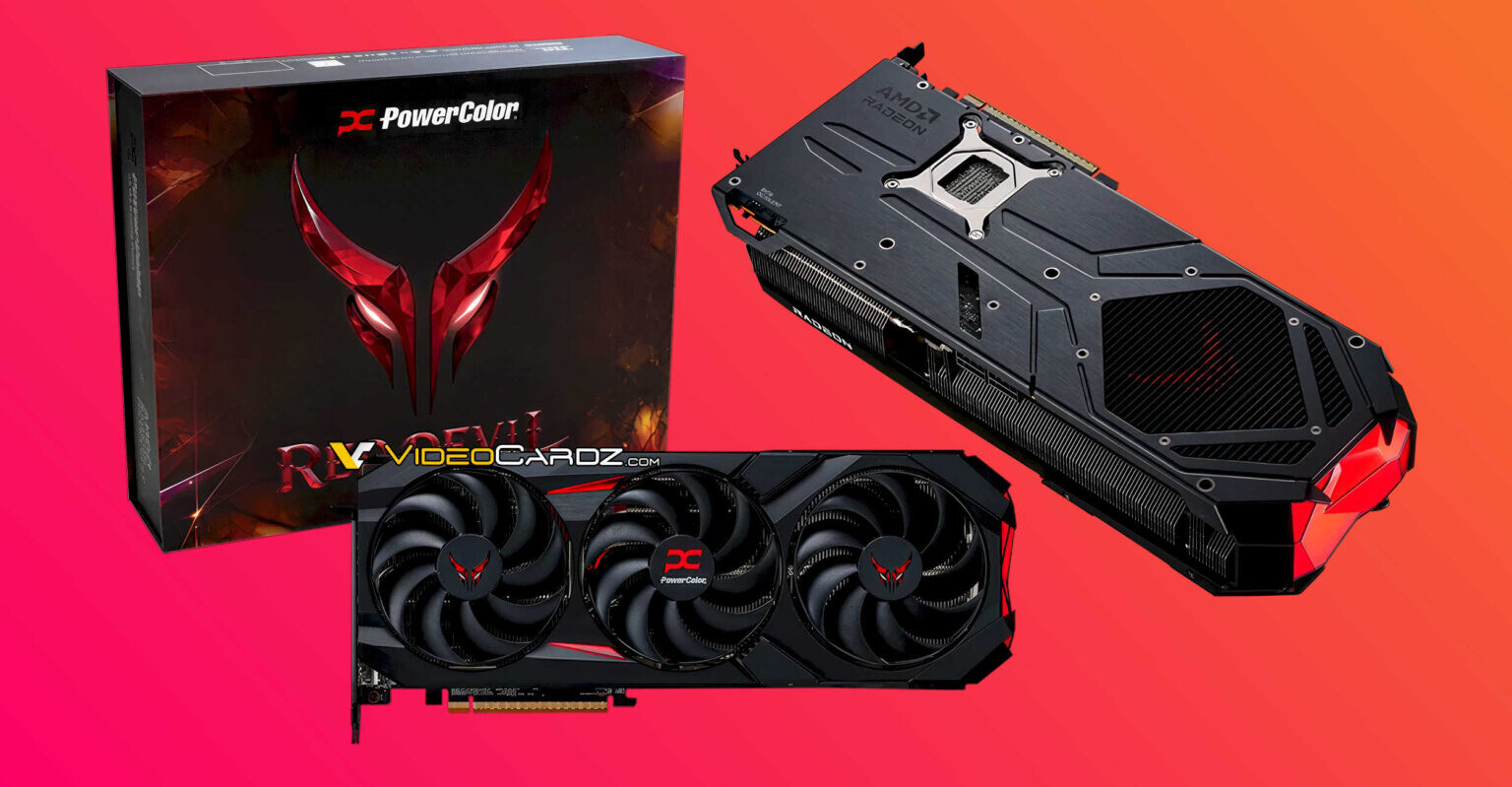
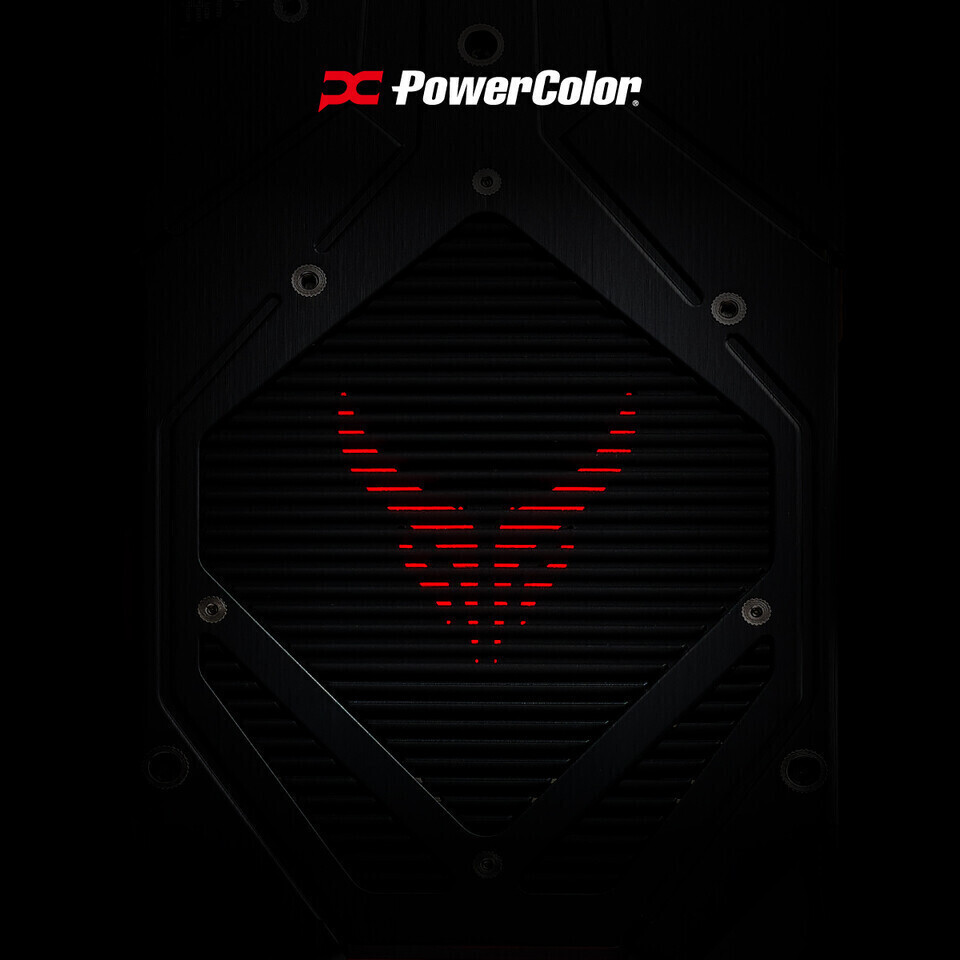
Micro Center Lists PowerColor Radeon RX 9070 XT Red Devil L.E. with "PCIe 5.0" Interface

Upcoming AMD Radeon RX 9070 XT and RX 9070 (non-XT) graphics card specification sheets remain under wraps; we will very likely be presented with the full kibosh on February 28. Throughout early 2025, Team Red and its board partners have divulged very little. Instead, PC hardware news outlets have depended on a steady flow of leaked information. The opening round of Team Red RDNA 4 models have been comprehensively linked to PCIe 4.0 connection standards, but recent anomalies have appeared online. Contradictory spec info arrived late last week, courtesy of a leaker having pre-release access to an allegedly very high-end custom design. The validity of an uploaded GPU-Z session screenshot was questioned by the PC gaming hardware community; the detected candidate card seemed to be connected via a PCI-Express 5.0 x16 bus interface. VideoCardz has stumbled upon additional evidence—their weekend reporting activities pointed to a compelling new product listing on the Micro Center website.

The North American e-tailer's webstore features a "PowerColor AMD Radeon RX 9070 XT Red Devil Limited Edition Overclocked Triple Fan 16 GB GDDR6 PCIe 5.0 Graphics Card." Micro Center's threadbare product page is devoid of promotional images/renders, in-depth technical details or specifications. The "no longer available" special edition package has an SKU assignment code of 796672, and a manufacturer part number read-out of LERX9070XT16GEO. VideoCardz reached out to their "inside source" at PowerColor for research purposes. The company mole confirmed that the PCIe 5.0 spec point is genuine. The leaked photo of "Red Devil packaging" did not reveal any PCIe interface-related info. The publication reckons that the PowerColor Radeon RX 9070 XT Red Devil model's interface "matches the appearance of the PCIe 5.0 standard," as seen on the new generation of NVIDIA RTX 50-series graphics cards. Looking back into recent history, Intel dropped initial plans for PCIe 5.0 connectivity with Arc "Battlemage" graphics cards. The B580 and B570 models have arrived at retail with bog-standard PCIe 4.0 x8 bus interfaces.

Arc "Celestial" Graphics Card Series Linked to "Xe3P" Architecture & Intel Foundry Process

Last December, Intel revealed that its next-generation "Celestial" GPU architecture was "complete." At the time, Team Blue's Tom "TAP" Petersen revealed: "our IP that's kind of called Xe3, which is the one after Xe2, that's pretty much baked... And so the software teams have a lot of work to do on Xe3. The hardware teams are off on the next thing (aka Xe4/Druid), right." Noted Intel inside info leaker—Raichu—believes that "Celestial" will be: "different from Panther Lake, Celestial dGPU looks like will maybe be based on Xe3P instead of Xe3. I estimate it will (be) based on INTC's process instead of outside." Their Friday evening (February 14) social media declaration suggests that Team Blue is bringing things in-house for the manufacturing of discrete "Celestial" graphics cards; utilizing an Intel Foundry node process, rather than rely on TSMC once more. The latter's foundry produced the Arc "Alchemist" and "Battlemage" dGPU generations.

Intel's rumored "Xe3P" architecture is not a fully known quantity, but reports from last November pointed to the existence of multiple "Xe3" variants; courtesy of information gleaned from an employee's LinkedIn profile. Over the past two weeks, we have witnessed plenty of leaks alluding to future Intel CPU families, but the flow of Arc graphic solutions-related leaks seemingly slowed down around the launch of Intel's budget-friendly "Battlemage" B570 card. Recent-ish insider disclosures have uncovered a possible expansion of the current-gen Arc series, with more SKUs rumored to be on the way. A certain group of industry watchdogs reckon that the unannounced "BGM-G31" GPU will be the basis for higher-end "Battlemage" B-series models, but others believe that options above B580 and B570 are canceled—potentially paving the way for "Xe3P-based" C-series designs later this year, or in 2026.

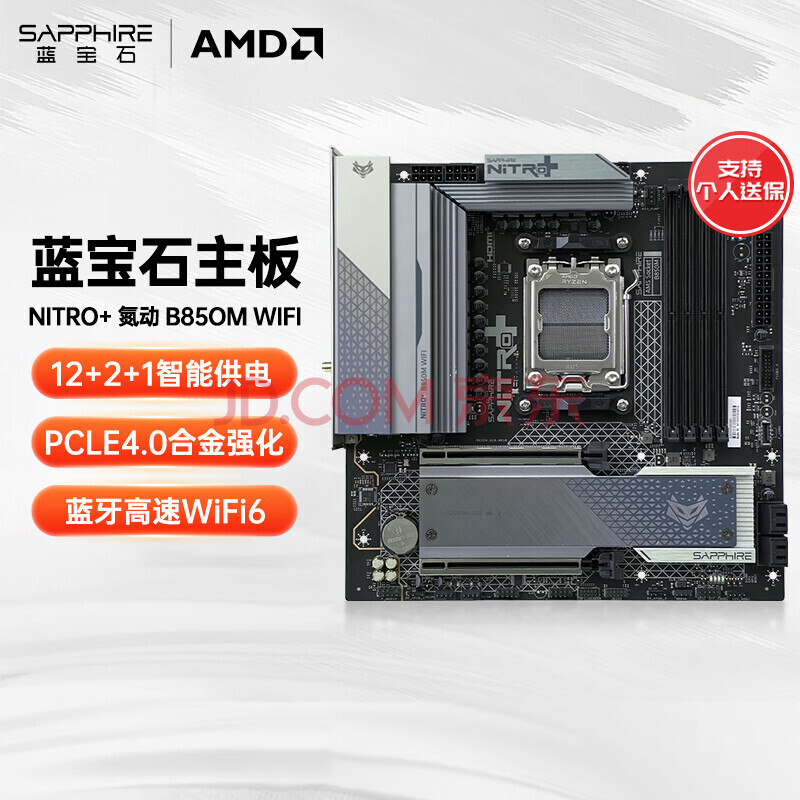
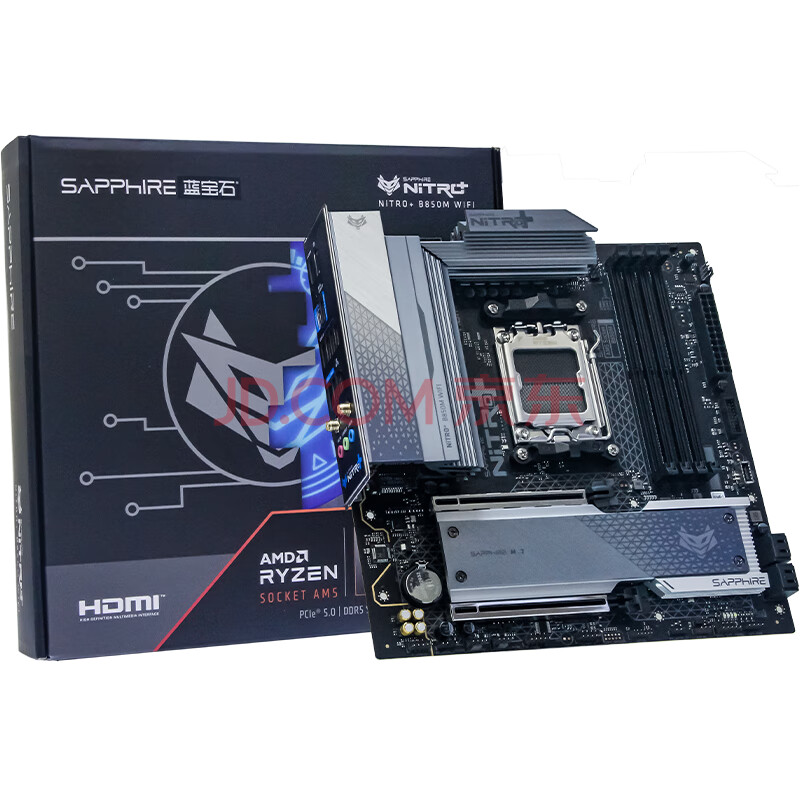
Sapphire Launches NITRO+ B850M WiFi Motherboard Model in China

Sapphire Technology has introduced a new NITRO+ motherboard model in China—weekend reports pointed to a listing on JD.com, where the latest addition resides alongside various previous-gen B650 options. This appears to be another region specific release—priced at 1299 RMB (~$179 USD). The NITRO+ B850M Wi-Fi model seems to share its overall aesthetic design with the preceding B650M-equipped equivalent. As surmised by VideoCardz, the Sapphire NITRO+ board's VRM patterning reminded them of the leaked premium-tier Radeon NITRO+ RX 9070 graphics card series.

The generational jump from AMD B650 to B850 chipset—as expected—yields only minor benefits (see below). The older NITRO+ B650M Wi-Fi model is a significantly cheaper prospect; coming in at 899 RMB ($124 USD). VideoCardz's weekend detective work settled on a nice improvement: "based on our research, the memory overclocking support has increased from 7600 MT/s+ to 8000 MT/s. Keep in mind that these figures may be higher for both motherboards; this is just what Sapphire guarantees when paired with a supported memory kit." Industry watchdogs believe that ASRock is likely involved in the contract manufacturing of Sapphire's motherboard offerings—the former has been long-involved in pumping out NZXT-badged products.

Nintendo Switch 2 Units Reportedly Due for Sale on Chinese Black Market, Priced at ~$40,000

NDA-busting renders of the much-anticipated and rumored Nintendo Switch 2 console appeared online late last year—reports suggested that a member of the Xiahongshu forum was involved in this dramatic leak. The source seemingly had access to a 3D CAD model—possibly procured from a manufacturing partner. Industry insiders believed that top Nintendo brass were incensed by the pre-Christmas 2024 leaks. Around mid-January, an official unveiling of the next-gen gaming handheld arrived online, courtesy of a relatively short teaser video. Early April public showcases are on the calendar; press outlets and regular punters will be participating in hands-on experiences (invite-only) at venues across North America, Europe, Asia and Australia. The flow of early 2025 Switch successor leaks have seemingly slowed down, but renewed activity on Reddit points to early samples emerging via black market outlets.

The aforementioned Xiahongshu forum member is reportedly considering a purchase of pre-release Switch 2 units—previous boasts have indicated that they already own one example. Screenshots of alleged interactions between the seller and potential client were uploaded to Chinese discussion boards, and then shared on the Nintendo Switch 2 Subreddit. The anonymous black market dealer reckons that stock will be available in the near future—claiming by "next week"—with an asking price of 290,000 RMB per package (~$39,780 USD). This steep demand—allegedly—grants early access to the core console tablet, Joy-Con controllers, and dock. Online community debates have produced several theories, regarding the leaker's motivations. Given their history of selling CAD models to accessory makers; this working relationship could develop into a—presumably more profitable—supply of actual working hardware.

Insiders Predict Delay of NVIDIA GeForce RTX 50-series Laptops

Retailers are set to open up pre-order floodgates for upcoming GeForce RTX 50-series laptops on February 25, as we learned earlier this week. According to a new DigiTimes report, the launch of mobile devices—sporting Team Green "Blackwell" GPUs—is expected to be "significantly delayed." A loose March launch window was teased during Jensen Huang's keynote presentation at CES 2025, but supply chain insiders have claimed that high-end RTX 50 laptops were "originally planned to be launched in January 2025." Additionally, they surmise that mid-range and low-end offerings are postponed to April. DigiTimes believes that the rumored postponements have surprised supply chain moles; Team Green is not known to delay product launches. Extenuating circumstances are cited as the reason behind alleged deferred release windows, but insiders have not yet determined the extent of lengthened launch parameters.

An anonymous source stated: "NVIDIA, which has never been late in the past, also encountered this situation. It is probably related to NVIDIA's full sprint to AI servers. Even though there are differences in server and PC chip design and manufacturing processes, the company's resource allocation may still affect the debugging efficiency of new products." Other insiders have murmured about GeForce RTX 50-series mobile GPU performance not meeting expectations. Rumors have swirled about problems with early sample units; most notably the encountering of major screen issues when the "hardware is turned on." Laptop/notebook supply chain insiders reckon that manufacturers have anticipated a healthy level of growth in 2025—thanks to the emergence of new NVIDIA graphics cards—but targets have been reduced, due to anticipated delays. Optimistic industry chatter predicts higher education students and esport enthusiasts driving unit sales upward, following a stagnant 2024 market.

AMD Radeon RX 9000 Series Event Scheduled: February 28

David McAfee—AMD's corporate vice president and general manager of client channel business—has highlighted February 28 as a highly important date for next-gen graphics technology. The much-anticipated (and teased) Radeon RX 9000 series unveiling event has a confirmed time slot on that day: 8 AM EST. The overseer of Ryzen CPU and Radeon GPUs has warded off curious queries from journalists and members of the PC hardware for several weeks, since the conclusion of CES 2025. A confusing early January presentation did not include a segment dedicated to upcoming RDNA 4 products. Online conjecture pointed to Team Red delaying and restrategizing the launch of Radeon RX 9070 XT and RX 9070 models.

AMD enthusiasts will breathe a collective sigh of relief, after reading McAfee's announcement: "the wait is almost over. Join us on February 28 at 8 AM EST for the reveal of the next-gen AMD Radeon RX 9000 Series. Get ready to make it yours when it hits shelves in early March. RSVP by subscribing to the AMD YouTube channel." Insider sources reckon that retailers will have stock on shelves by the rumored March 6 launch day. Mid-to-late January leaks suggested a fairly comprehensive distribution of board partner custom cards across European retail channels. Alleged specifications and performance results have leaked out over the past month and a half—will AMD (and AIBs) have any surprises lined up for the February 28 event?

Sapphire Radeon NITRO+ RX 9070 Series Promo Images Leaked Online

Sapphire is readying multiple Radeon RX 9070 custom designs for next month's launch; official announcements and leaks have revealed upcoming PURE, PULSE and NITRO+ cards. The latter was identified in AMD's CES 2025 press material, but no demonstration sample turned up at last month's Las Vegas AIB roundup. A lone fuzzy low-resolution screengrab showcased the premium Radeon RX 9070 series card's hefty and blocky triple-slot profile. An hour or two ago, Everest (aka Olrak29) uploaded two alleged promotional images to social media. Thankfully, the leaked shots have arrived with decent pixel definition. Sapphire has initiated staggered marketing campaigns for its lower-end and mid-range RDNA 4 cards, so the latest leak has most likely preempted an upcoming official reveal of (possible) NITRO+ Radeon RX 9070 XT and RX 9070 cards.

Sapphire reserves the crème de la crème of feature sets for its premium-tier NITRO+ designs. Previous-gen examples were substantial prospects, and the incoming design is touted to continue that dimensional legacy. Well-heeled Team Red enthusiasts will welcome an updated triple-fan configuration and somewhat subtle internal ARGB lighting zones. The leaked card sports a luxurious "champagne gold" tinted shroud and backplate, with an optional detachable panel. The vented side plates sport a lighter-hue, but the elaborate triangular cut-out aesthetic could be off-putting to certain connoisseurs. Press outlets have honed in on the new NITRO+ model's hidden power connector design, potentially leading to a single input—utilizing a 12 or 16-pin interface.

AMD Radeon RX 9070 XT GPU Specs Spotted in Leaked GPU-Z Screenshot

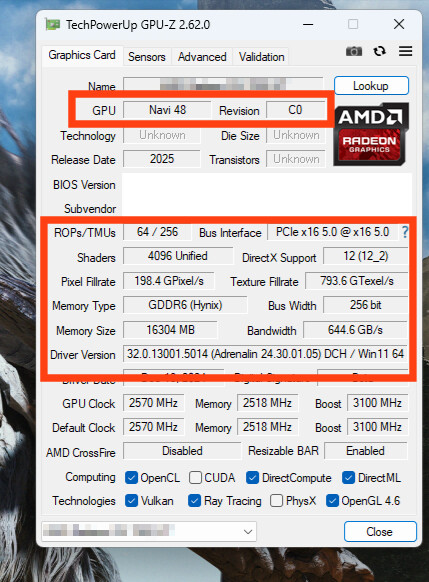
AMD's Radeon RX 9070 GPU series is due for release next month; a specific date has not been set, but we will likely find out more through official channels at the end of this month. Team Red and its board partners have chosen to remain silent on the subject of RDNA 4's technical makeup; post-CES 2025, hardware news outlets have relied on a steady trickle of Radeon RX 9070 XT and RX 9070-related leaks. Very basic sleuthing pointed to pools of 16 GB VRAM for both models, while insiders kept on mentioning an unannounced "Navi 48" GPU. The latest—courtesy of HKEPC—seems to confirm that the Radeon RX 9070 XT will utilize the aforementioned new RDNA 4 Navi chip. Earlier today, a screenshot was uploaded to social media—the leaker shared graphics card information displayed in a TechPowerUp GPU-Z (v2.62) session. Despite patch notes not disclosing compatibility, the latest version of GPU-Z is seemingly able to identify key aspects of the alleged "RX 9070 XT (Navi 48)" sample.

The card's name is obscured, but HKEPC and several press outlets believe that it is the genuine article. The fundamental details appear to be: 16 GB GDDR6 VRAM (Hynix-made), a 256-bit memory bus, 4096 stream processors, and a boost clock reaching a maximum frequency of 3.1 GHz. Older leaks have indicated that the first wave of RDNA 4 cards will make do with PCI-Express 4.0 x16 interfaces, but the GPU-Z screenshot shows a PCI-Express 5.0 x16 bus interface (detection could be bugged). The driver version was identified as Adrenalin 24.30.01.05. The unnamed card appears to feature a steep factory overclock; industry experts reckon that the sample could be a very high-end AIB model. Past reports suggest that PowerColor's Radeon RX 9070 XT Red Devil card is capable of boosting up to 3060 MHz. HKEPC uploaded another incriminating screenshot; showcasing performance results produced by Capcom's Monster Hunter Wilds PC performance benchmark tool. The test system—featuring Intel's Core Ultra 9 285K CPU and 48 GB of RAM—scored 36102 points and achieved a maximum frame rate of 211.71 FPS at 1080p, with "Very High" profile settings. The leaker confirmed that FSR and Frame Generation were enabled during the benchmark session.

AMD Ryzen AI MAX+ 395 "Strix Halo" APU Benched in 3DMark, Leak Suggests Impressive iGPU Performance

Late last month, an AMD "How to Sell" Ryzen AI MAX series guide appeared online—contents provided an early preview of the Radeon 8060S iGPU's prowess in 1080p gaming environments. Team Red seemed to have some swagger in their step; they claimed that their forthcoming "RDNA 3.5" integrated graphics solution was up to 68% faster than NVIDIA's discrete GeForce RTX 4070 Mobile GPU (subjected to thermal limits). Naturally, first-party/internal documentation should be treated with a degree of skepticism—the PC hardware community often relies on (truly) independent sources to form opinions. A Chinese leaker has procured a pre-release laptop that features a "Zen 5" AMD Ryzen AI Max+ 395 processor. By Wednesday evening, the tester presented benchmark results on the Tieba Baidu forums.

The leaker uploaded a screenshot from a 3DMark Time Spy session. No further insights were shared via written text. On-screen diagnostics pointed to a "Radeon 8050S" GPU, and the CPU being an "AMD Eng Sample: 100-000001243-50_Y." Wccftech double-checked this information; they believe that the OPN ID corresponds to a: "Ryzen AI MAX+ 395 with the Radeon 8060S, instead of the AMD Radeon 8050S iGPU...The difference between the two is that the Radeon 8060S packs the full 40 Compute Units while the Radeon 8050S is configured with 32 Compute Units. The CPU for each iGPU is also different and the one tested here packs 16 Zen 5 cores instead of the 12 Zen 5 cores featured on the Ryzen AI MAX 390." According to the NDA-busting screenshot, Team Red's Ryzen AI MAX+ 395 engineering sample racked up an overall score of 9006 in 3DMark Time Spy. Its graphics score tally came in at 10,106, while its CPU scored 5571 points. The alleged Radeon 8060S iGPU managed to pull in just under NVIDIA's GeForce RTX 4060 Mobile dGPU (average) score of 10,614. The plucky RDNA 3.5 40 CU iGPU seems to outperform a somewhat related sibling; the Radeon RX 7600M XT dGPU (with 32 RDNA 3 CUs) scored 8742 points. Radeon 8060S trails the desktop Radeon RX 7600 GPU by 884 points.

XFX & ASRock Register Radeon RX 9070 Series SKUs in South Korea

XFX and ASRock have registered various Radeon RX 9070 XT and RX 9070 SKUs in South Korea—earlier today, harukaze5719 discovered these "public secrets." The National Radio Agency received two filings from Hightech Systematic Limited (aka XFX); the graphics card manufacturer is seeking certification for five models. A single filing from ASRock Incorporation contains one product, a Radeon RX 9070 (non-XT) Challenger 16 GB card—TechPowerUp spent a little bit of hands-on time with this particular model at CES 2025.

XFX showcased two unnamed custom Radeon 9070 graphics card designs at last month's CES event, but yesterday's leak revealed a slew of incoming MERCURY, QUICKSILVER and SWIFT SKUs. The latest South Korean filings corroborate a couple of the accidental Canadian retail listings. The unannounced QUICKSILVER Magnetic Air model has attracted the most interest—promotional imagery is not available at the time of writing, but VideoCardz reckons that XFX could borrow elements from last year's hot-swappable Radeon RX 7900 XTX and RX 7800 XT Series design. TPU's W1zzard praised XFX's Magnetic Air system, in his evaluation of the Radeon RX 7900 XTX MERCURY model. An "amazing removable fan implementation" was pinpointed as a major highlight. The unusual usage of Honeywell PTM7950 thermal paste—a phase change material (PCM)—was another novel plus point.

Insider Refutes Reports of Samsung "Galaxy S26 Series" Featuring 6000+ mAh Capacity Batteries

Yesterday's news cycle pointed to Samsung's alleged development of 7000 mAh capacity batteries for the next-gen "Galaxy S26" smartphone series. Additionally, reports suggest that the South Korean megacorporation's Electronics division is experimenting with silicon-carbon battery technology. Industry watchdogs reckon that Chinese manufacturers are market leaders in terms of silicon-carbon battery tech breakthrough, with Apple and Samsung trailing far behind. PandaFlashPro took issue with the latest reports, and dismissed the notion of a so-called "Galaxy S26 Ultra" model featuring a 7000 mAh capacity battery. According to their network of insider sources, Samsung engineers are struggling with their planned improvements.

Typically, flagship Galaxy S phones have utilized 5000 mAh lithium-polymer batteries. PandaFlashPro envisions an underwhelming next-gen upgrade in this department: "I'll delete my X/Twitter account if Samsung gives the 'Galaxy S26 Ultra' a 7000 mAh or even a 6000 mAh battery I bet...based on my five sources, the internal Samsung Test Lab only seem to have a maximum capacity of 5500mAh; not more." The self-proclaimed science and tech enthusiast did not clarify whether the new generation of Galaxy S models will utilize silicon-carbon tech. Industry whispers allege that Samsung is perfecting its "battery formula," thus ensuring that it meets internal standards and expectations.

AMD Radeon RX 9070 XT & 9070 Prices Leaked by Canadian Retailer

AMD will be launching its new generation of "RDNA 4" Radeon RX 9070 XT and RX 9070 graphics cards next month, but we will likely hear more about technical details and price points from official sources around late February. Team Red had scheduled a special "launch event," but Radeon RX 9070 series leaks continue to flow online. Earlier today, reports alluded to an XT variant that allegedly sports a generous VRAM pool of 32 GB. VideoCardz has received another RDNA 4 tip-off, courtesy of Tomasz Gawroński and the AnandTech forums. Based on screenshots, Canada Computers has inadvertently revealed regional prices (minus tax) for PowerColor and XFX's opening round of custom Radeon RX 9070 XT and RX 9070 models.

Team Red is reportedly lining up an aggressive price strategy; industry insiders reckon that that baseline MSRP for the Radeon RX 9070 XT will be $599. Its non-XT sibling is expected to launch at a minimum point of $499. The Canada Computers leak seems to contain a small selection of models that hover closer to AMD's guidelines, but the majority of listed cards seemingly demand a premium upcharge. PowerColor's barebones models appear to conform closest to Team Red's recommended baseline—according to VideoCardz's conversion-crunching, the Radeon RX 9070 XT Reaper will cost $999 CAD (~$697 USD). The RX 9070 (non-XT) Reaper will come in at $839 CAD (~$586 USD). We spotted no surprises when looking up and down the list of leaked PowerColor RDNA 4 SKUs; TechPowerUp staffers handled Red Devil, Hellhound and Reaper samples at CES 2025. In sharp contrast, XFX appears to have all sorts of options lined up for launch (refer to VideoCardz's chart, below). Two unnamed demonstration units—in black or white—were on display at AMD's recent partner roundup.

Intel Xeon "Granite Rapids-W" Mainstream & Expert HEDT CPUs Leaked

Unannounced Intel processor families have emerged online over the past week—one source, Jaykihn, has unearthed a treasure trove of speculative mobile SKUs. Today's discovery pushes into the enterprise market segment; focusing on Team Blue's "Granite Rapids-W" (GNR-W) platform, likely equipped with Redwood Cove cores. The latest leak suggests an upcoming emergence of "Mainstream" and "Expert" workstation-oriented product tiers, allegedly prepared with the company's rumored W890 motherboard chipset. Past generations of "Xeon W" HEDT processor families have rolled out with entry-level and high-end offerings.

The leaker reckons that the mainstream Intel Granite Rapids-W "Xeon W" lineup will arrive with 4-channel memory support and 80 PCIe Gen 5 Lanes. Team Blue's higher-end "Expert" tier is anticipated with 128 PCIe Gen 5 lanes and 8-channel memory support. In addition to leaking processor information, Jaykihn outlined basic details regarding the W890 chipset—they believe that board designs will have access to 24 PCIe Gen 4 lanes, as well as 8 Gen 4 lanes for Intel's proprietary link (DMI) between northbridge and southbridge. The leaker did not divulge details of upcoming socket types—Team Blue is notorious for its elaborate rollout out of multiple LGA platforms.

MSI RTX 5070 Ti GAMING TRIO OC+ & VANGUARD SOC Pricing Leaks Out in Europe: €1149+

European PC hardware retailers are readying themselves with NVIDIA GeForce RTX 5070 Ti partner models, ahead of the GPU's freshly scheduled launch on February 20. Tech news sites and industry watchdogs have already sniffed out preliminary pricing; courtesy of accidental listings of MSI custom card designs in France and Austria. We are more than a week away from GeForce RTX 5070 Ti release day, so speculative price points are subject to change. The Austrian arm of MediaMarkt was quick to correct matters after an accidental leak, and proceeded to remove an MSI GeForce RTX 5070 Ti GAMING TRIO OC PLUS product page from its webstore. VideoCardz managed to preserve fundamental details, prior to MediaMarkt AT's de-listing of the offending item. The card's alleged €1169 asking price has raised Central European eyebrows—factoring in the region's customary VAT, we are looking at an approximate 32% increase over NVIDIA's baseline MSRP (€884). It should be noted that a Founders Edition does not exist in Team Green's upper-mid "Blackwell" GPU segment.

MSI's price point for its GeForce RTX 5070 Ti VENTUS 3X OC PLUS card is expected to reside closer to Team Green's recommendation, but this barebones offering sits within the company's "entry-level" product tier. The manufacturer's GAMING TRIO OC PLUS range tends to slot right into middle of product hierarchies—provisioned RGB lighting, larger heatsinks and miscellaneous fancy features often demand an upcharge at retail. Tomasz Gawroński (aka GawroskiT) happened upon additional MSI listings in France; an unnamed e-tailer has priced the GeForce RTX 5070 Ti GAMING TRIO OC PLUS at €1149 (€20 cheaper than MediaMarkt AT). The upper crust MSI GeForce RTX 5070 Ti VANGUARD SOC LIMITED EDITION model demands that French customers part way with €1199, for the pleasure of ownership.

Recent Leak Reveals Upcoming Lenovo ThinkPad, ThinkBook, and Yoga Laptops

A recent leak from the reliable analyst Evan Blass has revealed a bunch of new ThinkPad, ThinkBook, and Yoga devices set to see the light of day at MWC 2025. Although the tweet has been deleted by Evan, Notebookcheck was able to summarize the information provided in the nick of time. First up, we have the refreshed ThinkPads, including the T14, T14s, T16, and X13. All the devices are equipped with the beloved TrackPoint, unlike the recently launched ThinkPad X9 Aura. The T14 G6 and T16 G4 are expected to be marketed as a CoPilot+ PC, indicating Lunar Lake prowess. However, the processor powering the X13 is not known at this point.

The Lenovo Yoga Pro 9i Aura will also reportedly see the light of day at MWC 2025, packing a 16-inch display with an unconfirmed Intel processor. As for the ThinkBooks, the lineup will likely welcome two new entrants, including the ThinkBook 14 2-in-1 -- a 14-inch convertible with a touchscreen and stylus support -- and the ThinkBook 16P G6 - a 16-inch device that is rumored to boast a dedicated GPU, a numeric keypad, and a spacious trackpad. Finally, we have the IdeaPad Slim 3x, which will boast the entry-level Snapdragon X processor and position itself as a budget device with a 16-inch display, fingerprint scanner, SD card reader, USB-A and USB-C ports, as well as a privacy cover for the webcam. The image order has been detailed below.

Apple MacBook Air M4 "T8132" Chip Identifier Leaked Online

Last October, Apple introduced its modernized range of MacBook Pro models; featuring the M4 family of chips. Ultra-thin notebook enthusiasts wondered whether the MacBook Air range series would receive similar treatment in the near future. Apple provided an answer around December-time, by accidentally publishing "Mac16,12" and "Mac16,13" machine listings within their macOS Sequoia 15.2 release. MacRumors believed that the referenced models are MacBook Air M4 13-inch and M4 15-inch products. At the time, industry moles suggested that Apple had settled on a possible April (2025) launch window. A fresh follow-up report points to an earlier than anticipated release—MacRumors reckons that a recent leak indicates an "imminent" launch.

Yesterday, the publication discovered intriguing information online; posted by an anonymous source on X. Based on said leak, MacRumors reports that the updated MacBook Air models: "will be equipped with Apple's T8132 chip." Apple's internal reference code points to both 13-inch and 15-inch models housing a 10-core M4 chipset (part number: APL1206). Mark Gurman—Bloomberg's resident technology guru—has picked up on signs of dwindling current-gen MacBook Air M3 stock. His weekend detective work suggests that successors are only weeks away from launch.

Latest CPU-Z Update Adds AMD Ryzen 9000HX & 9000HX3D "Fire Range" CPU Support

AMD's Ryzen 9000HX lineup of "Fire Range" Zen 5 mobile processors is due for release within a vague March to April window, with the upcoming 3D V-Cache-equipped Ryzen 9 9955HX3D SKU touted to become a top choice for manufacturers of ultra high-end gaming laptops. The latest version of CPU-Z is ready (in advance) with support for Team Red's incoming product line; CPUID's patch notes (published on February 8) have revealed previously unannounced models. AMD's official introduction of Ryzen 9000HX series CPUs included an opening salvo of Ryzen 9 9955HX3D (16-core), 9955HX (16-core) and 9850HX (12-core) models.

According to CPU-Z version 2.14, three additional "Fire Range" SKUs are seemingly on the way. Starting off with the Ryzen 9 9950HX3D—a (presumably) slightly less potent 3D V-Cache-sporting model—its nomenclature suggests that it will sit just below the series flagship. The 9950HX model is expected to slot just under the already announced 9955HX chip. The newly revealed 9845HX SKU could become the lowest 12-core offering within AMD's "Fire Range" product stack.

AMD Ryzen 9 9950X3D & 9900X3D Speculative Pricing Appears Online, $699 & $599 Respectively

The AMD Ryzen 9 9950X3D and Ryzen 9 9900X3D "Zen 5" processors are due for launch at some point next month, but Team Red's recent-ish introductory presentation did not include any details regarding prices. Given patterns demonstrated by previous generations of Team Red's popular 3D V-Cache-equipped CPUs, we can safely assume that the incoming duo will demand a premium over the already released Ryzen 7 9800X3D SKU (MSRP: $479). Late last week, momomo_us happened upon speculated price points during a sleuthing session involving a comparison shopping website.

The PCPartPicker's price aggregation engine pulled data from two Newegg listings—now scrubbed from existence—that outlined a cost of $699.99 (plus a $12.41 shipping fee) for the 16-core Ryzen 9 9950X3D model, and $599.99 (plus shipping) for the 12-core Ryzen 9 9900X3D. Fortunately, VideoCardz preserved this information over the weekend. PCPartPicker has removed the aforementioned figures from its price history chart system, and Newegg has delisted the offending pages. The leaked price points align closely with MSRPs set for previous-gen (Zen 4) Ryzen 9 7000-series CPUs: $699 for the 7950X3D, and $599 for 7900X3D. The de-listed prices could be based on placeholder information—the Ryzen 7 9800X3D launched last November with a generational premium of $30 (Ryzen 7 7800X3D's original MSRP was $449). AMD has alluded to gaming performance being on a roughly even plane, so the incoming Ryzen 9 9950X3D and 9900X3D models are not expected to surpass the Ryzen 7 9800X3D as "THE best gaming processor."

Report Suggests OpenAI Finalizing Proprietary GPU Design

Going back a year, we started hearing about an OpenAI proprietary AI chip project—this (allegedly) highly ambitious endeavor included grand plans for a dedicated fabrication network. TSMC was reportedly in the equation, but indirectly laughed at the AI research organization's ardent requests. Fast-forward to the present day; OpenAI appears to be actively pursuing a proprietary GPU design through traditional means. A Reuters exclusive report points to 2025 being an important year for the company's aforementioned "in-house" AI chip—the publication believes that OpenAI's debut silicon design has reached the finalization stage. Insiders have divulged that the project is only months away from being submitted to TSMC for "taping out." The foundry's advanced 3-nanometer process technology is reported to be on the cards. A Reuters source reckons that the unnamed chip features: "a commonly used systolic array architecture with high-bandwidth memory (HBM)...and extensive networking capabilities."

Broadcom is reportedly assisting with the development of OpenAI's in-house design—we heard about rumored negotiations taking place last summer. Jim Keller's tempting offer—of creating an AI chip for less than $1 trillion—was ignored early last year; OpenAI has instead assembled its own internal team of industry veterans. The October 2024 news cycle posited that former Google TPU engineers were drafted in as team leaders, with a targeted mass production window scheduled for 2026. The latest Reuters news article reiterates this projected timeframe, albeit dependent on the initial tape going "smoothly." OpenAI's chip department has grown to around forty individuals with recent months, according to industry moles—a small number relative to the headcounts at "Google or Amazon's AI chip program."

Intel "Panther Lake" & "Wildcat Lake" SKU Details Leak Out

So far, this Friday (February 7) has been a bumper day for Intel CPU-related leaks. Golden Pig Upgrade and Jaykihn appear to be in competition with each other—they have uncovered all manner of speculative treasures across desktop and mobile segments. The latest revelation provides an early insight into unannounced feline-themed next-gen CPUs, courtesy of a Jaykihn social media post. Team Blue's Panther Lake processor family is slated for launch within the latter half of 2025—Intel officially stated that it would be their "lead product" on 18A. Older rumors had the "mobile-exclusive" Panther Lake processor family linked to a mixed configuration of new "Cougar Cove" P-cores and updated "Skymont" E-cores. According to today's leak, a variety of core configurations and feature sets are in the pipeline.

Jaykihn has listed three Panther Lake SKUs, and a "more mainstream" lower-end Wildcat Lake model. Common features include support for Thunderbolt 4 connectivity and LPDDR5X memory. Team Blue's rumored highest-end Panther Lake-H (PTL-H) processor appears to max out with a grand total of sixteen cores—consisting of 4 P-cores, 8 E-Cores, and 4 LP cores. The integrated graphics solution is (allegedly) a 12 core Xe3 "Celestial" GPU, with support for LPDDR5X memory—it is the only one on the list to completely jettison DDR5 compatibility. Insiders believe that the total platform (TOPS) rating is 180. As interpreted by VideoCardz, a 12-core "Panther Lake-U" (PTL-U) SKU is reportedly free of efficiency (E) units. The sole Wildcat Lake (WCL) model seems to sport a 2 P-core, 4-LP, and 2-Xe3 configuration.

Intel Reportedly Considering Resurrection of "Arrow Lake Refresh" Processor Family

Intel is reported to be eyeing a revival of its "Arrow Lake Refresh" desktop processor design—Golden Pig Upgrade disclosed this "strange" revelation via an updated Weibo blog post. Back in 2023, the Chinese hardware reviewer and leaker extraordinaire theorized that Team Blue's much-rumored shelving of "ARL-S/HX Refresh" came down to cost/benefit considerations relating to accommodating an upgraded NPU in the chip's tile-based design. Last September, reports suggested that Intel had put the final kibosh on a 14th Gen Core Ultra 8P+32E "Arrow Lake Refresh" processor series—leaked roadmaps had a launch window marked down for late 2025, going into 2026. Industry watchdogs have picked up on Golden Pig Upgrade's latest forecast—prompting further theorizing.

Intel has its mobile segment's future covered with Panther Lake (later in 2025) and Nova Lake (2026), but a notable gap exists in their desktop world. Nova Lake's desktop S-series is slated for launch at some point in 2026, so this year could be prime territory for a mild refresh of existing Arrow Lake-S processors—on the LGA1851 socket. Golden Pig Upgrade reckons that refreshes of ARL-S (desktop) and ARL-HX (high-end laptop) are back on Team Blue's upcoming product roadmap. Industry moles reckon that an updated NPU design—potentially similar to the one housed in Lunar Lake mobile chips—will be the only major upgrade lined up for the so-called "Core Ultra 300" processor series. Intel's current-gen flagship model—Core Ultra 9 285K—has NPU performance topping off at 13 TOPS. Refreshed Arrow Lake SKUs could be deployed with an improved NPU aspect, perhaps capable of hitting 48 TOPS.

AMD's Frank Azor Expects Upcoming Presentation to Fully Detail RDNA 4 GPUs

AMD debuted its first wave of RDNA 4 graphics cards—consisting of Radeon RX 9070 XT and RX 9070 (non-XT) models—at the beginning of January. At the time, press outlets and PC gaming hardware enthusiasts were equally flummoxed by Team Red's confusing presentation strategy. Invited attendees of CES 2025 were allowed to handle demonstration samples, but board partners appeared to be sworn to secrecy regarding technical specifications or performance figures. Miscellaneous leaks and rumors have seeped out since then—according to insiders, AMD was prepping its new Radeon product line for launch late last month. A re-scheduled rollout is seemingly in the works, possibly on next month's calendar entry. Benchlife (via VideoCardz) believes that a pre-launch showcase event is lined up for late February.

Following publication of the latest RDNA 4-related leaks, a brave soul engaged with AMD's Frank Azor on social media. Dee Batch, a loyal and long-term supporter of Radeon gaming hardware, sent a query to Team Red's chief architect of gaming solutions: "can we see the RDNA 4 full presentation? I honestly feel you can prevent many gamers from getting a GeForce RTX 5070 or RTX 5070 Ti GPU...Please, do not miss this opportunity to gain gamer mind share." Azor replied with a short sentence: "yes, full details are coming soon." This brief interaction attracted additional participants—VideoCardz noted that the Team Red executive was taking on board feedback about expectations surrounding RDNA 4 MSRPs. Late last month, Azor refuted rumors of the Radeon RX 9070 XT pricing starting at a baseline of $899. NVIDIA has officially disclosed price points of $549 (RTX 5070) and $749 (RTX 5070 Ti)—AMD enthusiasts have their fingers crossed in hope of TBA competitive numbers.

New MSI B850 Motherboard Models Leak Out

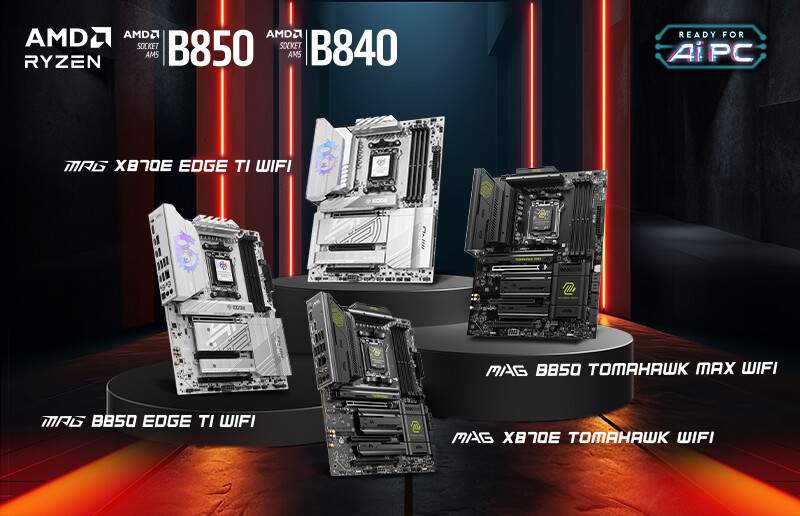
MSI introduced an impressive number of new AMD B850 and B840 chipset-based motherboards at January's CES trade event. According to a Wccftech report, the company's AM5—socketed lineup will expand in the near future—a leaked presentation slide provides an early preview of (allegedly) incoming budget-friendly offerings. MSI's leaked roadmap (Q1 to Q2 2025) shows new additions—mostly smaller form factor—across performance (MPG) and Pro Series product ranges. Their Arsenal Gaming (MAG) B850 range seems to be fully released, as of the first quarter of this year—consisting of models already unveiled at CES.

Five new models are seemingly lined up for release within the next couple of months—the Wccftech article listed the following SKUs: MPG B850I Edge WIFI (Mini-ITX), PRO B850M-P WIFI (M-ATX), PRO B850M-B (M-ATX), B850 Gaming PLUS WIFI PZ (ATX) and PRO B850M-A WIFI PZ (M-ATX). The publication commented on its discoveries: "as you can see, MSI will have at least one new variant within the MPG lineup which will feature a Mini-ITX design. The company has already released the full ATX-sized version of the EDGE TI WIFI, and it's nice to know that we will get a Mini-ITX variant too." The report proposes that MSI has prepped its new budget models with the latest connectivity features—most notably, Wi-Fi 7 rated at the full 320 MHz band. Support for Zen 4 and 5 Ryzen X3D CPUs is expected upon launch.

Samsung Reportedly Optimizing Exynos 2500 SoC for Late 2025 Launch

At the end of January, Samsung Electronics released their financial results for the fourth quarter and the fiscal year 2024. Smartphone tech watchdogs paid close to attention to the South Korean giant's accompanying earnings call. The recently released Galaxy S25 smartphone family is, exclusively, powered by Qualcomm Snapdragon 8 Elite chipsets—insiders believe that Samsung opted out of utilizing proprietary chip designs (for this generation) due to missed production goals. Late last year, inside sources pointed to the foundry's allegedly problematic 3 nm Gate-All-Around (GAA) process node. Follow-up reports suggest that Samsung engineers have moved onto developing a 2 nm manufacturing process, possibly linked to a re-designed Exynos 2500 flagship mobile processor.

Brian Ma, a technology industry analyst, extracted relevant information from Samsung's recent earnings meeting—several press outlets have picked up on his brief social media post. The IDC employee stated: "Samsung System LSI just mentioned in its earnings call that it's optimizing Exynos 2500 and 'aiming' to secure design wins for mobile models scheduled for release in 2H" The rumor mill has proposed that new "Galaxy Z Flip 7 and Fold 7" smartphone models are currently in the development pipeline—coincidental timing indicates that the two devices could launch later in 2025, potentially with next-gen flagship Exynos SoCs onboard. Tipsters reckon that the Exynos 2500 is configured with a 10-core cluster, and its integrated graphics solution will be an AMD RDNA 3.5-enabled Xclipse 950 model.

Apple Reportedly Cancels AR Smart Glasses Project

Bloomberg's Mark Gurman believes that Apple's headset design department has cancelled a long-gestating project. Development of the company's augmented reality (AR) smart glasses—allegedly codenamed "N107"—ceased not long ago, according to the journalist's insider network. At first, Apple's augmented reality engineering team supposedly envisioned the (regular/normal-sized) glasses being powered via a direct connection to a wearer's iPhone. Gurman reckons that the smartphone-connected system was a mega-drainer of batteries, due to the onboard chipset being a bit of a power hog. Apple proceeded to experiment with a glasses-linked up-to-Mac concept—reportedly, company leadership canceled the project after rejecting the inelegant personal computer-powered solution.

Apple's AR smart glasses could have competed with a similar next-gen offering, upon a rumored 2027 launch—Meta's "Orion" solution is still in a concept phase. Leaked feature set information indicates functionality akin to Xreal's One AR series, albeit with a required connection to a compatible Mac computer. The Apple headset department has struggled (allegedly) with the development of various concepts—going far back as 2017, according to several of Gurman's reports. Two years ago, he heard whispers about the AR/VR team labelling their N107 project as a "hopeless" prospect. By Mid-2024, industry leaks indicated an end of development for the "expensive Vision Pro 2" mixed reality headset.
Return to Keyword Browsing
Nov 24th, 2026 04:27 CST change timezone

New Forum Posts

Popular Reviews

TPU on YouTube

Controversial News Posts