News Posts matching #NAND flash

Return to Keyword Browsing

Green House Intros GH-SSDxGS-1MA 1.8" SATA SSDs

Japanese company Green House introduced the GH-SSDxS-1MA series (where "x" = capacity in GB). Built in the 1.8" SATA form-factor, the drives are available in capacities of 32 GB (GH-SSD32GS-1MA), 64 GB (SSD64GS-1MA), and 128 GB (GH-SSD128GS-1MA). The drives use MLC NAND flash, and an unknown controller with 64 MB DDR cache. Features such as TRIM, NCQ, and ECC (48bit/2KB) come standard.

Sequential speeds are up to 230 MB/s (read) and 190 MB/s (write) for the 64 GB and 128 GB models; and 220 MB/s (read) with 100 MB/s (write) for the 32 GB model. Backed by 1 million hours MTBF and 1,500G/0.5 ms shock-resistance, the 32, 64, and 128 GB models are priced at 10,500 JPY (US $129), 16,800 JPY (US $206), and 25,200 JPY (US $310), respectively. They are slated for mid-March.


Patriot Memory Names High Powered Industry Veteran Paul McGuire as Executive VP Sales

Patriot Memory, a global pioneer in high-performance memory, NAND flash, storage, and enthusiast computer products is pleased to announce the company has named Paul McGuire as Executive Vice President of Sales. The addition of Mr. McGuire to Patriot Memory's Executive team will swiftly propel the company through its next set of growth objectives. In his role, Mr. McGuire will be overseeing worldwide business development and ramping up sales channels for Patriot Memory's full suite of products.

"As we continue to aggressively expand our global sales initiatives with our key corporate alliances, we are very excited to have Paul McGuire join our team," said Paul Jones, CEO of Patriot Memory. "Paul is an extremely focused executive leader with the experience to be an enormous asset in positioning Patriot Memory for incredible growth in our major global channels."

OCZ AEONDrive DRAM SSD Detailed

As a leading SSD vendor, OCZ sure has a strong engineering muscle to flex. Flex it did, with the AEONDrive DRAM SSD. This drive uses DRAM as its primary storage medium (as long as there's a constant power source). The device is thus ideal for those parts of the datacenter which hold "hot data". Unlike similar solutions such as FusionIO drives, the AEONDrive utilizes SAS 6 Gb/s interface. SAS is a low-overhead protocol since it allows exchange of larger numbers of simultaneous host commands than ATA. As for the performance OCZ claims the AEONDrive provides 140,000 IOPS 4K, and 540,000 IOPS 512. Since DRAM is a much lower-density medium than NAND flash, one should expect AEONDrives to be available only in relatively low capacities such as 64 GB (still big enough for pain databases). Not much more is detailed about the drive. It would be great if the AEONDrive could back itself up onto NAND flash before turning itself off.

EMC Selects Hitachi GST Enterprise-Class Solid State Drives

Hitachi Global Storage Technologies (Hitachi GST), a leading supplier of enterprise-class solid state and hard disk drives, today announced that EMC Corporation (NYSE:EMC) has qualified and is now shipping Hitachi Ultrastar SSD400S SLC-based (single level cell), 2.5-inch, SAS solid state drives (SSD) in its "all Flash" VNX Unified Storage systems for mission-critical Microsoft and Oracle environments. The Ultrastar SSD400S family is the world's first jointly develop SAS and FC enterprise-class SSDs, combining Hitachi GST's proven enterprise HDD strength with Intel's extensive capabilities developing high-endurance SLC NAND flash memory and advanced SSD technology. All of this powers Hitachi GST's leading line SSDs with high endurance, reliability and sustained performance for Tier 0, mission-critical server and storage workloads.

Super Talent Introduces USB 3.0 and PCIe Flash Disk Modules

Super Talent Technology, a leading manufacturer of NAND flash solutions, today announces two new Flash Disk Module (FDM) solutions for Industrial and Embedded applications.
Already known for their IDE, SATA and USB flash disk modules; Super Talent now introduces two new FDM solutions focused on increase performance, PCIe and USB 3.0 FDM modules. Designed for Industrial and Embedded applications, Super Talent's FDM solutions provide high speed data throughput and reliability.

The new USB 3.0 FDM features a 20-pin DIP configuration, now appearing on many new motherboards, and is available in capacities of 8GB to 32GB. These USB 3.0 FDMs mount vertically and measure 32.2mm(h) x 26.2mm(w) and 4mm(t) and can hit speeds of 85MB/s Reads and 40 MB/s Writes.

OCZ Agility 3 180 GB and 360 GB Models Unveiled

While Vertex 3 is OCZ's flagship SATA 6 Gb/s SSD based on the SandForce SF-2281 processor, Agility 3 is its performance-mainstream variant that uses the same SF-2281, but with async NAND flash memory. Reviews have found the drive to offer high price-performance. OCZ has traditionally kept Agility 3 reserved for lower capacities, reserving higher capacities for its other product families., however two new variants hit the radar in the Japanese markets today, the 180 GB (AGT3-25SAT3-180G), which is not even listed on OCZ's global site, and a 360 GB variant (AGT3-25SAT3-360G).

The 180 GB variant offers sequential speeds of up to 525 MB/s read, and 500 MB/s write, with 35,000 IOPS 4K random write performance; while the 360 GB variant offers sequential speeds of 525 MB/s read, 495 MB/s write, and 35,000 IOPS 4K random write performance. Like all other drives in the Agility 3 series, the two are built in the 2.5-inch form-factor, with SATA 6 Gb/s interface. The Agility 3 180 GB is priced at 19,000 JPY (US $256), and the 360 GB variant at 36,000 JPY (US $447).

Greenliant Now Shipping Industrial Grade SATA NANDrive Embedded SSDs

Greenliant Systems, a leader in energy-efficient, highly secure and reliable solid state storage products, has started mass production of its industrial grade SATA interface NANDrive solid state drives (SSDs). Operating at temperatures between -40 and +85 degrees Celsius, I-grade SATA NANDrive devices keep customer data safe while withstanding extreme environments.

The industrial grade SATA NANDrive is currently available in 2 GByte, 4 GByte and 8 GByte, with higher capacities planned. These products combine Greenliant's internally developed NAND controller with single-level cell (SLC) NAND flash die for a fully integrated SSD in a multi-chip package. For applications requiring the endurance and speed of solid state storage in very small form factors, SATA NANDrive is one of the smallest SSDs at 14mm x 24mm x 1.95mm. Offered in a 145 ball grid array (BGA), 1mm ball pitch package for easy and firm mounting to a system motherboard, NANDrive is resistant to shock and vibration.

LSI-SandForce Releases Code to SSD Manufacturers That Adjusts Over-provisioning

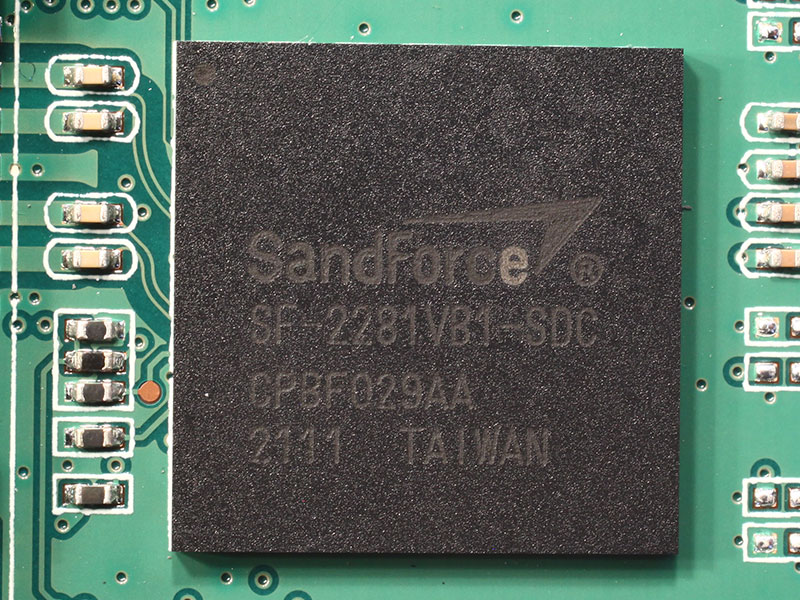
To anyone who's familiar with SSDs, "SandForce" is equally familiar, as it makes the brains of some of the fastest client SSDs in the business. Buyers have also come to know of SandForce-driven SSDs as being characterized by unique capacity amounts caused by allocating a certain amount of the physical NAND flash capacity for some special low-level tasks by the controller, resulting in capacities such as 60 GB, 120 GB, 240 GB, for drives with physical NAND flash capacities of 64, 128, and 256 GB, respectively. This allocation is called "over-provisioning". An impression was built that this ~7% loss in capacity is some sort of a trade-off for higher performance. It appears like that's not quite the case.

SanDisk Follows Kingston, Cuts NAND Flash Product Prices

Following reports that Kingston is reducing prices of its NAND flash-based products by up to 15%, SanDisk too is reportedly preparing price-cuts of its own. Unlike Kingston, SanDisk's entire product portfolio is connected with NAND flash memory, it is the world's largest vendor of memory cards, and also has a vast lineup of USB flash drives. SanDisk will lower its prices just enough to maintain competitiveness with Kingston's products. The company maintains that initiating a price-cutting strategy is intended to boost sales volume and maintain the company's leading market share. According to DRAMeXchange, major NAND flash vendors are initiating price cuts to clear inventories, to make way for flash memory built on newer fabrication technologies.

Kingston To Cut Prices of NAND Flash-Based Products

Memory industry major Kingston is working towards reducing prices of its products that are based on NAND flash memory. This includes a large chunk of Kingston's product portfolio, as the only products excluded would be DRAM. NAND flash-based products include memory cards, USB flash drives, and SSDs. Kingston will reportedly cut prices by as much as 15 percent. Responding to a DigiTimes report, Kingston said that it is adjusting its NAND flash product pricing to coordinate with the rest of the industry to shift towards more advanced processes, and that it wants to enhance its presence in the NAND flash market. In other words, Kingston is clearing its inventory to make way for newer, more advanced technology.

Super Talent Introduces Overclocked Quad Channel DDR3 Kits

Super Talent Technology, a leading manufacturer of NAND flash solutions, today announces their Quadra series, overclocked, quad-channel DDR3 memory kits, targeted at the extreme enthusiast market.

Gamers and enthusiasts already know about Intel's i7-3960X 6-Core processors and now they are scrambling to find DRAM worthy of their new rig. The Quadra, DDR3 Quad-kits, come in 1600 MHz and 1866 MHz and pairs perfectly with the i7 processors, which now handles 4 channels of memory. By fully populating all 8 slots of memory with Super Talent's 4GB DIMMs, users will experience reduced loading times with all their high-system-requirement programs. Now more time can be spent using a computer than waiting on it.

Transcend Announces New SATA III 6Gb/s SSD720 as the Ultimate System Upgrade

Transcend Information, Inc. (Transcend), a worldwide leader in storage and multimedia products, today announced the launch of its new next generation SSD720 SATA III 6Gb/s solid state drive (SSD) that delivers significantly improved computer performance over standard rotating hard drives. Designed with multitasking power users in mind, the productivity-enhancing SSD720 is the ideal solution for demanding system applications, such as specialized multimedia computing and advanced gaming.

Elpida Memory Develops Resistance RAM Prototype

Elpida Memory, Inc. ("Elpida", TOKYO: 6665 JP), the world's third largest Dynamic Random Access Memory ("DRAM") manufacturer, today announced the development of its first-ever high-speed non-volatile resistance memory (ReRAM) prototype. As the ReRAM prototype was made using a 50-nanometer (nm[1]) process technology it has a memory cell array operation of 64 megabits[2], one of the highest densities possible for ReRAM. The prototype was jointly developed with the New Energy and Industrial Technology Development Organization (NEDO), a Japanese-funded public institution. Further work on ReRAM development is being conducted with Sharp Corporation ("Sharp", TOKYO: 6753 JP), the National Institute of Advanced Industrial Science and Technology (AIST, another Japanese public institution) and the University of Tokyo.

ReRAM (Resistance Random Access Memory) is next-generation semiconductor memory technology that uses material which changes resistance in response to changes in the electric voltage. This new type of non-volatile memory can store data even when the power supply is turned off. Its most attractive feature is that it can read/write data at high speeds using little voltage. While dynamic random-access memory (DRAM) is superior to existing non-volatile memory with respect to read/write speeds and endurance, DRAM quickly loses data when the power supply is removed. NAND flash memory, a leading example of nonvolatile memory, retains data even when the power is removed but has performance measures that are inferior to DRAM.

Orange Systems Announces Wings Modular PCIe SSD

Japanese company Orange Systems announced a new modular PCI Express SSD, the "Wings" series, which is a collection of products: the PCIe SSD card, its SSD subunits that have to be purchased separately, and those subunits in hard cases that turn them into 2.5-inch simple SSDs. To begin with, Angelbird has three PCIe SSD main card variants: "Lite", 16 GB, and 32 GB. These cards are basically PCI Express x4 SATA 3 Gb/s RAID cards that have SATA power+data interfaces on the card. The 16 GB and 32 GB cards have a localized SSD subunit on the board, while the "lite" variant has no localized subunit, and relies entirely on attached subunits.

These subunits are basically 2.5-inch SSD PCBs stripped of their cases, which Orange Systems refers to as Wings Expansion Cartridges, which are basically SandForce SF-1220 driven SSDs with MLC NAND flash, available in capacities of 60 GB, 115 GB, and 240 GB. When attached in pairs to the Wings PCIe SSD card, the card's main controller runs them in a RAID 0 configuration that is abstract to the host, delivering increased performance. Lastly, these "Expansion Cartridges" are available with their outer shells, branded as "Crest SSDs".

Patriot Displays Range of Industrial and Macbook Air SSDs

Patriot Memory displayed its four main client bare-PCB SSD lines, the Industrial Series mSATA, Industrial Series half-height-mSATA, 1.8-inch half-height Industrial Series, and Mac Series SSD-stick. All three Industrial Series products are driven by PHISON controllers, and are available in MLC NAND flash and SLC NAND flash variants, each with its own capacity options. The mSATA MLC is available in capacities ranging from 16 GB to 128 GB, mSATA SLC from 4 GB to 32 GB; mSATA half-height MLC from 4 GB to 32 GB, mSATA half-height SLC from 1 GB to 8 GB.

The "Slim SATA" (half-height 1.8-inch) MLC is available in capacities ranging from 16 GB to 128 GB, and its SLC variant is available in capacities ranging from 4 GB to 32 GB. Moving on, Patriot has SSD sticks for Macbook Air, and other Apple devices that support this form-factor, these sticks are driven by SandForce SF-228x controllers, feature MLC NAND flash memory, and are available in capacities of 120 GB, 240 GB, and 480 GB.

RunCore Displays Single-Chip SSDs

RunCore showed off its engineering potential in four "single-chip" solid-state drives (SSDs). If we're playing semantics here, almost every USB flash drive in the market these days is a "single chip SSD", but in context of these drives, "single chip" refers to a component that combines MLC NAND flash and a SATA interface controller into a single package. The number of NAND flash channels internally is not known, but RunCore thinks these chips should offer good performance in the value segment.

The blue PCBs in the first picture depict single-chip SSDs in three main client form-factors: 2.5-inch SATA, 1.8-inch SATA, and mSATA. As you can see, there's just one main chip, no controller, no cache DRAM, nothing else, except power-conditioning components and firmware ROM chips on the back side of the PCB.

OCZ Technology Acquires SANRAD Inc.

OCZ Technology Group, Inc., a leading provider of high-performance solid-state drives (SSDs) for computing devices and systems, today announced it has acquired SANRAD Inc., a privately held provider of flash caching and virtualization software and hardware.

"This transaction is an important step in OCZ's enterprise solid state drive strategy," said Ryan Petersen, CEO of OCZ Technology Group. "It significantly enhances the ability for customers to increase datacenter performance and efficiency by putting more virtual machines (VM) on a server without slowing down the VM's ability to access stored data, thus substantially lowering the overall cost of deployment. SANRAD's VXL has the ability to optimize caching strategies based on the application and support for VMware's vMotion, which sets the solution apart from others in the industry, allowing enterprises to finally realize the benefit of running a single unified virtualized environment," concluded Mr. Petersen.

Memoright Announces 7 mm-Slim SSDs

With the Ultrabook form-factor gaining prominence, there's an urgent need for notebook components to shape up, so is the case with storage devices. A little earlier this month, Crucial announced its latest M4 series SSD in the 2.5" SATA form-factor, which is just 7 mm-slim, as opposed to the ~9.3 mm thickness that's standard. It looks like more SSD makers are hopping into this trend, including Memoright, which launched its FTM Plus Slim series. For SSDs, slimmer 7 mm enclosures don't affect components inside, as SSDs are essentially a printed-circuit board with controllers, DRAM and NAND flash chips.

The FTM Plus Slim series have otherwise the same specifications as the regular (9.3 mm-thick) FTM Plus series. These drives are driven by SandForce SF-2281 controllers, with sequential transfer rates of up to 550 MB/s reads, 500 MB/s writes, and 55,000/50,000 read/write 4K IOPS. They take advantage of SATA 6 Gb/s interface to achieve those speeds. Like its thicker siblings, the FTM Plus Slim will be available in 60 GB, 120 GB, 240 GB, and 480 GB capacities.

Patriot Announces Gauntlet WiFi Wireless Network-Attached Storage

Patriot Memory, a global pioneer in high-performance memory, NAND flash, storage, and enthusiast computer products today launches its new portable cloud solution the Gauntlet Wifi. Designed for seamless integration with tablets and other popular mobile devices, the Gauntlet Wifi offers superior portability with the ability to connect up to 5 devices for immediate access to stored data on the go.

With App support for IOS, Android, and plug and play compatibility with Windows based operating systems, the Gauntlet Wifi will offer one of the most robust and easy to use personal cloud storage solutions. For ultimate portability and streaming on the go, a built in lithium-ion battery will power the Gauntlet Wifi for up to 5 hours of data streaming. Streaming content will be supported in media player applications and IE 6 or higher, Firefox, and Safari.

Toshiba to Launch SLC NAND Flash Memory Embedded ECC

Toshiba Corporation today announced the development of BENAND, a versatile, multi-application single level cell (SLC) NAND flash memory with an embedded error correction code (ECC). BENAND's diverse applications include LCD TVs and digital cameras along with robots and other industrial applications. Samples of eight BENAND products in two capacities, 4 Gigabit and 8 Gigabit, will be available from today and mass production will follow from March 2012.

The simple interface and high reliability of small capacity SLC NAND has won it wide use in consumer applications and industrial programming. Until now, the ECC has been embedded in the host processor and corrected 1 bit per 512 bytes. However, advances in memory process technology require enhanced error correction; more than 4 bit correction per 512 bytes for NAND flash fabricated with 32nm process. For NAND flash memory without ECC fabricated with 32nm and beyond, the controller in the host processor must be changed to secure the required level of correction.
Return to Keyword Browsing
Nov 11th, 2026 07:09 CST change timezone

New Forum Posts

Popular Reviews

TPU on YouTube

Controversial News Posts