News Posts matching #NVIDIA

Return to Keyword Browsing

NVIDIA Launches RTX PRO 4500 Blackwell Server Edition GPU

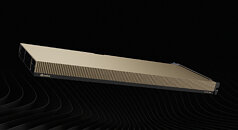
NVIDIA has added another graphics card to its server lineup, this time in the form of a passively cooled, single-slot RTX PRO 4500 Blackwell Server Edition GPU. The company positions this release as a highly efficient GPU for compute-dense environments. It comes with 10,496 CUDA cores, 82 Ray Tracing cores, and 32 GB of GDDR7 memory running on a 256-bit bus, providing 800 GB/s of memory bandwidth, all within a total graphics power of 165 W. This specification is similar to the current RTX PRO 4500 Blackwell with an active dual-slot cooler but saves a few watts of TGP, as the actively-cooled edition has a 200 W TGP. The difference in TGP is attributed to higher-binned "Blackwell" GB203 dies with better frequency tuning, resulting in a similar performance target for this GPU. This server edition SKU also reduces memory bandwidth, running the 32 GB GDDR7 modules at 25 Gbps effective, while the regular blower-style RTX PRO 4500 Blackwell uses full 28 Gbps modules.

This server edition SKU is designed for server configurations that require hyper-dense setups, where a single-slot solution will be cooled by high-RPM server fans. For example, server farms could install a dozen of these GPUs in parallel within a single system, stacking them as long as there are available PCIe slots. High airflow chassis would push air through the passively cooled GPU shroud, cooling the 165 W TGP. Interestingly, this is not even the most efficient GB203 bin with 10,496 CUDA cores, as NVIDIA offers a GeForce RTX 5090 Mobile GPU SKU with only a 95 W TDP. However, that comes at the cost of some clock speeds, which are still unknown for the newest RTX PRO 4500 Blackwell Server Edition GPU.
Supermicro Unveils NVIDIA BlueField-4 STX Storage Server

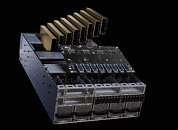
Supermicro, Inc. (NASDAQ: SMCI), a Total IT Solution Provider for AI, Cloud, Storage, and 5G/Edge, today unveiled one of the industry's first context memory (CMX) storage server as part of NVIDIA STX reference architecture announced NVIDIA GTC 2026. STX is a new modular reference architecture from NVIDIA which is designed to accelerate the full lifecycle of AI.

"Supermicro continues to be first to market with new rack scale architectures designed to exceed the needs of a rapidly evolving AI Factory customer base," said Charles Liang, president and CEO of Supermicro. "Building upon last year's introduction of the Petascale JBOF (Just a Bunch of Flash), where we proved the feasibility of a JBOF powered by NVIDIA BlueField-3 DPUs, we have developed the CMX storage server. Our prototype of the latest storage architecture demonstrates the level of our collaboration with NVIDIA, and our commitment to be first-to-market with game changing technologies."

ASUS Republic of Gamers Strix Laptop Lineup Returns With the Latest Intel Core Ultra 9 290HX Plus Processors

ASUS Republic of Gamers (ROG) is proud to launch the 2026 ROG Strix G16 and Strix G18, two incredible gaming laptops featuring the latest hardware and technology to deliver incredible performance to gamers everywhere. Boasting the all-new Intel Core Ultra 9 290HX Plus processor and up to an NVIDIA GeForce RTX 5080 Laptop GPU, these machines are built from the ground up for enthusiast gamers. Both the ROG Strix G16 and G18 feature the latest ROG displays, cooling, and tool-less chassis designs that allow gamers to seamlessly upgrade critical components. Later this year, the flagship ROG Strix SCAR 18 will also be unveiled, delivering flagship performance in an incredibly sleek ROG chassis.

Elite performance for every arena
The 2026 Strix G16 and G18 gaming laptops are engineered for players and creators who demand uncompromising performance across competitive esports titles, visually rich AAA games, and intensive content-creation workflows. Both models feature the latest Intel Core Ultra 9 290HX Plus processor, delivering exceptional multi-threaded power and next-generation AI capabilities.

Silicon Motion Showcases Enterprise SSD Controllers and PCIe NVMe Boot Drive Solutions at GTC 2026

Silicon Motion Technology Corporation, a global leader in designing and marketing NAND flash controllers for solid-state storage devices, today announced that it will showcase a rich portfolio of differentiated enterprise SSD controllers and PCIe NVMe BGA boot SSD at NVIDIA GTC 2026, Booth #3015, purpose-built to meet the evolving requirements of the NVIDIA AI ecosystem. As AI models scale, inference architectures are extending beyond HBM and System DRAM into high-performance NAND storage tiers, as reflected in NVIDIA's ICMS initiative. In this new architecture, NAND-based Storage becomes a performance-critical layer that requires deterministic latency and quality-of-service differentiation.

Silicon Motion delivers a vertically integrated storage solution encompassing advanced SSD controller design, full firmware development, and compact Reference Design Kits (RDKs) aligned with leading enterprise form factors such as E1.S, E1.L, E3.S, E3.L, and U.2 for AI server deployments. The company also provides enterprise PCIe NVMe BGA boot SSD with strong endurance and long-term operational stability, deployed in AI systems.

NVIDIA's DLSS 5 Keeps Image Quality Consistent with Artistic Intent

Yesterday, NVIDIA unveiled its latest DLSS 5 technology, offering gamers the first real-time neural rendering. However, even after the announcement, many questions arose about what DLSS 5 is capable of and how it will work with games. NVIDIA released a FAQ to address some common inquiries. The primary goal of DLSS 5 is to enhance visual fidelity through various techniques that create scenes with photorealistic lighting and materials. Perhaps the most interesting aspect is that DLSS 5 will honor the original artistic intent by using the game's color and motion vectors for each frame, anchoring the DLSS 5 model to the specific setting. This keeps the output in line with what the game developers originally envisioned for each frame. DLSS 5 will add visual enhancements that help each frame undergo an overhaul.

This overhaul is completed in several steps. The first is cinematic lighting, achieved through complex effect reconstruction for realistic skin glow, shadows, and more. Next is material depth—DLSS 5 applies micro-realism to the surface of any object, such as a rock or a wall, delivering a realistic texture that enhances the game. NVIDIA highlights that its latest DLSS installment offers temporal consistency, meaning the image quality is fine-tuned frame by frame to closely follow the game content, ensuring visual enhancements remain consistent. Interestingly, this technology will work alongside existing techniques like path tracing, where path tracing provides lighting accuracy, and DLSS enhances lighting photorealism. This means path tracing improves overall shadow behavior and reflections, while DLSS 5 makes them as realistic as possible.

Acer Refreshes Predator Helios Neo Gaming Laptops With Intel Core Ultra 200HX Plus and NVIDIA GeForce RTX 5080 Laptop GPUs

Acer today announced refreshed Predator Helios Neo series gaming laptops equipped with the latest Intel Core Ultra 200HX Plus series processors and up to an NVIDIA GeForce RTX 5080 Laptop GPU, bringing the latest performance capabilities to gaming enthusiasts across a range of form factors and display options. The new Intel Core Ultra 200HX Plus series processors power a new class of gaming laptops with significant performance gains over the previous generation. These devices are built for split-second responsiveness, rock-solid FPS, smart tuning, and battery life that keeps players locked in across an extensive selection of games and apps.

Powered by NVIDIA Blackwell, NVIDIA GeForce RTX 50 Series Laptop GPUs bring game-changing capabilities to gamers and creators. Equipped with a massive level of AI horsepower, the RTX 50 Series enables new experiences and next-level graphics fidelity. Multiply performance with NVIDIA DLSS 4.5 and generate images at unprecedented speed.

Giga Computing Shows Data Center Portfolio and Infrastructure at NVIDIA GTC 2026 Including New NVIDIA Rubin Platforms

Giga Computing, a subsidiary of GIGABYTE and a leader in accelerated computing and infrastructure solutions, today announced new enterprise AI solutions that support NVIDIA Vera CPU and NVIDIA Vera Rubin platform, well as a new AI factory in Taiwan. The GIGABYTE booth at NVIDIA GTC shows scalable AI solutions that not only focus on performance and efficiency but also incorporate the software and infrastructure needed to build AI factories and other large GPU clusters. The GIGABYTE booth staff is ready to introduce the latest hardware and software for success in deploying accelerated computing.

Personal AI Supercomputers
With products spanning all segments of the supercomputer space, Giga Computing showcases professional desktop and deskside solutions that are ideal for AI development and accelerating AI training and inference workloads. These solutions are being used by data scientists and researchers in research institutions, government agencies, and enterprises.

ASUS Announces 2026 TUF Gaming Laptop Lineup

ASUS is proud to announce the launch of the 2026 TUF Gaming A16, F16, and A18 gaming laptops. The TUF Gaming A16 and F16 boast two impressive display options, either a gorgeous 2.5K 120 Hz OLED panel or an ultra-fast 2.5K 300 Hz IPS display. Both models feature advanced anti-reflection coatings on the panel for increased immersion, while the TUF Gaming F16 also comes equipped with the all-new Intel Core Ultra 9 processor 290HX Plus. The larger TUF Gaming A18 sports up to an NVIDIA GeForce RTX 5070 Ti Laptop GPU and a lightning-fast 2.5K 300 Hz IPS display for a truly impressive and immersive gaming experience.

16-inch upgrades
The 16-inch TUF Gaming A16 and F16 receive major upgrades this generation, headlined by two premium new display configurations designed to elevate both immersion and competitive play. Users can choose between a stunning 2.5K 120 Hz OLED panel featuring a Corning DXC advanced anti-reflection coating, or an ultrafast 2.5K 300 Hz IPS panel enhanced with ACR anti-reflection technology for clearer visibility in bright environments. These advanced coatings significantly reduce glare while preserving color accuracy and contrast even when viewed at off angles, ensuring gameplay remains sharp and distraction-free and increasing immersion across your entire gaming library.

MSI Launches XpertStation WS300 on NVIDIA DGX Station Architecture

MSI today announced the launch of XpertStation WS300 on NVIDIA DGX Station Architecture, a next-generation deskside AI supercomputer built to support the accelerating demands of large language models (LLMs), generative AI, and advanced data science workflows. Powered by NVIDIA GB300 Grace Blackwell Ultra Desktop Superchip, supporting up to 748 GB of large coherent memory and dual 400GbE networking, the platform extends advanced AI infrastructure capabilities into a compact deskside deployment model and is available for order starting today.

"MSI has a strategic vision to advance AI-first computing," said Danny Hsu, General Manager of MSI's Enterprise Platform Solutions. "With NVIDIA, we are defining the next era of AI infrastructure, bridging centralized performance and distributed innovation, and enabling organizations to move from experimentation to production with greater speed, scale, and confidence."

ASUS Unveils Liquid-Cooled AI Infrastructure Powered by NVIDIA Vera Rubin Platform

ASUS today unveiled its fully liquid-cooled AI infrastructure at NVIDIA GTC 2026 (Booth# 421), delivering a comprehensive, end-to-end solution powered by the NVIDIA Vera Rubin platform. Under the theme Trusted AI, Total Flexibility, this customizable framework—from rack-scale AI Factories, desktop AI supercomputing, Edge AI to Enterprise AI solutions—enables enterprises and cloud providers to build high-performance, energy-efficient large-scale AI clusters with unmatched efficiency and dramatically reduced PUE and TCO.

As a provider of NVIDIA GB300 NVL72 and NVIDIA HGX B300 systems, the flagship ASUS offering is the ASUS AI POD built on the NVIDIA Vera Rubin platform—a liquid-cooled, rack-scale powerhouse designed for massive AI workloads. Through strategic partnerships with leading cooling and component providers, ASUS offers diverse cooling modalities, tailored thermal solutions, and redundancy to meet any enterprise requirement. Proven by global client successes, ASUS provides expert consultation, a broad portfolio of AI and storage solutions, seamless infrastructure deployment, application integration, and ongoing services—combining scalability, and sustainability to drive business value and intelligence.

SK hynix Showcases AI Memory Leadership at NVIDIA GTC 2026

SK hynix Inc. announced today that it is participating in GTC 2026, held from March 16 to 19 in San Jose, California. NVIDIA GTC is the global AI conference where business leaders and developers gather to share the latest breakthroughs and future trends in AI and accelerated computing. SK hynix memory solutions are designed to minimize data bottlenecks and maximize performance for both AI training and inference in NVIDIA AI infrastructure. Through its participation in GTC 2026, the company plans to demonstrate its competitive edge in memory technology—the core infrastructure of the AI era.

Under the theme "Spotlight on AI Memory," SK hynix will feature an exhibition space dedicated to the AI memory technologies and solutions. The booth will consist of three main areas: the NVIDIA Collaboration Zone, the Product Portfolio Zone, and the Event Zone. The exhibition is designed around interactive content to provide visitors with an intuitive understanding of AI memory technology.

Samsung Unveils HBM4E Solutions at NVIDIA GTC 2026

Samsung Electronics, a global leader in advanced semiconductor technology, today announced the comprehensive AI computing technologies it will showcase at NVIDIA GTC 2026 in San Jose, California, scheduled for March 16-19. As the industry's only semiconductor company offering a total AI solution spanning memory, logic, foundry and advanced packaging, Samsung will exhibit its full suite of products and solutions that enable customers to design and build groundbreaking AI systems. To learn more about Samsung's AI solutions, please visit the company's GTC 2026 booth (#1207).

The centerpiece of Samsung's showcase at NVIDIA GTC 2026 will be the new sixth-generation HBM4, which is now in mass production and is designed for the NVIDIA Vera Rubin platform. Samsung's HBM4 is expected to help accelerate the development of future AI applications, delivering consistent processing speeds of 11.7 gigabits-per-second (Gbps), which exceeds the industry standard of 8 Gbps, and can be enhanced to 13 Gbps.

Penguin Solutions Introduces Industry's First Production-Ready CXL-Based KV Cache Server

Penguin Solutions, Inc. (Nasdaq: PENG), the AI factory platform company, today announced the industry's first production-ready KV cache server that utilizes CXL memory technology to address the critical "memory wall" challenge in AI inferencing—Penguin Solutions MemoryAI KV cache server. This innovative solution delivers up to 11 TB of CXL-based memory engineered to optimize performance of enterprise scale inference, including agentic AI. The result is lower latency, higher throughput, increased efficiency of GPU clusters, consistent achievement of stringent service-level agreements (SLAs), and faster time-to-first-token (TTFT).

While model training and tuning is primarily compute-bound and occurs episodically, the continuous memory-bound and latency-sensitive inference workloads required for inference and agentic AI are complex and fundamentally different. Inference demands are typically 30% compute driven (GPU) and 70% memory driven (RAM), elevating the need for greater memory capacity and causing performance bottlenecks and GPU idle time. Accelerating memory-dependent AI processes, Penguin's MemoryAI KV cache server increases memory capacity by integrating 3 TB of DDR5 main memory and up to eight 1 TB CXL Add-in Cards (AICs).

Dell First to Ship NVIDIA GB300 Desktop with NemoClaw and OpenShell

Dell Technologies (NYSE: DELL) today announces support for NVIDIA NemoClaw and NVIDIA OpenShell, expanding its collaboration with NVIDIA to advance secure, autonomous AI agents. For developers working locally, Dell and NVIDIA are teaming up on NVIDIA NemoClaw—an open source stack that simplifies running OpenClaw always-on assistants, more safely, with a single command. As part of the NVIDIA Agent Toolkit, it installs the NVIDIA OpenShell, an open source runtime providing a secure environment for running autonomous agents, and open source models like NVIDIA Nemotron.

Dell Pro Max with GB10 and GB300 provide purpose-built desktop platforms that allow enterprises to build and run autonomous, self-evolving agents locally with frontier-level intelligence. As the first OEM to ship a desktop with NVIDIA GB300 Grace Blackwell Ultra Desktop Superchip, Dell brings 20 petaFLOPS of performance and 748 GB of memory directly to developers' desks.

KIOXIA Announces New Super High IOPS SSD Series

Kioxia America, Inc. today announced the development of its Super High IOPS SSD, a new type of SSD enabling the GPU to directly access high-speed flash memory as an expansion to High Bandwidth Memory (HBM) in AI systems. The new Super High IOPS SSD, the KIOXIA GP Series, is purpose-built to meet the growing performance demands of AI and high-performance computing, providing larger GPU-accessible memory capacity for faster data access to AI workloads. Evaluation samples of KIOXIA GP Series will be available to select customers by the end of 2026.

The NVIDIA Storage-Next initiative addresses the anticipated shift from compute-intensive to data-intensive workloads and the expanded need for GPU-accessible memory space, currently limited by HBM size. Expanding the GPU's usable memory space allows access to larger data sets and improves GPU utilization by moving more data closer to compute resources.

Supermicro Reveals DCBBS with New NVIDIA Vera Rubin NVL72, HGX Rubin NVL8, and Vera CPU Systems

Super Micro Computer, Inc. (NASDAQ: SMCI), a Total IT Solution Provider for Cloud Computing, AI/ML, Storage, and 5G/Edge, today unveiled its upcoming system portfolio powered by the NVIDIA Vera Rubin platform. As data centers transform into AI factories, producing intelligence at massive scale, agentic reasoning, long-context AI, and Mixture-of-Experts (MoE) workloads are driving demand for an entirely new class of compute and storage infrastructure. Supermicro's NVIDIA Vera Rubin NVL72, NVIDIA HGX Rubin NVL8, NVIDIA Vera CPU systems are being designed and built with Supermicro's Data Center Building Block Solutions (DCBBS) advanced liquid-cooling technology stack to accelerate time-to-market for customers.

"We are entering a new era where every organization requires an AI factory to win in the marketplace, as the demand for inference workloads is reshaping what data center infrastructure must deliver," said Charles Liang, president and CEO of Supermicro. "Supermicro's DCBBS technology stack is being engineered to empower upcoming NVIDIA Vera Rubin NVL72, HGX Rubin NVL8, and Vera CPU systems to give our customers a fast, clear path to deploying next-generation AI factories, at scale. We are excited to provide an early look at these solutions as a testament to being first to market with the infrastructure that will power the next frontier of AI."

Intel Xeon 6 Used as Host CPUs in NVIDIA DGX Rubin NVL8 Systems

Today at NVIDIA GTC 2026, Intel announced that Intel Xeon 6 is being used as the processor for NVIDIA DGX Rubin NVL8 systems. This highlights Xeon's role in providing architectural continuity and scalability for GPU-accelerated AI systems as workloads shift toward massive, real-time inference.

"AI is shifting from large-scale training to real-time, everywhere inference-driven by agentic AI and reasoning systems," said Jeff McVeigh, corporate vice president and general manager, Data Center Strategic Programs at Intel. "In this new era, the host CPU is mission-critical. It governs orchestration, memory access, model security, and throughput across GPU-accelerated systems. Intel Xeon 6 delivers leadership performance, efficiency, and compatibility with the extensive x86 software ecosystem that customers rely on to scale inference workloads."

NVIDIA Launches BlueField-4 STX Storage Architecture With Broad Industry Adoption

NVIDIA today announced NVIDIA BlueField-4 STX, a modular reference architecture that enables enterprises, cloud and AI providers to easily deploy accelerated storage infrastructure capable of the long-context reasoning required for agentic AI. Traditional data centers provide high-capacity, general-purpose storage but lack the responsiveness required for seamless interaction with AI agents that work across many steps, tools and sessions. Agentic AI demands real-time access to data and contextual working memory to keep conversations and tasks fast and coherent. As context grows, traditional storage and data paths can slow AI inference and reduce GPU utilization.

NVIDIA STX allows storage providers to build infrastructure that keeps data close and accessible at scale, so agentic AI factories can deliver higher throughput and responsiveness across inference, training and analytics. The first rack-scale implementation includes the new NVIDIA CMX context memory storage platform, which expands GPU memory with a high-performance context layer for scalable inference and agentic systems - providing up to 5x tokens per second compared with traditional storage.

NVIDIA Launches Vera CPU, Purpose-Built for Agentic AI

NVIDIA today launched the NVIDIA Vera CPU, the world's first processor purpose-built for the age of agentic AI and reinforcement learning—delivering results with twice the efficiency and 50% faster than traditional rack-scale CPUs. As reasoning and agentic AI advances, scale, performance and cost are increasingly driven by the infrastructure supporting the models that plan tasks, run tools, interact with data, run code and validate results.

The NVIDIA Vera CPU builds on the success of the NVIDIA Grace CPU, enabling organizations of all sizes and across industries to build AI factories that unlock agentic AI at scale. With the highest single-thread performance and bandwidth per core, Vera is a new class of CPU that delivers higher AI throughput, responsiveness and efficiency for large-scale AI services such as coding assistants, as well as consumer and enterprise agents.

NVIDIA Unveils DLSS 5 with Real-Time Neural Rendering

NVIDIA today unveiled NVIDIA DLSS 5, the company's most significant breakthrough in computer graphics since the debut of real-time ray tracing in 2018. DLSS 5 introduces a real-time neural rendering model that infuses pixels with photoreal lighting and materials. Bridging the divide between rendering and reality, DLSS 5 empowers game developers to deliver a new level of photoreal computer graphics previously only achieved in Hollywood visual effects.

"Twenty-five years after NVIDIA invented the programmable shader, we are reinventing computer graphics once again," said Jensen Huang, founder and CEO of NVIDIA. "DLSS 5 is the GPT moment for graphics—blending hand-crafted rendering with generative AI to deliver a dramatic leap in visual realism while preserving the control artists need for creative expression."

MSI Accuses NVIDIA of 20% GPU Undersupply, Follows ASUS Down DDR4 Production Increase

As PC gamers and enthusiasts, we all know by now that there is a supply shortage of various silicon components in the personal computing market, with the blame largely falling on AI demand and NVIDIA's and AMD's pivots to AI data center supply. In a recent report by Money UDN MSI's General Manager, Huang Jinqing, predicts a 15-30% price increase for its gaming products across the board as a result of the current market conditions. Jinqing goes on to say that there is an NVIDIA GPU supply shortage on the order of 20%.

As a result of the current supply shortages, Jinqing suggests that the overall PC market will shrink by as much as 10-20%. Recent retailer reports paint a slightly grimmer picture, though, with Mindfactory's sales figures pointing to a more significant decline in GPU sales volume. In light of the recent shortages, especially of DDR5 memory, hardware makers have turned to older platforms, with ASUS announcing increased production for DDR4 motherboards. Now, it seems as though MSI will follow ASUS down that path, with Jinqing confirming that it has signed long-term contracts for memory and shifted production to increase DDR4 motherboard output.

Mindfactory Reports AMD Radeon RX 9070 XT Still Tops Sales Charts but GPU Sales Plummet

German retailer Mindfactory indicates that AMD's Radeon RX 9070 XT is its top-selling GPU for weeks 9-11 of 2026 (meaning March 1-15), although it also indicated that there is a dramatic decrease in GPU sales during the same time period. According to the retailer data (shared by TechEpiphanyYT on X), AMD made up 55.6% of the outlet's sales for that time period, with the AMD Radeon RX 9070 XT in the lead as top seller with 25.6% market share and the RX 9060 XT following that up with 20.3%. The next five spots, though, are all NVIDIA GPUs—namely the RTX 5080 at 11.8%, the RTX 5070 Ti at 9%, the RTX 5060 and 5070 at 7% each, and the RTX 5090 at 5.3%.

The next-most-popular AMD GPU at Mindfactory was the Radeon RX 7600 in the eighth spot, with the RX 7900 XTX, 7900 XT, and 7700 XT following in 10th, 11th, and 12th place. Curious as it may seem to see AMD in the lead where NVIDIA usually dominates in most other markets, it follows trends set by previous Mindfactory reports. More concerning, GPU sales have also reportedly fallen to roughly a third of their usual numbers, likely as a result of stock shortages and skyrocketing hardware prices across the board. While recent reports indicate that GPU prices might be correcting slightly, at least on the AMD side, other component supply issues and the resulting high prices may be dissuading people from platform upgrades or fresh PC builds altogether.

Optical Scale-up Consortium Established to Create an Open Specification for AI Infrastructure

The Optical Compute Interconnect (OCI) Multi-Source Agreement (MSA) group today announced its formation, led by founding members AMD, Broadcom, Meta, Microsoft, NVIDIA and OpenAI. This industry consortium marks a pivotal shift toward a hyperscaler-driven open ecosystem to enable the development of a multi-vendor supply chain for optical scale-up interconnects. By aligning on an open specification, the OCI MSA members are promoting a robust optical ecosystem which will ensure that the future of AI interconnects is built with a flexible, multi-vendor foundation to meet the optical interconnect needs of modern AI infrastructure.

The Physics and Power Mandate
As large language models (LLMs) advance toward super intelligence, traditional copper-based connectivity is reaching limitations in physical reach which are impacting AI cluster scale-up domain architectures. OCI will enable migration from copper-based to optical-based scale-up architectures, alleviating copper interconnect bottlenecks.

Meta Unveils Four MTIA Chips Focused on High-Perfomance Inference

Meta has laid out an aggressive, inference-first roadmap for its in-house accelerators, announcing four Meta Training and Inference Accelerator (MTIA) generations developed with Broadcom and due to be integrated into its data centers over the next two years. The family spans MTIA 300, 400, 450, and 500, with early units already running ranking and recommendation workloads and later designs optimized for real-time model serving. Since Meta runs some of the largest social platforms on the web, developing a fast inference accelerator is required to make social media browsing and recommendation algorithms instant. Rather than pursuing raw peak arithmetic alone, Meta emphasizes memory throughput and inference efficiency. According to the specification table, HBM bandwidth and capacity rises substantially across the series while compute grows more linearly. This means that Meta's point is increasing on-package bandwidth and capacity which can cut latency and power costs for production inference.

The MTIA chips also include hardware support for attention primitives and mixture-of-experts layers, along with low-precision formats tailored to inference to reduce conversion overhead. Software compatibility was a stated priority. Meta says the stack runs natively on common frameworks, so existing production models can be deployed on both GPUs and MTIA without major rewrites, which should ease adoption. Multiple MTIA generations are built to share the same chassis, rack, and networking, allowing upgrades by swapping modules rather than refitting data center infrastructure. That modularity helps explain Meta's fast release cadence compared with the industry norm, considering that Meta's data centers span millions of chips. MTIA chips are already running at kilowatt power budgets and PetaFLOPS of compute, so MTIA accelerators are also competing with industry-leading solutions from NVIDIA, AMD, and other hyperscalers.

NVIDIA Confirms: No Missing ROPs on RTX PRO 5000 "Blackwell" GPU

NVIDIA has officially confirmed the ROP count for its Pro-Viz RTX PRO 5000 "Blackwell" graphics card, listing it at 160 ROPs for this GPU. Reddit user "xmikjee" posted on the NVIDIA subreddit that his recently purchased RTX PRO 5000 "Blackwell" graphics card with 48 GB has 160 ROPs instead of the 176 that our database and several online sources initially suggested. However, NVIDIA has confirmed for TechPowerUP that this is an error and that the card officially comes with 160 ROPs, as detected by our GPU-Z software. GPU-Z reads the ROP count on the GPU as soon as the driver is installed. This means that "live data" is shown and read using NVIDIA drivers that are probed by the GPU-Z utility, which then reports the ROP count. Coincidentally, another user in the thread mentioned that his card also runs with 160 ROPs as detected by GPU-Z.

To understand why the ROP count on the RTX PRO 5000 "Blackwell" matters, it's helpful to know how NVIDIA structures its GPUs. The chip is built in layers, starting with Graphics Processing Clusters (GPCs) at the top, breaking down into Texture Processing Clusters (TPCs), and then into Streaming Multiprocessors (SMs), which are the cores doing the actual work. ROPs follow this same hierarchy, with each GPC contributing 16 ROPs. On a fully loaded "Blackwell" GB202, that totals 192 ROPs across 12 GPCs. The RTX PRO 5000 "Blackwell" takes an interesting path. With 14,080 CUDA cores, pointing to just under 7 GPCs worth of compute, you might expect a leaner configuration. However, NVIDIA used 10 fully active GPCs on the card, leaving some SMs off. This results in a ROP count of 160, which is notably strong for a professional card at this tier. It suggests that NVIDIA was quite generous with the silicon it left enabled and indicates the segmentation the company is doing within the GB202 SKU. Considering the very expensive RTX PRO 5000 "Blackwell" professional graphics card that NVIDIA lists for $5,099 on its Amazon store, this is a valid compromise.
Return to Keyword Browsing
Nov 27th, 2026 20:31 CST change timezone

New Forum Posts

Popular Reviews

TPU on YouTube

Controversial News Posts