Wednesday, March 11th 2026

NVIDIA Confirms: No Missing ROPs on RTX PRO 5000 "Blackwell" GPU
NVIDIA has officially confirmed the ROP count for its Pro-Viz RTX PRO 5000 "Blackwell" graphics card, listing it at 160 ROPs for this GPU. Reddit user "xmikjee" posted on the NVIDIA subreddit that his recently purchased RTX PRO 5000 "Blackwell" graphics card with 48 GB has 160 ROPs instead of the 176 that our database and several online sources initially suggested. However, NVIDIA has confirmed for TechPowerUP that this is an error and that the card officially comes with 160 ROPs, as detected by our GPU-Z software. GPU-Z reads the ROP count on the GPU as soon as the driver is installed. This means that "live data" is shown and read using NVIDIA drivers that are probed by the GPU-Z utility, which then reports the ROP count. Coincidentally, another user in the thread mentioned that his card also runs with 160 ROPs as detected by GPU-Z.
To understand why the ROP count on the RTX PRO 5000 "Blackwell" matters, it's helpful to know how NVIDIA structures its GPUs. The chip is built in layers, starting with Graphics Processing Clusters (GPCs) at the top, breaking down into Texture Processing Clusters (TPCs), and then into Streaming Multiprocessors (SMs), which are the cores doing the actual work. ROPs follow this same hierarchy, with each GPC contributing 16 ROPs. On a fully loaded "Blackwell" GB202, that totals 192 ROPs across 12 GPCs. The RTX PRO 5000 "Blackwell" takes an interesting path. With 14,080 CUDA cores, pointing to just under 7 GPCs worth of compute, you might expect a leaner configuration. However, NVIDIA used 10 fully active GPCs on the card, leaving some SMs off. This results in a ROP count of 160, which is notably strong for a professional card at this tier. It suggests that NVIDIA was quite generous with the silicon it left enabled and indicates the segmentation the company is doing within the GB202 SKU. Considering the very expensive RTX PRO 5000 "Blackwell" professional graphics card that NVIDIA lists for $5,099 on its Amazon store, this is a valid compromise.
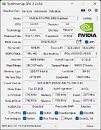
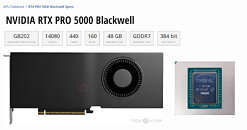 We have reached out to NVIDIA to update our GPU database, as early last year, we discovered that some NVIDIA GeForce RTX 5090 GPUs came with fewer ROPs than officially specified, with only 168 enabled instead of the advertised 176. To avoid additional drama, we have updated the database, and our GPU-Z tool is successfully detecting the correct number of ROPs across all NVIDIA GPUs. For those needing more ROPs on these professional graphics cards, the more expensive RTX PRO 6000 "Blackwell" is an option, featuring the full 192 ROPs on 12 GPCs and 24,064 CUDA cores. But that will set customers back $9,499, according to PNY on its Amazon store.
To understand why the ROP count on the RTX PRO 5000 "Blackwell" matters, it's helpful to know how NVIDIA structures its GPUs. The chip is built in layers, starting with Graphics Processing Clusters (GPCs) at the top, breaking down into Texture Processing Clusters (TPCs), and then into Streaming Multiprocessors (SMs), which are the cores doing the actual work. ROPs follow this same hierarchy, with each GPC contributing 16 ROPs. On a fully loaded "Blackwell" GB202, that totals 192 ROPs across 12 GPCs. The RTX PRO 5000 "Blackwell" takes an interesting path. With 14,080 CUDA cores, pointing to just under 7 GPCs worth of compute, you might expect a leaner configuration. However, NVIDIA used 10 fully active GPCs on the card, leaving some SMs off. This results in a ROP count of 160, which is notably strong for a professional card at this tier. It suggests that NVIDIA was quite generous with the silicon it left enabled and indicates the segmentation the company is doing within the GB202 SKU. Considering the very expensive RTX PRO 5000 "Blackwell" professional graphics card that NVIDIA lists for $5,099 on its Amazon store, this is a valid compromise.


7 Comments on NVIDIA Confirms: No Missing ROPs on RTX PRO 5000 "Blackwell" GPU
Pretty sure that is the bottleneck of this generation.
Sad days
i doubt anyone here wrote on purpose more rop units as previous knownnvidia finally provides specifications for nvidia ... card
nvidia ends speculation on calculation units for nvidia ... card
confirm sounds like a software error. the text reads like some wrong assumption or data went into pages which provide datasheet like facts about graphic cards.
a decent nvidia marketing company and company would cross check its data which is published on tthe most likely number 1 source on the net, techpowerup.
several youtubers quote techpowerup when they talk about graphic card data. and not nvidia. root cause nvidia has a mess on lack of documentation on their homepages when i checked it several times in the past.