News Posts matching #NVIDIA

Return to Keyword Browsing

Liquid Cooling for NVIDIA GB300 "Blackwell Ultra" NVL72 Costs Nearly $50,000

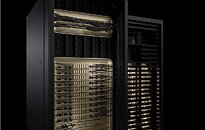
NVIDIA's "Blackwell Ultra" server racks are undoubtedly powerful, but they demand significant system cooling. NVIDIA promotes the GB300 NVL72 as the top configuration: these liquid-cooled racks, built with Grace Blackwell Ultra Superchips, achieve exascale-class dense FP4 performance and offer substantial improvements in throughput-per-megawatt compared to previous HGX platforms. However, this extreme performance mandates massive cooling systems, which can cost around $50,000. According to a valuation model from investment bank Morgan Stanley, NVIDIA is spending nearly $50,000 on cooling for the 72-GPU configuration within its Oberon rack. With each chip rated at 1,400 W TDP, traditional air-based cooling solutions are not feasible.

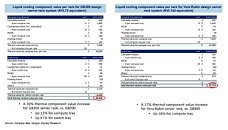
Considering that there are 72 GPUs rated up to 1,400 W, that is over 100 kW from GPUs alone. Add 32 "Grace" CPUs that are powering the system, and you have more than a 100 kW of heat at the peak load. Morgan Stanley models the rack as containing 18 compute trays (each consuming roughly 6.6 kW but needing cooling for about 6.2 kW) alongside nine switch trays. The firm values the cooling components for a single compute tray at about $2,260, which multiplies to roughly $40,680 across the rack. Switch-tray cooling adds about $1,020 per tray, or $9,180 total. High-performance cold plates are singled out as the most expensive parts in the BOM, with per-unit prices in the low hundreds.
Giga Computing Announces Worldwide Availability of Its NVIDIA RTX PRO Server

Giga Computing, a subsidiary of GIGABYTE Group, announces the worldwide availability of its recently launched GIGABYTE XL44-SX2-AAS1, an NVIDIA RTX PRO Server that integrates NVIDIA RTX PRO 6000 Blackwell Server Edition GPUs, NVIDIA BlueField-3 DPU, NVIDIA ConnectX-8 SuperNICs, and NVIDIA AI Enterprise software. The system unifies compute, networking, and software layers to accelerate the full data-to-AI workflow.

Built on the NVIDIA MGX modular reference design, the XL44-SX2-AAS1 supports up to eight NVIDIA RTX PRO 6000 Blackwell Server Edition GPUs for a total of 768 GB of GDDR7 memory, delivering exceptional throughput for generative AI, 3D rendering, and scientific workloads. Dual Intel Xeon 6700/6500 CPUs, 32x DDR5 DIMMs, and 3+1 redundant 3200 W 80 Plus Titanium power supplies ensure performance and reliability.

NVIDIA DLSS 4 Arrives This Week to Final Fantasy VII Rebirth, The Last Caretaker and Deathground

More than 800 games and applications feature RTX technologies, and each week new games integrating NVIDIA DLSS, NVIDIA Reflex, and advanced ray-traced effects are released or announced, delivering the definitive PC experience for GeForce RTX players. Last week, ARC Raiders and Duet Night Abyss joined the ever-expanding catalogue of games featuring DLSS 4 with Multi Frame Generation, ensuring they run and play best on GeForce RTX.

This week, FINAL FANTASY VII REBIRTH adds DLSS 4 with Multi Frame Generation. Plus, Deathground is out now with DLSS 4, and The Last Caretaker launches this week with our performance-multiplying technology. Additionally, Europa Universalis V launches today with DLSS Super Resolution, and Wreckreation is available now.

NVIDIA Releases GeForce 581.80 WHQL Game Ready Drivers

NVIDIA today released the latest version of its GeForce Game Ready drivers. Version 581.80 WHQL comes with day-zero optimization for Call of Duty: Black Ops 7, Anno 117: Pax Romana, and Europa Universalis V. This release adds support for DLSS 4 with Multi Frame Generation and NVIDIA Reflex in Call of Duty: Black Ops 7. Among the gaming bugs fixed with this release are performance optimizations for F1 25 when using DLSS Frame Generation. A general bug causing Vulkan applications to crash when launched on Core 2 Duo and Core 2 Quad CPUs has also been resolved.

NVIDIA listed a few known issues with this release. In Counter-Strike 2, text may appear slightly distorted when running at a resolution lower than the display's native setting. Like a Dragon: Infinite Wealth may exhibit light flickering on certain system configurations after updating to this driver.

DOWNLOAD: NVIDIA GeForce 581.80 WHQL

SK hynix Showcases Full-Stack AI Memory Portfolio at 2025 OCP Global Summit

SK hynix showcased its full-stack AI memory portfolio for enhancing AI and data center infrastructure at the 2025 OCP Global Summit in San Jose, California from October 13-16. The OCP Global Summit is a conference hosted by the Open Compute Project (OCP), the world's largest open data center technology collaboration community. Held under the theme "Leading the Future of AI", this year's event welcomed experts from leading global companies and developers to share the latest trends in data center and AI infrastructure and discuss developing industry solutions.

Under the slogan "MEMORY, Powering AI and Tomorrow," SK hynix presented a range of innovative technologies which improve the performance and efficiency of AI infrastructure. The company's interactive booth was organized into four sections - HBM, AiM, DRAM, and eSSDs - and featured product-based character designs, 3D models of key technologies, and live demonstrations. The centerpiece of SK hynix's booth was its groundbreaking 12-layer HBM4. In September 2025, the company became the first in the world to complete development of HBM4 and establish the product's mass production system. Featuring 2,048 input/output (I/O) channels, twice that of the previous generation, HBM4 offers increased bandwidth and over 40% greater power efficiency. These specifications make it optimized for ultra-high-performance AI computing systems.

NVIDIA and SK Group Build AI Factory to Drive Korea's Manufacturing and Digital Transformation

NVIDIA today announced that it is working with SK Group to build an AI factory to advance semiconductor research, development and production, as well as cloud infrastructure to support digital twin and AI agent development. SK Group is building an AI factory featuring more than 50,000 NVIDIA GPUs, with the first phase planned for completion by late 2027. Once complete, the system is expected to be one of Korea's largest AI factories.

The new factory will serve SK subsidiaries - including SK hynix and SK Telecom (SKT) - as well as external organizations through a GPU-as-a-service model, accelerating digital transformation and industrial innovation for Korea's industries. Further expanding the NVIDIA and SK Group partnership, the companies are collaborating on the development of SK hynix high-bandwidth memory (HBM) and next-generation advanced memory solutions for NVIDIA GPUs, semiconductor manufacturing and telecommunications infrastructure.

NVIDIA and Samsung Build AI Factory to Transform Global Intelligent Manufacturing

NVIDIA today announced plans with Samsung Electronics to build a new AI factory, representing a new era where intelligent computing and chip manufacturing converge. The state-of-the-art AI factory will combine Samsung's semiconductor technologies with NVIDIA platforms to establish the foundation of next-generation, AI-driven production. Powered by more than 50,000 NVIDIA GPUs, Samsung's semiconductor AI factory will be a centerpiece of the company's digital transformation, integrating accelerated computing directly into full-fledged advanced chip manufacturing.

Through this collaboration, Samsung and NVIDIA are setting a global benchmark for AI-driven semiconductor manufacturing at scale, integrating data from physical equipment and production workflows to achieve predictive maintenance, process improvements and increased operational efficiency in autonomous fab environments.

ARC Raiders Available Now With DLSS 4 & Reflex

More than 800 games and applications feature RTX technologies, and each week new games integrating NVIDIA DLSS, NVIDIA Reflex, and advanced ray-traced effects are released or announced, delivering the definitive PC experience for GeForce RTX players. Last week, The Outer Worlds 2, Vampire: The Masquerade - Bloodlines 2, and Jurassic World Evolution 3 all launched with day-one support for DLSS 4 with Multi Frame Generation.

This week, even more DLSS 4 titles join the ever-expanding catalogue of games that run and play best on GeForce RTX, starting with ARC Raiders, which has just launched today with DLSS 4 with Multi Frame Generation, NVIDIA Reflex, and ray tracing. Later this week, Duet Night Abyss launches with DLSS 4 with Multi Frame Generation, and Battlefield 6's battle royale mode is available now, accelerated by DLSS 4. Looking to the future, AION 2, CINDER CITY and Directive 8020 are all launching in 2026 with DLSS 4, and we've got new trailers for each that you can check out below.

NVIDIA GeForce NOW Gets 10 New Titles, Including ARC Raiders and The Outer Worlds 2

Get ready, raiders - the wait is over. ARC Raiders is dropping onto GeForce NOW and bringing the fight from orbit to the screen. To celebrate the launch, gamers can score ARC Raiders for free with the purchase of a 12-month Ultimate membership - a bundle packed with everything needed to jump into the resistance. This week also brings 10 games, including the next big adventure in The Outer Worlds 2, the mystical new "Visions of Eternity" expansion for Guild Wars 2 and Ghost Trick: Phantom Detective, a clever classic from Capcom. Sofia, Bulgaria, is the latest region to get GeForce RTX 5080-class power, with Amsterdam and Montreal coming up next. Stay tuned to GFN Thursday for updates as more regions upgrade to Blackwell RTX. Those who want to follow along can track latest progress on the server rollout page.

The Cloud Suits Up
In ARC Raiders, survival means banding together against overwhelming odds. Set in a retro-futuristic world under siege, the game blends squad-based strategy with explosive firefights wrapped in a striking '80s-inspired sci-fi style. The story is simple but relentless: mysterious mechanical invaders, the ARC, rain down from orbit to strip Earth bare. Battling them takes teamwork, scavenged weapons and quick thinking across sprawling environments. Every encounter feels like a desperate stand where improvisation and cooperation turn the tide.

Samsung Ships HBM4 Samples to Customers, Mass Production in 2026

Samsung has just reported its third quarter 2025 results, and the company has confirmed that its next-generation HBM4 memory samples has been shipped to customers worldwide, with mass production expected in 2026. "HBM3E is currently in mass production and being sold to all related customers, while HBM4 samples are simultaneously being shipped to key clients," notes Samsung, confirming that its memory business is thriving and advanced memory solutions are in great demand. In addition, the company has confirmed that "In 2026, the Foundry Business will focus on providing a stable supply of new 2 nm GAA products and the HBM4 base-die, and beginning operations at the Company's fab in Taylor, Texas in a timely manner."

In an HBM stack, consisting of stacked DRAM dies up to a 12-high, connected with TSVs, there is the possibility of embedding an optional base die with customized logic/accelerator circuitry tailored to a specific need. Companies usually opt for off-the-shelf HBM memory for the standardized pricing model implemented across suppliers like Samsung, Micron, and SK Hynix. However, when ordering quantities so large, like NVIDIA and AMD do, they can request special accommodation features. While this may not be necessarily a compute die that brings TeraFLOPS of power, it will likely be a data processing/logic die that helps route data packets more efficiently, cutting latency and improving performance. Especially during inference, where latency is the most important factor, having a "smarter" HBM could yield sizable, double-digit gains in throughput of tokens.

Inno3D Intros GeForce RTX 5060 LP Low-profile Graphics Card

Inno3D today rolled out the GeForce RTX 5060 LP, a low-profile graphics card capable of maxed out gaming at 1080p, including with ray tracing. The card is strictly half-height (low-profile), and is 2 slots thick. It uses an aluminium fin-stack heatsink with a tightly packed fin-stack sitting on top of a copper baseplate, with copper heat pipes spreading heat across. This heatsink is ventilated by three 50 mm fans.

The card draws power from a single 8-pin power connector, and display outputs include two standard DisplayPort 2.1b and one full-size HDMI 2.1b. The power connector points toward the tail end, to ensure clearance along the top edge. In all, the Inno3D RTX 5060 LP measures 17.8 cm x 6.9 cm x 4.1 cm (WxHxD). It sticks to NVIDIA-reference clock speeds, boosting up to 2497 MHz. Based on the 5 nm GB206 silicon and the Blackwell graphics architecture, the RTX 5060 offers 3,840 CUDA cores, 30 RT cores, 120 Tensor cores, 120 TMUs, and 48 ROPs. It comes with 8 GB of 28 Gbps GDDR7 memory across a 128-bit wide memory bus. Inno3D did not announce pricing, and availability for now is limited to the Chinese market.

NVIDIA First Company in History at $5 Trillion Value After Major Announcements at GTC 2025

NVIDIA's stock jumped 5% on Tuesday, closing at a record high and pushing the company's valuation to $4.89 trillion, just shy of the $5 trillion milestone. The surge followed a wave of new announcements at its GTC event in Washington, D.C., covering AI, supercomputing, and major industry partnerships. NVIDIA's shares have risen more than 50% year-to-date, more than doubling since April, fueled by demand for GPUs powering cloud data centers from Amazon, Google, and Microsoft. The company has also invested up to $100 billion in OpenAI, one of its largest customers. In his keynote, CEO Jensen Huang said that it is expecting $500 billion in GPU sales by the end of 2026, a realistic target if we consider that NVIDIA generated over $100 billion in revenue in just the first two quarters of this year.

During the GTC event NVIDIA revealed plans with the U.S. Department of Energy to build seven new supercomputers including one powered by 10,000 Blackwell GPUs. NVIDIA also introduced NVQLink, a new open systems architecture designed to accelerate the development of quantum supercomputers. Moreover, NVIDIA yesterday showcased its highly anticipated "Vera Rubin" Superchip, a single package combining two Rubin GPUs with a Vera CPU featuring 88 cores and 176 threads. While competition from AMD, Qualcomm, and in-house chips developed by hyperscalers continues to grow, NVIDIA remains positioned at the center of the AI infrastructure boom edging closer to the $5 trillion milestone valuation that seems set to become reality in a matter of days.

Update 18:31 UTC: NVIDIA's finance team has clarified that CEO Jensen Huang's reference to "$500 billion in GPU sales by the end of 2026" during his GTC keynote was misinterpreted. The figure refers to cumulative sales from the Blackwell and Rubin platforms over roughly two years—through calendar 2026 or fiscal 2027—not over the next five quarters. Analysts confirmed the correction following discussions with CFO Colette Kress's team. NVIDIA also reiterated its long-term goal of reaching $1 trillion in annual revenue later this decade. However, the revised guidance remains well above Wall Street expectations and does not yet consider the potential China-related sales, which could boost future figures.

Update 15:42 UTC: NVIDIA just crossed $5 trillion milestone, reaching $5.14 trillion valuation. A quick reminder, the company was valued at $10 billion ten years ago. It then hit the $1T milestone in May 2023, $2T in March 2024, $3T in June 2024, and $4T this July.

NVIDIA's "Vera Rubin" Superchip System Pictured for the First Time

NVIDIA yesterday had a GTC conference in Washington D.C., showing its latest "Vera Rubin" Superchip symbiote. Pictured for the first time is the combination of two "Rubin" GPU paired with a single "Vera" CPU carrying 88 custom NVIDIA cores and 176 threads in a single package. NVIDIA quoted performance targets of roughly 50 PetaFLOPS of FP4 compute per Rubin GPU, which yields about 100 PetaFLOPS FP4 for the two-GPU Superchip. The company said engineering samples are already moving through labs and set mass production goals for 2026 with broader shipments and deployments into 2027.

Each Rubin GPU appears to integrate two reticle-sized compute chiplets (2x830mm²?) paired with eight HBM4 stacks, delivering about 288 GB of HBM4 per GPU and roughly 576 GB of HBM4 on the full Superchip. NVIDIA also populated the board with SOCAMM2 LPDDR5X modules to provide large, low-latency system memory, with some older briefings indicating around 1.5 TB of LPDDR5X per Vera CPU on typical trays. The Vera CPU itself uses an 88-core, 176-thread Arm-based custom design and shows signs of a multi-chiplet layout with a distinct I/O chiplet nearby. With "Grace," NVIDIA relied on Arm's Neoverse design, but with Vera, the design team brought this CPU core in the house to extract maximum performance. Additionally, NVLink bandwidth climbs to approximately 1.8 TB/s to sustain heavy CPU-to-GPU traffic in system-demanding workloads such as AI inference and training.

HPE to Build "Mission" and "Vision" Supercomputers Featuring NVIDIA Vera Rubin

HPE today announced, in partnership with the U.S. Department of Energy (DOE), National Nuclear Security Administration (NNSA) and Los Alamos National Laboratory (LANL), that it has been selected to deliver two state-of-the-art supercomputers, named "Mission" and "Vision". The next-generation systems will be based on the new direct liquid-cooled HPE Cray Supercomputing GX5000 system and feature upcoming NVIDIA Vera Rubin Superchips. Mission and Vision are part of the DOE's $370 million investment to accelerate scientific discovery, advance AI initiatives and strengthen national security.

"For decades, HPE and Los Alamos National Laboratory have collaborated on innovative supercomputing designs that deliver powerful capabilities to solve complex scientific challenges and bolster national security efforts," said Trish Damkroger, senior vice president and general manager, HPC & AI Infrastructure Solutions at HPE. "We are proud to continue powering the lab's journey with the upcoming Mission and Vision systems. These innovations will be among the first to feature next-generation HPE Cray supercomputing architecture to drive AI innovation and scientific impact."

Supermicro Expands NVIDIA Collaboration, Focuses on U.S.-Made AI Systems for Government Use

Super Micro Computer, Inc. (SMCI), a Total IT Solution Provider for AI/ML, HPC, Cloud, Storage, and 5G/Edge, is showcasing its advanced AI infrastructure solutions at NVIDIA GTC in Washington, D.C. this week, highlighting systems tailored to meet the stringent requirements of federal customers. Supermicro announced its plans to deliver next-generation NVIDIA AI platforms, including the NVIDIA Vera Rubin NVL144 and NVIDIA Vera Rubin NVL144 CPX in 2026. Additionally, Supermicro introduces U.S.-manufactured, TAA (Trade Agreements Act)-compliant systems, including the high-density 2OU NVIDIA HGX B300 8-GPU system with up to 144 GPUs per rack and an expanded portfolio featuring a Super AI Station based on NVIDIA GB300 and the new rack-scale NVIDIA GB200 NVL4 HPC solutions.

"Our expanded collaboration with NVIDIA and our focus on U.S.-based manufacturing position Supermicro as a trusted partner for federal AI deployments. With our corporate headquarters, manufacturing, and R&D all based in San Jose, California, in the heart of Silicon Valley, we have an unparalleled ability and capacity to deliver first-to-market solutions are developed, constructed, validated (and manufactured) for American federal customers," said Charles Liang, president and CEO, Supermicro. "The result of many years of working hand-in-hand with our close partner NVIDIA—also based in Silicon Valley—Supermicro has cemented its position as a pioneer of American AI infrastructure development."

MAINGEAR Introduces aiDAPTIV+ Package for Pro RS & Pro WS Workstations Co-Developed With Phison

MAINGEAR, a leading provider of high-performance custom PCs, today announced a new aiDAPTIV+ package, co-developed with Phison Electronics, a global leader in NAND flash controllers and storage solutions, for its Pro RS and Pro WS workstations. The aiDAPTIV+ add-on enables full-parameter fine-tuning and large-model inference on mainstream GPUs, helping teams move faster while keeping data private and on-prem. Live demos of a MAINGEAR workstation equipped with aiDAPTIV+ will be available at Phison's booth during NVIDIA GTC Washington, D.C.

AI teams need on-prem training and inference performance without the unpredictability of cloud costs or the exposure of sensitive data. The aiDAPTIV+ package combines MAINGEAR's powerful, enterprise-ready workstations with Phison's aiDAPTIV+ intelligent SSD caching to expand effective VRAM, enabling larger models and longer contexts at the edge, with predictable costs and IT-friendly deployment.

Giga Computing Showcases Scalable Next-Gen AI and Visualization Solutions at NVIDIA GTC DC 2025

Giga Computing, a subsidiary of GIGABYTE and an industry innovator and leader in AI hardware and advanced cooling solutions, today announced its participation in NVIDIA GTC DC (Oct. 28-29). With the importance of AI and scalable solutions, Giga Computing demonstrates how innovation in hardware and software can drive forth the transformation into the AI-driven era. These solutions will empower developers, researchers, and creators to achieve more, from the desktop to the data center, and discussions are being held at the GIGABYTE booth #528.

The booth features four flagship GIGABYTE systems: the AI TOP ATOM, the W775-V10 workstation, the XL44-SX2 (NVIDIA RTX PRO Server), and a liquid-cooled G4L4-SD3 AI server. Together, these GIGABYTE solutions built on the NVIDIA Blackwell architecture to enable efficient, high-performance AI and visualization workloads spanning every compute tier.

ASUS IoT Announces PE3000N Based On NVIDIA Jetson Thor

ASUS IoT today unveils PE3000N, a compact edge-AI platform engineered to meet the advanced requirements of next-generation robotics and intelligent automation. Accelerated by the cutting-edge NVIDIA Jetson Thor platform, with advanced NVIDIA Blackwell GPU, a powerful 14-core Arm CPU, and an industry-leading 128 GB of LPDDR5X memory, enabling an impressive 2,070 FP4 TFLOPS of AI processing power in a highly space-efficient form factor - making it ideal for integration into robotic systems where both space and energy efficiency are critical. With its robust architecture, PE3000N powered by Jetson T5000 module enables developers and integrators to achieve new levels of autonomy, sensor fusion, and AI-driven control for industrial, commercial, and smart infrastructure deployments.

Rugged reliability for challenging environments
Engineered for durability, PE3000N incorporates MIL-STD-810H industrial-grade connectors and a low-profile chassis to withstand demanding operating conditions. With support for up to four optional 25GbE links and 16 GMSL cameras, it enables high-bandwidth sensor fusion and advanced machine vision, even in the most challenging environments. The wide 12-60 V DC input and ignition support provide stable, battery-friendly operation across diverse settings - from factory floors and autonomous vehicles to smart-city infrastructure. With an operating temperature range from -20°C up to 60°C, PE3000N ensures resilient performance and secure data handling, making it a trusted solution for mission-critical robotics, automation, and edge AI deployments.

NVIDIA IGX Thor Robotics Processor Brings Real-Time Physical AI to the Industrial and Medical Edge

AI is moving from the digital world into the physical one. Across factory floors and operating rooms, machines are evolving into collaborators that can see, sense and make decisions in real time. To accelerate this transformation, NVIDIA today unveiled NVIDIA IGX Thor, a powerful, industrial-grade platform built to bring real-time physical AI directly to the edge, combining high-speed sensor processing, enterprise-grade reliability and functional safety in a small module for the desktop.

Delivering up to 8x the AI compute performance of its predecessor, NVIDIA IGX Orin, IGX Thor enables developers to build intelligent systems that perceive, reason and act faster, safer and smarter than ever. Early adopters include industrial, robotic, medical and healthcare leaders, Diligent Robotics, EndoQuest Robotics, Hitachi Rail, Joby Aviation, Maven and SETI Institute, while CMR Surgical is evaluating IGX Thor to advance its medical capabilities.

Quantum Machines Announces NVIDIA NVQLink Integration

Quantum Machines (QM), the leading provider of quantum control solutions, today announced its integration with NVIDIA NVQLink, the new open platform for real-time orchestration between quantum and classical computing resources. This marks a major step that extends QM's first-of-its-kind, field-proven, µs-latency quantum-classical integration solution.

Building on the foundation of NVIDIA DGX Quantum - the first system to connect a quantum controller directly with the NVIDIA accelerated computing stack - QM's platform will support the new NVQLink open architecture, providing seamless interoperability between quantum processors (QPUs), control hardware, CPUs, and GPUs. The result is real-time data exchange and control at microsecond latency, enabling the demanding workloads required for logical qubits and large-scale quantum error correction.

NVIDIA Launches BlueField-4 DPUs with 800 Gb/s Throughput for AI Data Centers

AI factories continue to grow at unprecedented scale, processing structured, unstructured and emerging AI-native data. With demand for trillion-token workloads exploding, a new class of infrastructure is required to keep pace. At NVIDIA GTC Washington, D.C, NVIDIA revealed the NVIDIA BlueField-4 data processing unit, part of the full-stack BlueField platform that accelerates gigascale AI infrastructure, delivering massive computing performance, supporting 800 Gb/s of throughput and enabling high-performance inference processing.

Powered by software-defined acceleration across AI data storage, networking and security, NVIDIA BlueField-4 transforms data centers into secure, intelligent AI infrastructure—designed to accelerate every workload, in every AI factory. It's purpose-built as the end-to-end engine for a new class of AI storage platforms, bringing AI data storage acceleration to the foundation of AI data pipelines for efficient data processing and breakthrough performance at scale.

NVIDIA to Build Seven New AI Supercomputers for U.S. Government

NVIDIA today announced that it is working with the U.S. Department of Energy's national labs and the nation's leading companies to build America's AI infrastructure to support scientific discovery, economic growth and power the next industrial revolution.

"We are at the dawn of the AI industrial revolution that will define the future of every industry and nation," said Jensen Huang, founder and CEO of NVIDIA. "It is imperative that America lead the race to the future—this is our generation's Apollo moment. The next wave of inventions, discoveries and progress will be determined by our nation's ability to scale AI infrastructure. Together with our partners, we are building the most advanced AI infrastructure ever created, ensuring that America has the foundation for a prosperous future, and that the world's AI runs on American innovation, openness and collaboration, for the benefit of all."

NVIDIA DGX Spark Reportedly Runs at Half the Power and Performance

NVIDIA's DGX Spark machine, designed as the ultimate AI box for local and fast AI prototyping, is reportedly operating at half the expected power and performance levels. John Carmack, founder of AGI-focused Keen Technologies and former CTO of Oculus VR, claims that the DGX Spark mini PC is not meeting its specified performance. NVIDIA rates the DGX Spark mini PC at 240 W of system power, but Carmack's benchmarks indicate it only draws about 100 W, effectively halving the power draw and performance. The DGX Spark's peak throughput is approximately 31 TeraFLOPS for FP32 and around 1,000 TOPS with NVIDIA's NVFP4 reduced-precision format. At BF16 dense compute, it is supposed to achieve 125 TeraFLOPS, but these targets are not being met. The measured compute is about 480 TeraFLOPS at FP4 and only about 60 TeraFLOPS at BF16.

After facing multiple delays, NVIDIA's DGX Spark has finally reached developers. However, many are reporting software and firmware issues on NVIDIA's end. There may also be thermal throttling problems, causing the chip to reduce frequency and voltage to prevent overheating. In some cases, the system has rebooted, potentially due to inadequate cooling. The GB10 SoC is rated for a 140 W TDP, and the 128 GB configuration of LPDDR5X could add several dozen additional watts. Therefore, a 100 W power draw doesn't seem feasible for the DGX Spark. It remains to be seen whether a software or firmware update will address these issues, or if NVIDIA will provide an aftermarket cooling solution for its $3,999 machine if it continues to overheat.

ASUS Launches XA NB3I-E12 AI Server Built with NVIDIA HGX B300

ASUS today announced the shipment of the XA NB3I-E12 AI server, built on the NVIDIA HGX B300 platform. Delivering next-generation AI performance and reliability, XA NB3I-E12 gives enterprises and cloud-service providers (CSPs) early access to cutting-edge computing capabilities for the AI era. Accelerated by eight NVIDIA Blackwell Ultra GPUs and dual Intel Xeon 6 Scalable processors, ASUS XA NB3I-E12 is engineered for intensive AI workloads. With eight NVIDIA ConnectX-8 InfiniBand SuperNICs, five PCIe expansion slots, 32 DIMMs, 10 NVMe drives, and dual 10 Gb LAN, it transforms data into intelligence for real-world automation. The system is ideal for enterprises and CSPs running large language models (LLMs), research institutions and universities performing scientific computing, and the financial and automotive sectors focused on AI model training and inference.

MSI Launches NVIDIA GeForce RTX 5050 Inspire Dual-Slot GPU for SFF PC Builds

MSI has officially announced the latest entries in its Inspire GPU line-up, the NVIDIA GeForce RTX 5050 Inspire ITX and the RTX 5050 Inspire ITX OC. As the name suggests, the RTX 5050 Inspire ITX line-up is designed for small form-factor PC builds, so both models feature the same compact two-slot design as the RTX 5060 version we recently reported on, measuring in at just 147 × 120 × 45 mm. Both versions of the GPU also feature the same cooling solution, with a single-fan cooler design with a Torx Fan 5.0 and a single heat pipe.

The only notable difference between the two versions is the clock speed, with the vanilla RTX 5050 Inspire ITX topping out at 2587 MHz in Extreme Performance mode (2572 MHz regular boost clocks), while the OC version is capable of 2617 MHz in Extreme Performance mode while boosting to 2602 MHz ordinarily. Both ITX cards feature three DisplayPort 2.1b ports and a single HDMI 2.1b port and have a rated power consumption of 130 W, supplied via a single 8-pin power connector. Users can select between Gaming and Silent modes in MSI Center or dive deeper into customization and overclocking in MSI Afterburner. No pricing information has been announced for the new ITX GPUs.
Return to Keyword Browsing
Nov 27th, 2026 19:49 CST change timezone

New Forum Posts

Popular Reviews

TPU on YouTube

Controversial News Posts