Tuesday, October 28th 2025

NVIDIA Introduces NVQLink — Connecting Quantum and GPU Computing for 17 Quantum Builders and Nine Scientific Labs
NVIDIA today announced NVIDIA NVQLink, an open system architecture for tightly coupling the extreme performance of GPU computing with quantum processors to build accelerated quantum supercomputers.
Researchers from leading supercomputing centers at national laboratories including Brookhaven National Laboratory, Fermi Laboratory, Lawrence Berkeley National Laboratory (Berkeley Lab), Los Alamos National Laboratory, MIT Lincoln Laboratory, the Department of Energy's Oak Ridge National Laboratory, Pacific Northwest National Laboratory and Sandia National Laboratories guided the development of NVQLink, helping accelerate next-generation work on quantum computing. NVQLink provides an open approach to quantum integration, supporting 17 QPU builders, five controller builders and nine U.S national labs.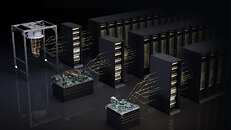 Qubit—the units of information enabling quantum computers to process information in ways ordinary computers cannot—are delicate and error-prone, requiring complex calibration, quantum error correction and other control algorithms to operate correctly.
These algorithms must run over an extremely demanding low-latency, high-throughput connection to a conventional supercomputer to keep on top of qubit errors and enable impactful quantum applications. NVQLink provides that interconnect, enabling the environment needed for future, transformative applications across industries.
"In the near future, every NVIDIA GPU scientific supercomputer will be hybrid, tightly coupled with quantum processors to expand what is possible with computing," said Jensen Huang, founder and CEO of NVIDIA. "NVQLink is the Rosetta Stone connecting quantum and classical supercomputers—uniting them into a single, coherent system that marks the onset of the quantum-GPU computing era."
U.S. national laboratories, led by the Department of Energy, will use NVIDIA NVQLink to make new breakthroughs in quantum computing.
"Maintaining America's leadership in high-performance computing requires us to build the bridge to the next era of computing: accelerated quantum supercomputing," said U.S. Secretary of Energy Chris Wright. "The deep collaboration between our national laboratories, startups and industry partners like NVIDIA is central to this mission—and NVIDIA NVQLink provides the critical technology to unite world-class GPU supercomputers with emerging quantum processors, creating the powerful systems we need to solve the grand scientific challenges of our time."
NVQLink connects the many approaches to quantum processors and control hardware systems directly to AI supercomputing—providing a unified, turnkey solution for overcoming the key integration challenges that quantum researchers face in scaling their hardware.
With contributions from supercomputing centers, quantum hardware builders and quantum control system providers, NVQLink sets the foundation for uncovering the breakthroughs in control, calibration, quantum error correction and hybrid application development needed to run useful quantum applications.
Researchers and developers can access NVQLink through its integration with the NVIDIA CUDA-Q software platform to create and test applications that seamlessly draw on CPUs and GPUs alongside quantum processors, helping ready the industry for the hybrid quantum-classical supercomputers of the future.
Partners contributing to NVQLink include quantum hardware builders Alice & Bob, Anyon Computing, Atom Computing, Diraq, Infleqtion, IonQ, IQM Quantum Computers, ORCA Computing, Oxford Quantum Circuits, Pasqal, Quandela, Quantinuum, Quantum Circuits, Inc., Quantum Machines, Quantum Motion, QuEra, Rigetti, SEEQC and Silicon Quantum Computing—as well as quantum control system builders including Keysight Technologies, Quantum Machines, Qblox, QubiC and Zurich Instruments.
Availability
Quantum builders and supercomputing centers interested in NVIDIA NVQLink can sign up for access on this webpage.
Source:
NVIDIA
Researchers from leading supercomputing centers at national laboratories including Brookhaven National Laboratory, Fermi Laboratory, Lawrence Berkeley National Laboratory (Berkeley Lab), Los Alamos National Laboratory, MIT Lincoln Laboratory, the Department of Energy's Oak Ridge National Laboratory, Pacific Northwest National Laboratory and Sandia National Laboratories guided the development of NVQLink, helping accelerate next-generation work on quantum computing. NVQLink provides an open approach to quantum integration, supporting 17 QPU builders, five controller builders and nine U.S national labs.

These algorithms must run over an extremely demanding low-latency, high-throughput connection to a conventional supercomputer to keep on top of qubit errors and enable impactful quantum applications. NVQLink provides that interconnect, enabling the environment needed for future, transformative applications across industries.
"In the near future, every NVIDIA GPU scientific supercomputer will be hybrid, tightly coupled with quantum processors to expand what is possible with computing," said Jensen Huang, founder and CEO of NVIDIA. "NVQLink is the Rosetta Stone connecting quantum and classical supercomputers—uniting them into a single, coherent system that marks the onset of the quantum-GPU computing era."
U.S. national laboratories, led by the Department of Energy, will use NVIDIA NVQLink to make new breakthroughs in quantum computing.
"Maintaining America's leadership in high-performance computing requires us to build the bridge to the next era of computing: accelerated quantum supercomputing," said U.S. Secretary of Energy Chris Wright. "The deep collaboration between our national laboratories, startups and industry partners like NVIDIA is central to this mission—and NVIDIA NVQLink provides the critical technology to unite world-class GPU supercomputers with emerging quantum processors, creating the powerful systems we need to solve the grand scientific challenges of our time."
NVQLink connects the many approaches to quantum processors and control hardware systems directly to AI supercomputing—providing a unified, turnkey solution for overcoming the key integration challenges that quantum researchers face in scaling their hardware.
With contributions from supercomputing centers, quantum hardware builders and quantum control system providers, NVQLink sets the foundation for uncovering the breakthroughs in control, calibration, quantum error correction and hybrid application development needed to run useful quantum applications.
Researchers and developers can access NVQLink through its integration with the NVIDIA CUDA-Q software platform to create and test applications that seamlessly draw on CPUs and GPUs alongside quantum processors, helping ready the industry for the hybrid quantum-classical supercomputers of the future.
Partners contributing to NVQLink include quantum hardware builders Alice & Bob, Anyon Computing, Atom Computing, Diraq, Infleqtion, IonQ, IQM Quantum Computers, ORCA Computing, Oxford Quantum Circuits, Pasqal, Quandela, Quantinuum, Quantum Circuits, Inc., Quantum Machines, Quantum Motion, QuEra, Rigetti, SEEQC and Silicon Quantum Computing—as well as quantum control system builders including Keysight Technologies, Quantum Machines, Qblox, QubiC and Zurich Instruments.
Availability
Quantum builders and supercomputing centers interested in NVIDIA NVQLink can sign up for access on this webpage.
4 Comments on NVIDIA Introduces NVQLink — Connecting Quantum and GPU Computing for 17 Quantum Builders and Nine Scientific Labs
IBM Runs Quantum Computing Algorithm on AMD FPGA Chips | TechPowerUpOuch?
The benefit of AMD’s and IBM’s approaches lies in making a quantum computer operate stable at all the environment where it is expected to be deployed. Nowadays, this requires an incredibly expensive qubit controller, custom-designed for each quantum computer. Economically, this isn’t very practical, because designing a standalone controller for each machine (at around $20 million per computer) would make the deployment financially unfeasible. AMD’s solution to this is simple: don’t design individual controllers at all. Instead, they provide a universal one that anyone can buy. The advantage is clear. There’s no need for a custom ~$20 million controller for every quantum computer; AMD provides a universal one, lets say for $2 million. This is worthwhile for the market, because it saves $18 million per deployed machine, and it’s profitable for AMD as well, since they can sell a controller that costs less than $500 to manufacture for $2 million.
NVIDIA’s NVQLink, on the other hand, addresses a completely different problem, but it first requires quantum computers that are already stable and relatively inexpensive to deploy. Once that’s in place, the next challenge is how to connect the quantum computer to a classical one. That’s where NVQLink comes in. So, it’s a completely different component of the overall operation.
IBM says that the FPGA solution offers 10 times the compute performance needing for the task, so while Nvidia's presentation was hyping it's "low-latency, high-throughput connection .... to keep on top of qubit errors and enable impactful quantum applications" maybe this isn't a necessity today. Maybe it will be more important "for future, transformative applications across industries". But for now IBM's solution seems more than capable and probably inexpensive compared to other solutions.
One more thing. IBM was absent from the list of companies Nvidia mentioned in it's presentation about Quantum computing. That might indicate something. IBM and Nvidia do collaborate in AI, but I can't see an indication that they collaborate in Quantum Computing.