News Posts matching #NVIDIA

Return to Keyword Browsing

NVIDIA Prepares New Driver Era for "Rubin" GPUs in 2026

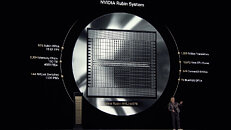
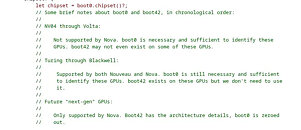
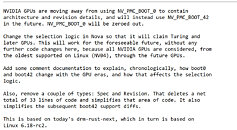
NVIDIA appears to be gearing up for software support for "Rubin," the architecture expected to succeed "Blackwell," after a set of driver patches introduced a new identification register called BOOT_42. The initial patches landed on public mailing lists late on a Friday and include a change titled for next-generation GPUs. In the patch cover letter, NVIDIA engineer John Hubbard explains that architecture and revision metadata will transition from NV_PMC_BOOT_0 to NV_PMC_BOOT_42, with BOOT_0 being cleared. These updates were submitted to the Nova kernel driver tree, which is serving as the public platform for this early work. The patches adjust the detection path so the driver can recognize devices from Turing onward using the new register layout.

The submission also adds comments that document how BOOT_0 and BOOT_42 evolve across GPU generations, and it removes a couple of legacy types, Spec and Revision. According to the notes, this simplification removes some complexity and makes future boot42 support updates easier to follow, avoiding generation-specific adjustments when new revisions arrive. The changes confirm that current generations from Turing through Blackwell will continue to use BOOT_0 while future, post-Blackwell chips will be identified solely via BOOT_42. Targeting Rubin, this work is another example where NVIDIA is actively preparing driver support ahead of hardware launch. If Rubin enters volume production in the second half of 2026 as previously reported, having the identification and selection logic ready in advance should help reduce the gap between shipments and software enablement, meaning that fast-moving hardware release cycles will be followed very closely with optimized software.
NVIDIA Orders AIC Partners to Prioritize 16 GB RTX 5060 Ti as Gamers Reject 8 GB Model

NVIDIA's GeForce RTX 5060 Ti is available in 16 GB and 8 GB models. It appears that NVIDIA is focusing more on producing the 16 GB version, as many gamers prefer GPUs with higher capacity. As a result, the 8 GB version has become less of a priority, with most attention now on the RTX 5060 Ti 16 GB. According to Board Channels, NVIDIA has directed its AIC partners to prioritize the production of the 16 GB SKU over the 8 GB model, making the latter a secondary option. It is obvious from this that the demand for this mid-range GPU is good, and that gamers in this range want to future-proof their systems to last a bit longer, as modern games increase their VRAM usage.

This is happening almost four months after we reported an insight into the sales of NVIDIA's GeForce RTX 5060 Ti 16 GB and 8 GB models from one of Germany's largest retailers, Mindfactory.de. According to the sum of the units sold, the 16 GB version of the GeForce RTX 5060 Ti is outselling the 8 GB version by more than 16 times, which represents a 1,600% difference. Mindfactory lists each GeForce RTX 5060 Ti model with a tag indicating the number of units sold, showing how many units were sold to customers of a specific model. Even with good availability of both SKUs, gamers have consistently opted for the 16 GB version. MSRPs of both GPUs are $50 apart, with the 8 GB SKU at $379.99 and 16 GB at $429.99.

Borderlands 4 Gets Up to 20% FPS Increase in October Update

If you've been following along since the launch of Borderlands 4, you'll know by now that the latest entry into the legendary looter shooter franchise hasn't had the smoothest launch. While early patches were issued to address some of the more bothersome performance issues relating to frame drops and hitches, average frame rates were still what most would describe as suboptimal, with even high-end hardware struggling to hit 60 FPS at higher resolutions. The game's latest October 23 patch, however, claims to improve performance, with 2K Games and Gearbox promising "widespread stability improvements," in addition to UI polish, multiplayer fixes, and quality of life improvements for both the audio and visuals in the game. The claims were subsequently put to the test by MxBenchmarkPC on YouTube, and although the performance improvements varied by resolution, FPS saw improvements of up to 20% at 4K with Very High settings.

[Editor's note: Our in-depth performance review of Borderlands 4 is now live]

The YouTuber tested Borderlands 4 on a PC using an NVIDIA GeForce RTX 5080 paired with an Intel Core i7 14700F at 4K and 1440p with a variety of quality settings. At 4K with optimization applied in the settings page via the "Auto-Detect Graphics Preset" function, the performance difference drops to around 10%. While comparative testing was not conducted at 1440p and with DLSS and frame generation enabled, performance remained above 60 FPS at 1440p with DLSS running in DLAA mode. When DLSS was set to "Quality" at 1440p resolution with the optimized settings, the frame rate jumped up to 90-100 FPS, which is more than playable for a non-competitive game. The frame rate in the YouTube test footage is also impressively smooth, with little to no hitching visible in any of the tests.

Intel Beats Q3 Profit Targets as Cost Cuts and Strategic Investments Take Effect

Intel has posted stronger than expected third-quarter 2025 results, boosted by aggressive cost-cutting measures under CEO Lip-Bu Tan and fresh capital injections from NVIDIA, SoftBank, and the U.S. government. Shares rose about 5% after its share price drop of about 60% last year. Team Blue reported $2.5 billion in operating cash flow, its fourth straight quarter of improved execution, and noted that demand is now outpacing supply heading into 2026. CFO David Zinsner said the new funding increases Intel's operational flexibility and highlights its importance to the broader semiconductor ecosystem.

Recently Intel unveiled its Core Ultra Series 3 "Panther Lake" processors and Xeon 6+ "Clearwater Forest", both built on Intel 18A process technology, alongside a new inference GPU, "Crescent Island." Meanwhile, Fab 52 in Chandler, Arizona is now fully operational, producing 18A wafers, part of Intel's $100 billion domestic expansion plan. Intel strengthened its balance sheet in Q3 with several major deals. The company received $5.7 billion from a planned $8.9 billion U.S. government, while NVIDIA invested $5 billion and agreed to co-develop future PC and datacenter platforms using NVLink. SoftBank added $2 billion to support Intel's U.S. fab expansion, and the Altera stake sale generated an additional $5.2 billion in cash. Compared to Q3 2024 Intel Foundry's revenue is still down 2% while Data Center and AI dropped 1% indicating that both divisions are still under pressure. For the fourth quarter of 2025, Intel expects revenue between $12.8 billion and $13.8 billion.

NVIDIA GeForce NOW Gets Nine New Games, Including Vampire The Masquerade: Bloodlines 2, and NINJA GAIDEN 4

The nights grow longer and the shadows get bolder with Vampire The Masquerade: Bloodlines 2 on GeForce NOW, launching with GeForce RTX 5080-power. Members can sink their teeth into the action role-playing game from Paradox Interactive as part of nine games coming to the cloud this week, including NINJA GAIDEN 4. Be among the first to play The Outer Worlds 2 with early access available in the cloud starting tomorrow, Oct. 24. Atlanta is the latest region to get GeForce RTX 5080-class power, with Sofia, Bulgaria, coming next. Stay tuned to GFN Thursday for updates as more regions upgrade to NVIDIA Blackwell RTX. Follow along with the latest progress on the server rollout page.

The Night Belongs to the Cloud
Vampire: The Masquerade - Bloodlines 2, Paradox's sequel to the cult classic, invites fans to sink their fangs into Seattle's dark nightlife, putting players in the immortal boots of Phyre - the newly awakened Elder vampire with a mysterious voice in their head. In every dark corner hides a new alliance or a rival, and every choice carves a path through the bloody politics of the night.

NVIDIA H100 Makes Its Cosmic Debut as the First AI Accelerator in Space

NVIDIA has decided that covering the earth with data centers is not enough, so the company now wants to accelerate infrastructure in the outer space. According to the latest blog post, NVIDIA will be a part of an AI-equipped satellite from Starcloud, powered by a single NVIDIA H100 "Hopper" GPU. After many months or even years of validation and testing that goes into designing a space payload, Starcloud and NVIDIA have designed a 60 kg package the size of a small fridge, that will be installed in space satellite orbiting the planet Earth. This will be more powerful than any current space infrastructure, at more than 100x compute capacity than the existing accelerators. We still don't know if this GPU has been radiation hardened, or it has just been isolated enough for space radiation to not represent a problem.

In space, the power requirements can easily be neglected. With the use of solar panels, any hardware is capable of tapping nearly infinite energy for powering the infrastructure. That way, NVIDIA H100 GPU can run at full throttle crunching any AI computation without any issues, and making sure that the Starcloud satellite is doing its job. The cooling structure of this AI module is intriguing. It is engineered to function effectively without relying on convective cooling, instead using radiative heat rejection into the cold expanse of space. Since outer space is essentially a vacuum, there is no air to conduct heat away. Therefore, the module must internally conduct heat from the computing components, such as CPUs and GPUs, to external radiators that emit infrared radiation into deep space. When oriented favorably, with radiators facing away from direct solar irradiation, the module can maintain a lower operating temperature than would be possible on Earth. However, this is not a "magic" solution. The design must carefully balance factors such as the thermal interface, radiator area, emissivity, orientation, and internal heat flow.

NVIDIA DLSS 4 Available This Week In The Outer Worlds 2, Vampire: The Masquerade - Bloodlines 2 and Jurassic World Evolution 3

More than 800 games and applications feature RTX technologies, and each week new games integrating NVIDIA DLSS, NVIDIA Reflex, and advanced ray-traced effects are released or announced, delivering the definitive PC experience for GeForce RTX players. Last week, DLSS 4 with Multi Frame Generation came to Pax Dei, Keeper and Farlight 84, and accelerated frame rates in the ARC Raiders server slam.

This week, The Outer Worlds 2, Vampire: The Masquerade - Bloodlines 2 and Jurassic World Evolution 3 all launch with day-one support for DLSS 4 with Multi Frame Generation. Additionally, NINJA GAIDEN 4 launches today with DLSS Super Resolution, followed by GODBREAKERS on October 23rd. And on October 30th, you can tune in to the Seoul GeForce Gamer Festival live on Twitch for RTX announcements, and more, starting at 19:00 KST/10:00 UTC/03:00 PT.

NINJA GAIDEN 4 Gets Launch Trailer, System Requirements, and Available on PC, Handhelds, Xbox, and PlayStation 5

Unveiled back in January 2025, NINJA GAIDEN 4 is now available on PC, ROG Xbox Ally handhelds, Xbox, and PlayStation 5. Team Ninja and PlatinumGames have also released an official launch trailer for the game as well as full PC system requirements. The developers have continued the legacy of NINJA GAIDEN, building upon the story of Ryu Hayabusa, but also introduced a new protagonist, Yakumo. A young prodigy of the Raven Clan, Yakumo brings a new layer to the NINJA GAIDEN series. The combat system has been upgraded to modern pacing and layered control, allowing switching between different forms and giving the game a more tactical approach.

"Experience a return to the intense, high-octane action that established NINJA GAIDEN as a premier action game series. This long-awaited 4th installment introduces an all-new protagonist in Yakumo, a young ninja prodigy whose fate is intertwined with the legendary Ryu Hayabusa himself. Prepare for a legacy reborn with exhilarating style and thrilling action for a new generation of players. With adjustable difficulty settings and customizable experience, NINJA GAIDEN 4 will push action game veterans to their limits while inviting newcomers to rise to the legendary ranks of "Master Ninja."

NVIDIA's Arizona-Made "Blackwell" GPUs Must Travel Back to Taiwan for Packaging

Just three days ago, NVIDIA and TSMC celebrated the production of the first "Blackwell" GPU at TSMC's Fab 21 complex in Phoenix, Arizona. This marked a significant milestone for both companies, as it signifies the creation of the world's most powerful silicon on U.S. soil. However, the production phase is only part of the story, as the chip benefits not only from an advanced node but also from TSMC's advanced packaging systems. Specifically, the Blackwell family of GPUs utilizes TSMC's Chip on Wafer on Substrate (CoWoS) packaging system.

For CoWoS access, TSMC must send these chips back to the Taiwanese facilities overseas and house the raw die in a CoWoS-S configuration with silicon interposer. This establishes a supply chain dependency on Taiwanese facilities, which remain essential for completing the production of advanced silicon. As a result, the chip isn't entirely manufactured on American soil, indicating that some issues still need to be resolved. TSMC produces NVIDIA's Blackwell chips using a custom 4N 4 nm class node specifically designed for NVIDIA. This die is paired with eight stacks of HBM3E, all housed within a CoWoS-S package.

NVIDIA RTX PRO 5000 "Blackwell" GPU with 72 GB GDDR7 Memory Appears

NVIDIA's RTX PRO 5000 "Blackwell" GPU has officially appeared with 72 GB of GDDR7 ECC memory, on the company's product page. Initially, NVIDIA launched an RTX PRO 5000 Blackwell GPU with 48 GB of GDDR7 memory spread across 24 modules with the capacity of 2 GB, sandwiching the PCB on both sides. However, NVIDIA has now decided to update the GPU with the new 3 GB memory modules, which are upping the total capacity to 72 GB on a 512-bit bus with 1,344 GB/s memory bandwidth, making the card a much more attractive offer for professionals working in the fields of data science, AI, HPC, and many other areas such as professional video editing. However, this 24 module design with 12 GDDR7 modules on each side is less impressive than the RTX PRO 6000 Blackwell GPU, which arranges 16 such modules on each side of the PCB to achieve a remarkable 96 GB capacity.

As a reminder, the RTX PRO 5000 GPU is based on the GB202 GPU and carries 14,080 CUDA cores, 440 TMUs, and 176 ROPs. Upgraded NVENC/NVDEC blocks speed up high-quality encode/decode for live production and fast video editing. Multi-Instance GPU (MIG) gives IT and cloud/VDI admins an easy way to split a GPU into isolated instances, so more users get guaranteed, accelerated performance. NVIDIA has wrapped all of this in a 300 W TDP in a dual-slot GPU, with a blower fan. Pricing structure is still unknown, but given that its older sibling, the RTX PRO 6000 Blackwell, is retailing just under $10,000, we could see the 72 GB version just a grand or two lower. Additionally, as we see NVIDIA incorporating 3 GB GDDR7 memory modules inside more products, the company could be gearing up for a "SUPER" overhaul of the Blackwell gaming lineup.

Zotac Boards Powerful Mini PC Hype Train With NVIDIA RTX 5060 Ti-Powered ZBOX MAGNUS

In light of the recent flood of AI-ready mini PCs coming from the likes of Framework and GMKtec, Zotac has announced its own competitor, this time opting for a slightly different approach than the hyped AMD Ryzen AI Max+ 395 APU. Instead, the component company known for its mini PCs and discrete NVIDIA GPUs has equipped the Zbox Magnus (stylized as ZBOX MAGNUS) with an NVIDIA GeForce RTX 5070 Ti and up to a 20-core (8 performance, 12 efficiency cores) Intel Core Ultra 7 255HX CPU paired with dual memory slots for up to 96 GB of DDR5-6400 CSODIMM or DDR5-5600 SODIMM RAM—all in a mere 2.65-liter chassis. By default, however, the Magnus doesn't ship with RAM or storage, with a barebones variant currently listed on the company's Chinese site at a converted price of around $1,966 (13,9999 Yuan).

The product page lists the cooling solution as a heatsink and fan, but it's unclear whether there are separate heatsinks and fans for the CPU and GPU, raising questions about potential thermal throttling, given the tiny chassis. Zotac says that the Zbox Magnus is the first mini PC of its size to offer a desktop-class GeForce RTX 5060 Ti 16 GB GPU in a chassis that small, with the chassis measuring in at just 210 × 203 × 62.2 mm. That small chassis comes with the caveats that the Zbox Magnus needs a 330 W external AC-DC adapter, and that it features a soldered laptop-class CPU. Despite the small chassis, the Zbox Magnus has a decent selection of ports, with five USB Type-A ports, dual front USB Type-C ports, and dual Ethernet ports. It also comes with wall mount hardware and Wi-Fi antennae in the box.

Google Cloud G4 VMs With NVIDIA RTX PRO 6000 Blackwell GPU Now Generally Available

NVIDIA and Google Cloud are expanding access to accelerated computing to transform the full spectrum of enterprise workloads, from visual computing to agentic and physical AI. Google Cloud today announced the general availability of G4 VMs, powered by NVIDIA RTX PRO 6000 Blackwell Server Edition GPUs. Plus, NVIDIA Omniverse and NVIDIA Isaac Sim are now available as virtual machine images (VMIs) on the Google Cloud Marketplace to unlock physical AI-driven applications for key industries like manufacturing, automotive and logistics. This powerful combination creates a versatile, multi-workload platform for enterprises to accelerate their most demanding challenges on Google Cloud.

NVIDIA RTX PRO 6000 Blackwell GPUs excel at high-performance AI inference for multimodal, generative and agentic AI deployments, while also powering complex visual and simulation workloads ranging from computer-aided engineering and content creation to robotics simulation. Customers like WPP are using G4 VMs with NVIDIA Omniverse to instantly generate photorealistic 3D advertising environments at global scale, while Altair is using the platform within Altair One to accelerate demanding simulation and fluid dynamics workloads.

NVIDIA "Vera Rubin" NVL144 Servers Set for 2026 Volume Production

Foxconn has begun engineering validation for NVIDIA's "Vera Rubin" NVL144 MGX liquid-cooled racks, with plans for mass production in the latter half of 2026, according to internal supply-chain documents obtained by Taiwan Economics Daily. Each NVL144 unit features 144 Rubin GPUs with HBM4, updated 88-core Vera CPUs, and ConnectX-9 NICs and NVLink 6 interconnect for CPU-to-GPU and GPU-to-GPU communication, effectively doubling the compute density of the current NVL72 platform. The Taiwanese contractor Foxconn currently handles about 60% of NVIDIA's AI server output and is expanding its immersion-cooling and copper-plating lines at its Wisconsin and Houston facilities to meet new domestic manufacturing requirements.

The gap between GB300 peak shipments and Rubin's first silicon will be six to eight months, the shortest generational gap in NVIDIA's history. Despite the accelerated roadmap, Blackwell Ultra remains NVIDIA's main revenue source through mid-2026. Procurement data shows that cloud providers have reserved around 400,000 GB300 nodes for delivery in late 2025 and early 2026, indicating strong near-term demand. At the same time, OpenAI has placed a large preorder for Vera Rubin silicon, securing initial production volumes and supporting Foxconn's capacity investments. The rapid transition from Hopper to Blackwell and then to Rubin within 30 months marks the fastest acceleration of datacenter equipment cycles, leading hyperscale operators to speed up depreciation schedules.

NVIDIA and TSMC Celebrate First NVIDIA Blackwell Wafer Produced in the US

AI has ignited a new industrial revolution. NVIDIA and TSMC are working together to build the infrastructure that powers the world's AI factories, right here in America. NVIDIA founder and CEO Jensen Huang today visited TSMC's semiconductor manufacturing facility in Phoenix to celebrate the first NVIDIA Blackwell wafer produced on U.S. soil, representing that Blackwell has reached volume production. Onstage at the celebration, Huang joined Y.L. Wang, vice president of operations at TSMC, to sign the Blackwell wafer, commemorating a milestone that showcases how the engines of the world's AI infrastructure are now being constructed domestically. This bolsters the U.S. supply chain and onshores the AI technology stack that will turn data into intelligence and secure America's leadership for the AI era.

"This is a historic moment for several reasons. It's the very first time in recent American history that the single most important chip is being manufactured here in the United States by the most advanced fab, by TSMC, here in the United States," Huang said at the event. "This is the vision of President Trump of reindustrialization - to bring back manufacturing to America, to create jobs, of course, but also, this is the single most vital manufacturing industry and the most important technology industry in the world."

NVIDIA GeForce NOW Gets 10 New Games, Borderlands 4 Reward, and SteelSeries Giveaway

GeForce NOW is more than just a platform to stream fresh games every week - it offers celebrations for the gamers who make it epic, with member rewards to sweeten the deal. This week, GeForce NOW Ultimate members can score a free Borderlands 4 reward and upgrade their setup with the latest SteelSeries Nimbus Cloud controllers and headsets - the perfect gear for leveling up any cloud-based adventures. Plus, Steam Next Fest kicks off this week, serving up a flood of new demos. Get them all through Install-to-Play, the latest feature on GeForce NOW with the NVIDIA Blackwell RTX upgrade.

Fire up the cloud, grab a controller and check out the 10 new games in the cloud this week, on top of the 1.0 release of Pax Dei. It's always a rewarding time to be a GeForce NOW member. Ashburn, Portland, Dallas and London are the latest regions to get GeForce RTX 5080-class power, with Atlanta coming next. Stay tuned to GFN Thursday for updates as more regions upgrade to Blackwell RTX. Follow along with the latest progress on the server rollout page. This week, Control joins the lineup of GeForce RTX 5080-ready titles, already available on the service. Look for the "GeForce RTX 5080 Ready" row in the app or check out the full list.

Frore Systems introduces LiquidJet, Coldplate for AI Data Centers

Frore Systems today announced the launch of LiquidJet, a revolutionary direct-to-chip liquid cooling 3D coldplate solution designed to meet the escalating demands of AI Data Centers. Built with Frore's unique semiconductor manufacturing process adapted to metal wafers, LiquidJet unlocks higher performance from the world's most powerful GPUs—starting with NVIDIA Blackwell Ultra—delivering significant reductions in data center total cost of ownership (TCO).

"LiquidJet's unique 3D architecture, with customized short-loop jet channel microstructures, sets a new bar for coldplate thermal performance," said Seshu Madhavapeddy, CEO and Founder of Frore Systems. "Just as AirJet redefined active cooling for consumer and edge devices, LiquidJet transforms coldplates into a future-ready platform for the AI Factory."

MSI EdgeXpert Personal AI Supercomputer Officially Available

MSI, a global leader in high-performance computing, today announced that its MSI EdgeXpert AI Supercomputer will be officially available starting October 15, 2025 through MSI's official website and authorized distributors. This product is designed for AI education, research, and development. Developers, researchers, and enterprises can access professional-grade AI computing immediately.

At the core of EdgeXpert is the NVIDIA GB10 Grace Blackwell Superchip with 128 GB unified memory. It provides exceptional computing performance for model fine tuning and inference. The unified hardware, OS, and NVIDIA AI software stack ensures compatibility with mainstream AI frameworks. It simplifies data workflows, accelerates model tuning, and improves inference efficiency. Researchers and developers can focus on algorithms and innovation without worrying about the lack of local memory or access to required software.

GIGABYTE Announces Availability of GAMING A16 PRO and GAMING A18 Laptops

GIGABYTE, the world's leading computer brand, officially announces the global availability of its next-gen gaming laptops—the GAMING A16 PRO and GAMING A18. Expanding the 2025 GAMING Series lineup, both models combine uncompromised power with portable design, featuring up to NVIDIA GeForce RTX 5080 Laptop GPUs and GIGABYTE's exclusive GiMATE AI Agent. With over 12 hours of battery life, these ultraslim laptops deliver intelligent performance and immersive experiences for gamers and creators alike.

Built for hybrid gaming and AI workflows, the GAMING A16 PRO and GAMING A18 integrate top-tier technologies, including NVIDIA DLSS 4, NVIDIA Studio, and support for NVIDIA NIM microservices. GiMATE, GIGABYTE's proprietary AI agent, enables intuitive "Press and Speak" control for performance tuning, fan adjustment, privacy functions, and more. The laptops also feature WQXGA 165 Hz high-refresh displays with 3 ms response time, Dolby Atmos spatial audio, and a newly designed keyboard with enlarged keycaps and 1.7 mm key travel for maximum accuracy and comfort. A built-in MUX Switch further optimizes GPU performance on demand.

NVIDIA GB10 Superchip Powering DGX Spark Codesigned by MediaTek

MediaTek has teamed with NVIDIA on the design of the GB10 Grace Blackwell Superchip in NVIDIA DGX Spark, a personal AI supercomputer that allows developers to prototype, fine-tune, and inference large AI models on the desktop. Announced earlier this year, DGX Spark will be available to the public starting today to drive the next wave of AI development across industries.

The GB10 Grace Blackwell Superchip leverages MediaTek's experience in designing power-efficient and high-performance CPU, memory subsystem, and high-speed interfaces to power the Grace 20-core Arm CPU. Combined with the latest generation Blackwell GPU and 128 GB of unified memory, GB10 delivers up to 1 PFLOP of AI performance to accelerate model tuning and real-time inferencing. This configuration allows developers to work with large AI models up to 200 billion parameters or use the built-in ConnectX-7 networking technology to connect two DGX Spark systems together to enable inference on models up to 405B parameters. DGX Spark packs all this performance into a compact design that can easily fit onto a desktop and is power-efficient enough to use a standard electrical outlet.

MSI Clarifies: GeForce RTX 5090 is Not Officially Sold in China; Non-Authorized Units Identified as Parallel Imports

MSI has noted online rumors claiming that the GeForce RTX 5090 is circulating in China, creating market confusion. We clarify that MSI has never officially sold or distributed the GeForce RTX 5090 in China. Any units found locally are not from MSI-authorized channels and have entered through unauthorized distribution unrelated to our sales policy.

We strictly comply with international regulations and NVIDIA's regional authorization framework. The GeForce RTX 5090 is available only in the Americas, Europe, and select Asia-Pacific markets. In China, MSI offers only the GeForce RTX 5090 D and GeForce RTX 5090 D V2—versions designed to meet local regulatory requirements. Any RTX 5090 units appearing in China can therefore be clearly identified as non-official supply.

MiTAC Computing Showcases Future-Ready AI Cluster Solutions at the 2025 OCP Global

MiTAC Computing Technology, a global leader in high-performance and energy-efficient server solutions, is proud to announce its participation at the 2025 OCP Global Summit (October 13-16, San Jose, CA), Booth C14. Under the theme "From AI Server to Cluster - Open for Growth. Built to Cool." MiTAC will showcase modular, scalable infrastructures advancing from single AI servers to full clusters, powered by cutting-edge liquid-cooling and sustainable designs. Teaming up with AMD, Broadcom, CoolIT, Intel, Micron, Murata, NVIDIA, and Solidigm, MiTAC continues to drive open computing innovation and energy-efficient data center evolution.

MAINGEAR Unleashes Hell with Ultra-Premium Limited Edition DOOM EDITION Desktop Gaming PC Drop

MAINGEAR, the leader in premium-quality, high-performance, custom gaming PCs, is dropping its all-new DOOM EDITION desktops, forged in collaboration with HAVN, using their HS 420 DOOM: The Dark Ages Limited Edition chassis. Combining the artistry of HAVN's award-winning design with MAINGEAR's industry-leading engineering, these limited-edition systems are bespoke-crafted battle stations worthy of the Slayer himself. Face the nightmare, watch the drop come alive in this short video.

MAINGEAR's DOOM EDITION PCs are built using no ordinary PC case. Crafted with precision-cut steel, tempered glass, and premium-grade finishes, the chassis is built to resemble a relic of war, brutal, imposing, and instantly recognizable as DOOM. Designed for maximum airflow, cable management, and support for the highest-end GPUs and cooling systems, it's a masterpiece of form and function. MAINGEAR takes this foundation and infuses it with top-of-the-line components and expert craftsmanship, ensuring that every DOOM EDITION desktop doesn't just look the part, but dominates the battlefield of modern gaming.

NVIDIA Taps Samsung Foundry for Custom Silicon Manufacturing

NVIDIA announced at the OCP Global Summit that Samsung Foundry is joining its NVLink Fusion ecosystem, bringing Samsung's design and manufacturing muscle into the fold for custom CPUs and XPUs. The partnership positions Samsung to offer end-to-end support. Everything from silicon design and verification through integration and tape-out for chips that can connect directly into NVLink-enabled MGX and OCP rack architectures. For hyperscalers and AI data centers chasing greater performance and tighter CPU-GPU coupling, the development opens another route to custom silicon that speaks NVIDIA's high-bandwidth fabric language. Technically, NVLink Fusion functions as an IP and chiplet framework that enables non-NVIDIA processors and accelerators to become first-class participants in the company's data center fabric.

Earlier partners and chipset makers can now interoperate inside the same MGX and OCP designs, and Samsung adds both fabrication capacity and design services. NVIDIA's own engineering work on the Vera Rubin OCP rack and MGX integration was cited as the backbone that makes these cross-vendor connections possible, and industry players such as Intel, Fujitsu, and Qualcomm were highlighted as part of the larger custom-silicon network. Bringing Samsung Foundry into the NVLink Fusion circle should help shorten development cycles, reduce single-source risk, and give companies more choice when building CPUs and XPUs tuned for large language models and agentic era AI. For integrators, that means faster prototyping of workload-specific hardware and simpler paths to volume production.

ARC Raiders Open Beta & Pax Dei Launch This Week With DLSS 4

More than 800 games and applications feature RTX technologies, and each week new games integrating NVIDIA DLSS, NVIDIA Reflex, and advanced ray-traced effects are released or announced, delivering the definitive PC experience for GeForce RTX players. Last week, the highly anticipated Battlefield 6 launched with DLSS 4 with Multi Frame Generation, as did Little Nightmares III.

This week, Pax Dei exits Early Access with support for DLSS 4 with Multi Frame Generation, all gamers can play ARC Raiders with DLSS 4 during this weekend's Server Slam Open Test, Double Fine's Keeper can be upgraded to DLSS 4 using NVIDIA app, and a Warhammer 40,000: Space Marine 2 demo launches on October 16th with support for DLSS 4 with Multi Frame Generation.

NVIDIA and Oracle to Accelerate Enterprise AI and Data Processing

Oracle AI Database 26ai architects AI into the core of data management, furthering Oracle's commitment to help customers securely bring AI to all their data, everywhere. This milestone advances Oracle's "AI for Data" vision of a next-generation AI-native database with use of AI across the entire data and development stack, including AI Vector Search, AI for Database Management, AI for Data Development, AI for Application Development, and AI for Analytics. Customers can now run dynamic agentic AI workflows to provide sophisticated answers and actions that combine private database data with public information.

"By architecting AI and data together, Oracle AI Database makes "AI for Data" simple to learn and simple to use," said Juan Loaiza, executive vice president, Oracle Database Technologies, Oracle. "We enable our customers to easily deliver trusted AI insights, innovations, and productivity for all their data, everywhere, including both operational systems and analytic data lakes."
Return to Keyword Browsing
Nov 27th, 2026 19:49 CST change timezone

New Forum Posts

Popular Reviews

TPU on YouTube

Controversial News Posts