News Posts matching #NVIDIA

Return to Keyword Browsing

Meta Shows Open-Architecture NVIDIA "Blackwell" GB200 System for Data Center

During the Open Compute Project (OCP) Summit 2024, Meta, one of the prime members of the OCP project, showed its NVIDIA "Blackwell" GB200 systems for its massive data centers. We previously covered Microsoft's Azure server rack with GB200 GPUs featuring one-third of the rack space for computing and two-thirds for cooling. A few days later, Google showed off its smaller GB200 system, and today, Meta is showing off its GB200 system—the smallest of the bunch. To train a dense transformer large language model with 405B parameters and a context window of up to 128k tokens, like the Llama 3.1 405B, Meta must redesign its data center infrastructure to run a distributed training job on two 24,000 GPU clusters. That is 48,000 GPUs used for training a single AI model.

Called "Catalina," it is built on the NVIDIA Blackwell platform, emphasizing modularity and adaptability while incorporating the latest NVIDIA GB200 Grace Blackwell Superchip. To address the escalating power requirements of GPUs, Catalina introduces the Orv3, a high-power rack capable of delivering up to 140kW. The comprehensive liquid-cooled setup encompasses a power shelf supporting various components, including a compute tray, switch tray, the Orv3 HPR, Wedge 400 fabric switch with 12.8 Tbps switching capacity, management switch, battery backup, and a rack management controller. Interestingly, Meta also upgraded its "Grand Teton" system for internal usage, such as deep learning recommendation models (DLRMs) and content understanding with AMD Instinct MI300X. Those are used to inference internal models, and MI300X appears to provide the best performance per Dollar for inference. According to Meta, the computational demand stemming from AI will continue to increase exponentially, so more NVIDIA and AMD GPUs is needed, and we can't wait to see what the company builds.

Intel Won't Compete Against NVIDIA's High-End AI Dominance Soon, Starts Laying Off Over 2,200 Workers Across US

Intel's taking a different path with its Gaudi 3 accelerator chips. It's staying away from the high-demand market for training big AI models, which has made NVIDIA so successful. Instead, Intel wants to help businesses that need cheaper AI solutions to train and run smaller specific models and open-source options. At a recent event, Intel talked up Gaudi 3's "price performance advantage" over NVIDIA's H100 GPU for inference tasks. Intel says Gaudi 3 is faster and more cost-effective than the H100 when running Llama 3 and Llama 2 models of different sizes.

Intel also claims that Gaudi 3 is as power-efficient as the H100 for large language model (LLM) inference with small token outputs and does even better with larger outputs. The company even suggests Gaudi 3 beats NVIDIA's newer H200 in LLM inference throughput for large token outputs. However, Gaudi 3 doesn't match up to the H100 in overall floating-point operation throughput for 16-bit and 8-bit formats. For bfloat16 and 8-bit floating-point precision matrix math, Gaudi 3 hits 1,835 TFLOPS in each format, while the H100 reaches 1,979 TFLOPS for BF16 and 3,958 TFLOPS for FP8.

NVIDIA GeForce NOW Gets 10 New Games and Dragon Age: The Veilguard Bundled with Ultimate Tier

Bundle up this fall with GeForce NOW and Dragon Age: The Veilguard with a special, limited-time promotion just for members. The highly anticipated role-playing game (RPG) leads 10 titles joining the ever-growing GeForce NOW library of over 2,000 games.

A Heroic Bundle
Fight for Thedas' future at Ultimate quality this fall as new and existing members who purchase six months of GeForce NOW Ultimate can get BioWare and Electronic Arts' epic RPG Dragon Age: The Veilguard for free when it releases on Oct. 31. Rise as Rook, Dragon Age's newest hero. Lead a team of seven companions, each with their own unique story, against a new evil rising in Thedas. The latest entry in the legendary Dragon Age franchise lets players customize their characters and engage with new romancable companions whose stories unfold over time. Band together and become the Veilguard. Ultimate members can experience BioWare's latest entry at full GeForce quality, with support for NVIDIA DLSS 3, low-latency gameplay with NVIDIA Reflex, and enhanced image quality and immersion with ray-traced ambient occlusion and reflections. Ultimate members can also play popular PC games at up to 4K resolution with extended session lengths, even on low-spec devices. Move fast - this bundle is only available for a limited time until Oct. 30.

NVIDIA Fine-Tunes Llama3.1 Model to Beat GPT-4o and Claude 3.5 Sonnet with Only 70 Billion Parameters

NVIDIA has officially released its Llama-3.1-Nemotron-70B-Instruct model. Based on META's Llama3.1 70B, the Nemotron model is a large language model customized by NVIDIA in order to improve the helpfulness of LLM-generated responses. NVIDIA uses fine-tuning structured data to steer the model and allow it to generate more helpful responses. With only 70 billion parameters, the model is punching far above its weight class. The company claims that the model is beating the current top models from leading labs like OpenAI's GPT-4o and Anthropic's Claude 3.5 Sonnet, which are the current leaders across AI benchmarks. In evaluations such as Arena Hard, the NVIDIA Llama3.1 Nemotron 70B is scoring 85 points, while GPT-4o and Sonnet 3.5 score 79.3 and 79.2, respectively. Other benchmarks like AlpacaEval and MT-Bench spot NVIDIA also hold the top spot, with 57.6 and 8.98 scores earned. Claude and GPT reach 52.4 / 8.81 and 57.5 / 8.74, just below Nemotron.

This language model underwent training using reinforcement learning from human feedback (RLHF), specifically employing the REINFORCE algorithm. The process involved a reward model based on a large language model architecture and custom preference prompts designed to guide the model's behavior. The training began with a pre-existing instruction-tuned language model as the starting point. It was trained on Llama-3.1-Nemotron-70B-Reward and HelpSteer2-Preference prompts on a Llama-3.1-70B-Instruct model as the initial policy. Running the model locally requires either four 40 GB or two 80 GB VRAM GPUs and 150 GB of free disk space. We managed to take it for a spin on NVIDIA's website to say hello to TechPowerUp readers. The model also passes the infamous "strawberry" test, where it has to count the number of specific letters in a word, however, it appears that it was part of the fine-tuning data as it fails the next test, shown in the image below.

MSI Unveils AI Servers Powered by NVIDIA MGX at OCP 2024

MSI, a leading global provider of high-performance server solutions, proudly announced it is showcasing new AI servers powered by the NVIDIA MGX platform—designed to address the increasing demand for scalable, energy-efficient AI workloads in modern data centers—at the OCP Global Summit 2024, booth A6. This collaboration highlights MSI's continued commitment to advancing server solutions, focusing on cutting-edge AI acceleration and high-performance computing (HPC).

The NVIDIA MGX platform offers a flexible architecture that enables MSI to deliver purpose-built solutions optimized for AI, HPC, and LLMs. By leveraging this platform, MSI's AI server solutions provide exceptional scalability, efficiency, and enhanced GPU density—key factors in meeting the growing computational demands of AI workloads. Tapping into MSI's engineering expertise and NVIDIA's advanced AI technologies, these AI servers based on the MGX architecture deliver unparalleled compute power, positioning data centers to maximize performance and power efficiency while paving the way for the future of AI-driven infrastructure.

Lenovo Announces New Liquid Cooled Servers for Intel Xeon and NVIDIA Blackwell Platforms

At Lenovo Tech World 2024, we announced new Supercomputing servers for HPC and AI workloads. These new water-cooled servers use the latest processor and accelerator technology from Intel and NVIDIA.

ThinkSystem SC750 V4
Engineered for large-scale cloud infrastructures and High Performance Computing (HPC), the Lenovo ThinkSystem SC750 V4 Neptune excels in intensive simulations and complex modeling. It's designed to handle technical computing, grid deployments, and analytics workloads in various fields such as research, life sciences, energy, engineering, and financial simulation.

Google Shows Production NVIDIA "Blackwell" GB200 NVL System for Cloud

Last week, we got a preview of Microsoft's Azure production-ready NVIDIA "Blackwell" GB200 system, showing that only a third of the rack that goes in the data center is actually holding the compute elements, with the other two-thirds holding the cooling compartment to cool down the immense heat output from tens of GB200 GPUs. Today, Google is showing off a part of its own infrastructure ahead of the Google Cloud App Dev & Infrastructure Summit, taking place on October 30, digitally as an event. Shown below are two racks standing side by side, connecting NVIDIA "Blackwell" GB200 NVL cards with the rest of the Google infrastructure. Unlike Microsoft Azure, Google Cloud uses a different data center design in its facilities.

There is one rack with power distribution units, networking switches, and cooling distribution units, all connected to the compute rack, which houses power supplies, GPUs, and CPU servers. Networking equipment is present, and it connects to Google's "global" data center network, which is Google's own data center fabric. We are not sure what is the fabric connection of choice between these racks; as for optimal performance, NVIDIA recommends InfiniBand (Mellanox acquisition). However, given that Google's infrastructure is set up differently, there may be Ethernet switches present. Interestingly, Google's design of GB200 racks differs from Azure's, as it uses additional rack space to distribute the coolant to its local heat exchangers, i.e., coolers. We are curious to see if Google releases more information on infrastructure, as it has been known as the infrastructure king because of its ability to scale and keep everything organized.

NVIDIA to Release the Bulk of its RTX 50-series in Q1-2025

The first quarter of 2025 (January thru March) will see back-to-back launches of next-generation GeForce RTX 50-series "Blackwell" graphics card, according to the latest rumors. NVIDIA CEO Jensen Huang is confirmed to take center stage for the 2025 International CES keynote address, where he is widely expected to kick off the GeForce "Blackwell" gaming GPU generation. CES is expected to see NVIDIA launch its flagship GeForce RTX 5090 (RTX 4090-successor SKU), and its next-best part, the GeForce RTX 5080 (RTX 4080 successor).

February 2025 is expected to see the company debut the RTX 5070, and possibly the RTX 5070 Ti, if there is such a SKU. The RTX 5070 succeeds a long line of extremely successful SKUs that tended to sell in large volumes. Perhaps the most important launches of the generation will come in March 2025, when the company is expected to debut the RTX 5060 and RTX 5060 Ti, which succeed the current RTX 4060 and RTX 4060 Ti, respectively. The xx60 tier tends to be the bestselling class of gaming GPUs in any generation. In all, it's expected that NVIDIA will release six new SKUs within Q1, and you can expect over a hundred graphics card reviews from TechPowerUp in Q1.

Call of Duty: Black Ops 6 Gets New PC Trailer, System Requirements, Preloading Info, and More

Call of Duty: Black Ops 6 is fast approaching its October 25 launch date on the PC Microsoft Store, Battle.net and Steam. In partnership with Treyarch Studios, Call of Duty PC lead developer Beenox is developing a cutting-edge PC experience with 4K graphics and Ultrawide support plus a huge number of options across a variety of settings so players can dial in the best playing experience possible.

Get the Ultimate Performance Boost with AMD FSR 3.1
Some of the major features include:
  • AMD FidelityFX Super Resolution
    • AMD FidelityFX Super Resolution 3 transforms your gaming experience with faster, more responsive framerates in Black Ops 6 using super resolution temporal upscaling and advanced frame generation.
  • Advanced Frame Generation Technologies
    • The FSR Frame Generation toggle found in your graphics settings allows you to enable Frame Generation, which significantly increases your framerate and works seamlessly with other upscaling solutions.
  • AMD FidelityFX Contrast Adaptive Sharpening (CAS)
    • An overhead sharpening slider can help bring more details to edges of weapons, players, and environments.
AMD FSR 3.1 is compatible with a wide range of graphics cards from AMD and other vendors, delivering exceptional upscaling image quality and massive performance boosts when gaming at 4K or 1440p.

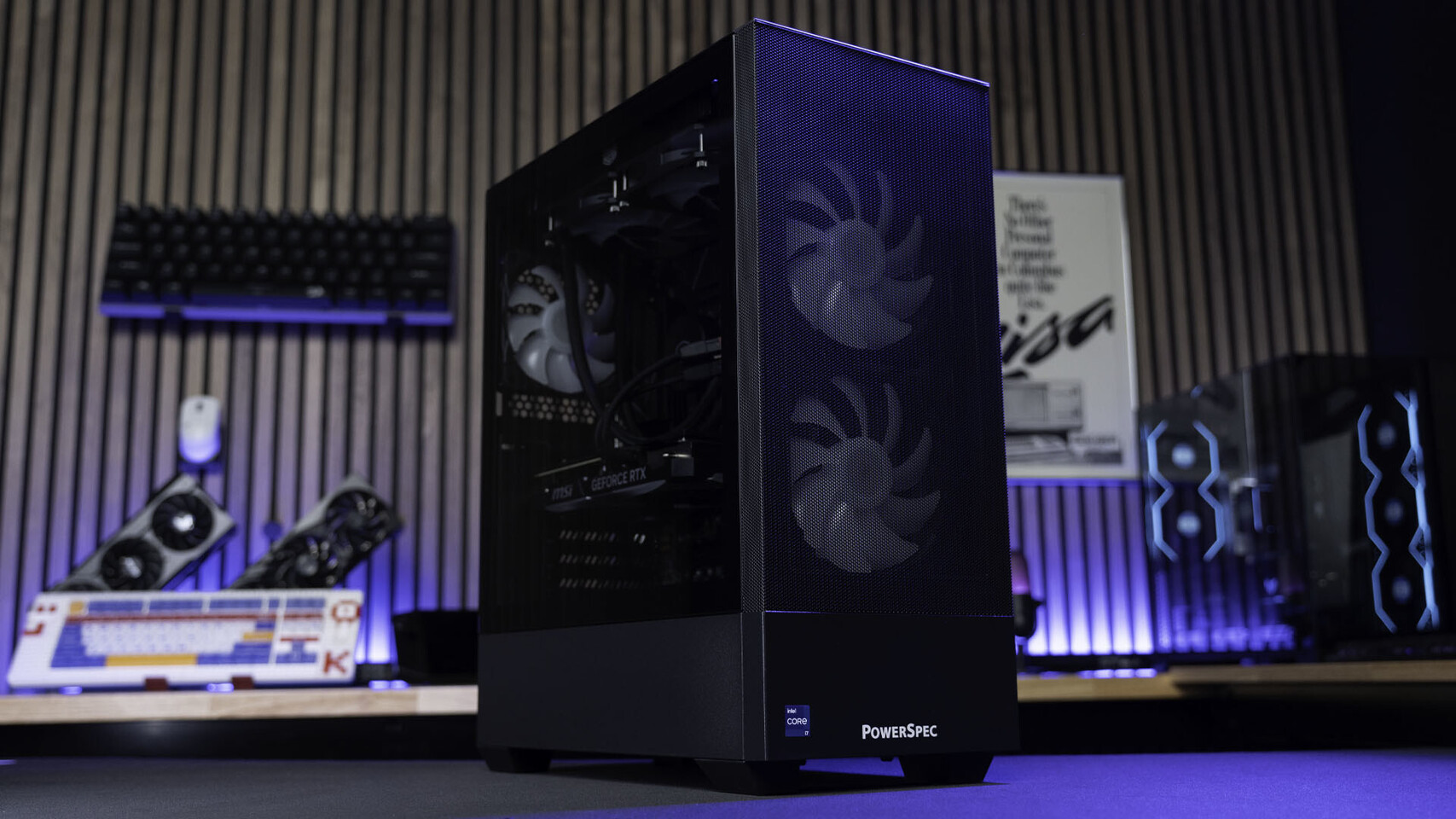
Micro Center Announces Relaunch of Updated PowerSpec Website

Micro Center, a leading national computer and electronic device retailer, has relaunched the online presence of its PowerSpec brand, a trusted name in high-performance desktop PCs. The newly redesigned PowerSpec.com offers an enhanced user experience tailored to meet the needs of gamers, professionals, and tech enthusiasts alike.

Since 1992, PowerSpec has been at the forefront of delivering powerful, adaptable, and upgradeable PCs backed by Micro Center's industry-leading customer service. The revamped website reflects PowerSpec's commitment to quality, innovation, and customer satisfaction by offering streamlined navigation, detailed product information, and easy access to essential drivers and support resources.

Supermicro's Liquid-Cooled SuperClusters for AI Data Centers Powered by NVIDIA GB200 NVL72 and NVIDIA HGX B200 Systems

Supermicro, Inc., a Total IT Solution Provider for AI, Cloud, Storage, and 5G/Edge, is accelerating the industry's transition to liquid-cooled data centers with the NVIDIA Blackwell platform to deliver a new paradigm of energy-efficiency for the rapidly heightened energy demand of new AI infrastructures. Supermicro's industry-leading end-to-end liquid-cooling solutions are powered by the NVIDIA GB200 NVL72 platform for exascale computing in a single rack and have started sampling to select customers for full-scale production in late Q4. In addition, the recently announced Supermicro X14 and H14 4U liquid-cooled systems and 10U air-cooled systems are production-ready for the NVIDIA HGX B200 8-GPU system.

"We're driving the future of sustainable AI computing, and our liquid-cooled AI solutions are rapidly being adopted by some of the most ambitious AI Infrastructure projects in the world with over 2000 liquid-cooled racks shipped since June 2024," said Charles Liang, president and CEO of Supermicro. "Supermicro's end-to-end liquid-cooling solution, with the NVIDIA Blackwell platform, unlocks the computational power, cost-effectiveness, and energy-efficiency of the next generation of GPUs, such as those that are part of the NVIDIA GB200 NVL72, an exascale computer contained in a single rack. Supermicro's extensive experience in deploying liquid-cooled AI infrastructure, along with comprehensive on-site services, management software, and global manufacturing capacity, provides customers a distinct advantage in transforming data centers with the most powerful and sustainable AI solutions."

Supermicro Adds New Petascale JBOF All-Flash Storage Solution Integrating NVIDIA BlueField-3 DPU for AI Data Pipeline Acceleration

Supermicro, Inc., a Total IT Solution Provider for AI, Cloud, Storage, and 5G/Edge, is launching a new optimized storage system for high performance AI training, inference and HPC workloads. This JBOF (Just a Bunch of Flash) system utilizes up to four NVIDIA BlueField-3 data processing units (DPUs) in a 2U form factor to run software-defined storage workloads. Each BlueField-3 DPU features 400 Gb Ethernet or InfiniBand networking and hardware acceleration for high computation storage and networking workloads such as encryption, compression and erasure coding, as well as AI storage expansion. The state-of-the-art, dual port JBOF architecture enables active-active clustering ensuring high availability for scale up mission critical storage applications as well as scale-out storage such as object storage and parallel file systems.

"Supermicro's new high performance JBOF Storage System is designed using our Building Block approach which enables support for either E3.S or U.2 form-factor SSDs and the latest PCIe Gen 5 connectivity for the SSDs and the DPU networking and storage platform," said Charles Liang, president and CEO of Supermicro. "Supermicro's system design supports 24 or 36 SSD's enabling up to 1.105PB of raw capacity using 30.71 TB SSDs. Our balanced network and storage I/O design can saturate the full 400 Gb/s BlueField-3 line-rate realizing more than 250 GB/s bandwidth of the Gen 5 SSDs."

NVIDIA Contributes Blackwell Platform Design to Open Hardware Ecosystem, Accelerating AI Infrastructure Innovation

To drive the development of open, efficient and scalable data center technologies, NVIDIA today announced that it has contributed foundational elements of its NVIDIA Blackwell accelerated computing platform design to the Open Compute Project (OCP) and broadened NVIDIA Spectrum-X support for OCP standards.

At this year's OCP Global Summit, NVIDIA will be sharing key portions of the NVIDIA GB200 NVL72 system electro-mechanical design with the OCP community — including the rack architecture, compute and switch tray mechanicals, liquid-cooling and thermal environment specifications, and NVIDIA NVLink cable cartridge volumetrics — to support higher compute density and networking bandwidth.

NVIDIA Releases GeForce Studio 565.90 WHQL Graphics Drivers

NVIDIA today released the latest version of its GeForce Studio drivers. These are drivers with optimization targeting creators and creative professionals that use GeForce GPUs at work. The new NVIDIA GeForce Studio 565.90 WHQL is based on the GeForce Game Ready 565.90 WHQL drivers that the company released a couple of weeks ago. Version 565.90 WHQL of the Studio drivers come with support for AI-accelerated features of Adobe Creative Cloud suite announced at Adobe MAX 2024. NVIDIA has been working with Adobe to get all its creativity applications to benefit from the AI acceleration capabilities of GeForce RTX GPUs. Apps such as Premiere Pro, After Effects, and the Substance 3D should benefit the most. The drivers also add support for CUDA 12.7. The drivers also include some of the game-specific fixes introduced in the Game Ready version of GeForce 565.90 WHQL. Grab the drivers from the link below.

DOWNLOAD: NVIDIA Studio Drivers 565.90 WHQL (October 2024 Update)

DLSS 3 Available This Week In MechWarrior 5: Clans & A Quiet Place: The Road Ahead

More than 600 games and applications feature RTX technologies, and each week new games integrating NVIDIA DLSS, NVIDIA Reflex and advanced ray-traced effects are released or announced, delivering the definitive PC experience for GeForce RTX players.

This week, A Quiet Place: The Road Ahead and MechWarrior 5: Clans both launch with day-one support for DLSS 3, featuring DLSS Super Resolution and DLSS Frame Generation. We're also highlighting Forgive Me Father 2, which recently added support for DLSS 3, and you can check out another incredible custom GeForce RTX PC, this time themed around FINAL FANTASY XVI.

Western Digital Enterprise SSDs Certified to Support NVIDIA GB200 NVL72 System for Compute-Intensive AI Environments

Western Digital Corp. today announced that its PCIe Gen 5 DC SN861 E.1S enterprise-class NVMe SSDs have been certified to support the NVIDIA GB200 NVL72 rack-scale system.

The rapid rise of AI, ML, and large language models (LLMs) is creating a challenge for companies with two opposing forces. Data generation and consumption are accelerating, while organizations face pressure to quickly derive value from this data. Performance, scalability, and efficiency are essential for AI technology stacks as storage demands rise. Certified to be compatible with the GB200 NVL72 system, Western Digital's enterprise SSD addresses the growing needs of the AI market for high-speed accelerated computing combined with low latency to serve compute-intensive AI environments.

NVIDIA "Blackwell" GPUs are Sold Out for 12 Months, Customers Ordering in 100K GPU Quantities

NVIDIA's "Blackwell" series of GPUs, including B100, B200, and GB200, are reportedly sold out for 12 months or an entire year. This directly means that if a new customer is willing to order a new Blackwell GPU now, there is a 12-month waitlist to get that GPU. Analyst from Morgan Stanley Joe Moore confirmed that in a meeting with NVIDIA and its investors, NVIDIA executives confirmed that the demand for "Blackwell" is so great that there is a 12-month backlog to fulfill first before shipping to anyone else. We expect that this includes customers like Amazon, META, Microsoft, Google, Oracle, and others, who are ordering GPUs in insane quantities to keep up with the demand from their customers.

The previous generation of "Hopper" GPUs was ordered in 10s of thousands of GPUs, while this "Blackwell" generation was ordered in 100s of thousands of GPUs simultaneously. For NVIDIA, that is excellent news, as that demand is expected to continue. The only one standing in the way of customers is TSMC, which manufactures these GPUs as fast as possible to meet demand. NVIDIA is one of TSMC's largest customers, so wafer allocation at TSMC's facilities is only expected to grow. We are now officially in the era of the million-GPU data centers, and we can only question at what point this massive growth stops or if it will stop at all in the near future.

NVIDIA Might Consider Major Design Shift for Future 300 GPU Series

NVIDIA is reportedly considering a significant design change for its GPU products, shifting from the current on-board solution to an independent GPU socket design following the GB200 shipment in Q4, according to reports from MoneyDJ and the Economic Daily News quoted by TrendForce. This move is not new in the industry, AMD has already introduced socket design in 2023 with their MI300A series via Supermicro dedicated servers. The B300 series, expected to become NVIDIA's mainstream product in the second half of 2025, is rumored to be the main beneficiary of this design change that could improve yield rates, though it may come with some performance trade-offs.

According to the Economic Daily News, the socket design will simplify after-sales service and server board maintenance, allowing users to replace or upgrade the GPUs quickly. The report also pointed out that based on the slot design, boards will contain up to four NVIDIA GPUs and a CPU, with each GPU having its dedicated slot. This will bring benefits for Taiwanese manufacturers like Foxconn and LOTES, who will supply different components and connectors. The move seems logical since with the current on-board design, once a GPU becomes faulty, the entire motherboard needs to be replaced, leading to significant downtime and high operational and maintenance costs.

NVIDIA GeForce NOW Gets Diablo IV: Vessel of Hatred and Six More Games This Week

Prepare for a devilishly good time this GFN Thursday as the critically acclaimed Diablo IV: Vessel of Hatred downloadable content (DLC) joins the cloud, one of six new games available this week. GeForce NOW also extends its game-library sync feature to Battle.net accounts, so members can seamlessly bring their favorite Blizzard games into their cloud-streaming libraries.

Hell's Bells and Whistles
Get ready to rage. New DLC for the hit title Diablo IV: Vessel of Hatred is available to stream at launch this week, with thrilling content and gameplay for GeForce NOW members to experience. Diablo IV: Vessel of Hatred DLC is the highly anticipated expansion of the latest installment in Blizzard's iconic action role-playing game series. It introduces players to the lush and dangerous jungles of Nahantu. Teeming with both beauty and dangers, this new environment offers a fresh backdrop for action-packed battles against the demonic forces of Hell. A new playable class, the Spiritborn, offers unique gameplay mechanics tied to four guardian spirits: the eagle, gorilla, jaguar and centipede.

BOXX Unveils S-Class Workstations with New Intel Core Ultra Processors

BOXX Technologies, the leading innovator of high-performance computer workstations, rendering systems, and servers, today announced that its best-selling APEXX S-Class workstations now feature Intel Core Ultra 7 and Ultra 9 processors. The new CPUs deliver outstanding performance for CAD, 3D design, motion media, and other professional software applications. BOXX is first to market with workstations featuring the new Intel Core Ultra processors and is accepting orders now.

"Intel Core Ultra processors unlock new levels of performance with features like AI optimization, increased PCIe lanes, and maximized peripheral connectivity," said BOXX founder and Chief Technology Officer Tim Lawrence. "Whether you're 3D modeling, video editing, engineering, designing, or utilizing AI enhancements, BOXX APEXX S-class systems powered by Intel Core Ultra processors will accelerate your creative applications and render engines through their most demanding tasks."

YEYIAN GAMING Presents New Gaming PCs Powered by INTEL CORE ULTRA Series 2 Processors

YEYIAN GAMING, a leading innovator in high-performance gaming systems, today announced the launch of 12 new gaming PCs powered by the latest INTEL CORE ULTRA Series 2 Processors and NVIDIA GeForce RTX 40 series graphics cards, setting a new standard for gaming performance.

Frank Lee, Vice President of YEYIAN GAMING, expressed his enthusiasm for the partnership with INTEL, stating, "Our collaboration with INTEL has allowed us to create some of the most powerful gaming PCs on the market. By integrating the INTEL CORE ULTRA Series 2 Processors with the NVIDIA RTX 4080 Super, 4070 Ti Super, and 4070 Super graphics cards, we provide gamers with an unparalleled experience. These systems are designed for those who demand peak performance and future-proof technology."

MSI Unveils Next-Generation AI Gaming Desktops Powered by Intel's Arrow Lake-S

MSI unveils its new lineup of AI gaming desktops, following the introduction of Intel's Arrow Lake-S desktop processors. The lineup features two advanced models: the MPG Infinite X3 AI and the MEG Vision X. These desktops harness the power of Intel Core Ultra processors (Series 2) with built-in Neural Processing Units (NPUs), coupled with NVIDIA GeForce RTX graphics cards. This powerful combination delivers enhanced performance in both AI-accelerated gaming and complex processing tasks, aiming to optimize the gaming experiences.

These new desktops are equipped with up to Intel Core Ultra 9 processor 285K, boasting 8 P-Cores, 16 E-Cores, and an integrated 13 trillion operations per second (TOPS) NPU. When paired with up to a GeForce RTX 4090 graphics card, the systems achieve an impressive total of over 1300 TOPS, enabling them to handle advanced AI tasks effortlessly while enhancing gaming performance and AI-generated content (AIGC) efficiency. The integrated NPU significantly enhances processing capabilities, particularly for AI-related tasks. In applications like DIGIME software, it boosts AI inference efficiency while simultaneously reducing GPU load. This optimization not only improves performance in specific applications but also benefits overall AI computation across various tasks.

NVIDIA "Blackwell" GB200 Server Dedicates Two-Thirds of Space to Cooling at Microsoft Azure

Late Tuesday, Microsoft Azure shared an interesting picture on its social media platform X, showcasing the pinnacle of GPU-accelerated servers—NVIDIA "Blackwell" GB200-powered AI systems. Microsoft is one of NVIDIA's largest customers, and the company often receives products first to integrate into its cloud and company infrastructure. Even NVIDIA listens to feedback from companies like Microsoft about designing future products, especially those like the now-canceled NVL36x2 system. The picture below shows a massive cluster that roughly divides the compute area into a single-third of the entire system, with a gigantic two-thirds of the system dedicated to closed-loop liquid cooling.

The entire system is connected using Infiniband networking, a standard for GPU-accelerated systems due to its lower latency in packet transfer. While the details of the system are scarce, we can see that the integrated closed-loop liquid cooling allows the GPU racks to be in a 1U form for increased density. Given that these systems will go into the wider Microsoft Azure data centers, a system needs to be easily maintained and cooled. There are indeed limits in power and heat output that Microsoft's data centers can handle, so these types of systems often fit inside internal specifications that Microsoft designs. There are more compute-dense systems, of course, like NVIDIA's NVL72, but hyperscalers should usually opt for other custom solutions that fit into their data center specifications. Finally, Microsoft noted that we can expect to see more details at the upcoming Microsoft Ignite conference in November and learn more about its GB200-powered AI systems.

NVIDIA cuLitho Computational Lithography Platform is Moving to Production at TSMC

TSMC, the world leader in semiconductor manufacturing, is moving to production with NVIDIA's computational lithography platform, called cuLitho, to accelerate manufacturing and push the limits of physics for the next generation of advanced semiconductor chips. A critical step in the manufacture of computer chips, computational lithography is involved in the transfer of circuitry onto silicon. It requires complex computation - involving electromagnetic physics, photochemistry, computational geometry, iterative optimization and distributed computing. A typical foundry dedicates massive data centers for this computation, and yet this step has traditionally been a bottleneck in bringing new technology nodes and computer architectures to market.

Computational lithography is also the most compute-intensive workload in the entire semiconductor design and manufacturing process. It consumes tens of billions of hours per year on CPUs in the leading-edge foundries. A typical mask set for a chip can take 30 million or more hours of CPU compute time, necessitating large data centers within semiconductor foundries. With accelerated computing, 350 NVIDIA H100 Tensor Core GPU-based systems can now replace 40,000 CPU systems, accelerating production time, while reducing costs, space and power.

Red Dead Redemption and Undead Nightmare Coming to PC October 29

For the first time in its storied legacy, John Marston's beloved journey can be experienced on PC in stunning, new detail, with both Red Dead Redemption and its iconic zombie-horror companion story, Undead Nightmare, arriving to PC on October 29. In collaboration with Double Eleven, this new version adds PC-specific enhancements including native 4K resolution at up to 144hz on compatible hardware, monitor support for both Ultrawide (21:9) and Super Ultrawide (32:9), HDR10 support, and full keyboard and mouse functionality.

There's also support for NVIDIA DLSS 3.7 and AMD FSR 3.0 upscaling technologies, NVIDIA DLSS Frame Generation, adjustable draw distances, shadow quality settings, and more. Check out the new trailer above and stay tuned for more details, including information later this week on how to pre-purchase Red Dead Redemption and Undead Nightmare at the Rockstar Store, Steam, or the Epic Games Store.
Return to Keyword Browsing
Nov 27th, 2026 19:25 CST change timezone

New Forum Posts

Popular Reviews

TPU on YouTube

Controversial News Posts