News Posts matching #NVIDIA

Return to Keyword Browsing

NVIDIA Unveils New Jetson Orin Nano Super Developer Kit

NVIDIA is taking the wraps off a new compact generative AI supercomputer, offering increased performance at a lower price with a software upgrade. The new NVIDIA Jetson Orin Nano Super Developer Kit, which fits in the palm of a hand, provides everyone from commercial AI developers to hobbyists and students, gains in generative AI capabilities and performance. And the price is now $249, down from $499.

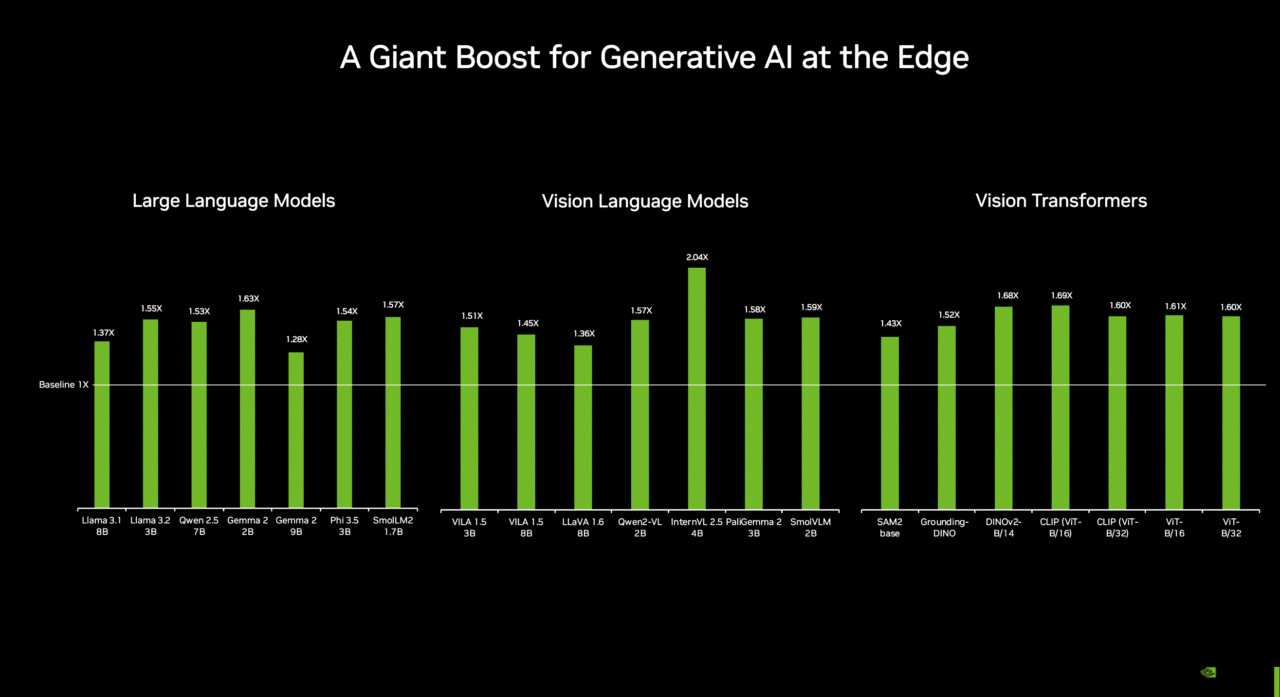
Available today, it delivers as much as a 1.7x leap in generative AI inference performance, a 70% increase in performance to 67 INT8 TOPS, and a 50% increase in memory bandwidth to 102 GB/s compared with its predecessor. Whether creating LLM chatbots based on retrieval-augmented generation, building a visual AI agent, or deploying AI-based robots, the Jetson Orin Nano Super is an ideal solution to fetch.

NVIDIA GeForce RTX 5080 to Stand Out with 30 Gbps GDDR7 Memory, Other SKUs Remain on 28 Gbps

NVIDIA is preparing to unveil its "Blackwell" GeForce RTX 5080 graphics card, featuring cutting-edge GDDR7 memory technology. However, RTX 5080 is expected to be equipped with 16 GB of GDDR7 memory running at an impressive 30 Gbps. Combined with a 256-bit memory bus, this configuration will deliver approximately 960 GB/s bandwidth—a 34% improvement over its predecessor, the RTX 4080, which operates at 716.8 GB/s. While the RTX 5080 will stand as the sole card in the lineup featuring 30 Gbps memory modules, while other models in the RTX 50 series will incorporate slightly slower 28 Gbps variants. This strategic differentiation is possibly due to the massive CUDA cores gap between the rumored RTX 5080 and RTX 5090.

The flagship RTX 5090 is set to push boundaries even further, implementing a wider 512-bit memory bus that could potentially achieve bandwidth exceeding 1.7 TB/s. NVIDIA appears to be reserving larger memory configurations of 16 GB+ exclusively for this top-tier model, at least until higher-capacity GDDR7 modules become available in the market. Despite these impressive specifications, the RTX 5080's bandwidth still falls approximately 5% short of the current RTX 4090, which benefits from a physically wider bus configuration. This performance gap between the 5080 and the anticipated 5090 suggests NVIDIA is maintaining a clear hierarchy within its product stack, and we have to wait for the final launch to conclude what, how, and why of the Blackwell gaming GPUs.

NVIDIA GeForce RTX 5070 Ti Leak Tips More VRAM, Cores, and Power Draw

It's an open secret by now that NVIDIA's GeForce RTX 5000 series GPUs are on the way, with an early 2025 launch on the cards. Now, preliminary details about the RTX 5070 Ti have leaked, revealing an increase in both VRAM and TDP and suggesting that the new upper mid-range GPU will finally address the increased VRAM demand from modern games. According to the leak from Wccftech, the RTX 5070 Ti will have 16 GB of GDDR7 VRAM, up from 12 GB on the RTX 4070 Ti, as we previously speculated. Also confirming previous leaks, the new sources confirm that the 5070 Ti will use the cut-down GB203 chip, although the new leak points to a significantly higher TBP of 350 W. The new memory configuration will supposedly run on a 256-bit memory bus and run at 28 Gbps for a total memory bandwidth of 896 GB/s, which is a significant boost over the RTX 4070 Ti.

Supposedly, the RTX 5070 Ti will also see a bump in total CUDA cores, from 7680 in the RTX 4070 Ti to 8960 in the RTX 5070 Ti. The new RTX 5070 Ti will also switch to the 12V-2x6 power connector, compared to the 16-pin connector from the 4070 Ti. NVIDIA is expected to announce the RTX 5000 series graphics cards at CES 2025 in early January, but the RTX 5070 Ti will supposedly be the third card in the 5000-series launch cycle. That said, leaks suggest that the 5070 Ti will still launch in Q1 2025, meaning we may see an indication of specs at CES 2025, although pricing is still unclear.

Update Dec 16th: Kopite7kimi, ubiquitous hardware leaker, has since responded to the RTX 5070 Ti leaks, stating that 350 W may be on the higher end for the RTX 5070 Ti: "...the latest data shows 285W. However, 350W is also one of the configs." This could mean that a TBP of 350 W is possible, although maybe only on certain graphics card models, if competition is strong, or in certain boost scenarios.

The Witcher IV Gets New Trailer at The Game Awards, Pre-Rendered on Unannounced NVIDIA RTX GPU

CD Projekt RED pulled out a rabbit out of its hat, revealing the first trailer for the upcoming The Witcher IV title. The new trailer is pre-rendered in a custom build of Unreal Engine 5, which CD Projekt RED is now using instead of its own in-house engine, as announced earlier. More interestingly, it is pre-rendered on an "unannounced NVIDIA GeForce RTX GPU." CD Projekt RED teamed up with Platige Image, who were responsible for intro cinematics in the previous Witcher games.

The trailer, which is almost six minutes long, follows Ciri, which confirms earlier rumors that the game might focus on Ciri as the main character. As detailed by CD Projekt RED, the trailer shows Ciri's new abilities and tools, as well as a small part of the story, a witcher contract set in a remote village. CD Projekt RED is promising that The Witcher IV will be "the most immersive and ambitious open-world Witcher game to date."

JPR: Q3'24 PC Graphics AiB Shipments Decreased 14.5% Compared to the Last Quarter

According to a new research report from the analyst firm Jon Peddie Research, the growth of the global PC-based graphics add-in board market reached 8.1 million units in Q3'24 and desktop PC CPU shipments increased to 20.1 million units. Overall, AIBs will have a compound annual growth rate of -6.0% from 2024 to 2028 and reach an installed base of 119 million units at the end of the forecast period. Over the next five years, the penetration of AIBs in desktop PCs will be 83%.

As indicated in the following chart, AMD's overall AIB market share decreased -2.0% from last quarter, and NVIDIA's market share increased by 2.0%. These slight flips of market share in a down quarter don't mean much except to the winner. The overall market dynamics haven't changed.
  • The AIB overall attach rate in desktop PCs for the quarter decreased to 141%, down -26.9% from last quarter.
  • The desktop PC CPU market decreased -3.4% year to year and increased 42.2% quarter to quarter, which influenced the attach rate of AIBs.

Ayar Labs, with Investments from AMD, Intel Capital, and NVIDIA, Secures $155 Million Series D Funding

Ayar Labs, the leader in optical interconnect solutions for large-scale AI workloads, today announced it has secured $155 million in financing led by Advent Global Opportunities and Light Street Capital to break down the AI bottleneck of data movement with its optical I/O technology. This brings the company's total funding to $370 million and raises the company's valuation to above $1 billion.

The strength of the round and caliber of investors, including participation from AMD Ventures, Intel Capital, and NVIDIA, marks another key milestone as Ayar Labs prepares its optical solution for high volume manufacturing strategically aligned to customer roadmaps. Other new strategic and financial investors participating in the round include 3M Ventures and Autopilot. They join existing investors such as Applied Ventures LLC, Axial Partners, Boardman Bay Capital Management, GlobalFoundries, IAG Capital Partners, Lockheed Martin Ventures, Playground Global, and VentureTech Alliance.

NVIDIA GeForce NOW Gets Six New Games This Week

From heart-pounding action games to remastered classics, there's something for everyone this GFN Thursday. Six new titles join the cloud this week, starting with The Thing: Remastered. Face the horrors of the Antarctic as the game oozes onto GeForce NOW. Nightdive Studios' revival of the cult-classic 2002 survival-horror game came to the cloud as a surprise at the PC Gaming Show last week. Since then, GeForce NOW members have been able to experience all the bone-chilling action in the sequel to the title based on Universal Pictures' genre-defining 1982 film. And don't miss out on the limited-time GeForce NOW holiday sale, which offers 50% off the first month of a new Ultimate or Performance membership. The 25% off Day Pass sale ends today - take advantage of the offer to experience 24 hours of cloud gaming with all the benefits of Ultimate or Performance membership.

It's Alive!
The Thing: Remastered brings the 2002 third-person shooter into the modern era with stunning visual upgrades, including improved character models, textures and animations, all meticulously crafted to enhance the game's already-tense atmosphere. Playing as Captain J.F. Blake, leader of a U.S. governmental rescue team, navigate the blood-curdling aftermath of the events depicted in the original film. Trust is a precious commodity as members command their squad through 11 terrifying levels, never knowing who might harbor the alien within. The remaster introduces enhanced lighting and atmospheric effects that make the desolate research facility more immersive and frightening than ever.

Dell Pro Max 16/18 Plus Leak Hints at Arrow Lake-H Prowess With Up To 256 GB of Memory

Dell laptops are widely considered to be among the best, and the company shows no signs of getting complacent. According to a fresh new leak, Dell is gearing up to announce new 16- and 18-inch workstation laptops, dubbed the Dell Pro Max 16 Plus and the Dell Pro Max 18 Plus. Of course, the naming scheme likely couldn't get any worse, but the leaked specifications certainly do seem enticing.

First and foremost, the laptops will be powered by Intel's upcoming Arrow Lake-HX CPUs, paired with up to an impressive 256 GB of CAMM2 memory. The graphics will be handled by NVIDIA RTX 5000-class GPUs, and the entire system will boast a 170 W and 200 W TDP for the 16- and 18-inch variants respectively. The 18-inch Dell Pro Max will be able to accommodate up to a whopping 16 TB of SSD storage, whereas the 16-inch Dell Pro Max will boast up to 12 TB of SSD storage.

NVIDIA Under Antitrust Investigation in China Amid Escalating Chip Tensions

Today China announced an investigation into NVIDIA for possible violations of antitrust laws. This is apparently in retaliation for the recent U.S. embargo on semiconductor exports, Reuters reported. China's State Administration for Market Regulatory Affairs (SAMR) did not provide specific details about the antitrust violations however it said they may allegedly be linked to NVIDIA's acquisition of Mellanox Technologies in 2020. NVIDIA once dominated China's AI market with over 90% of the market share, however, it now generates just 17% of its revenue from the region, down from 26% two years ago. The decline in income is a direct result of U.S. export controls as NVIDIA was forced to develop Chinese-specific chip versions.

The investigation on NVIDIA mirrors China's 2013 antitrust probe against Qualcomm's local subsidiary for overcharging and abusing market position in wireless communication standards. The investigation resulted in a $975 million fine which Qualcomm agreed to pay. Recently, the United States announced additional export restrictions adding 140 Chinese companies from the semiconductor industry including chip equipment manufacturers. Shortly after, China announced a ban on exports of key minerals (gallium, germanium, and antimony) while Chinese industry associations urged domestic companies to avoid U.S.-made chips.

NVIDIA Shows Future AI Accelerator Design: Silicon Photonics and DRAM on Top of Compute

During the prestigious IEDM 2024 conference, NVIDIA presented its vision for the future AI accelerator design, which the company plans to chase after in future accelerator iterations. Currently, the limits of chip packaging and silicon innovation are being stretched. However, future AI accelerators might need some additional verticals to gain the required performance improvement. The proposed design at IEDM 24 introduces silicon photonics (SiPh) at the center stage. NVIDIA's architecture calls for 12 SiPh connections for intrachip and interchip connections, with three connections per GPU tile across four GPU tiles per tier. This marks a significant departure from traditional interconnect technologies, which in the past have been limited by the natural properties of copper.

Perhaps the most striking aspect of NVIDIA's vision is the introduction of so-called "GPU tiers"—a novel approach that appears to stack GPU components vertically. This is complemented by an advanced 3D stacked DRAM configuration featuring six memory units per tile, enabling fine-grained memory access and substantially improved bandwidth. This stacked DRAM would have a direct electrical connection to the GPU tiles, mimicking the AMD 3D V-Cache on a larger scale. However, the timeline for implementation reflects the significant technological hurdles that must be overcome. The scale-up of silicon photonics manufacturing presents a particular challenge, with NVIDIA requiring the capacity to produce over one million SiPh connections monthly to make the design commercially viable. NVIDIA has invested in Lightmatter, which builds photonic packages for scaling the compute, so some form of its technology could end up in future NVIDIA accelerators

TSMC and NVIDIA Reportedly in Talks to Bring "Blackwell" GPU Production to Arizona

TSMC is reportedly negotiating with NVIDIA to manufacture advanced "Blackwell" GPUs in its Arizona facility. First reported by Reuters, this partnership could mark another major shift in AI chip production toward US soil. The discussion centers around TSMC's Fab 21 in Phoenix, Arizona, specializing in 4 nm and 5 nm chip production. NVIDIA's Blackwell GPUs utilize TSMC's 4NP process technology, making the Arizona facility a technically viable production site. However, the proposed arrangement faces several logistical challenges. A key issue is the absence of advanced packaging facilities in the United States. There is Amkor that planned to do advanced packaging, but it's only scheduled to begin packaging in 2027. TSMC's sophisticated CoWoS packaging technology is currently available only in Taiwan. This means that chips manufactured in Arizona would need to be shipped back to Taiwan for final assembly, potentially increasing production costs.

While alternative solutions exist, such as redesigning the chips to use Intel's packaging technology or focusing on gaming GPU production in Arizona, these options present their own complications. Intel's packaging methods would likely increase costs, and the current absence of graphics card manufacturing infrastructure in the US makes domestic gaming GPU production less practical. Both TSMC and NVIDIA have declined to comment on the ongoing negotiations, as this is confidential information unknown to the public. Interestingly, TSMC's Arizona facility has already attracted a few more US firms for domestic manufacturing, like Apple, rumored to manufacture its A16 Bionic chip and AMD with high-performance designs, likely either EPYC or Instinct MI chips.

NVIDIA's Next-Gen "Rubin" AI GPU Development 6 Months Ahead of Schedule: Report

The "Rubin" architecture succeeds NVIDIA's current "Blackwell," which powers the company's AI GPUs, as well as the upcoming GeForce RTX 50-series gaming GPUs. NVIDIA will likely not build gaming GPUs with "Rubin," just like it didn't with "Hopper," and for the most part, "Volta." NVIDIA's AI GPU product roadmap put out at SC'24 puts "Blackwell" firmly in charge of the company's AI GPU product stack throughout 2025, with "Rubin" only succeeding it in the following year, for a two-year run in the market, being capped off with a "Rubin Ultra" larger GPU slated for 2027. A new report by United Daily News (UDN), a Taiwan-based publication, says that the development of "Rubin" is running 6 months ahead of schedule.

Being 6 months ahead of schedule doesn't necessarily mean that the product will launch sooner. It would give NVIDIA headroom to get "Rubin" better evaluated in the industry, and make last-minute changes to the product if needed; or even advance the launch if it wants to. The first AI GPU powered by "Rubin" will feature 8-high HBM4 memory stacks. The company will also introduce the "Vera" CPU, the long-awaited successor to "Grace." It will also introduce the X1600 InfiniBand/Ethernet network processor. According to the SC'24 roadmap by NVIDIA, these three would've seen a 2026 launch. Then in 2027, the company would follow up with an even larger AI GPU based on the same "Rubin" architecture, codenamed "Rubin Ultra." This features 12-high HBM4 stacks. NVIDIA's current GB200 "Blackwell" is a tile-based GPU, with two dies that have full cache-coherence. "Rubin" is rumored to feature four tiles.

Forza Motorsport Gets Ray-Traced Global Illumination in December 9 Visual Update

Forza Motorsport, Xbox Studios's cinematic 2023 live-service racing sim, is getting a nice visual upgrade in an upcoming update (titled Update 15) shortly after the first anniversary of its release. On December 9, Forza Motorsport will get Ray-Traced Global Illumination (RTGI), making the racing game and all its shiny cars look more realistic. RTGI will be available for all PC versions of Forza Motorsport as of December 9—as long as the game is up-to-date that is—although it will need to be manually enabled in the game's graphics settings. After being enabled, RTGI will apply to both gameplay rendering and in-game cinematics, as well as the built-in photo mode.

While Forza Motorsport's minimum recommended GPU specification is an NVIDIA GeForce GTX 1060, you will need at least an NVIDIA GeForce RTX 20-series or AMD RX 6000-series graphics card to take advantage of RTGI, with the game's developer, Turn 10, recommending an NVIDIA GeForce RTX 3080 or better for high graphics and RTGI settings. For the uninitiated, RTGI helps increase realism by simulating how light interacts with surfaces and materials, more accurately rendering indirect lighting and shadows in-game. In NVIDIA's blog post announcing the updated visuals for Forza Motorsport, it recommends using the RTGI in conjunction with DLSS Super Resolution or DLAA to get the highest frame rates. Forza Motorsport is available for PC on Steam (currently 50% off), the Microsoft Store, and PC Game Pass

NVIDIA GeForce NOW Gets Indiana Jones and the Great Circle and Twelve More Games

GeForce NOW is wrapping a sleigh-full of gaming gifts this month, stuffing members' cloud gaming stockings with new titles and fresh offers to keep holiday gaming spirits merry and bright. Adventure calls and whip-cracking action awaits in the highly anticipated Indiana Jones and the Great Circle, streaming in the cloud today during the Advanced Access period for those who have preordered the Premium Edition from Steam or the Microsoft Store. The title can only be played with RTX ON - GeForce NOW is offering gamers without high-performance hardware the ability to play it with 25% off Ultimate and Performance Day Passes. It's like finding that extra-special gift hidden behind the tree.

This GFN Thursday also brings a new limited-time offer: 50% off the first month of new Ultimate or Performance memberships - a gift that can keep on giving. Whether looking to try out GeForce NOW or buckle in for long-term cloud gaming, new members can choose between the Day Pass sale or the new membership offer. There's a perfect gaming gift for everyone this holiday season. GFN Thursday also brings 13 new titles in December, with four available this week to get the festivities going. Plus, the latest update to GeForce NOW - version 2.0.69 - includes expanded support for 10-bit color precision. This feature enhances image quality when streaming on Windows, macOS and NVIDIA SHIELD TVs - and now to Edge and Chrome browsers on Windows devices, as well as to the Chrome browser on Chromebooks, Samsung TVs and LG TVs.

NVIDIA to Open Vietnam R&D Center to Bolster AI Development

NVIDIA announced today it is opening its first Vietnam research and development center, signaling its confidence in the country's bright artificial intelligence future. The company is collaborating with the Vietnamese government to establish its new Vietnam Research and Development Center focused on AI. NVIDIA will use the R&D center to focus on software development, capitalizing on the country's strong talent pool of STEM engineers, and to engage industry leaders, startups, government agencies, universities and students to accelerate the adoption of AI.

"We are delighted to open NVIDIA's R&D center to accelerate Vietnam's AI journey," said Jensen Huang, founder and CEO of NVIDIA. "With our expertise in AI development, we will partner with a vibrant ecosystem of researchers, startups and enterprise organizations to build incredible AI right here in Vietnam."

AGON by AOC Launches the Q27G4XY Smart Gaming Monitor Featuring Google TV

Your favorite shows, movies, series, live TV, and games are in your space on the screen of your AGON by AOC Q27G4XY SMART GAMING MONITOR. The AGON by AOC Q27G4XY 27" SMART GAMING MONITOR is a pioneer in this field, bringing the convenience of Google TV to your monitor screen. This 27" QHD 2560x1440 WLED monitor, featuring a 180 Hz refresh rate, 1 ms GtG response time, AMD FreeSync, NVIDIA G-SYNC, and HDR10, combined with Google TV, delivers an immersive gaming and streaming experience—ideal for any dorm room!

Google TV
When you're done gaming, there's no need to switch devices. The AGON by AOC Q27G4XY Smart Gaming Monitor, powered by Google TV's built-in operating system, brings all your entertainment to one place. Instantly browse movies, shows, live TV, sports, and more across your favorite apps. Google TV brings together everything you stream on one screen, so you can find what to watch without jumping from app to app. Not sure what to watch? Just ask Google Assistant and search across apps with your voice to find what you're looking for. Finding your next watch is now as easy as ever.

NVIDIA DLSS 3 Comes to Indiana Jones and the Great Circle and Marvel Rivals This Week

More than 600 games and applications feature RTX technologies, and each week new games integrating NVIDIA DLSS, NVIDIA Reflex and advanced ray-traced effects are released or announced, delivering the definitive PC experience for GeForce RTX players. This week, Indiana Jones and the Great Circle and Marvel Rivals launch with DLSS 3, Path of Exile 2 enters Early Access with day-one support for DLSS Super Resolution, and the Delta Force PC Global Open Beta kicks-off, also with day-one DLSS Super Resolution support. On December 9th, Forza Motorsport's next update introduces support for immersive Ray-Traced Global Illumination lighting. And in the near future, Warhammer 40,000: Space Marine 2's next update introduces support for DLSS 3 Frame Generation.

Indiana Jones and the Great Circle Launching With DLSS 3 & Ray Tracing
Uncover one of history's greatest mysteries in Indiana Jones and the Great Circle on December 6th with the game's Digital Premium Edition Advanced Access launch, followed by its general release on December 9th. Step into the shoes of Indiana Jones and embark on a single-player, narrative-driven journey that spans the globe during the height of the legendary archaeologist's career. From the hallowed halls of the Vatican and the sunken temples of Sukhothai to the pyramids of Egypt and the snowy peaks of the Himalayas.

NVIDIA GeForce 566.36 WHQL Game Ready Drivers Released

NVIDIA today released the latest version of its GeForce Game Ready drivers. Version 566.36 WHQL comes with Game Ready optimization for Indiana Jones and the Great Circle, Delta Force, Marvel Rivals, Path of Exile 2, Forza Motorsport RT Global Illumination update, and Warhammer 40,000: Space Marine 2 DLSS 3 Frame Gen update. This release also includes optimal settings that can be applied using GeForce Experience or the NVIDIA App, for Farming Simulator 25, Microsoft Flight Simulator 2024, and S.T.A.L.K.E.R. 2: Heart of Chornobyl. Game crashes noticed in Forza Horizon 5 and God of War: Ragnarok, after updating to R565 drivers, have been fixed.

DOWNLOAD: NVIDIA GeForce 566.36 WHQL

SK Hynix Shifts to 3nm Process for Its HBM4 Base Die in 2025

SK Hynix plans to produce its 6th generation high-bandwidth memory chips (HBM4) using TSMC's 3 nm process, a change from initial plans to use the 5 nm technology. The Korea Economic Daily reports that these chips will be delivered to NVIDIA in the second half of 2025. NVIDIA's GPU products are currently based on 4 nm HBM chips. The HBM4 prototype chip launched in March by SK Hynix features vertical stacking on a 3 nm die., compared to a 5 nm base die, the new 3 nm-based HBM chip is expected to offer a 20-30% performance improvement. However, SK Hynix's general-purpose HBM4 and HBM4E chips will continue to use the 12 nm process in collaboration with TSMC.

While SK Hynix's fifth-generation HBM3E chips used its own base die technology, the company has chosen TSMC's 3 nm technology for HBM4. This decision is anticipated to significantly widen the performance gap with competitor Samsung Electronics, which plans to manufacture its HBM4 chips using the 4 nm process. SK hynix is currently leading the global HBM market with almost 50% of market share, most of its HBM products been delivered to NVIDIA.

NVIDIA's Massive Quad-Slot GeForce RTX 4090 Prototype Pictured

A recently discarded NVIDIA graphics card prototype has emerged from an unexpected source—a dumpster. Reported by VideoCardz citing an anonymous tipster from Reddit, the new GPU is identified as an experimental RTX 4090 variant, and has very unique design features and engineering choices. The recovered prototype shares core specifications with the retail RTX 4090 Founders Edition, featuring identical PG147 SKU 330 board architecture and power specifications of 450 W typical draw with a 600 W peak capacity. However, technicalities reveal some differences, particularly in its BIOS version (95.02.01.22.01) and operating frequencies, with a 2115 MHz base clock and 2355 MHz boost clock running approximately 5% lower than the regular Founders Editions model.

Most intriguingly, the prototype implements an interesting triple-fan cooling solution, distinguished by a concealed middle fan integrated within the heatsink structure. This design element aligns with previous industry speculation about NVIDIA's development of an 900 W-capable Founders Edition card. However, the discovered unit maintains standard RTX 4090 branding without any "Ti" or "TITAN" designations, which we previously associated the massive heatsink with. Further analysis suggests the prototype's distinctive three-section PCB layout was likely developed to accommodate additional processing cores and memory components, pointing to NVIDIA's exploration of more powerful variants that ultimately never reached production.

NVIDIA GeForce NOW Gets Six New Games and Black Friday Promotion

Turn Black Friday into Green Thursday with a new deal on GeForce NOW Ultimate and Performance memberships this week. For a limited time, get 50% off new Ultimate or Performance memberships for the first three months to experience the power of GeForce RTX-powered gaming at a fraction of the cost. The giving continues for GeForce NOW members: SteelSeries is offering a 30% discount exclusively to all GeForce NOW members on Stratus+ or Nimbus+ controllers, perfect for gaming anytime, anywhere when paired with GeForce NOW on Android and iOS devices. To redeem the discount, opt in to GeForce NOW rewards and look out for an email with details. Enjoy this exclusive offer on its own - it can't be combined with other SteelSeries promotions. It's not a GFN Thursday without new games - this week, six are joining the over 2,000 titles in the GeForce NOW library.

Plus, the Steam Autumn Sale is happening now, featuring stellar discounts on GeForce NOW-supported games. Snag beloved publishers' top titles, including Nightingale from Inflexion Games, Remnant and Remnant II from Arc Games, and Cult of the Lamb and The Plucky Squire from Devolver - and even more from publishers Frost Giant Studios, Metric Empire, tinyBuild, Torn Banner Studios and Tripwire. The sale runs through Wednesday, Dec. 4.

TechPowerUp Releases NVCleanstall v1.17.0

TechPowerUp today released the latest version of NVCleanstall, our nifty little utility that lets you download and install NVIDIA GeForce drivers with a much higher level of customization than NVIDIA's installer permits. This utility lets you disable (or enable) several components in the GeForce driver package that you can't find in the NVIDIA installer's "Custom install" page, including important settings such as telemetry. Version 1.17.0 introduces several improvements and fixed. To begin with, driver signature rebuild not working on Windows 11 24H2 has been fixed. The startup page now has a "what's new" link that takes you to the driver change-log from the Release Notes. We fixed an issue where the "automatically click driver unsigned warning" option was not working under certain conditions.

The messaging in the "Finished" page of NVCleanstall has been fixed. The driver dropdown now indicates "Windows 10/11" instead of simply "Windows 10." We improved the "build package" screen with a tip that the "-y" argument allows unattended installation. The overall interface has been improved to help with systems that have very low screen resolution. The "experimental" label has been removed from the GitHub-based NVENC Video Encoding Session Limit Patch in the options list. A rare error encountered when unpacking installers has been fixed.

DOWNLOAD: TechPowerUp NVCleanstall 1.17.0
The change-log follows.

NVIDIA DLSS Comes To Void Crew, Towers of Aghasba, and War Thunder

More than 600 games and applications feature RTX technologies, and each week new games integrating NVIDIA DLSS, NVIDIA Reflex and advanced ray-traced effects are released or announced, delivering the definitive PC experience for GeForce RTX players. This week, Void Crew has officially launched with support for DLSS Super Resolution. Towers of Aghasba is available now with DLSS Super Resolution. And War Thunder has added new hardware-accelerated ray-traced effects that take full advantage of GeForce RTX Ray Tracing Cores.

Void Crew Out Now With DLSS Super Resolution
Hutlihut Games and Focus Entertainment's Void Crew is a co-op roguelite for 1-4 players, where you and your friends join the ranks of METEM's chosen clone warriors, embarking on a Pilgrimage into the unknown. As a crew, you'll take on the role of Pilot, Gunner, Engineer, or Scavenger to face the threats lurking deep in METEM's domain. Your mission? Stand against the mysterious HOLLOW, an alien force like no other, to restore order - and try not to panic! Void Crew has just exited Early Access, adding a ton of new content, along with new technical features. Now, GeForce RTX gamers can accelerate performance using DLSS Super Resolution, to make their space adventures even better.

NVIDIA GeForce RTX 5090D "China Edition": A Regular RTX 5090 SKU with Firmware Modification

NVIDIA's upcoming GeForce RTX 50-series is expected to make a debut during the CES 2025 show in January. However, NVIDIA serves a lot of markets, and its significant presence is also recorded in the Chinese market as well. Hence, the company has prepared its "Dragon" version of the top-of-the-line GPU versions for Chinese gamers, complying with export regulations that forbid Chinese entities from acquiring GPUs powerful enough to train AI models. NVIDIA appears to be developing "D" variants for both RTX 5090 and RTX 5080 cards, but we only have the confirmation for the GeForce RTX 5090D so far, thanks to MEGAsizeGPU. However, a new leak from the Chinese Chiphell forum points to RTX5090D having the same hardware specification as the regular RTX 5090.

In the last generation, RTX 4090 and RTX 4090D were different, with the RTX 4090D having lower TGP and core count. However, this time around, NVIDIA will physically leave the same expected GB202 "Blackwell" die with CUDA core count and memory, only to lock certain features through firmware. Since the primary goal of export regulations the US is imposing is slowing down Chinese access to GPUs powerful enough to train and inference AI models, we expect to see the RTX 5090D with reduced Tensor core capability and maybe a lowered frequency of the overall chip. This could limit some applications from using these Tensor cores for inference, while NVIDIA's AI features like DLSS could also be a bit slowed down. NVIDIA may find a way to allow DLSS and other gaming-related technologies to operate normally while other general-purpose AI tasks are limited. Readers may recall Low Hash Rate (LHR) cards during the crypto mining boom, which had a similar firmware lock to cap mining hash rate.

Sony Electronics' Spatial Reality Display Now Supercharged with NVIDIA Omniverse

Sony Electronics is setting a new benchmark for immersive 3D experiences with its cutting-edge ELF-SR2 (27-inch) and ELF-SR1 (15.6-inch) Spatial Reality Displays and the NVIDIA Omniverse development platform. The combination of Sony's unmatched 3D display technology and Omniverse's powerful real-time 3D design and simulation capabilities is poised to revolutionize industries from gaming and entertainment to architecture, engineering, and automotive design—without the need for VR headsets or special glasses.

With Sony's Spatial Reality Display and the new NVIDIA Omniverse, creators can now experience real-time rendering like never before. NVIDIA Omniverse is a platform of application programming interfaces, software development kits, and services that enable developers to seamlessly combine Universal Scene Description (OpenUSD) and NVIDIA RTX rendering technologies into existing software tools. By connecting OpenUSD-based applications developed on NVIDIA Omniverse with Sony's Spatial Reality Display, creators can instantly view and manipulate their 3D assets in real time. This allows creators to turn their digital designs into holographic-like experiences, giving them the freedom to explore all aspects of their work from every angle, no extra hardware required.
Return to Keyword Browsing
Nov 27th, 2026 19:17 CST change timezone

New Forum Posts

Popular Reviews

TPU on YouTube

Controversial News Posts