News Posts matching #NVIDIA

Return to Keyword Browsing

NVIDIA DLSS 3 Coming To S.T.A.L.K.E.R. 2: Heart of Chornobyl and Microsoft Flight Simulator 2024

More than 600 games and applications feature RTX technologies, and each week new games integrating NVIDIA DLSS, NVIDIA Reflex and advanced ray-traced effects are released or announced, delivering the definitive PC experience for GeForce RTX players. In the very near future, both Microsoft Flight Simulator 2024 and S.T.A.L.K.E.R. 2: Heart of Chornobyl will be launching with day-one support for DLSS 3 with Frame Generation and Super Resolution. Farming Simulator 25 launches today with day-one support for DLSS Super Resolution. And Mortal Rite is out now with DLSS Super Resolution. Additionally, our new Indiana Jones and the Great Circle GeForce RTX 40 Series GPU and laptop bundle is available now.

S.T.A.L.K.E.R. 2: Heart of Chornobyl Launches November 20th With DLSS 3 & Reflex
GSC Game World's S.T.A.L.K.E.R. 2: Heart of Chornobyl is a brand-new entry in the legendary series, enjoyed by millions of players worldwide. The unique combination of first-person shooter, immersive sim, and horror is back. With unprecedented scale, advanced graphics, freedom of choices, and the thickest atmosphere of a deadly adventure, it's going to be the ultimate S.T.A.L.K.E.R. experience.

NVIDIA Switches Production Capacity to RTX 50-series "Blackwell"

Q1-2025 promises to be an action-packed quarter for graphics cards, with NVIDIA introducing the bulk of its next-generation GeForce RTX 50-series "Blackwell" GPUs. The company is expected to start things off with the two enthusiast-segment SKUs, the RTX 5090 and RTX 5080, in January, followed by the RTX 5070-series in February, and rounded off nicely with the RTX 5060-series in March. This would mean hundreds of individual new graphics card SKUs from NVIDIA's board partners, which are reportedly busy winding up the final inventory deliveries of their RTX 40-series "Ada" products, and transferring this production capacity to the RTX 50-series. So, when the RTX 50-series GPU models do come out across the quarter, there's plenty of inventory to go around. Board Channels reports that on NVIDIA's end, production of nearly every AD100-series silicon has ended, except the AD107, which will continue selling for entry-mainstream GeForce RTX 40-series SKUs. The AD106 production line has stopped, as has the AD103, AD104, and AD102.

NVIDIA Announces Indiana Jones and the Great Circle GeForce RTX 40 Series Bundle

Uncover one of history's greatest mysteries in Indiana Jones and the Great Circle with the ultimate power and performance of the GeForce RTX 40 Series. Live the adventure as Indy and immerse yourself in fully ray-traced graphics as you venture around the globe across iconic locations, accelerated and enhanced by AI-powered NVIDIA DLSS for the definitive PC experience. Step into the shoes of Indiana Jones and embark on a single-player, narrative-driven journey that spans the globe during the height of the legendary archaeologist's career. From the hallowed halls of the Vatican and the sunken temples of Sukhothai to the pyramids of Egypt and the snowy peaks of the Himalayas, you'll experience Indy's adventure at the highest levels of fidelity, performance and responsiveness on GeForce RTX 40 Series GPUs and laptops.

Until December 29th, as part of our Indiana Jones and the Great Circle GeForce RTX 40 Series Bundle, get the Digital Premium Edition of Indiana Jones and the Great Circle (a $99.99 value) with the purchase of a qualifying GeForce RTX 4090, 4080 SUPER, 4080, 4070 Ti SUPER, 4070 Ti, 4070 SUPER, or 4070 desktop or graphics card, or laptop with a GeForce RTX 4090 Laptop GPU, RTX 4080 Laptop GPU, RTX 4070 Laptop GPU. And as an added bonus, the Digital Premium Edition enables Advanced Access to Indiana Jones and the Great Circle on December 6th, three days before the official December 9th release date.

NVIDIA Releases GeForce 566.14 WHQL Game Ready Driver

NVIDIA has released its latest GeForce Game Ready drivers, version 566.14 WHQL. The new drivers release comes with optimization for S.T.A.L.K.E.R 2: Heart of Chornobyl and Microsoft Flight Simulator 2024, including DLSS 3 support for these two games. The one-click optimal settings in GeForce Experience and the NVIDIA App have been updated with new titles as well and now include Call of Duty: Black Ops 6, Delta Force, Dragon Age: The Veilguard, Horizon Zero Dawn Remastered, and Red Dead Redemption.

The new GeForce 566.14 WHQL Game Ready drivers also fixes a couple of gaming and general bugs, including DSSR/DLDSR custom resolution not appearing in some games, issues with Call of Duty MWIII where filename change prevented users from using GFE Freestyle Filters, higher than normal CPU usage in Bluestacks/Corsair iCUE, and bug where cache files are still created even when Shader Cache size is disabled. The NVIDIA App is also finally out of the beta stage, and you can check out our in-depth review, as well as download it from NVIDIA.

DOWNLOAD: NVIDIA GeForce 566.14 WHQL

NVIDIA DLSS 3 Comes to DUCKSIDE, Empire of the Ants, and Planet Coaster 2

More than 600 games and applications feature RTX technologies, and each week new games integrating NVIDIA DLSS, NVIDIA Reflex, and advanced ray-traced effects are released or announced, delivering the definitive PC experience for GeForce RTX players. This week, there's a ton of new releases and announcements, so let's dive on in.

Following the launch of even more amazing blockbuster DLSS games last week, this week Empire of the Ants and Planet Coaster 2 launch with DLSS 3 with Frame Generation and Super Resolution, and we're highlighting the recently released indie game DUCKSIDE, which also boasts support for DLSS 3. Additionally, SILENT HILL 2 and Kristala now feature support for DLSS 3 with Frame Generation. And you can win a GeForce RTX 40 Series PC by speedrunning a new Fortnite Lofi Girl challenge map.

NVIDIA GeForce Now Gimps Game Streaming With New Monetization, Monthly Play Time Caps

NVIDIA today announced incoming changes to its GeForce Now game streaming service, some of which are not likely to sit well with gamers. The biggest, and likely most controversial change coming to GeForce Now is the addition of monthly playtime caps for all GeForce Now users, regardless of which plan they're on. According to the blog post announcing the changes, GeForce Now gamers will be limited to 100 hours of gameplay per month in addition to the daily playtime caps. NVIDIA will allow gamers who don't use their whole monthly cap to roll 15 hours of game time into the following month.

It's not all bad news, however, as NVIDIA also announced that it will be increasing the resolution and image quality of the GeForce Now Performance tier—previously Priority—from 1080p to 1440p. The Ultimate and Basic tiers remain unchanged in both name and feature set. NVIDIA says the playtime limit was necessary in order "to continue providing exceptional quality and speed—as well as shorter queue times." Of course players can buy extra playtime at a rate of $2.99 for 15 hours of GeForce Now Performance and $5.99 for 15 hours of GeForce Now Ultimate. The playtime limits will come into effect on January 1, 2025, and anyone that signs up for a paid GeForce Now subscription before then won't be subjected to the new playtime limits until January 2026.

Nintendo Switch Successor: Backward Compatibility Confirmed for 2025 Launch

Nintendo has officially announced that its next-generation Switch console will feature backward compatibility, allowing players to use their existing game libraries on the new system. However, those eagerly awaiting the console's release may need to exercise patience as launch expectations have shifted to early 2025. On the official X account, Nintendo has announced: "At today's Corporate Management Policy Briefing, we announced that Nintendo Switch software will also be playable on the successor to Nintendo Switch. Nintendo Switch Online will be available on the successor to Nintendo Switch as well. Further information about the successor to Nintendo Switch, including its compatibility with Nintendo Switch, will be announced at a later date."

While the original Switch evolved from a 20 nm Tegra X1 to a more power-efficient 16 nm Tegra X1+ SoC (both featuring four Cortex-A57 and four Cortex-A53 cores with GM20B Maxwell GPUs), the Switch 2 is rumored to utilize a customized variant of NVIDIA's Jetson Orin SoC, now codenamed T239. The new chip represents a significant upgrade with its 12 Cortex-A78AE cores, LPDDR5 memory, and Ampere GPU architecture with 1,536 CUDA cores, promising enhanced battery efficiency and DLSS capabilities for the handheld gaming market. With the holiday 2024 release window now seemingly off the table, the new console is anticipated to debut in the first half of 2025, marking nearly eight years since the original Switch's launch.

NVIDIA Surpasses Apple as the World's Most Valuable Company

Valued at $3.43 trillion against Apple's $3.38 trillion at the time of this writing, NVIDIA Corporation is now the most valuable company in the world. NVIDIA has been the hottest tech stock since 2021, as it created the most valuable IP of this decade—AI GPUs, which were ready just in time for OpenAI and ChatGPT to open its doors, jumpstarting the generative AI revolution. NVIDIA's AI GPUs didn't come to being overnight, the company had been investing in the parallel computing and HPC space since the 2000s, with its CUDA programming language that lets application exploit the SIMD parallelism of its GPUs. In the mid-2010s, the company created the Tensor core, accelerating AI, and invested heavily in AI frameworks. Some of the most fundamental research leading up to GPT was done on NVIDIA GPUs. This would lead to the big payoff in the 2020s, helping NVIDIA become a multi-trillion-dollar company. Founding CEO Jensen Huang has been NVIDIA's brains and spine throughout the company's 30+ year journey, and its success could not be possible without him at the reins.

U.S. Supreme Court to Hear NVIDIA and Facebook Appeals on Securities Fraud Claims

The United States Supreme Court is about to decide on two cases brought by NVIDIA and Meta (Facebook) to avoid legal action against them for fraud on securities. The U.S. Supreme Court will hear NVIDIA's arguments on November 13 regarding the dismissal attempt of the securities class action lawsuit. Swedish investment firm E. Ohman J:or Fonder AB claims NVIDIA misled investors in 2017-2018 by understating its revenue dependency on cryptocurrency mining. NVIDIA's stand lies in the plaintiff's failure to meet the criteria established by the 1995 Private Securities Litigation Reform Act. Earlier this year, NVIDIA settled with the U.S. regulatory authority to pay $5.5 million to settle charges about the poor reporting of crypto mining's impact on its gaming segment.

The Supreme Court is also set to adjudicate the case brought by Facebook to dismiss the securities lawsuit where investors led by Amalgamated Bank accused the company of deceiving them by not revealing a 2015 data breach that involved Cambridge Analytica and which, in turn, affected more than 30 million users. The case came to the fore after Facebook's stock tanked in the light of reports about Cambridge Analytica's misuse of user data during the 2016 Trump campaign. Facebook maintains it wasn't obliged to disclose past breaches in risk statements, as these are supposedly forward-looking. The company had previously paid $100 million in penalty to the SEC and $5 billion to the FTC over the same issue. Recently, three Supreme Court decisions in June had eroded federal regulators, namely the SEC which is the principal regulator of securities fraud, and appear to bring more limitations to the power of private plaintiffs to be able to enforce federal rules set out for corporate misconduct.

NVIDIA CEO Jensen Huang Asks SK hynix to Speed Up HBM4 Delivery by Six Months

SK hynix announced the first 48 GB 16-high HBM3E in the industry at the SK AI Summit in Seoul today. During the event, news came out about newer plans to develop their next-gen memory tech. Reuters and ZDNet Korea reported that NVIDIA CEO Jensen Huang asked SK hynix to speed up their HBM4 delivery by six months. SK Group Chairman Chey Tae-won shared this info at the Summit. The company had earlier said they would give HBM4 chips to customers in the second half of 2025.

When ZDNet asked about this sped-up plan, SK hynix President Kwak Noh-Jung gave a careful answer saying "We will give it a try." A company spokesperson told Reuters that this new schedule would be quicker than first planned, but they didn't share more details. In a video interview shown at the Summit, NVIDIA's Jensen Huang pointed out the strong team-up between the companies. He said working with SK hynix has helped NVIDIA go beyond Moore's Law performance gains. He stressed that NVIDIA will keep needing SK hynix's HBM tech for future products. SK hynix plans to supply the latest 12-layer HBM3E to an undisclosed customer this year, and will start sampling of the 16-layer HBM3E early next year.

New Arm CPUs from NVIDIA Coming in 2025

According to DigiTimes, NVIDIA is reportedly targeting the high-end segment for its first consumer CPU attempt. Slated to arrive in 2025, NVIDIA is partnering with MediaTek to break into the AI PC market, currently being popularized by Qualcomm, Intel, and AMD. With Microsoft and Qualcomm laying the foundation for Windows-on-Arm (WoA) development, NVIDIA plans to join and leverage its massive ecosystem of partners to design and deliver regular applications and games for its Arm-based processors. At the same time, NVIDIA is also scheduled to launch "Blackwell" GPUs for consumers, which could end up in these AI PCs with an Arm CPU at its core.

NVIDIA's partner, MediaTek, has recently launched a big core SoC for mobile called Dimensity 9400. NVIDIA could use something like that as a base for its SoC and add its Blackwell IP to the mix. This would be similar to what Apple is doing with its Apple Silicon and the recent M4 Max chip, which is apparently the fastest CPU in single-threaded and multithreaded workloads, as per recent Geekbench recordings. For NVIDIA, the company already has a team of CPU designers that delivered its Grace CPU to enterprise/server customers. Using off-the-shelf Arm Neoverse IP, the company's customers are acquiring systems with Grace CPUs as fast as they are produced. This puts a lot of hope into NVIDIA's upcoming AI PC, which could offer a selling point no other WoA device currently provides, and that is tried and tested gaming-grade GPU with AI accelerators.

NVIDIA GeForce NOW Gets Dragon Age: The Veilguard, 17 More Games in November

Even post-spooky season, GFN Thursday has some treats for GeForce NOW members: a new batch of 17 games joining the cloud in November. Catch the five games available to stream this week, including Dragon Age: The Veilguard, the highly anticipated next installment in BioWare's beloved fantasy role-playing game series. Players who purchased the GeForce NOW Ultimate bundle can stream the game at launch for free starting today.

Unite the Veilguard
In Dragon Age: The Veilguard, take on the role of Rook and stop a pair of corrupt ancient gods who've broken free from centuries of darkness, hellbent on destroying the world. Set in the rich world of Thedas, the game includes an epic story with meaningful choices, deep character relationships, and a mix of familiar and new companions to go on adventures with. Select from three classes, each with distinct weapon types, and harness the classes' unique, powerful abilities while coordinating with a team of seven companions, who have their own rich lives and deep backstories. An expansive skill-tree system allows for diverse character builds across the Warrior, Rogue and Mage classes.

Dragon Age: The Veilguard, Now Available on PlayStation 5, Xbox Series X|S and PC

Electronic Arts Inc. and BioWare announced today that Dragon Age: The Veilguard is now available for PlayStation 5 (also enhanced for PS5 Pro), Xbox Series X|S and PC via Steam (Steam Deck Verified), EA app and Epic Games Store. This bold, heroic adventure is built to deliver on what the series is best known for: rich storytelling, fantasy worldbuilding, companions & fellowship, and a world where you matter. The next installment in BioWare's beloved franchise has captivated critics worldwide, with outlets such as IGN and GamesRadar+ proclaiming it "deserves its place in the RPG pantheon" and is "A true return to RPG form for BioWare" in their 9/10 and 4.5/5 reviews.

In Dragon Age: The Veilguard, Solas, the Dread Wolf, wants to tear down the Veil that separates Thedas from the world of demons, restoring his people's immortality and glory - even at the cost of countless lives. But his ritual goes awry, and his worst fears are realized, as two of his most ancient and powerful adversaries are released. Players will step into the role of Rook, a fully-customizable protagonist who must rise up and unite their companions to stop these two powerful deities on a journey that will span across Thedas' bustling cities, lush tropics, boreal forests, fettered swamps and deepest depths.

Cisco Unveils Plug-and-Play AI Solutions Powered by NVIDIA H100 and H200 Tensor Core GPUs

Today, Cisco announced new additions to its data center infrastructure portfolio: an AI server family purpose-built for GPU-intensive AI workloads with NVIDIA accelerated computing, and AI PODs to simplify and de-risk AI infrastructure investment. They give organizations an adaptable and scalable path to AI, supported by Cisco's industry-leading networking capabilities.

"Enterprise customers are under pressure to deploy AI workloads, especially as we move toward agentic workflows and AI begins solving problems on its own," said Jeetu Patel, Chief Product Officer, Cisco. "Cisco innovations like AI PODs and the GPU server strengthen the security, compliance, and processing power of those workloads as customers navigate their AI journeys from inferencing to training."

NVIDIA DLSS 3 Comes to Dragon Age: The Veilguard, Horizon Zero Dawn Remastered, and Red Dead Redemption This Week

More than 600 games and applications feature RTX technologies, and each week new games integrating NVIDIA DLSS, NVIDIA Reflex and advanced ray-traced effects are released or announced, delivering the definitive PC experience for GeForce RTX players. This week, there's a ton of new releases and announcements, so let's dive on in. Following the launch of several great DLSS games last week, this week sees Dragon Age: The Veilguard, Horizon Zero Dawn Remastered, and Red Dead Redemption all launch with DLSS. And Torque Drift 2 is adding support for DLSS 3 Frame Generation.

Dragon Age: The Veilguard Launches October 31st With DLSS 3, Reflex & Ray Tracing
Rise as Rook, Dragon Age's newest hero. Be who you want to be and play how you want to play as you fight to stop the gods from blighting the world in Dragon Age: The Veilguard. But you can't do this alone - the odds are stacked against you. Lead a team of seven companions, each with their own rich story to discover and shape, and together you will become The Veilguard. When BioWare and Electronic Arts' Dragon Age: The Veilguard launches on October 31st, you'll be able to accelerate performance with DLSS 3, and enhance image quality and immersion with ray-traced reflections and ray-traced ambient occlusion.

NVIDIA Ethernet Networking Accelerates World's Largest AI Supercomputer, Built by xAI

NVIDIA today announced that xAI's Colossus supercomputer cluster comprising 100,000 NVIDIA Hopper GPUs in Memphis, Tennessee, achieved this massive scale by using the NVIDIA Spectrum-X Ethernet networking platform, which is designed to deliver superior performance to multi-tenant, hyperscale AI factories using standards-based Ethernet, for its Remote Direct Memory Access (RDMA) network.

Colossus, the world's largest AI supercomputer, is being used to train xAI's Grok family of large language models, with chatbots offered as a feature for X Premium subscribers. xAI is in the process of doubling the size of Colossus to a combined total of 200,000 NVIDIA Hopper GPUs.

Next-Gen GPUs: Pricing and Raster 3D Performance Matter Most to TPU Readers

Our latest front-page poll sheds light on what people want from the next generation of gaming GPUs. We asked our readers what mattered most to them, with answers including raster performance, ray tracing performance, energy efficiency, upscaling or frame-gen technologies, the size of video memory, and lastly, pricing. Our poll ran from September 19, and gathered close to 24,000 votes as of this writing. Pricing remains the king of our polls, with the option gathering 36.1% of the vote, or 8,620 votes. Our readers expect pricing of next-generation GPUs to remain flat, variant-for-variant, and not continue on the absurdly upward trend it has had for the past few generations, with the high-end being pushed beyond the $1,000-mark, and $500 barely bringing in a 1440p-class GPU, while 4K-capable game consoles exist.

Both AMD and NVIDIA know that Moore's Law is cooked, and that generational leaps in performance and transistor counts are only possible with increase in pricing for the latest foundry nodes. AMD even tried experimenting with disaggregated (chiplet-based) GPUs with its latest RDNA 3 generation, before calling it quits on the enthusiast-segment, so it could focus on the sub-$1000 performance segment. The second most popular response was Raster 3D performance (classic 3D rendering performance), which scored 27% or 6,453 votes.

Thermaltake Launches New AI-Enhanced Gaming Desktops with Intel Core Ultra Series 2 Processors

Thermaltake, a global leader in PC gaming hardware, proudly introduces its latest line of high-performance pre-built gaming desktops. Powered by the new Intel Core Ultra Series 2 processors and NVIDIA GeForce RTX 40 and RTX 40 Super series graphics cards, these five new systems are engineered to set new gaming and content creation standards. With unrivaled speed, AI-enhanced performance, and intelligent resource management, the new desktops promise to deliver next-level experiences for enthusiasts and creators alike.

Equipped with advanced AI capabilities, the Intel Core Ultra Series 2 processors optimize system performance in real-time, learning user patterns to deliver smoother gameplay, faster rendering, and superior multitasking. Combined with Thermaltake's sleek design and top-tier PC cases and components, the new gaming desktops offer a perfect blend of performance, reliability, and style, catering to the needs of pro gamers, content creators, and PC enthusiasts. These systems are available at the Thermaltake Webstore, Amazon, and Best Buy.

NVIDIA GeForce NOW Gets Call of Duty: Black Ops 6 and Nine More Games

Attention, recruits! It's time to test combat skills and strategic prowess. Drop into the heart of the action this GFN Thursday with the launch of the highly anticipated first-person blockbuster Call of Duty: Black Ops 6, streaming in the cloud Oct. 24, 9pm PT. Plus, embark on an adventure to defend an empire in the remake of the classic role-playing game (RPG), Romancing SaGa 2: Revenge of the Seven. That's just the tip of the iceberg. These are part of the nine titles being added to GeForce NOW's library of over 2,000 games. Members can also look forward to a new reward - a free in-game Stag-Heart Skull Sallet Hat - for the award-winning RPG The Elder Scrolls Online, starting on Thursday, Oct. 31. Get ready by opting into GeForce NOW's Rewards program today.

Mission Critical
Get ready, soldiers - the next assignment awaits in the cloud. Call of Duty: Black Ops 6 is set against the backdrop of the Gulf War in the early 1990s, and will bring a thrilling Campaign, action-packed Multiplayer and a Zombies experience sure to thrill fans. The new game introduces the Omnimovement system to the franchise, allowing players to sprint, slide and dive in any direction, enhancing tactical gameplay across all modes. Call of Duty: Black Ops 6 launches with 16 new Multiplayer maps and two Zombies maps - Terminus and Liberty Falls. In Multiplayer, the classic Prestige system makes a comeback, while the single player Campaign experience promises a gripping espionage narrative. With its blend of historical fiction, gameplay innovations and fan-favorite features, Black Ops 6 aims to deliver an intense Call of Duty experience that pushes the boundaries of the franchise.

NVIDIA Ships Over One Billion RISC-V Cores This Year Inside Its Accelerators, Up to 40 Cores Per Chip

During the 2024 RISC-V Summit in Santa Clara, California, NVIDIA was one of the presenting members. RISC-V, being a free and open-source instruction set architecture, is an interesting choice for many companies looking to develop custom solutions. NVIDIA designs accelerators for AI and graphics processing, all of which are equipped with up to tens of thousands of cores. To manage these cores, NVIDIA has developed a custom RISC-V processor called "NV-RISCV," which is a replacement for its predecessor "Falcon." Unlike Falcon, NV-RISCV is based on an open-source ISA and is customized much more deeply, with features like more customized caches and special instructions. Initially, the company reported better performance over its Falcon GPU System Processor (GSP), and NV-RISCV is now running in millions of NVIDIA chips.

Thanks to a post on X by Nick Brown, we learn that NVIDIA is shipping roughly one billion RISC-V cores in the year 2024. Each NVIDIA chip includes between 10 and 40 RISC-V cores, depending on the chip size and complexity. Some more complex designs, like GB200, require massive data coordination, meaning that more cores are needed to handle these requests and distribute them. This includes chip-to-chip interfaces, context switching, memory controller, camera handling, video codecs, display output, resource management, power management, and more. NVIDIA has developed a total of over 20 custom extensions for RISC-V cores, which all serve their specific use cases.

Micron SSDs Qualified for Recommended Vendor List on NVIDIA GB200 NVL72

Micron Technology, Inc., today announced that its 9550 PCIe Gen 5 E1.S data center SSDs have been added to the NVIDIA recommended vendor list (RVL) for the NVIDIA GB200 NVL72 system and its derivatives. The GB200 NVL72 uses the GB200 Grace Blackwell Superchip to deliver rack-scale, energy-efficient AI infrastructure. The enablement of PCIe Gen 5 storage in the system makes the Micron 9550 SSD an ideal fit for optimizing performance and power efficiency in AI workloads like large-scale training of AI models, real-time trillion-parameter language model inference and high-performance computing (HPC) tasks.

Micron 9550 delivers world-class AI workload performance and power efficiency:
Compared with other industry offerings, the 9550 SSD delivers up to 34% higher throughput for NVIDIA Magnum IO GPUDirect (GDS) and up to 33% faster workload completion times in graph neural network (GNN) training with Big Accelerator Memory (BaM). The Micron 9550 SSD saves energy and sets new sustainability benchmarks by consuming 81% less SSD energy per 1 TB transferred than other SSD offerings with NVIDIA Magnum IO GDS and up to 43% lower SSD power in GNN training with BaM.

Possible NVIDIA GeForce RTX 5080 Laptop GPU Pictured

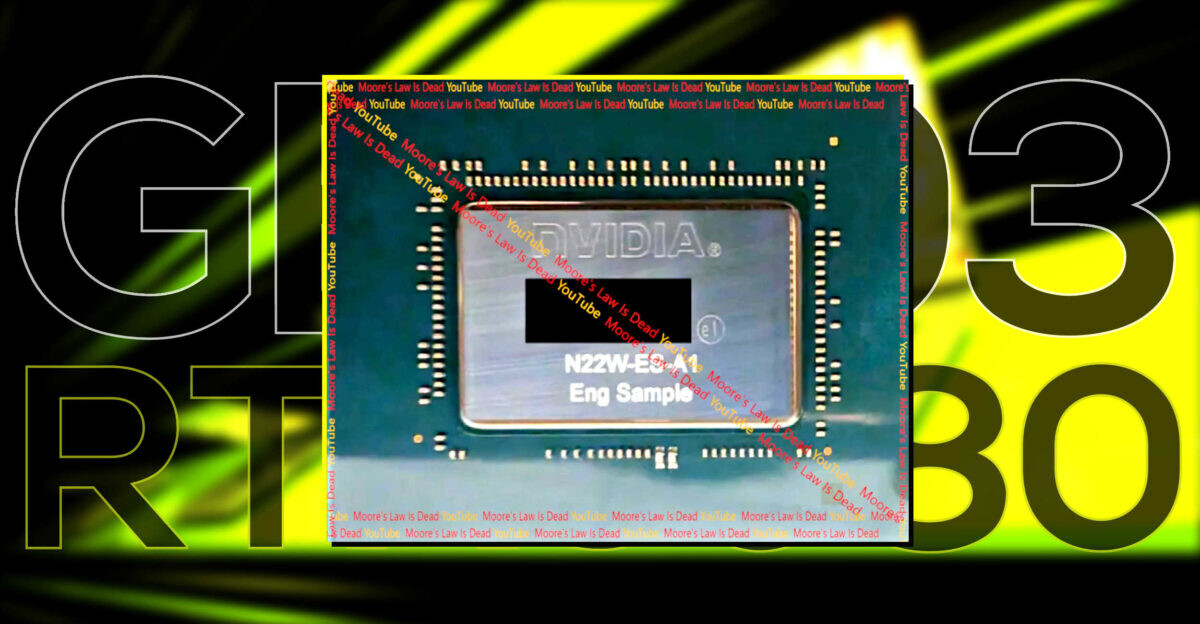
Could this be the first picture of an NVIDIA GeForce RTX 5080 Laptop GPU? This picture, coupled with a specs sheet by notebook OEM Clevo, seems to suggest so, thanks to a new video by Moore's Law is Dead. The chip is noticeably more rectangular than the Ada "AD104," and is labelled N22W-ES-A1. It is an engineering sample. Cross-referencing "N22W" with the Clevo specs-sheet for a next-generation laptop mainboard, points to the possibility that the chip is indeed based on a next-gen silicon by NVIDIA. The board design has to undergo a significant change, due to the major change in the pin-map of the fiberglass substrate brought about by the switch to the new GDDR7 memory type.

The GeForce "Blackwell" generation comes in several GPU silicon sizes, and the RTX 5080 Laptop GPU is expected to be based on the "GB203" chip, which is expected to power the desktop RTX 5080 and possibly some SKUs in even the RTX 5070 series, such as the "RTX 5070 Ti." It is rumored to feature as many as 8,192 CUDA cores, and a 256-bit wide GDDR7 memory interface. NVIDIA is expected to unveil the GeForce "Blackwell" generation at CES 2025.

The Finals Dev's New Extraction Shooter Arc Raiders Gets October 24 Tech Test

Arc Raiders, the upcoming third-person PvPvE survival shooter from the developer of The Finals has received a date for its first tech test on Steam. This will apparently be the game's largest external play test to date, and, given the far-away release date, the developer will likely be evaluating things like server performance and game stability first and foremost—although players will likely be asked for feedback regarding game performance and features, as well. The tech test will run for four days, starting on October 24 and ending on October 27.

Players interested in trying out the upcoming extraction shooter can apply via the game's Steam Store page, although they will also need to agree to a non-disclosure agreement, and they will not be allowed to stream any gameplay, share any footage or images from the new game, or even talk about the playtest. In the announcement for the playtest, Embark Studios is clear that this is not meant to be a marketing push for Arc Raiders, despite the press wave that came with the tech test announcement, and the studio hopes to save the excitement for when the game fully releases in 2025.

NVIDIA Releases GeForce 566.03 WHQL Game Ready Driver

NVIDIA today released the latest version of GeForce Game Ready drivers. Version 566.03 WHQL comes with optimization for Dragon Age: The Veilguard, and Alan Wake 2: The Lake House, and Call of Duty: Black Ops 6. It extends DLSS 3 Frame Generation support to both these games, and to Horizon Zero Dawn Remastered, No More Room In Hell 2, Red Dead Redemption, and The Axis Unseen. This release does not come with any game-specific bug fixes, but corrects a system-specific bug, where your Digital Vibrance custom setting does not persist reboots or waking up from sleep.

DOWNLOAD: NVIDIA GeForce 566.03 WHQL

NVIDIA GeForce RTX 5090 "Blackwell" GPU Appears During Factory Boot-Up

We officially have the first look at NVIDIA's GeForce RTX 5090 "Blackwell" add-in board from what appears to be ZOTAC manufacturing facility. The leaked video shows a newly opened factory in Indonesia, which is recently opened-up to circumvent US export regulations. Published on Chiphell platform, the factory video shows NVIDIA GeForce RTX 5090 AIB design powering up, followed by cheering of factory workers. This signals that the alleged NVIDIA GeForce RTX 50 series scheduled for CES is near indeed, and AIB designs are also going to be available around that timeframe.

To confirm that the video is indeed showing GeForce RTX 5090, the video description, translated from Chinese, is as follows: "Due to the US's chip export control on China, graphics card chips with performance equal to or higher than 4090 are prohibited from being exported to mainland China. In order to avoid the impact of this move on the launch of RTX 5090, Bo Neng urgently built a factory in Batam, Indonesia. The video shows the debugging of the factory production line. The graphics card that lights up the monitor in the video is the NVIDIA RTX 5090 graphics card that will be launched soon." Although the video is quite blurry, we have to wait for the official launch or more leaks to see the GPU in its full glory.
Return to Keyword Browsing
Nov 27th, 2026 19:17 CST change timezone

New Forum Posts

Popular Reviews

TPU on YouTube

Controversial News Posts