News Posts matching #RAM

Return to Keyword Browsing

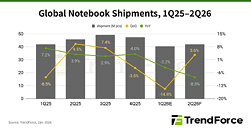
Dual Pressure from Rising CPU and Memory Prices to Drive Global Notebook Shipments Down 14.8% QoQ in 1Q26

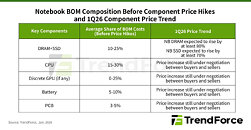
TrendForce's latest survey of the notebook industry reveals that global notebook brands have been grappling with sharp increases in memory prices since 2H25. Entering early 2026, they are now also facing a temporary CPU supply shortfall and price hikes. These challenges are compounded by rising costs for PCBs, batteries, and PMICs, which together are expected to drive global notebook shipments down 14.8% QoQ in 1Q26, falling below brands' original expectations.

TrendForce observes that, depending on the system setup, CPUs generally make up about 15-30% of a notebook's total BOM cost. Currently, most entry-level and mainstream notebooks mainly use Intel processors. However, Intel's recent price hikes on lower-end CPUs and ongoing supply shortages—expected to persist until after March—are adding pressure to product planning and shipment timing.
AI Architecture Evolution Set to Drive Memory Market Revenue to a New Peak in 2027, with Annual Growth Exceeding 50%

TrendForce's latest research indicates that AI innovation is causing a fundamental shift in the memory market. As data access volumes continue to grow, AI systems depend more on high-bandwidth, high-capacity, low-latency DRAM to handle large-scale model parameters, long-sequence inference, and multi-task parallel processing. Additionally, NAND Flash has become essential for fast data transfer, making memory a key component in AI infrastructure and a strategic focus for CSPs.

Memory prices have continuously increased due to limited capacity and rising demand for allocations, pushing industry revenue to new record levels. TrendForce projects the memory market to be worth $551.6 billion in 2026 and to surge to a peak of $842.7 billion in 2027, reflecting a 53% YoY growth.

Arduino UNO Q is Now Available with 4 GB RAM and 32 GB Storage

We've already seen lots of amazing projects based on Arduino UNO Q come up since its launch in early October - but we're doubling down anyway! Today, we are launching a new Arduino UNO Q variant with 4 GB of RAM and 32 GB of eMMC storage, allowing all of you to dream bigger and go further, while still enjoying the same Arduino UNO Q form factor and ease of use.

4 good reasons to choose 4 GB
In this 4 GB variant, Arduino UNO Q still leverages a unique combination of powerful Qualcomm Dragonwing QRB2210 microprocessor and real-time STM32U585 microcontroller, but can now better meet the needs of developers who require a more ample memory configuration.

Micron to Buy Fab From PSMC in Taiwan to Increase DRAM Output

Micron has signed a letter of intent with Taiwanese Powerchip Semiconductor Manufacturing Corporation (PSMC) to buy its P5 fab in Tongluo in Central Taiwan. Micron and PSMC have agreed on a cash price of US$1.8 billion for the fab, which is PSMC's most recent 12-inch fab and should allow Micron to add additional 1x nm DRAM production capacity. The two companies are expecting the transaction to close by the second quarter of this year, but it doesn't mean that Micron will take over the facility from day one. Instead, Micron isn't expecting the fab to "contribute to meaningful DRAM wafer output" until the second half of 2027.

PSMC doesn't have its own 1x nm DRAM production today, as the company is still developing its own nodes, which could be part of the reason for the delayed "meaningful" output for Micron. That means that with the current equipment in place, Micron will end up with 2x nm DRAM to start with, suggesting it's DDR4 that's being produced at the fab today. According to TrendForce, the fab should be able to contribute as much as 10 percent of Micron's total DRAM output in 2027, which is not an insignificant amount. TrendForce also noted that PSMC is expecting to get a 1x nm (1Y or 1Z) DRAM license for its other fabs, to help it produce higher-density DRAM in the near future at its other fabs.

NVIDIA Reportedly Ends GeForce RTX 5070 Ti Production, RTX 5060 Ti 16 GB Next

NVIDIA has reportedly stopped production of its mid-range GeForce RTX 5070 Ti graphics card, according to ASUS, one of the largest PC manufacturers. ASUS shared exclusive information with Hardware Unboxed, revealing that NVIDIA has created a supply shortage for the GeForce RTX 5070 Ti, effectively ending its production. As one of NVIDIA's largest AIB partners, ASUS has learned that the model is essentially in end-of-life status. The company noted the supply shortage and offered no further comments on availability or potential improvements in supply. Since retailers and manufacturers can't source enough stock of the GeForce RTX 5070 Ti GPUs, the shortage has led to significant price increases for these models and suggests that the future availability of this GPU SKU might be nonexistent.

Update 2, January 16, 08:30 UTC: ASUS issued an official public statement regarding the "incomplete" information about the RTX 5070 Ti and RTX 5060 Ti EOL.
ASUSWe would like to clarify recent reports regarding the ASUS GeForce RTX 5070 Ti and RTX 5060 Ti 16 GB. Certain media may have received incomplete information from an ASUS PR representative regarding these products. The GeForce RTX 5070 Ti and GeForce RTX 5060 Ti 16 GB have not been discontinued or designated as end-of-life (EOL). ASUS has no plans to stop selling these models. Current fluctuations in supply for both products are primarily due to memory supply constraints, which have temporarily affected production output and restocking cycles. As a result, availability may appear limited in certain markets, but this should not be interpreted as a production halt or product retirement. ASUS will continue to support the GeForce RTX 5070 Ti and RTX 5060 Ti 16 GB and is working closely with partners to stabilize supply as conditions improve.

NVIDIA To Prioritize RTX 5060 at Expense of Rest of 50 Series

It's been predicted for a while now that the looming DRAM crisis would have an effect on GPU prices in 2026, with previous stories we've covered indicating that cards like the RTX 5090 would see increases up to $5,000 before the end of the year. Now, an industry insider has claimed on Board Channels, via Wccftech, that NVIDIA would prioritize production and logistics for the GeForce RTX 5060 series, specifically referring to the RTX 5060 and 5060 Ti 8 GB models. This comes after NVIDIA has supposedly cut shipments of the 5060 Ti 16 GB and 5070 Ti models. This means that higher-end models will become more scarce and prices will likely become even more inflated as a result of the scarcity.

The switch-up in the logistics pipeline is supposedly a direct response to the shortage of consumer memory, which has resulted in higher density GDDR7 modules becoming more difficult to procure. These supply chain struggles are not limited to GPU add-in-board partners or NVIDIA, as there have been rumors about prominent laptop and smartphone manufacturers potentially delaying 2025 launches as a result of the DRAM crisis or even trimming the RAM on flagship devices in order to keep costs somewhat lower. Even the next-gen console generation is said to be caught in the crossfire, with delays apparently being discussed by the likes of Microsoft and Sony.

Gigabyte Announces Support for 256GB of DDR5-7200 CQDIMMs at CES 2026

Gigabyte, the world's leading computer brand, announces a breakthrough introduction of the world's first CQDIMM (Clocked Unbuffered Dual In-Line Memory Module) technology at CES 2026. By leveraging the CQDIMM-supported motherboard, Z890 AORUS Tachyon ICE CQDIMM Edition, and BIOS tuning technology, Gigabyte achieves the industry-first record DDR5-7200 without compromise at full capacity with two 128 GB memory modules.

Traditionally, increasing DDR5 memory capacity has required significant trade-offs in frequency and stability. Inherent in Gigabyte's expertise in hardware and firmware design, this critical compromise is conquered. On the hardware side, Gigabyte has optimized motherboard circuit layouts to significantly reduce memory channel loading, improving signal integrity and ensuring stable operation even under heavy workloads. Complementing the hardware advancements is Gigabyte's sophisticated BIOS tuning technology. Through an optimized clock driver architecture, Gigabyte's BIOS intelligently manages timing, signal synchronization, and voltage behavior to unleash extreme performance.

Memory Makers Prioritize Server Applications, Driving Across-the-Board Price Increases in 1Q26

TrendForce's latest investigations indicate that DRAM suppliers in 1Q26 will continue to reallocate advanced process nodes and new capacity toward server and HBM products to support rising AI server demand. This shift has significantly limited supply in other markets, causing conventional DRAM contract prices to increase by about 55-60% QoQ. Meanwhile, disciplined capacity management by NAND Flash suppliers, along with robust server demand that is displacing other applications, is likely to increase contract prices across all NAND Flash product categories by 33-38%.

Despite weaker notebook shipments and slower growth in memory demand due to potential specification downgrades, PC DRAM prices are still set to rise sharply in the first quarter. DRAM suppliers have simultaneously tightened supply to PC OEMs and module makers, forcing some OEMs to procure memory at higher prices through modules makers. This is expected to raise DRAM suppliers' module pricing and significantly drive up PC DRAM prices.

Leaks Predict $5000 RTX 5090 GPUs in 2026 Thanks to AI Industry Demand

It's no secret that gaming is suffering under something of an affordability crisis, with increased demand for AI-capable GPUs and DDR5 memory resulting in rising prices for gamers and other far-reaching side effects on the gaming hardware market. Now, though, fresh leaks suggest that things are only going to get worse in 2026. According to Korean publication, Newsis, both AMD and NVIDIA are planning to gradually and permanently increase GPU prices "over the next several months." This is expected to start as early as January 2026, when AMD is expected to increase prices. NVIDIA will allegedly follow suit in February.

If the publication's insider sources are correct, the NVIDIA RTX 5090, which launched at $1,999, will reach as high as $5,000 before the end of the year. No prediction has been made for AMD's RX 9000 series, but memory has already been said to take up as much as 80% of the average GPU BOM cost, and memory prices are expected to increase by as much as 40% by Q2 2026. We've already reported on the fact that instability and price increases in the DRAM market will likely affect launch windows for upcoming hardware, potentially reaching as far as next-gen console launches, and ASUS recently announced that it would be increasing hardware prices starting in early January 2026, despite also increasing DDR4 motherboard production in response to the changing market.

ASUS Announces "Strategic Price Adjustments" for DRAM and SSDs

We recently covered a rumor that ASUS was planning on expanding its DDR4-compatible motherboard production and theorized that it might be a way to offer inexpensive build options to PC gamers in the midst of a growing DRAM shortage that continues to drive the price of DDR5 and NAND through the roof. It seems as though this may have been a correct estimation, as ASUS recently announced (via DigiTimes) a 2026 price hike on SSDs and DRAM kits, which will come into effect on January 5, 2026. While ASUS directly mentions DRAM and SSDs in its announcement, it doesn't specify which products will see a price increase, although it's easy to speculate where the effects will be felt the hardest—laptops, PC builds, smartphones, video cards, and gaming handhelds immediately stand out as victims.

ASUS says the price increase has become necessary after it has been "absorbing and responding to cost pressure over an extended period," and it blames supply chain pressure caused by increased demand from the AI industry for the price increases. This isn't entirely unexpected, and it was one of the potential outcomes industry insiders discussed in a prior rumor that suggested upcoming hardware launches may be delayed as a result of the DRAM shortage. The far-reaching effects of the DRAM crisis may extend to next-gen gaming consoles as well, which have been predicted to be delayed to well after the expected 2028 launch period.

Samsung Welcomes Galaxy A17 5G and Galaxy Tab A11+ to the Galaxy Ecosystem

Samsung Electronics America today introduced two new additions to its mobile portfolio: Galaxy A17 5G and Galaxy Tab A11+, expanding Galaxy experiences for every kind of user while offering fun and helpful new experiences at an incredible value. As the starting point for the Galaxy smartphone experience, Galaxy A17 5G introduces several updates for the Galaxy A series including improved cameras, enhanced durability, and innovative AI experiences.

Galaxy Tab A11+ is a do-it-all device offering excellent performance for everyday use. Designed to fit a wide range of needs, it's a great option for a shared device with features to keep everyone in the house connected.

Long Live AM4: ASUS Rumored To Increased DDR4 Motherboard Production

Perhaps in response to the overwhelming demand for DDR5 and the resulting price increase for PC hardware, ASUS is apparently planning to increase production of its B550 AM4 motherboards, which still rely on aging DDR4 RAM. This is according to a leak posted to Board Channels (via Videocardz), which claims that ASUS will make changes to its supply chain and production in the first quarter of 2026 in order to increase DDR4 motherboard production. This may be an indication that ASUS doesn't expect DDR5 supply and pricing to return to normal anytime soon, which lines up with recent rumors that console makers are considering postponing next-gen console launches until DRAM supply has stabilized.

These plans will include both AMD's B550 and A520 motherboards, both of which use the venerable AM4 socket, and Intel's B760M and H610M-G, and the increased supply will apparently be dedicated to e-commerce channels rather than physical retailers. These motherboards will cover up to AMD's Ryzen 5000 CPUs and Intel 14th-Gen CPUs. At the time of writing, there has been no confirmation from ASUS that these rumors are true, but the AM4 platform has continued to receive support from AMD, with the most recent AM4 CPU, the Ryzen 5 5600F, launching as recently as September 2025.

AMD Ryzen 9 9955HX3D Comes to SFF Desktop PCs in New Aoostar m-ATX Motherboard

AMD's Ryzen 9 9955HX3D launched earlier this year as a 16-core mobile gaming CPU based on AMD's Zen 5 architecture. Now, it appears to be coming to an microATX motherboard designed for use in DIY PC builds, courtesy of Aoostar. The company, known for its mini PCs, has announced two versions of the microATX motherboard via a Bilibili post: one with an AMD Ryzen 9 9955HX and another with the AMD Ryzen 9 9955HX3D. Both motherboards feature a full-size PCIe 5.0×16 expansion slots for dGPU compatibility, two DDR5 RAM slots for dual-channel capability, and dual 2280 M.2 PCIe 5.0×4 slots for storage expansion.

The motherboard also looks to use a standard 24-pin ATX power connector. The 9955HX3D's biggest claim to fame is the sizeable cache that's split between 64 MB of 3D V-Cache and 64 MB of regular cache, but this specific offering might be a decent option for those looking for a lot of power in a smaller form factor without the very limited expansion options that come from traditional mini PCs. The Ryzen 9 9955HX motherboard will launch at $530 (converted from ¥3799), a while the 3D V-Cache-equipped 9955HX3D will launch at $669.53 (converted from ¥4799), although it is unclear if these motherboards will be available for purchase outside of China.

Update Dec 30th: Aoostar has officially launched the TA95X3D microATX motherboards on its international store at a launch price of $749 (after a 25% discount).

RAM Crisis May Result in Next-Gen Console Delay

We have already reported on the outsized impact that the AI industry's demand for RAM and the ensuing RAM shortage have had on the PC gaming industry—including everything from price hikes to potential launch delays for next-gen PC hardware products—but now it seems as though console gamers may have to join PC gamers at the back of the line. According to a recent report by Insider Gaming, console hardware makers, likely referring to Microsoft and Sony, are in talks to delay the next console hardware generation.

Originally, the next-gen Xbox and PlayStation consoles were slated to launch sometime in 2027 or 2028, and a new launch window has not yet been revealed, but hardware makers are seemingly considering the delay in the hopes that RAM prices and availability will stabilize ahead of the launch. Currently, brands like Samsung are planning on pivoting some of their NAND production to DRAM, and other makers are scurrying to build out their supply chain to meet demand, but that takes time. We have already seen the RAM shortage impact console makers, with increasing NAND and DRAM prices resulting in slimmer margins, while some brands have had to start considering increasing the retail prices of their hardware.

Framework Announces Another DRAM Price Hike, Memory Costs $10 per GB of Capacity

Framework updated its original DRAM price hike blog post on December 24th, 2025, explaining that the company must respond to the price volatility its suppliers are experiencing. Initially, Framework announced a 50% price increase for its DDR5 memory upgrade configurations. To maintain transparency with customers, the company stated its intention to raise the price of DDR5 memory in Framework Laptop DIY Edition orders by 50%. This decision directly responds to the significantly higher costs from DRAM suppliers and distributors. As a result, the company cannot absorb all these cost increases and needs to pass some on to consumers. Therefore, another increase today is a natural response, as the company originally suggested.
FrameworkWith costs from our suppliers continuing to increase, we've had to make a further price adjustment on DDR5 memory modules. During this period of extreme memory shortages and price volatility, our priority is to make sure you can still buy a computer when you need one. With that in mind, we're setting our memory configuration prices as close as possible to the actual purchase prices we have with our suppliers and distributors. Since we're constantly sourcing additional memory and each purchase comes in at different (and often higher) pricing, we're using the Weighted Average Cost (WAC) of inventory, which currently comes to $10/GB for 8 GB, 16 GB, and 32 GB modules, and slightly higher for 48 GB modules.

System Integrators Start Offering No-RAM PCs Amid Rising Memory Costs

Paradox Customs, a boutique system builder based in Arizona, now offers customers the option to purchase prebuilt gaming PCs without memory installed. The company updated its online configurator and announced this change on its official X account. This option allows buyers to reduce immediate system costs or use memory kits they already own, helping them avoid additional expenses as memory shortages have driven prices up significantly. This change comes amid a severe shortage in the DRAM market, where DDR5 prices have risen sharply since early 2024, and certain high-performance modules are experiencing shipment delays of several weeks. For example, gamers are now expected to pay around $400 for 32 GB of DDR5 memory, which constitutes a significant portion of the total system cost.

The unusual choice now departs from the normal model in which system integrators select and validate every component to guarantee compatibility and simplify after-sales support. Purchasing memory modules in bulk have typically provided builders with stable margins and purchasing leverage that smooth short-term market swings. However, as the shortage is pricing out system integrators from accessing cheaper RAM, companies are looking to place the responsibility for sourcing RAM on the end use. Now system integrators like Paradox creates a product that sits between a fully supported turnkey machine and a do-it-yourself kit. This approach reduces the company's exposure to volatile inventory but also blurs the boundary between custom-builds and finished systems.

Update December 23, 22:20 UTC: MAINGEAR has also joined the "bring your own RAM" party, shipping systems without pre-installed RAM kits.

Micron Forecasts DRAM Shortages Beyond 2026

Despite achieving a record $13.64 billion in revenue for the first quarter of fiscal 2026, which ended on November 27, 2025, Micron addressed the ongoing DRAM shortage in its recent earnings call, noting that it is not a short-term issue. The company stated, "Sustained and strong industry demand, along with supply constraints, are contributing to tight market conditions, and we expect these conditions to persist beyond calendar 2026." Consequently, major customers are securing supply through multi-year contracts, driving up spot prices in both consumer and enterprise memory segments.

A significant factor in this imbalance is the increased demand for HBM memory. Micron mentioned that it "has completed agreements on price and volume for our entire calendar 2026 HBM supply," indicating that HBM customers are securing capacity well in advance. HBM requires more wafer area than standard DDR5 products as its stacks up to 12 DRAM dies, so its usage shifts scarce resources towards data center and AI workloads, reducing availability for traditional PC volumes. This results in a reallocation of limited dies and wafers to buyers willing to pay premiums and commit to long-term agreements, which are still a thing despite limited supply.

DRAM Price Hikes Have Minimal Impact on PC OEMs, Notes Report

The global DRAM shortage has driven up the prices of individual RAM kits, but PC OEMs have largely remained unaffected. Acer and ASUS indicated this week that rising memory costs are starting to influence notebook pricing, though retail price changes are still limited for now. Some brands, such as Dell, may begin raising prices on select high-end and business models, but neither Acer nor ASUS has officially changed their MSRPs in any way. Company executives warned that as new orders enter the market in the coming quarters, memory inflation will increasingly be reflected in end-product pricing. However, pricing remains stable for the time being, and there are no price changes.

Much of the near-term price stability comes from long-term supply agreements that protect OEMs and ODMs from paying spot market rates. Acer's CEO noted that memory historically accounted for about 8% to 10% of a PC's bill of materials, and that a 30% to 50% rise in memory costs so far has resulted in only an approximate 2% to 3% impact on the total BOM cost. Since many manufacturers secure memory through contracts that renew on quarterly or multi-year cycles, wider price fluctuations effects are likely to appear gradually, with more noticeable changes expected from the second quarter and into the third quarter of 2026 as contracts reset.

Marvell Designs Ultra-Low-Power 2 nm Dense SRAM, Outperforming Industry Standard

Marvell recently showcased its custom silicon IP advancements at the Marvell Analyst Day 2025. The company has developed SRAM IP that surpasses industry standards in terms of power efficiency and density. Initially launched in June, their 2 nm SRAM IP now reveals performance figures that highlight its superiority over standard solutions. In a 256K instance comparison, Marvell reports an 80% reduction in total power consumption, a 37% smaller area, and cycle times that are 22% faster. Additionally, Marvell's memory layout is more rectangular, facilitating easier integration into dense SoCs.

Further comparisons with top alternatives show that Marvell's custom SRAM uses 50% less area at the same bandwidth, reduces standby power by 66%, and delivers 17 times more bandwidth per mm² when normalized by area. These improvements are attributed to redesigned clocking and port structures that enhance bandwidth from on-die SRAM. Marvell argues that this architectural approach results in significantly higher bandwidth density and lower power consumption compared to standard dense SRAM IP. In an era where logic scaling continues to outpace memory in modern semiconductor nodes, having custom IP that aggressively boosts SRAM density and reduces power usage is a massive advantage.

Framework Pushes DDR5 Pricing 50% Higher Amid Shortage

Framework has published an official company blog post announcing that it is preparing a 50% price increase for its DDR5 memory upgrade configurations. In an effort to remain transparent with customers, the company has stated that it intends to raise the price of DDR5 memory available in Framework Laptop DIY Edition orders by 50%. This decision is a direct response to the significantly higher costs the company is facing from its DRAM suppliers and distributors. As a result, the company cannot absorb all of these cost increases on its own and needs to pass some of them on to the consumer.

The company will not increase the prices of its existing pre-configured systems that include DRAM, as these were acquired at earlier, standard prices. As the memory market becomes more volatile, this might be just the first wave of price hikes, since the company cannot absorb the added costs of new memory orders. Since Framework manufactures various components, from laptops to mini-PCs, the company uses a mix of DDR5, LPDDR5X, and GDDR. All of these are in tight supply due to the AI boom depleting any remaining DRAM inventory.

Kioxia Develops Core Technology that Will Allow the Practical Implementation of High-density, Low-power 3D DRAM

Kioxia Corporation, a world leader in memory solutions, today announced the development of highly stackable oxide-semiconductor channel transistors that will enable the practical implementation of high-density, low-power 3D DRAM. This technology was presented at the IEEE International Electron Devices Meeting (IEDM) held in San Francisco, USA, on December 10, and has the potential to reduce power consumption across a wide range of applications, including AI servers and IoT components.

In the era of AI, there is growing demand for DRAM with larger capacity and lower power consumption that can process large amounts of data. Traditional DRAM technology is reaching the physical limits of memory cell size scaling, prompting research into the 3D stacking of memory cells to provide additional capacity. The use of single-crystal silicon as the channel material for transistors in stacked memory cells, as is the case with conventional DRAM, drives up manufacturing costs, and the power required to refresh the memory cells increases proportionally to the memory capacity.

JEDEC Prepares SPHBM4 Standard to Deliver HBM4-Level Throughput with Reduced Pin Count

JEDEC Solid State Technology Association, the global leader in standards development for the microelectronics industry, today announced it is nearing completion of a new standard for Standard Package High Bandwidth Memory (SPHBM4). SPHBM4 devices are similar to the HBM4 devices commonly used in artificial intelligence accelerators, using the same DRAM dies on a new interface base die which can be mounted on standard organic substrates. In contrast, HBM4 is typically mounted on silicon substrates.

As planned, SPHBM operates at the same aggregate data throughput as HBM4 using fewer pins by operating at a higher frequency. Where the HBM4 interface has 2048 data signals, when published, SPHBM4 will define 512 data signals with 4:1 serialization to achieve the same bandwidth. This change allows the relaxed bump pitch required for connection to organic substrates.

Semiconductor Quarterly Revenue Surpasses $200bn for the First Time as Industry-Wide Growth Accelerates

New research from Omdia shows that the semiconductor market delivered a record breaking performance in 3Q25 with industry revenue reaching $216.3bn, up 14.5% quarter-over-quarter (QoQ). This marks the first time the global semiconductor market has exceeded $200bn in a single quarter, following an already strong 2Q25, which saw 8% QoQ growth. At this pace, the industry is on track to exceed $800bn in total revenue for 2025.

3Q25 far exceeds seasonal expectations
Demand for AI and memory products remains strong, with both segments continuing to outpace the wider market. While AI has dominated recent industry narratives, Omdia notes that more segments contributed to growth in 3Q25 than in previous quarters.

Memory Price Surge to Persist in 1Q26; Smartphone and Notebook Brands Begin Raising Prices and Downgrading Specs

TrendForce's latest investigations reveal that memory prices are projected to rise sharply again in the first quarter of 2026, exerting significant cost pressure on global end-device manufacturers. Consequently, smartphone and notebook brands are compelled to increase their product prices and reduce specifications. A further downward revision of shipment forecasts now seems unavoidable, with market resources becoming more concentrated among a few leading brands.

TrendForce notes that memory is increasingly accounting for a larger share of the BOM costs in consumer devices like smartphones and PCs. Even for Apple, which has strong profitability, the memory component in the total BOM for iPhones is expected to significantly increase in 1Q26. This development may lead Apple to reevaluate pricing strategies for new models and consider reducing or removing price cuts on older versions.

Penguin Solutions Expands Memory Portfolio with New 64 GB DDR5-6400 ECC CSODIMM

Penguin Solutions, Inc. (Nasdaq: PENG), a leading provider of high-performance computing and AI infrastructure solutions, today announced the release of its SMART 64 GB DDR5-6400 ECC CSODIMM memory modules, the newest addition to its broad DDR5 SODIMM lineup.

Designed for high-performance computing (HPC) in industrial, edge, telecom, and networking systems, the new module supports both commercial-temperature (C-temp) and industrial-temperature (I-temp) options, engineered to provide reliable operation in harsh environments. The compact CSODIMM form factor delivers higher density and faster bandwidth with error correction capability (ECC) to meet the demanding requirements of next-generation platforms.
Return to Keyword Browsing
Nov 16th, 2026 04:12 CST change timezone

New Forum Posts

Popular Reviews

TPU on YouTube

Controversial News Posts