Thursday, January 8th 2026

Gigabyte Announces Support for 256GB of DDR5-7200 CQDIMMs at CES 2026
Gigabyte, the world's leading computer brand, announces a breakthrough introduction of the world's first CQDIMM (Clocked Unbuffered Dual In-Line Memory Module) technology at CES 2026. By leveraging the CQDIMM-supported motherboard, Z890 AORUS Tachyon ICE CQDIMM Edition, and BIOS tuning technology, Gigabyte achieves the industry-first record DDR5-7200 without compromise at full capacity with two 128 GB memory modules.
Traditionally, increasing DDR5 memory capacity has required significant trade-offs in frequency and stability. Inherent in Gigabyte's expertise in hardware and firmware design, this critical compromise is conquered. On the hardware side, Gigabyte has optimized motherboard circuit layouts to significantly reduce memory channel loading, improving signal integrity and ensuring stable operation even under heavy workloads. Complementing the hardware advancements is Gigabyte's sophisticated BIOS tuning technology. Through an optimized clock driver architecture, Gigabyte's BIOS intelligently manages timing, signal synchronization, and voltage behavior to unleash extreme performance.
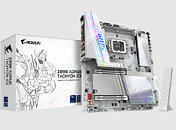
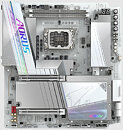 The tightly integrated hardware-firmware approach ensures that high-frequency operation remains stable and efficient, delivering uncompromising performance. Meanwhile, the industry-first milestone sets a new benchmark for high-performance computing, addressing the growing demand for both extreme bandwidth and maximum memory capacity in AI computing, content creation, data-intensive workloads, and professional applications.
To accelerate adoption and ensure broad compatibility, Gigabyte collaborates with leading memory partners, including ADATA, Kingston, and Team Group, for next-generation PC systems.
Source:
Gigabyte
Traditionally, increasing DDR5 memory capacity has required significant trade-offs in frequency and stability. Inherent in Gigabyte's expertise in hardware and firmware design, this critical compromise is conquered. On the hardware side, Gigabyte has optimized motherboard circuit layouts to significantly reduce memory channel loading, improving signal integrity and ensuring stable operation even under heavy workloads. Complementing the hardware advancements is Gigabyte's sophisticated BIOS tuning technology. Through an optimized clock driver architecture, Gigabyte's BIOS intelligently manages timing, signal synchronization, and voltage behavior to unleash extreme performance.


To accelerate adoption and ensure broad compatibility, Gigabyte collaborates with leading memory partners, including ADATA, Kingston, and Team Group, for next-generation PC systems.
14 Comments on Gigabyte Announces Support for 256GB of DDR5-7200 CQDIMMs at CES 2026
it's rather close to potentially sounding more like marketing speak for: existing dual-rank modules but since it's got two modules on the same stick/DIMM, it'd be "quad ranked" lol.
Apparently supposed to be short for [Client Quad-rank Unbuffered DIMM]. mm.
256GB (2x128) CQDIMM 7200 will probably cost about $4000 (based on upcharge for rarity and speed from 4x64 6400 currently at ~$3200)
But you can get 256GB (8x32) 6400 RDIMM for about $2100. Threadripper Pro has 8 channel memory so 8 channel @ 6400 is faster than dual channel @ 7200 for any task that you would actually need 256GB RAM for.
Threadripper Pro 9955WX 16c: $1799 + Asus Pro WS WRX90E-SAGE SE motherboard $1249 + 8x32 6400 RDIMM $2100 = $5148
Ryzen 9950X 16c $549 + Gigabyte Aorus Tachyon $600 + 2x128 7200 CQDIMM $4000 = $5149
Not to mention that on the Threadripper Pro system you get 7 real x16 slots, dual 10GbE, etc.
that is a wrong approach, we need better encoding and transmission technology and not flat DRAM modules.
Roughly €635. Who can afford 256GB kit these times?
Do we have now 128gb stick for consumers?