Thursday, December 11th 2025
Memory Price Surge to Persist in 1Q26; Smartphone and Notebook Brands Begin Raising Prices and Downgrading Specs
TrendForce's latest investigations reveal that memory prices are projected to rise sharply again in the first quarter of 2026, exerting significant cost pressure on global end-device manufacturers. Consequently, smartphone and notebook brands are compelled to increase their product prices and reduce specifications. A further downward revision of shipment forecasts now seems unavoidable, with market resources becoming more concentrated among a few leading brands.
TrendForce notes that memory is increasingly accounting for a larger share of the BOM costs in consumer devices like smartphones and PCs. Even for Apple, which has strong profitability, the memory component in the total BOM for iPhones is expected to significantly increase in 1Q26. This development may lead Apple to reevaluate pricing strategies for new models and consider reducing or removing price cuts on older versions.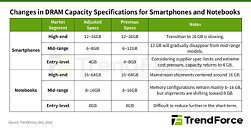 For Android brands targeting the mid- to low-end segments—where memory is a crucial marketing differentiator and a significant part of the BOM—rising memory costs will compel them to raise the launch prices of new models in 2026. They will also need to modify the pricing or lifecycle of existing models to minimize losses.
TrendForce further observes that rising memory costs will prompt notebook brands to adjust their product portfolios, procurement strategies, and regional sales strategies. High-end ultrathin notebooks, which often have mobile DRAM soldered directly onto the motherboard, cannot reduce costs by lowering specifications or replacing modules. Additionally, these models encounter stricter design limitations, making them the segment most prone to experiencing early and significant price pressure.
In the consumer notebook market, demand remains quite responsive to shifts in specifications and pricing. However, current stock levels of finished goods and inexpensive memory help safeguard short-term profits. While prices may stay stable for now, medium- and long-term adjustments, such as lowering specifications or raising prices, are inevitable. TrendForce forecasts more significant price fluctuations in the PC market by the second quarter of 2026.
TrendForce highlights that cutting down on specifications or postponing upgrades has become an essential cost-saving measure for smartphone and laptop manufacturers. This is especially true for DRAM, which makes up the largest portion of memory expenses.
In high-end and mid-range models, DRAM capacities are expected to hover near the minimum standards, slowing upgrade cycles. The most affected will be the low-end smartphone market, where base models are likely to return to 4 GB in 2026. Conversely, for budget notebooks, DRAM cannot be reduced quickly due to processor pairing needs and operating system limitations.
Source:
TrendForce
TrendForce notes that memory is increasingly accounting for a larger share of the BOM costs in consumer devices like smartphones and PCs. Even for Apple, which has strong profitability, the memory component in the total BOM for iPhones is expected to significantly increase in 1Q26. This development may lead Apple to reevaluate pricing strategies for new models and consider reducing or removing price cuts on older versions.

TrendForce further observes that rising memory costs will prompt notebook brands to adjust their product portfolios, procurement strategies, and regional sales strategies. High-end ultrathin notebooks, which often have mobile DRAM soldered directly onto the motherboard, cannot reduce costs by lowering specifications or replacing modules. Additionally, these models encounter stricter design limitations, making them the segment most prone to experiencing early and significant price pressure.
In the consumer notebook market, demand remains quite responsive to shifts in specifications and pricing. However, current stock levels of finished goods and inexpensive memory help safeguard short-term profits. While prices may stay stable for now, medium- and long-term adjustments, such as lowering specifications or raising prices, are inevitable. TrendForce forecasts more significant price fluctuations in the PC market by the second quarter of 2026.
TrendForce highlights that cutting down on specifications or postponing upgrades has become an essential cost-saving measure for smartphone and laptop manufacturers. This is especially true for DRAM, which makes up the largest portion of memory expenses.
In high-end and mid-range models, DRAM capacities are expected to hover near the minimum standards, slowing upgrade cycles. The most affected will be the low-end smartphone market, where base models are likely to return to 4 GB in 2026. Conversely, for budget notebooks, DRAM cannot be reduced quickly due to processor pairing needs and operating system limitations.
55 Comments on Memory Price Surge to Persist in 1Q26; Smartphone and Notebook Brands Begin Raising Prices and Downgrading Specs
Hope this ai bubble pops so hard
The bottom line, is technology from even 5 years ago is going to do largely the same job in most uses cases, no reason to spend massive money for new, except for edge case stuff.
SteamOS has a legitimate shot if this keeps up.
their "technological innovation" is ruining everything for everyone but a select few
at some point, it'll actually technologically set up back instead
"Since there are no technical aspects to discuss, comments have been disabled."
?
We're in for a very shitty future regarding PC sector. Who's gonna buy anything, if one complete segment becomes practically unavailable? In order to rake in as much revenue as possible, I predict everything will go up in price, to try to scalp the remaining buyers who are forced to purchase.
:p
garymarcus.substack.com/p/a-trillion-dollars-is-a-terrible
"No, the Wright Brothers didn’t mimic birds, but they learned something from avian flight control. Knowing what to borrow and what not is likely to be more than half the battle."
garymarcus.substack.com/p/breaking-news-scale-is-all-you-need
If only we got rid of regulation, independent agencies, etc (and let reality conform to us)...
Just checked again now it's 60eur...
www.windowslatest.com/2025/12/07/ram-prices-soar-but-popular-windows-11-apps-are-using-more-ram-due-to-electron-web-components/
www.windowslatest.com/2025/12/07/windows-11s-agenda-view-in-the-notification-center-is-a-webview2-web-app-component-not-native/
And apparently the new Run dialog is WebView2-based too, though I didn't find a proper statement for that, only someone making a funny comment about it...
Though the new Run dialog is less functional than the old one so I guess it's irrelevant if it's WebView2 or branded dogshit.
www.windowslatest.com/2025/12/05/windows-11-is-getting-a-modern-windows-run-winr-built-with-winui-3-and-it-might-get-new-features/
my refurbished notebook may last longer as companies may have to reduce the memory footprint of w11 pro apps.
(if you're in the memory business)
in 1-2 months, more that 1000€ seems likely...
Once production exceeds demand, prices will not just go back down, they will likely dip to unprecendented lows. The only thing we need to do is wait patiently for an increase in DRAM manufacturing capacity, which is almost certainly coming because that's how capitalism works. The real questions are "how fast can this additional capacity come online" and "how long will it take the additional capacity to meet demand"?
Also once all the mostly-corrupt circular spending in the AI sector collapses (because shareholders and stakeholders finally work out that this insanely inflated and unrealistic "value" of AI can't be converted into the cold hard cash they want as dividends on their investment) demand for AI might drop off very suddenly. It's not a bubble that will pop, but it's a bubble that will suddenly spring a leak and start shrinking
If there is real capitalism, Microsoft and Google would be splitted into 2 ~ 3 companies decade ago.
AMD+Intel, AMD+nVidia, HDD Producers due to floods, RAM producers every few years - we already watched this scenario several times. Heck, RAM market volatility is well-known and prices going suddenly up is nothing new.
If there is real capitalism, Intel would be dead... instead, they received billions of state money to build... "something"... that still does not produce money after all this time.
Tesla? Capitalims? You gotta be joking.
I mean, it is not like we have choice, just pointing out how it seems to me. We will have to wait and be patient, but I think that, just like with graphics and storage, we will never be back on the previous level of prices...