News Posts matching #Ryzen

Return to Keyword Browsing

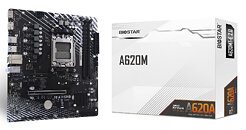
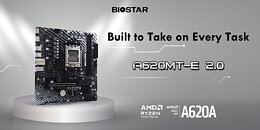
Biostar Introduces A620MT-E 2.0 AM5 Motherboard

BIOSTAR, a leading manufacturer of edge computing solutions, industrial motherboards, graphics cards, and storage devices, today unveils the A620MT-E 2.0 motherboard, a reliable and adaptable AM5 platform designed for modern office environments, home entertainment setups, and SI integration projects.

Built on AMD's A620A single chip architecture with full support for Ryzen 9000, 8000, and 7000 series processors, the A620MT-E 2.0 delivers efficient performance and dependable stability for a wide range of everyday applications. It is an ideal choice for office users who need a smooth experience running essential tasks such as web browsing, emails, and productivity software. Home users will enjoy its capability as an HTPC platform for streaming TV shows and movies, listening to music, and engaging in light gaming. SI builders will appreciate its ability to support integrated systems handling customer data, transaction records, communications, and various business processes with consistent and secure performance.
Microsoft Promises More Performant Windows 11 Optimized for Gaming

Microsoft has laid out its 2026 Windows 11 vision board, highlighting what the Redmond giant has in store for its operating system. According to Microsoft, the 2026 is shaping up to be a year of optimizations, as the company is now shifting towards performance delivery, alongside new features. "We're committed to making Windows the best place to play, and we will continue refining system behaviors that matter most to gaming: background workload management, power and scheduling improvements, graphics stack optimizations, and updated drivers," said Microsoft in its latest blog post.

Perhaps the most important pillar of this is the background workload management, which adds overhead to a system. Recently, we observed that the Xbox Full Screen Experience (FSE) on a regular Windows 11 build reduces background overhead, with RAM usage dropping significantly by 9.3%. Similarly, an increase in FPS of up to 8.6% can also be observed, thanks to more optimized background workload management. Features such as power and scheduling will also contribute a few percentage points of improvement, potentially making the OS overhead a negligible factor.

Dynabook Expands Tecra A-Series with New 14- and 16-inch Business Laptops Powered by AMD Ryzen and AMD Ryzen PRO Processors

Dynabook Americas, Inc., the gold standard for long-lasting, professional-grade laptops, today unveiled its latest Copilot-enhanced professional laptops, the all-new 14-inch Tecra A45-M and 16-inch Tecra A65-M. Engineered with AMD Ryzen and AMD Ryzen PRO 200 Series processors, these new Windows 11 Pro laptops fuse cutting-edge hardware with advanced AI to redefine productivity and performance for modern professionals and educators.

"These new Tecra laptops extend Dynabook's tradition of delivering high-value, professional-grade solutions while giving our customers a greater variety of processor options," said James Robbins, General Manager, Dynabook Americas, Inc. "By pairing AMD Ryzen and Ryzen PRO 200 Series processors with our pro-grade Tecra platform, we're bringing strong multi-core performance, practical on-device AI and enterprise-grade security and manageability to organizations that demand reliability and long-term value."

ASRock Expands Mini PC Line with DeskSlim Intel B760 & AMD X600 Variants

Leaked marketing material indicates that ASRock is readying a new branch of Mini PCs, that will exist alongside already launched DeskMeet, DeskMini, and Jupiter ranges. Yesterday afternoon, a specification sheet was shared online—by well known hardware sleuth momomo_us. The Taiwanese manufacturer seems to have an Intel-flavored DeskSlim B760 model prepared for imminent release. This system is centered on Team Blue's familiar LGA 1700 platform, covering 12 to 14th generations of Core processors. Fittingly, an Intel B760 chipset controls proceedings. Alternatively, customers can choose X600 variants—AMD hardware is housed in the same DeskSlim enclosure; a compact sub-5 liter prospect.

According to the leaked ASRock specification sheet, their Team Red variant—based on an X600 chipset, utilizing the AM5 platform—can accommodate Ryzen 7000, 8000 and 9000 series CPUs. Early analysis posits that the Intel and AMD systems will be sold as barebones products. Users can add their own appropriately-sized graphics cards—maximum would be a dual-slot low profile design, 200 mm in length. A standard 240 W external power adaptor is listed as a bundled-in item, but the spec sheet mentions a more potent 330 W optional unit. VideoCardz believes that ASRock will reveal official details next week; with brand new DeskSlim products actively listed across web presences.

Ayaneo Next II Gaming Handheld Will Feature AMD Strix Halo and 9-inch OLED Display

The Ayaneo Next II was recently revealed as a new gaming handheld powered by AMD's Ryzen AI Max+ 395 APU and its Radeon 8060S iGPU. Aside from those details and a few tidbits about the controller specifications, however, not much had been revealed about the new gaming handheld until now. Ayaneo recently posted a few additional details about the new plus-size Strix Halo gaming handheld on X, mostly centering on screen specs. Ayaneo also teased a launch event for November 28, 2025 at 23:30 PT (7:00 UTC).

According to the post, the Ayaneo Next II will have a 9-inch OLED display with a 165 Hz refresh rate, 2400×1504 resolution, and a native landscape orientation. This works out to a screen ratio of just under 3:2 (3:1.88, to be exact), and Ayaneo claims that this display is a custom, exclusive design, although it seems somewhat unlikely that it will stay this way for very long, given how competitive the high-performance gaming handheld market is getting these days—at the very least, we can likely expect other devices from Ayaneo to feature the same display at some point. Curiously, Ayaneo makes no mention of whether the display will feature VRR, although it seems unlikely that such a premium gaming handheld wouldn't.

COLORFUL Expands B850 Motherboard Lineup with New CVN, Battle-Ax, and MEOW Models

Colorful Technology Company Limited, a leading brand in gaming PC components, gaming laptops, and Hi-fi audio products, today announced three new additions to its B850 motherboard family: the CVN B850M ARK FROZEN, BATTLE-AX B850M-PLUS S WIFI7, and COLORFIRE B850M-MEOW WIFI7. These new models bring enhanced power delivery, upgraded connectivity, and signature COLORFUL design identities to meet the performance needs of next-generation AMD Ryzen processors.

The expanded B850 Series is engineered for gamers, creators, and PC enthusiasts seeking powerful performance and distinctive visual design. A key highlight of this launch is the much-anticipated COLORFIRE MEOW Series motherboard for AMD Ryzen users, now built on the AMD B850 chipset and refreshed with a new white color scheme, cat-inspired accents, and the playful MEOW aesthetic that defines the series. Each of the new B850 motherboards delivers robust support for AMD Ryzen 7000, 8000, and 9000 Series processors, high-speed DDR5 memory, and advanced thermal and aesthetic designs unique to their respective product lines.

Minisforum Unveils New G1 Pro Mini Gaming PC With Ryzen 9 8945HX and GeForce RTX 5060

MINISFORUM, an innovator in AI computing technology, today unveiled the G1 Pro, a game-changer for mini PC power users everywhere. Designed for today's demanding gamers, creators, and professionals, the G1 Pro redefines what's possible in small-form-factor computing. Engineered with a bold, vertical chassis inspired by next-gen consoles, this MINI powerhouse delivers uncompromising desktop-caliber performance in a footprint small enough to fit virtually any workspace or gaming environment.

Bridging the gap between performance and portability, the G1 Pro empowers users to enjoy high-end gaming, advanced AI workflows, and accelerated content creation, without the clutter, noise, or limitations of traditional towers and gaming laptops. It's a breakthrough designed for those who demand more: more speed, more computing capabilities, and more space to create.

Aoostar AMD Strix Halo Mini PC Gets Design Update

Aoostar showed off its Nex395 AMD Ryzen AI Max+ 395 mini PC design earlier this year, revealing a somewhat edgy mini PC design at the time. Now, however, thanks to IT Home, we have gotten a good look at the updated design, which is a lot more subdued and professional than the previous renders showed. It is expected that the Aoostar Nex395 will launch internationally, like many of the company's recent devices, however, Aoostar has not yet announced a release window or expected launch pricing. Instead, the teaser says the Nex395 is "coming soon," according to the new teaser.

The internals, however, remain seemingly unchanged. The Aoostar Nex395 mini PC will still launch with the AMD Ryzen AI Max+ 395 SoC and up to 128 GB of LPDDR5X memory. According to IT Home, the upcoming mini PC will have dual USB4 ports and one unspecified USB Type-C interface on the front edge next to the illuminated power button. The material looks like a matte aluminium, but it's unclear if it will be plastic, like the rest of the case appears to be. From the appearance, Aoostar is intending the Nex395 to be an AI workstation instead of the gaming boxes many companies have announced since the launch of Strix Halo. When it launches, the Nex395 will have to contend with a flurry of recent AMD Strix Halo-powered devices from companies like Minisforum and even a few gaming handhelds from the likes of Ayaneo and a gaming tablet from OneXPlayer. The following images depict the new design (left) and the design previously teased by Aoostar (right).

Qualcomm Says 90% of Games Run on Snapdragon X2 Elite, Outperforming Intel and AMD

Qualcomm is ready to push its Snapdragon X2 Elite and Elite Extreme SoCs into a sector that was previously dominated by x86 SoC makers, and that is gaming. The company now claims that its SoC can run more than 90% of the most played games available on the market on the initial launch. However, this is not the only striking claim, as Qualcomm has benchmarks that prove that its Adreno X2 iGPU is 50% faster than the iGPU inside Intel Core Ultra 9 288V "Lunar Lake" and 29% faster than the iGPU on AMD Ryzen AI 9 HX 370 "Strix Point," under the same graphics settings. This is of course, no small win, and Qualcomm expects to win hearts of gamers with its next-generation platform.

The new chip delivers frame rates up to 2.3x higher than its predecessor while supporting many popular Windows games. Its architecture uses four processing blocks that give the flagship X2 Elite Extreme an edge over competing integrated graphics. Each block efficiently processes graphics work before passing it to shader processors organized around two micro-units. These units each contain 128 KB of memory feeding 128 ALUs. The design supports multiple precision formats, employs a more efficient execution model, and can process two instructions at once to maximize its 128-ALU groups. In total, the GPU has eight shader processors and 2,048 ALUs running at up to 1.85 GHz, backed by 21 MB of on-chip memory, 2 MB of cache, and 228 GB/s of memory bandwidth on the flagship model.

AMD Details AI Innovations for Windows 11 PCs at Microsoft Ignite

Since Microsoft Build 2025, AMD has accelerated AI innovation across the Windows ecosystem through deep collaboration with Microsoft. Together, we are unlocking the full potential of Windows ML and Microsoft Foundry on Windows, an evolution of Windows AI Foundry. With the latest AMD Ryzen AI 300 Series processors and Radeon GPUs, AMD delivers fast, more efficient, and intelligent on-device AI performance. This partnership empowers developers to create the next generation of AI-powered Windows applications, delivering tangible benefits to customers and businesses without requiring cloud connectivity.

Accelerating AI on Windows with AMD Hardware
Our ongoing collaboration with Microsoft centers on optimizing Windows ML for AMD hardware accelerators -- GPUs and NPUs. These optimizations deliver high performance, improved efficiency, and broader support for the most advanced model architectures.

GMKtec Launches New NucBox M8 Mini PC With AMD Ryzen 5 PRO 6650H

GMKtec, a leading innovator in mini PC technology, has announced the launch of its latest compact powerhouse - the GMKtec NucBox M8, equipped with the AMD Ryzen 5 PRO 6650H processor. Designed for users who demand performance, reliability, and futuristic aesthetics, the M8 is built to power everything from creative workstations and gaming setups to enterprise, retail, and educational environments.

Crafted by a Red Dot Award-winning design team, the GMKtec M8 combines sleek all-metal construction with a floating "C-shaped" chassis and dynamic lighting accents, delivering both performance and elegance in a compact form factor. At the heart of the M8 is the AMD Ryzen 5 PRO 6650H (6 cores / 12 threads, up to 4.5 GHz), paired with a Radeon 660M GPU for smooth AAA gaming and professional-grade content creation. The system features high-speed LPDDR5X 6400 MHz memory and up to 1 TB PCIe 4.0 SSD storage, expandable to 8 TB.

AMD Confirms Zen 6 (2 nm) and Zen 7 with Efficiency Upgrades and New AI Features

AMD has updated its CPU core roadmap confirming Zen 6 and Zen 7 architectures as the next steps for its Ryzen and EPYC product families. The new roadmap was shown during the company's Financial Analyst Day 2025. Zen 6 will launch next year and is built using TSMC's 2 nm process node. The lineup will include both Zen 6 and Zen 6C variants, optimized respectively for high performance and power efficiency. According to AMD CTO Mark Papermaster, Zen 6 will bring higher IPC, improved efficiency and expanded AI data type support with additional AI pipelines. We recently detailed here the first Zen 6 ISA changes, which introduce several new instruction sets and expanded compute capabilities. The architecture will appear across multiple platforms, including EPYC "Venice," Ryzen Desktop "Olympic Ridge," and Ryzen Mobile "Medusa Point."

For the first time, AMD has also confirmed Zen 7, listed on the roadmap as a "Future Node" and "Next-Generation" design. Zen 7 will introduce a new matrix engine and broaden AI data format handling, marking a shift toward deeper AI integration within standard CPU cores. AMD has not disclosed the specific process node or launch window, though the architecture is expected to follow Zen 6 around 2027 in next-generation EPYC "Verano" processors. No other details about Zen 7 were shared, so we have to wait for specific things like cache layout, core counts, and power targets.

AMD Ryzen X3D CPUs Outsell Intel's Entire CPU Lineup on Amazon in October

Amazon US sales data for October, courtesy of @TechEpiphanyYT, reveal a huge disparity between AMD and Intel CPU sales. The combined shipments of AMD's Ryzen 9800X3D and 7800X3D reached roughly 16,000 units, while Intel's entire CPU lineup on the platform did not surpass 10,000 units. This gives AMD about 83.80% of the market share in terms of units sold, meaning that for every ten CPUs sold, more than eight were AMD models. The two X3D models sold roughly 8,000 units each, indicating a strong demand for AMD's high-end gaming processors, even at premium prices. In the value segment, the six-core Ryzen 5 5500 sold nearly 5,000 units, securing the third spot and outperforming common Intel alternatives like the Core i3 models, which typically offer four cores.

Intel saw a limited success with the Core Ultra 7 265K, which sold nearly 1,000 units after its price dropped below $300. However, this single product couldn't offset the production challenges Intel faced with its 12th, 13th, and 14th generation lines, where increasing prices have reduced competitiveness in price-sensitive retail markets. Interestingly, the average selling price of AMD CPUs was $272.05, while Intel's was higher at $308.62. This indicates that AMD is focusing more on the low and mid-range segments, whereas Intel's customers are primarily targeting higher-end builds.

GIGABYTE Introduces New X870E AORUS XTREME X3D AI TOP Motherboard

GIGABYTE TECHNOLOGY Co. Ltd, the world's leading computer brand, takes extreme performance and style to the next level with its All New X870E AORUS XTREME X3D AI TOP motherboard. First unveiled at GIGABYTE EVENT 2025, the X870E AORUS XTREME X3D AI TOP is the world's first Flagship motherboard platform purpose-built for AMD Ryzen X3D processors, delivering GIGABYTE X3D Turbo Mode 2.0 for uncompromising gaming and productivity, industry-leading DDR5 speeds of up to 9000+ MT/s, and a smarter user experience through innovative thermal solutions (e.g., CPU Thermal Matrix etc.), Unrivaled EZ-DIY features, and DriverBIOS technology.

At the core of the X870E AORUS XTREME X3D AI TOP is X3D Turbo Mode 2.0, a dynamic AI overclocking model trained on big data, tailored for per-chip optimization and resulting in a custom tuning profile with optimal results. This breakthrough enables users to achieve the optimal balance without compromise, improving 25% gaming performance and 14% multi-tasking productivity over default settings. By intelligently finetuning frequency, power, and thermal behavior, X3D Turbo Mode 2.0 unleashes the true potential of AMD Ryzen X3D processors.

AMD Readies Ryzen AI MAX+ 388: 8C/16T and Full 40-CU Radeon 8060S GPU

AMD is gearing up to release a new "Strix Halo" Ryzen AI MAX+ SKU specifically designed for gamers who don't need more than 8 cores and 16 threads of CPU power. In a recent PassMark benchmark, a new SKU called Ryzen AI MAX+ 388 was spotted. It features 8 cores, 16 threads, and a fully equipped Radeon 8060S GPU with 40 RDNA 3.5 Compute Units (CUs). Previously, the full Radeon 8060S configuration was only available in the high-end Ryzen AI Max+ 395 model, which combines 16 cores and 32 threads with the 40 CU Radeon 8060S. However, that model is more expensive and better suited for tasks like productivity and AI that benefit from higher core counts.

If and when AMD introduces the 8-core, 16-thread Ryzen AI MAX+ 388, we anticipate that more gaming devices will adopt this chip, as it offers an ideal balance of CPU and GPU power for running modern games. AMD supports up to 128 GB of 256-bit LPDDR5x memory at 8000 MT/s with its Ryzen AI MAX+ SoCs. However, the actual memory configuration will depend on the choices of the OEM or device manufacturer. Some devices, such as SIXUNITED 14-inch tablets, have already been seen using this APU, configured with a 65 W TDP. AMD provides a configurable TDP range of 45-125 W, with a default TDP of 55 W for its top three SKUs. Therefore, we can expect to see various TDP ratings as OEMs tailor this chip to their specific requirements, based on the device's form factor and thermal capacity.

AMD Reports Record Q3 2025 Revenue of $9.2 Billion

AMD (NASDAQ:AMD) today announced financial results for the third quarter of 2025. Third quarter revenue was a record $9.2 billion, gross margin was 52%, operating income was $1.3 billion, net income was $1.2 billion and diluted earnings per share was $0.75. On a non-GAAP basis, gross margin was 54%, operating income was $2.2 billion, net income was $2 billion and diluted earnings per share was $1.20. Our third quarter results did not include any revenue from shipments of AMD Instinct MI308 GPU products to China.

"We delivered an outstanding quarter, with record revenue and profitability reflecting broad based demand for our high-performance EPYC and Ryzen processors and Instinct AI accelerators," said Dr. Lisa Su, AMD chair and CEO. "Our record third quarter performance and strong fourth quarter guidance marks a clear step up in our growth trajectory as our expanding compute franchise and rapidly scaling data center AI business drive significant revenue and earnings growth."

AMD "Zen 5" RDSEED Bug Threatens Cryptographic Key Generation

AMD officially confirmed that a hardware defect in the RDSEED instruction on its new Zen 5 processors, cataloged as AMD-SB-7055 and assigned CVE-2025-62626. The company reports that the 16-bit and 32-bit forms of RDSEED can return zero values, which may be mistakenly interpreted as a successful entropy read. The 64-bit form is unaffected. AMD rates the issue as high severity and suggests short-term software workarounds: prioritize using the 64-bit RDSEED path where possible, mask RDSEED from software discovery, or treat a zero return as a failure and retry. Firmware and microcode updates are being rolled out to OEMs. AMD's advisory provides product-family target dates, such as AGESA TurinPI 1.0.0.8 for EPYC 9005, with a target date of November 14, 2025, and consumer families targeted for late November 2025. Users should install vendor BIOS/microcode updates when available and consider regenerating any sensitive keys created on unpatched systems.

RDSEED is a low-level instruction that supplies entropy used for cryptographic keys and other security functions. When it returns predictable values without detection, newly generated keys or nonces may be weaker than intended. According to AMD, the problem affects the 16-bit and 32-bit forms of RDSEED, while the 64-bit form does not appear to be impacted. The company is distributing firmware and platform updates to correct the issue, but until those updates are applied, the recommended interim measures are straightforward: prefer the 64-bit RDSEED path where possible, prevent software from discovering or using the affected RDSEED forms, or treat a zero result as a failure and retry. Once updates become available, users should install them promptly and consider regenerating any sensitive keys created on unpatched systems.

GTBOX T1 Launches As AMD-Powered Mini PC Disguised as a Bluetooth Speaker

With the recent barrage of AMD-powered mini PCs coming to the market, it was only a matter of time before manufacturers started dipping into peculiar form factors and niche gimmicks in order to set themselves apart from the vaguely Mac Mini-shaped crowd. GTBox has apparently decided that its new take on the mini PC would take shape as a PC disguised as a navy blue Bluetooth speaker. Not coincidentally, the mini PC also includes two 5 W stereo speakers, which GTBox claims deliver "precise localization, a wide soundstage, and deep immersion," although it's more likely something akin to a sound bar, given how much of the PC's internals are taken up by the actual PC components.

Questions about the speaker quality aside, the internals boast some decent specifications, including an AMD Ryzen 7 8745HS, with its Radeon 780M, 32 GB of DDR5 RAM, and a 1 TB PCIe SSD. The port selection isn't bad either, with the T1 equipped with 3× USB 3.2 ports, 1× USB 2.0, 1× USB4, an RJ45 port for 2.5 Gbps Ethernet, a DisplayPort 2.0 port, and an HDMI 2.1 port. All of the ports are located on the rear, alongside the exhaust for the single fan, all in an attempt to maintain the clean design with its fabric cover. The mini PC also features a backlit GTBox logo and an LED ring on the top of the case, which can be adjusted to green, blue, or yellow. It also comes with Bluetooth 5.0 and Wi-Fi 6 on-board.

Sapphire Launches the EDGE AI Mini PC Series Based On AMD Ryzen AI 300 Series

SAPPHIRE Technology is rolling out the EDGE AI Series, a new line of ultra-compact AI mini PCs designed to bring next-level performance and real-time intelligence to everything from content creation and office productivity to edge analytics and smart automation. Following a soft launch earlier this year, the SAPPHIRE EDGE AI Series is now preparing for full market availability.

At the heart of each system is the powerful AMD Ryzen AI 300 Series processor, combining a high-efficiency multicore CPU, AMD Radeon 800M graphics, and a built-in Neural Processing Unit (NPU) delivering up to 50 TOPS of AI acceleration-all in a sleek, highly compact footprint. From intelligent automation in offices and factories to local AI inference in healthcare and education, this platform is designed for professionals who need real-time AI performance with ultimate flexibility.

AMD openSIL Targets "Zen 6" Support in the First Half of 2027

AMD used the Open Compute Project Global Summit in San Jose to provide an update on openSIL, its initiative to replace the legacy AGESA firmware with an open silicon-initialization stack, with timelines for CPUs based on the "Zen 6" IP. Chief Firmware Architect Raj Kapoor presented the latest developments and confirmed that slides and a video of the talk are now available to the public. As part of the update, AMD released the openSIL Firmware Architecture Specification 1.0 and initial platform code for its "Phoenix" client SoCs, marking a shift from proof-of-concept work to wider platform availability. Kapoor also outlined a practical release schedule for future platforms. AMD reiterated that it will initially keep some platform sources under NDA until product launch, then release open-source platform code approximately one quarter after shipping.

According to this schedule, AMD plans to publish the "Venice" 6th Gen EPYC openSIL sources in 2026, suggesting a Venice product launch by Q3 in 2026, and to release the "Medusa" Ryzen CPUs based on "Zen 6" sources in the first half of 2027. The openSIL is designed as a modular, three-part static library written to modern C standards, intended to integrate seamlessly with any x86 host firmware while remaining scalable for different customer needs. Beyond timelines and deliverables, AMD envisioned openSIL as an effort to enhance transparency, speed up integration for hyperscalers, and improve security through auditable code. The project will allow public pull requests, although contributions will be reviewed to protect sensitive microarchitectural IP. This balance between openness and protection was a recurring theme in the presentation, as AMD seeks to open more of its firmware for community collaboration while managing to expose just enough of core design details that drive its CPUs.

MAINGEAR Introduces aiDAPTIV+ Package for Pro RS & Pro WS Workstations Co-Developed With Phison

MAINGEAR, a leading provider of high-performance custom PCs, today announced a new aiDAPTIV+ package, co-developed with Phison Electronics, a global leader in NAND flash controllers and storage solutions, for its Pro RS and Pro WS workstations. The aiDAPTIV+ add-on enables full-parameter fine-tuning and large-model inference on mainstream GPUs, helping teams move faster while keeping data private and on-prem. Live demos of a MAINGEAR workstation equipped with aiDAPTIV+ will be available at Phison's booth during NVIDIA GTC Washington, D.C.

AI teams need on-prem training and inference performance without the unpredictability of cloud costs or the exposure of sensitive data. The aiDAPTIV+ package combines MAINGEAR's powerful, enterprise-ready workstations with Phison's aiDAPTIV+ intelligent SSD caching to expand effective VRAM, enabling larger models and longer contexts at the edge, with predictable costs and IT-friendly deployment.

OneXPlayer Officially Reveals Water-Cooled AMD Strix Halo-Powered OneXFly Apex Gaming Handheld

OneXPlayer has officially announced its latest gaming handheld, the OneXFly Apex, which puts the exciting AMD Ryzen AI Max+ 395 APU and Radeon 8060 graphics into a compact handheld form factor with some interesting cooling and power tricks. The new Windows gaming handheld from OneXPlayer is clearly aimed to combat recent announcements from the likes of GPD, replete with a detachable battery, just like GPD's Win 5. Unlike the Win 5, however, OneXPlayer also saw fit to equip the OneXFly Apex with a liquid cooling system to keep the AMD Ryzen AI Max+ 395 in check. OneXPlayer says that the powerful APU is capable of drawing as much as 120 W with this cooling solution, claiming that it is the first Windows gaming handheld to achieve this feat. The Apex will come with an 8-inch, 120 Hz IPS display with a maximum rated brightness of 500 nits and 100% coverage of the sRGB color space.

The watercooling solution is a detachable tower containing the radiator, pump, and reservior, much like the XMG Neo 17's Oasis system we reviewed prior. In handheld mode, without the water cooling tower, the OneXFly's APU is said to be capable of sustained 80 W TDP with up to 100 W supposedly also possible. This is all powered by an 85 Wh external battery in a similar piggyback configuration to GPD's Win 5 detachable battery. OneXPlayer showed off some comparative testing putting the device up against another handheld equipped with the AMD Ryzen Z2 Extreme, and the Strix Halo-powered device expectedly blew the smaller APU out of the water when it came to gaming tests. As is the case with other portable devices using the same APU, the OneXPlayer OneXFly Apex will be available with up to 128 GB of LPDDR5x-8000 memory and a 2 TB NVMe SSD (with another M.2 slot available for upgrades). While the device is clearly intended primarily as a gaming handheld, OneXPlayer is openly marketing the Apex as a do-it-all machine, especially considering the water cooling dock.

AMD Introduces "New" Ryzen Branding: Ryzen 10 "Zen 2" and Ryzen 100 "Zen 3+" Processors

AMD just pulled another name shuffle, now with a couple of older-generation processors. The company quietly added two "new" processor families, Ryzen 100 and Ryzen 10, to its public price list, even though the dies inside very likely date back to when "Rembrandt" and "Mendocino" first shipped, around 2021-2022. If you see a bargain laptop this holiday season with one of those badges, you might be buying a rebadged Rembrandt or Mendocino chip dressed up for 2025 shelves. Early listings suggest the top Ryzen 100 models are essentially reshuffled Rembrandt, Zen 3+ parts carrying 8C/16T, a Radeon 680M iGPU and the FP7-R2 platform, repackaged with a 28 W TDP that vendors commonly tune between 15 W and 30 W.

Further down the stack, Ryzen 5 parts shave off cores and clocks but often keep the same 680M GPU. The Ryzen 10 line looks like a reuse of Mendocino, Zen 2 silicon for entry level systems that pairs 4C/8T CPU with a cut-down 2-CU Radeon 610M and typical 15 W power targets. Many of the refreshed listings still point to PCIe 3.0 as the fastest lane and leave USB4 as optional, so don't expect any modern I/O fireworks on these parts. Readers might wonder why is AMD bringing older silicon back? Our best guess is that AMD may be monetizing existing inventory, wafers and validated designs produced when 6 nm capacity was limited and costly. Having secured that capacity at TSMC, AMD was obliged to use it even if it moved on to newer CPU generations.

AMD Prepares Entry-Level Ryzen 5 7500X3D 6-Core CPU for CES 2026 Launch

A new Ryzen 5 7500X3D has surfaced in a UK retail listing hinting that AMD is preparing another entry-level X3D CPU for launch at CES 2026. The listing, shared by @momomo_us includes OPN code 100-000001904, confirming it as a new SKU within the "Raphael" lineup. The 7500X3D is expected to feature 6 cores and 12 threads, 96 MB of total cache (32 MB L3 + 64 MB 3D V-Cache), and a 65 W TDP. Boost clocks will likely come in below 4.7 GHz, roughly 300-400 MHz lower than the 7600X3D. If accurate, it would be AMD's most affordable 3D V-Cache CPU yet, aimed at budget-conscious gamers.

The new chip would join AMD's growing list of X3D models, including the 7800X3D, 7900X3D, 7950X3D, and 7600X3D. With multiple Zen 5 X3D refresh parts rumored for a CES 2026 launch; such as Ryzen 7 9850X3D and Ryzen 9 9950X3D2, AMD's X3D family is seeing another expansion in early 2026. The rumored Ryzen 9 9950X3D2 is particularly interesting as it appears to be AMD's next flagship model featuring 16 cores, 32 threads, 192 MB of L3 cache, and 200 W TDP. As for the Ryzen 5 7500X3D, there's currently no confirmation of global availability but given AMD's past moves with region-specific launches like the 5600X3D, wider distribution is possible.

New AGESA BIOS Code Rekindles Hope For Strix Point Desktop APUs for AMD Ryzen 9000G Series

We recently reported on a rumor that AMD would soon be launching desktop APUs based on its Krackan Point architecture that has until now only been featured in mobile parts. At first, it seemed as though Strix Point and its more powerful AMD Radeon 890M iGPU would be limited to the mobile side of things, however a well-known leaker, @9550pro on X, has recently pointed out that AMD's AGESA update version 1.2.7.0 does make mention of Strix Point in its code. This observation is backed up by further evidence shown in a post by @xgfancz on X, who pointed out that the list of architectures in the latest 1.2.7.0 AGESA beta update makes clear reference to "STX," presumably "Strix Point," alongside "PHX," which would be Phoenix Point, AMD's current Ryzen 8000G series of desktop APUs.

All of this suggests that AMD Ryzen 9000G desktop APUs may launch with Strix Point architecture instead of being limited to Krackan Point, as was previously the assumption. Stepping up from Krackan Point to Strix Point would mean that iGPUs in the Ryzen 9000G series may feature up to 16 CUs and RDNA 3.5 instead of RDNA 3 in the current APUs, which could mean gaming and iGPU performance right around the level of the likes of the AMD Ryzen Z2 Extreme now making its way to swathes of gaming handhelds. The AMD Ryzen 9000G desktop APUs aren't expected to launch until closer to the end of this year, and even if they do, there's no telling if they will launch at the same time as what is essentially the 8000G refresh we have seen in rumors before.
Return to Keyword Browsing
Nov 11th, 2026 04:13 CST change timezone

New Forum Posts

Popular Reviews

TPU on YouTube

Controversial News Posts