News Posts matching #Steam Machine

Return to Keyword Browsing

Valve Ditches Steam Machine Reservations but Warns of Price Hikes and Shortages

Valve officially released the Steam Machine in mid-2026 with a reservation program and limitations on per-customer sales in order to minimize the impact of the ongoing RAM crisis and ensure that as many people as possible got a fair shout at buying a living room console-PC hybrid. Now, nearly five months after the console's initial launch, Valve has dropped the Steam Machine's reservation program and started selling the device to the public. At the time of the announcement, Valve had stock of the 512 GB Steam Machine, but it has not yet cleared out the existing reservation queue of the 2 TB unit. However, the announcement that the Steam Machine's general availability also comes with a warning that supply and pricing aren't guaranteed.

We are continuing to build more Steam Machine units, but memory and storage costs continue to increase at unprecedented levels; as a result we don't yet know the number we are able to make, and at what price we'll be able to offer them. The 2 TB model in particular will be especially constrained.
We anticipate having more information to share come January.


Xbox Confirms Project Helix Is Not a PC, But It's Closer Than Ever

It's basically a running joke at this point that gaming consoles are just PCs with extra steps, and Xbox previously confirmed that the upcoming Project Helix would be a PC-console hybrid, capable of playing both PC and console games. This led to speculation and even rumors that Xbox would finally treat the Helix as if it were a proper PC, similarly to the Steam Machine. In the recent Xbox 25th Anniversary Magazine, Xbox Vice President of Next Gen, Jason Ronald, has confirmed that this will not be the case, although he also suggested that the way the Xbox Helix games will work is more akin to a PC than a console.
Jason Ronald, VP of Next Gen at XboxWe're very clear on the design goal: Helix is designed to be a console capable of playing PC games from your PC. It is not a PC that can also play console games. The goal is making it easy, intuitive, and instant to access my games. But if you're a hardcore gamer or a power user who wants to have that deeper level of customizability across settings and performance options, you can absolutely go for it.

Epic Games Names SteamOS Among Planned Linux Targets for Its New Launcher

SteamOS is now officially on the list of Linux distributions Epic Games plans to support with its new Epic Games Launcher. In a statement to GamingOnLinux, Epic communications director Jake Jones said the launcher is still in Preview, and that Epic plans to "support as many Linux distributions as possible, including Fedora, SteamOS, Cachy, Omarchy, and more." It seems to be the first time Epic has explicitly named SteamOS, which runs on the Steam Deck and Steam Machine. For now, the Preview only ships as a.deb package for Debian and Ubuntu, though Epic says it is testing other packaging formats and will bring back the AppImage version this month. Epic first said a native Linux launcher was coming back in August, and the Preview arrived on October 14.

For Steam Deck owners, official support could mean an easier way into their Epic libraries without third-party tools like the Heroic Games Launcher. However, Epic hasn't said how the launcher will work in SteamOS's Game Mode, and Windows games will still need a compatibility layer. In the current Preview, the launcher handles that by downloading GE-Proton. As for Fortnite, Epic plans to bring it to Linux through the new launcher once EAC Linux v2 is ready, but the new anti-cheat relies on a signed kernel, Secure Boot, and several other security features. Back in October, Epic said the Steam Deck doesn't currently support what EAC v2 needs, and that it is talking with Valve about it. It looks like Steam Deck owners will get the launcher well before they get Fortnite.

Helldivers 2 Anti-Cheat Change Breaks Mods but Keeps Steam Deck Compatibility

Helldivers 2 developer, Arrowhead, has just announced a substantial change to the game's anti-cheat systems: A move away from GameGuard to Easy Anti-Cheat. The change will take place on October 20, and Arrowhead explained in a recent Steam post that the justification for the switch away from GameGuard comes down to cracking down on cheat mods and implementing additional security tools to "improve game integrity protection."
  • Implementing additional security measures to crack down on recent cheat mods that have been circulating.
  • Transitioning from GameGuard to Easy Anti-Cheat today, October 20th, with additional security tools in place to enhance its effectiveness and improve game integrity protection.

New Steam Update Puts Startup Times Back Ahead of Epic's Vibe-Coded Launcher

Epic Games released a preview of its rebuilt, "vibe coded" Epic Games Launcher on October 14, and took a direct shot at Steam while at it. Epic's own chart shows the new launcher cold starting in 5.47 seconds against 10.07 seconds for Steam, which the company bills as 46% faster. That lead apparently didn't last long, as a clip posted by user girlglock_ on X shows the current Steam client starting in 5.23 seconds. Although it might seem like it at first, this isn't a rushed reply from Valve. The stable Steam Client Update that lists "Improved Steam Client startup performance" is dated October 13, a day before Epic's announcement, and Steam's beta client was already getting startup improvements back in September. Valve hasn't shared any numbers for it, though.

Epic's figures, on the other hand, come from testing it commissioned from Keywords Studios earlier this month, averaging five runs on 13 machines with the three lowest-end systems left out, so they were probably taken on an older Steam build. Results will vary from one PC to the next, of course. Epic's launcher is also light on features for now, and the company advises competitive Fortnite and Rocket League players to stay on the current launcher during the preview. It does run natively on Linux, with Fortnite set to follow once Epic finishes rebuilding its anti-cheat, and the vibe coding part fits Epic's recent shift to AI-first development. Readers are advised to treat both sets of startup numbers as rough guides.

Steam on Track for $20 Billion Year After Record $1.7 Billion September

Steam reportedly just had its best September on record. Alinea Analytics estimates that the platform generated a hefty $1.7 billion last month, up 13% from September 2025, which held the previous record. The third quarter was also Steam's best to date at $5.5 billion, a 12% increase year over year. That puts the 2026 total at $16.5 billion after nine months, compared to $14.5 billion in the same period last year, and well past the $11.1 billion it made in the first half. Valve doesn't publish these figures, so all of this is Alinea's estimate. Bulkhead's early access shooter Wardogs was the top premium game with $86.9 million after launching on September 10, followed by Onimusha: Way of the Sword at $30.4 million and The Blood of Dawnwalker at $26.9 million.

Free-to-play is still a big part of the picture, however. Counter-Strike 2, Apex Legends, PUBG, and Dota 2 brought in almost $168 million combined, nearly 10% of the month's total. Alinea also noted that The Witcher 3: Wild Hunt Remastered, a free upgrade for existing owners, pushed the 11-year-old game to roughly 2.4 million daily active users across Steam, PlayStation, and Xbox on its September 30 launch day, over ten times its 2026 average. All of this spending comes at a time when PC hardware is anything but cheap. Valve's own Steam Machine starts at $1,049, and Micron expects memory supply to be much tighter in 2027 and 2028. The analytics suggest people are buying games regardless, and Alinea expects Steam to cross $20 billion in a year for the first time. With the Q4 release slate still to come, that looks to be a safe bet.

SteamOS 3.9.2 Beta Previews Better Legion Go 2 Support and Squashes Myriad UI and Feature Bugs

Building on Valve's ongoing expansion of support for third-party gaming handhelds, SteamOS 3.9.2 beta has officially launched with several improvements across the board, but especially for non-Steam hardware. For one, the new beta adds preliminary native support for Lenovo Legion Go 2 brightness control. The beta also adds a workaround that addresses an issue that resulted in some ASUS devices exhibiting excessive fan ramping on boot, and it fixes issues with some recent Panther Lake CPUs failing to run certain games, with the update notes specifically calling out Elden Ring and Dark Souls III.

Similarly, SteamOS 3.9.2 also fixes the "disable frame limiter" toggle not working when VRR is enabled. This, along with many of the other fixes in this most recent update, focus not only on Valve's own Steam Machine, Deck, and Frame, but also on third-party devices and compatibility with a wide range of hardware, in a similar vein to the recent expansion of support for Steam on Arm devices, like the slew of Android gaming handhelds that modders have been turning into mini Steam Decks. There are other fixes contained in the new SteamOS beta, but they mostly focus on fixing small bugs and polishing the user experience. The full update notes continue.

TechPowerUp GPU-Z v2.71.0 Released

TechPowerUp released the latest version of GPU-Z, our lightweight graphics subsystem information, diagnostics, and monitoring utility for gamers, engineers, and enthusiasts. Version 2.71.0 introduces NVIDIA GeForce RTX 50-series "Blackwell" hot-spot temperature monitoring, which tells you the temperature of the hottest spot on the GPU die. GPU-Z also introduces RTX 50-series memory chip temperature reading. By default, the hottest memory chip's temperature is put out, but hovering your mouse over this puts out memory temperature values for all memory chips present on your graphics card.

With GPU-Z v2.71.0, we are also introducing the "overclocking" readout in the Advanced tab for NVIDIA GPUs, letting you see OC frequencies, including for internal clock domains such as crossbar (XBAR), SYS, video clock, and identify boost locks. We are also introducing the ability to read NVIDIA SYS, and L2 cache clocks. These have to be enabled to appear in the Sensors tab, they are disabled by default. A new feature reports PCI-Express bandwidth in GB/s for NVIDIA GPUs. We've introduced a way to identify if log-to-file is disabled for a sensor: its dropdown arrow will be grayed out. Among the new GPUs supported with this release are NVIDIA RTX 5060 (GB205), RTX 4070 10 GB, RTX PRO 4500 Blackwell Server, H100 PCIe variant, Tesla V100-SXM2-16 GB variant, P102-101; AMD Steam Machine GPU and Radeon PRO V710 (second variant); Intel Panther Lake, Lunar Lake, Arrow Lake H (285H, 265H, 255H, 235H, 225H), RPL-H Refresh (240H, 210H), Twin Lake (N355, N350, N250, N150); and Qualcomm Snapdragon X2-90, X2-85, X2-45. There are several minor fixes introduced with this release, detailed in the change-log below.

DOWNLOAD: TechPowerUp GPU-Z v2.71.0

Jsaux Gaming's E-Ink and Pixel Matrix Faceplates for Steam Machine Are Now Available

JSAUX GAMING today announced that its new E-Ink Faceplate and Pixel Matrix Faceplate for Steam Machine are now available, giving Steam Machine owners a new third-party option for customizing their system. Designed as magnetic replacement faceplates, the two panels give Steam Machine owners a simple way to make the system their own.
Winnie Chen, Marketing Communications Manager at JSAUX GAMING"We designed these faceplates to do more than change the look of Steam Machine. They give the front of the system a new role—part personal design statement, part information display."

SteamOS is Getting Native NVIDIA GPU Driver Support

Valve is officially adding NVIDIA GPU driver support to SteamOS, as confirmed by the company's software developer Pierre-Loup Griffais. Until now, AMD has been the primary choice for SteamOS, both for CPUs and GPUs, since all of Valve's products are based on AMD hardware. However, this is changing as Valve aims to expand SteamOS to more PCs, allowing gamers to realize the Steam Machine dream on their own hardware, even if it is based on a different GPU manufacturer. When IGN asked Valve's developer about the progress of NVIDIA driver support, the response was:
Pierre-Loup Griffais for IGNYeah, we're working on it hard... We've done a few things like we've enabled the driver now in the main tree of SteamOS, so you can get things to light up on certain generations, but in terms of the performance difference between that driver and where the state of the art is, there's definitely still a little bit of a rift that we're trying to work on, but it's getting better day-to-day.

Steam Deck 2 Plans Haven't Changed Despite RAM Crisis, Claims Valve

Valve has confirmed that the ongoing DRAM shortage hasn't changed anything about its plans for a Steam Deck 2, even though the crisis has driven up prices on the company's other hardware. Speaking with IGN's Jacqueline Thomas, Valve developer Pierre-Loup Griffais was asked directly whether the memory shortage had affected the next handheld's development. Here's what he told IGN:
"We've talked before about how we want to make sure there's a very delineated performance improvement for something like a future Steam Deck, and I think we're still looking at it in the same way. It's just a matter of looking at the current conditions and seeing how and when we can deliver something like that. But from what we're working on, as far as the user experience goes and what the product that we're trying to build goes, it's very similar goals."

Linux Kernel 7.4 Gets HDMI Upgrade With FreeSync, VRR, and Auto Low-Latency

HDMI 2.1 has long been a goalpost for many players in the Linux world, including Valve and AMD, who were both previously working on an open-source implementation of HDMI 2.1 drivers for the Linux kernel, despite roadblocks from the HDMI forum. Now, that appears to be a reality, with the Linux kernel mailing list citing patches that will likely be merged into the upstream kernel driver stack in Linux kernel 7.4

According to the merge request, HDMI 2.1 FRL will be landing in Linux with support for AMD FreeSync, VRR, and Auto Low-Latency Mode, all of which should be very useful for both desktop gamers and for couch gamers on machines like the Valve Steam Machine or its many SteamOS-touting alternatives. Linux kernel 7.4 is slated to land in October 2026, although an exact release date has yet to be determined. Valve also previously declared the work for HDMI 2.1 to be complete for the Steam Machine, although it seemingly has yet to implement the new driver in SteamOS, since the Steam Machine product page still cites HDMI 2.0.

Steam Gets "Big Art Mode" in Latest UI Overhaul

Valve has been tweaking and adjusting Steam's Big Picture and handheld client UI since the launch of the Steam Deck, and now, with the Steam Machine making its way to the hands of gamers, it seems as though the gaming giant is reevaluating its UI once again. This time, a new Steam beta has launched, featuring Big Art Mode, a new mode that more or less mimics the functionality of a third-party community-driven tool called DeckyLoader.

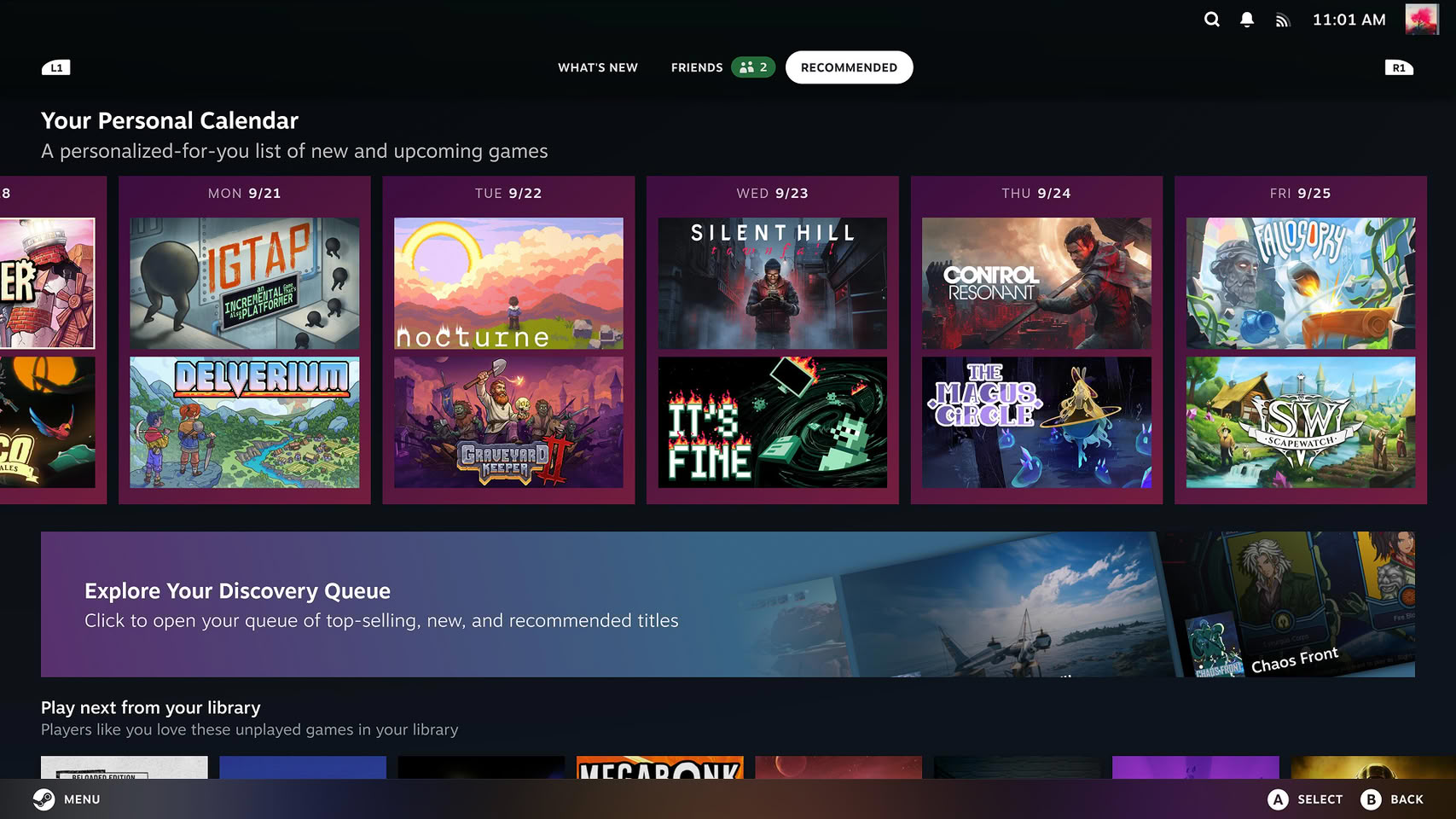
The new Big Art Mode can be optionally enabled, and it basically expands game thumbnails to a large vertical shelf at the bottom of the display, with the highlighted game's artwork scaled to fill in the background, instead of showing the customary grid with games in their shelves. This new Big Art Mode is also accompanied by several other new customization features, including new custom screensavers, and a new optional personal calendar on the Home screen.

Steam Frame Inches Closer to Launch With Store Updates

In mid-August, there were rumors that Valve may soon launch its Steam Frame VR headset, although there was no exact launch date proposed. Following this, Valve has apparently been updating the backend of the Steam Store page listing (via SteamDB) for the Frame with new package information, each representing a different SKU or bundle for the Steam Machine.

There are seven SKUs in total, and two of them were updated on September 3, following months of silence. The suggestion by notable VR industry insider, Brad Lynch, is that these updates may signal that Valve is preparing to make the Steam Frame available for pre-order or reservation soon. It is likely that there will be at least two base SKUs with no accessories aside from the controllers, a bundle with an additional battery pack, and at least one bundle with the so-called "Goopy Kit," which refers to the Ergonomic Accessories Kit that contains controller hand straps, a top head strap, and an extended light blocker.

SteamOS 3.8.26 Beta Squashes Numerous Bugs and Performance Issues in Desktop and Gaming Mode

Since the launch of the Valve Steam Deck, and subsequently the Steam Machine, much of Valve's focus in developing SteamOS has been on adding features and support for games, hardware, and other platforms, like Lenovo's and ASUS's gaming handhelds. More recently, specifically since SteamOS 3.8's launch, it seems like Valve is dedicating more time to fixing bugs and polishing the experience.

This has held true with the latest SteamOS 3.8.26 beta, which is entirely dedicated to fixing bugs in both desktop and game mode, and even a few tweaks for VR support ahead of the Steam Frame launch. The biggest, and likely the most notable change is a fix for performance degradations that came from games and features that required composition—most commonly seen with FSR enabled. Valve also fixed several Desktop Mode bugs, including one that previously resulted in occasional freezing in Firefox, and another that allowed desktop resolutions below 640 × 480, which was unreadable.

NVIDIA GeForce NOW Gets DLSS 4.5 Settings, Steam Machine Support and New Games

NVIDIA is adding a bunch of new features to GeForce NOW, giving subscribers more control over streaming quality while expanding support to more devices. In case you missed it, NVIDIA's GeForce NOW cloud gaming service lets users stream PC games they already own to pretty much anything with a screen, including old PCs, Macs, Steam Deck, phones, tablets and TVs. Supported games can run with ray tracing, path tracing and DLSS 4.5, while some fast-paced titles can be streamed at up to 360 FPS.

One of the more interesting additions is a new set of new DLSS 4.5 controls. NVIDIA says these will give users more control over how supported games look and perform, with options covering DLSS Super Resolution, Dynamic Frame Generation and Ray Reconstruction. Steam support is also getting another boost, and NVIDIA says that Steam Controller support is coming later this year for Steam Deck and Steam Machines, followed by Windows and macOS support.

Valve Celebrates 30 Years of Revolutionizing PC Gaming

On August 24, 1996, Gabe Newell and Mike Harrington officially founded Valve, forever changing the world of PC gaming. The company made a massive debut in 1998 with Half-Life, stepping into the realm of legendary PC game franchises. Later on, Valve started creating a variety of games like Dota, Counter-Strike, Artifact, Team Fortress, Left 4 Dead, Portal, and many more, all of which became staple releases and gained a worldwide following.

In 2003, the company officially entered the game distribution arena by launching Steam, now regarded as the leading PC gaming client software and the top destination for games, deals, promotions, and launches. With hundreds of millions of players across the globe, the Steam platform has become the largest PC gaming community on the planet. At its peak, Steam has achieved more than 40 million concurrent gamers online, meaning that at one point, 40 million enthusiasts were playing their favorite games, all purchased, downloaded, and managed through Steam.

Epic Games Launcher Coming "Soon" to Linux

Following the launch of the Valve Steam Deck, there has been a growing tide of game and software developers looking to bring their products and projects to the growing body of Linux gamers. Epic Games is no different, with the company previously revealing in a job listing that it was looking to expand Easy Anti-Cheat support on Linux. Following an announcement that Epic Games was rebuilding its game launcher with a new framework that promises 5× faster launch speeds, there has also been speculation that the Fortnite company could be launching a native Linux version of the Epic Games Launcher.

Now, as reported by Steam Deck HQ, an Epic Games employee has revealed in a Discord Q&A that a Linux version of the launcher is in development and would be launching "soon," when asked about the possibility by a Discord member. This doesn't actually give anyone a timeline or state of a native Linux version, but it serves as confirmation that Epic Games is actively working on Linux support. It's also an indicator that Epic Games is starting to take Linux more seriously as a gaming platform, despite CEO Tim Sweeney's prior dismissive remarks about Linux.

Steam Machine Water Cooling Project Drops Temps By 30°

The Valve Steam Machine is known for running cool and quietly, but one modder decided to kick things up a notch when it comes to the Steam Machine's cooling solution, creating a custom liquid cooled Steam Machine using a desktop CNC machine, impressive reverse engineering, and less than $200 in parts.

The modder, who goes by u/techmagnet on Reddit, has published a handful of in-progress dev logs of his liquid cooled Steam Machine project, with the latest being a short edit of the build process and the end result. The mod required a custom-machined copper water block, a heavily modded Steam Machine chassis, and an Alphacool water pump to build the custom loop.

Steam Machine Updates: FSR 4.1 Lands Alongside CAD Files for Custom Faceplates

Since the long-awaited launch of the Steam Machine, Valve has provided periodic updates on the new hybrid game console. Despite Valve's recent confirmations that RAM remains in short supply and at a high cost, the company has said in its latest update that it should be able to offer everyone in the reservation queue the option to purchase a Steam Machine by the end of 2026. After that, Valve will move on to users in the waitlist who have not yet had the chance to place a reservation.

Valve has also confirmed that it has published the CAD files for the Steam Machine's exterior for those who want to create their own faceplates or other accessories. The CAD model is in STEP format, which is widely regarded as a fairly universally accessible and compatible CAD format, and it is published under the Creative Commons Attribution-NonCommercial-ShareAlike 4.0 (BY-NC-SA) license, which specifies that the files are free to use and modify, but that users must attribute the original creator—in this case Valve—and share any projects they make under the same license. The CAD models have external topology, including fan mounting points, feet, and even geometry for the power button and I/O.

Dbrand Reveals Steam Machine Skins After Companion Cube Debacle

Less than a month after Dbrand was taken to task by Valve for using its IP without permission in the now-discontinued Companion Cube Portal-themed Steam Machine mod, the accessory maker has revealed a host of Steam Machine skins to customize the aesthetics of the Steam Machine beyond what Valve offers with the DIY

There are 51 skins in total, with designs ranging from classic Dbrand colorways and textures, like the Swarm and Matrix designs, to more extravagant looks, like the X-Ray and retro Terminal designs, as well as various glow-in-the-dark variants. Given the wide range of use cases for the Steam Machine, it makes sense to have a variety of options. The skins are available as kits for just the faceplate or to cover the whole Steam Machine.

Steam Deck Sales Crash After Price Hike in May

Despite a notable sales blip immediately following the recent RAMpocalypse-driven price hikes, which saw Steam Deck prices skyrocket by $240-300 overnight, it appears as though sales for the Steam Deck have plummeted since the price increases.

According to a recent report by Boiling Steam, which tracks Steam hardware sales by extrapolating Valve's Top Sellers chart data, there has been a massive decline in Steam Deck sales since the beginning of June. The analysts report that the Steam Deck's slide from fifth to 14th in the Top Sellers chart could represent an up to 82% decline in weekly sales figures.

Valve Doubles Down on Steam Machine Pricing Pessimism

Since the launch of the Steam Machine, which has been blasted online for its high pricing and middling performance, Valve has been fairly transparent about pricing woes relating to the hybrid console, with engineers previously going so far as to say that pricing before the AI-fuelled RAMpocalypse was as much as 30% cheaper than launch pricing, and that the light at the end of the tunnel is faint.

More recently, in a new interview with Bloomberg, Valve engineers Pierre-Loup Griffais and Yazan Aldehayyat, have once again reiterated that pricing of the Steam Machine, and hardware in general, "is lagging what we're seeing from a bulk supply by at least three to six months." In other words, the pricing for the Steam Machine and other PC components that have been impacted by the RAM crisis in mid-July are, at best, prices from February. If true, it also means that Valve effectively has a bit of clairvoyance when it comes to hardware pricing, as one would when working closely with suppliers, and the engineers only see it getting worse, at least for the next three to six months.

Valve Reportedly Sells 12-15K Steam Machine Units Per Week

When Valve listed its Steam Machine gaming console/PC back in late June, many doubted whether the console would sell due to its high price tag. However, it turns out that Valve's sales data have reportedly been good. Some investigative journalism led to an estimate that Valve is selling anywhere from 12,000 to 15,000 Steam Machine units per week. To reach that number, the Boiling Steam website used Steam's Global Top Sellers list, where Steam Machine is ranked as number two, right between Counter-Strike 2 and Palworld games. Based on data from multiple sources, the Boiling Steam estimation suggests that CS2 generates around $19-20 million in revenue, while third-place Palworld generates $7-9 million. This effectively places Steam Machine's revenue anywhere between $10-18 million per week. Considering that a weighted average distribution model shows most buyers, about 65%, are acquiring the base model priced at $1,049, the remaining 35% are purchasing the higher-tier $1,349 configuration.

The lower bound scenario suggests about 8,700 Steam Machine units sold per week, with the higher bound capped at about 15,600 units. A medium projection is about 12,000-15,000 units sold per week as of July 18, which is a healthy calculation. Since Valve keeps much of its information secretive, this estimation is one of the most concrete numbers we can get, all thanks to Boiling Steam's "napkin math." For the Steam Machine, which has been criticized for its high price tag, the sales numbers seem to be just okay, and the Steam community is buying these consoles in healthy numbers. If sales continue at this pace, there could be anywhere between 600,000 to 750,000 units sold in a year.

Steam Machine Running Windows With Performance On-Par With SteamOS

Valve recently released Windows drivers for the new Steam Machine living room console, and it turns out the drivers are pretty good, given recent benchmark results from ETA Prime. The notorious YouTuber and gaming hardware reviewer installed Windows 11 on the Steam Machine, noting that the process was fairly painless, and that all the hardware worked flawlessly. It's both notable and somewhat comical that the GPU shows up in both Windows Task Manager and AMD's Radeon Adrenaline driver as an AMD Radeon RX 7600.

The Steam Machine in question has been upgraded to have 64 GB of memory, so there may be slight differences in performance, especially once the Windows installation starts to accrue more and more programs. In terms of actual gaming and productivity performance, SteamOS and Windows mostly trade blows, but Windows does have a few notable performance wins over SteamOS.
Return to Keyword Browsing
Nov 28th, 2026 11:14 CST change timezone

New Forum Posts

Popular Reviews

TPU on YouTube

Controversial News Posts