Thursday, July 16th 2026

Steam Machine Running Windows With Performance On-Par With SteamOS
Valve recently released Windows drivers for the new Steam Machine living room console, and it turns out the drivers are pretty good, given recent benchmark results from ETA Prime. The notorious YouTuber and gaming hardware reviewer installed Windows 11 on the Steam Machine, noting that the process was fairly painless, and that all the hardware worked flawlessly. It's both notable and somewhat comical that the GPU shows up in both Windows Task Manager and AMD's Radeon Adrenaline driver as an AMD Radeon RX 7600.
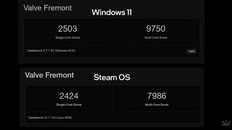
The Steam Machine in question has been upgraded to have 64 GB of memory, so there may be slight differences in performance, especially once the Windows installation starts to accrue more and more programs. In terms of actual gaming and productivity performance, SteamOS and Windows mostly trade blows, but Windows does have a few notable performance wins over SteamOS. For starters, Windows edges out SteamOS by a sizeable 22% margin in the Geekbench 6 multi-thread benchmark, with the single-core benchmark being just about on par. In Cinebench 2024, the Steam Machine scores a middling 99 points in the single-core benchmark and 554 points in the multicore test, falling significantly behind Apple's M1 Max and the AMD Ryzen 5800X in the multi-thread tests.
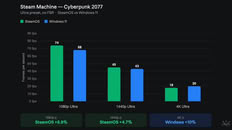
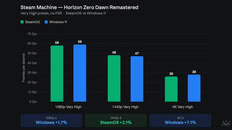
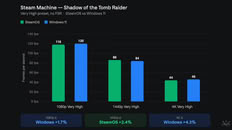 In gaming, things are a lot more even, although there's a trend that shows the Steam Machine running Windows gaining a small advantage at 4K and 1080p resolutions. In Shadow of the Tomb Raider, Windows outperforms SteamOS ever so slightly, at both 1080p (a 1.7% uplift) and 4K (a more substantial 4.3% win for Windows), but at 1440p, SteamOS is 2.4% faster. When it comes to Cyberpunk 2077 on Ultra settings, SteamOS has a handy 8.8% advantage over Windows and a smaller 4.7% win at 1440p. At 4K, however, both were unplayable, with SteamOS delivering 18 FPS average and Windows delivering 20 FPS. The two are neck-and-neck in Horizon Zero Dawn Remastered with High graphics and no FSR, too, with the only notable outlier being a 7.1% win for Windows in Horizon Zero Dawn Remastered. At 1440p, SteamOS was 2.1% faster, and at 1080p, Windows was, again 1.7% faster.
 In conclusion, it seems as though running Windows on the Steam Machine is perfectly feasible, and it's one of the things Valve has been vocal about in its Steam Machine marketing—that the Steam Machine is just a PC, and you can basically do with it whatever you'd be able to do with any other PC. However, there are other reasons to run SteamOS, aside from just gaming performance, as we discussed in another article covering a comparison between Fedora Linux and Windows 11 in gaming tests.
Source:
ETA Prime on YouTube
The Steam Machine in question has been upgraded to have 64 GB of memory, so there may be slight differences in performance, especially once the Windows installation starts to accrue more and more programs. In terms of actual gaming and productivity performance, SteamOS and Windows mostly trade blows, but Windows does have a few notable performance wins over SteamOS.


28 Comments on Steam Machine Running Windows With Performance On-Par With SteamOS
Great to know it performs equally in Windows, still don't really see much of a point to this box personally, but I'm sure it'll still sell well enough, at least at first.
Only games that support drivers older than 24.30 branch will run correctly and perform well on the Steam Machine, since the drivers are a prerelease, OEM only version of 24.30 that predates 25.3.1 (the first public release of 24.30) by about 5 months. An accurate report would point that this device is stuck on 19 month old beta drivers, not that "it performs well". The three games this YouTuber tested are all games released in 2024 or earlier. Games that require extensions and features introduced by newer releases will not work well with these drivers. Driver level bug fixes released since November of 2024 are not available, and future bug fixes that may be needed will not be provided unless Quanta purchases an update from AMD.For the aforementioned reasons and especially due to compatibility concerns you should NOT use Windows with your Steam Machine. Drivers under SteamOS are community maintained and always up to date.
Being roughly 2 years behind, no one can guarantee compatibility with newer games, which makes this advice dubious at best and incorrect at worst if the objective is to preserve compatibility. It'll basically run whatever was already working at that point in time, minus... the entirety of everything AMD did since then, which is to say, a lot.Point being, they are open source and anyone can issue a push request. Which is not the case with AMD's proprietary Windows driver and their semicustom licensing scheme.
That is very much the unbiased conclusion here.
Additional conclusive tests would be if all of the titles had VulkanAPI counter-parts to run on both systems, because Vulkan vs. DirectX only serves to compare directly the APIs instead of hardware.
And just for perspective, I'm using my GTX980 on a Windows 11 build ATM and it has zero issues running games or in the OS. The drivers for that card haven't been updated in what, 4 years now? Lack of driver updates is NOT a problem for went those drivers are being supplied by the manufacturer and are recently certified by them. Drivers don't magically stop working properly or become usless just because they turn two years old. To suggest they do is a meritless suggestion.
Put another way, I'm suggesting the logic you presented is flawed. There are LOTs of reasons using Windows on the SteamMachine could be a problem. The drivers are NOT one of them.
By the way, the GTX 980 last received driver update a couple of months ago. Pro version two weeks ago, although no new functionality has been added. Nvidia R580 drivers already have out of date extensions too. But they are a year newer than what Valve released here, and not exactly lacking two entire years of bug fixes. Most games haven't caught up them for a base requirement yet. But it's only a matter of time.
You can see with the Steam Deck too, drivers last updated 2023. Valve hasn't provided a maintenance update since.
Heck, in a test done very recently by macro nett, at 500hz the end to end latency is around 4ms (xwayland is 8ms)
For comparison at 240hz in overwatch, windows gets 20ms on default settings and 15ms with reflex/antilag, and in the same testing conditions but on xwayland, you'd get around 20ms.
If you extrapolate the information, you can assume that native wayland in overwatch would net you a minimum of 4ms putting wayland 1ms behind windows in its best conditions and 3ms ahead of windows in its average conditions.
If you can feel that, then absolutely go for it.
What we need nowadays on is testing like-for-like, Native wayland with VRR, dxvk-low-latency, LatencyFlex(Reflex) vs Windows with similar options all capped at the same framerate using the correct formula (forgot its name) and actually making sure each game reaches that cap consistently. Then testing for CPU-bound latency and GPU-Bound latency.
Imma assume when capped or CPU-bound, linux would win in those perfect scenarios and in GPU-bound scenarios windows would win by a lot.
I'm pretty sure it's not supposed to look 8 bit :P
which is "newer" than what AMD supports on 26.6.4 (1.3.344).Of course not every extension is supported on Maxwell and Pascal.Correction: did some research, 9070 XT up to 1.4.349.I understand your lack of urgency and the if it ain't broke don't fix it mindset - I did acknowledge games haven't caught up to this "API level" yet.But this is what I have a problem with. It's understandable if you look at it from the angle of an old GPU. But from a brand new system that is still being released and few owners have it in their hands? It's a bad place to be. Drivers are provided as a convenience, it is much too obvious that this machine is intended to run SteamOS. Driver updates are needed to ensure compatibility and stability with newer games, especially as time goes on. They are also required to correct problems that develop due to the OS changing all the time.Same principle applies overall, the experience on the Deck is notorious for being very poor on Windows while great under SteamOS, and this no doubt contributes to that.
But they don't wanna support these and haven't since Kaby Lake-G which caused quite a dispute between them and Intel, who kept pointing at each other for updates to RX Vega M. AMD claimed this was Intel's responsibility, Intel (rightfully) pointed out that it was a normal AMD driver with an Intel skin, end of the day it was over Intel making payments to AMD in order to release updates for this semicustom HW.
At the end of the day, whether or not a SteamMachine owner goes with the default StreamOS or goes with Windows is going to be personal preference and hardware drivers are just not going to be a problem.
And Steam big picture might not be as seemless of an integration as SteamOS for console-like experience. You still have to go through the Windows boot sequence and god knows what can happen there (like this OOBE-like full screen thing that you can tell to remind you in 3 days), and you might get Windows notifications or be brought back to the desktop for some reason.
This may be more viable with the recent Xbox mode (instead of Steam big picture), but there's still a question mark over HDMI CEC.
And they have to because first it would create a horrible look and impression to their own users and second, they are kind of forced to because in mobile RDNA 3/.5 is still the only thing AMD has to offer in mobile right now by their own choice. Which may not have been a good choice considering that basically all their current competitors are outperforming it with better capabilities now, even Qualcomm, but that's a different matter and out of this topic.It was created by the community, it still has a lot of community development and most development by companies and contractord are still by other parts and not mainly directly by AMD.
It's exactly thanks to RADV being the community driver that things like BC-250 support, PS5 Linux support, FSR 4 FP8 emulation to FP16 in RDNA 3 and many others have been possible; if the driver was mainly being handled and developed by AMD, like how AMDVLK was, none of that kind of code would have been allowed to be merged.
@PixelTech
Angry much?