News Posts matching #USB4

Return to Keyword Browsing

Synaptics to Acquire DisplayLink, Extending Video Interface Market Leadership

Synaptics Incorporated today announced the signing of a definitive agreement to acquire DisplayLink Corp., a leader in high-performance video compression technology, for $305 million in an all-cash transaction. The deal is expected to close in Synaptics' first quarter of fiscal year 2021, subject to customary closing conditions, and be financed from existing cash on hand. Synaptics expects the transaction to add approximately $94 million in annualized sales and be immediately accretive to non-GAAP gross margins, non-GAAP operating margins, and non-GAAP earnings post-close.

DisplayLink's high performance software compression technology enables universal docking and casting of high bandwidth video from any device to any display using any transport medium such as USB, Ethernet or Wi-Fi. For the Enterprise IT market, the solution supports multi-OS environments including Windows, MacOS, ChromeOS and Ubuntu Linux enabling a myriad of devices to seamlessly dock to multiple high resolution (4K, 8K) displays.


Intel Announces Thunderbolt 4: Universal Cable Connectivity for Everyone

Today, Intel revealed new details about Thunderbolt 4, the next generation of its universal cable connectivity solution, delivering increased minimum performance requirements, expanded capabilities and USB4 specification compliance. For the first time, Thunderbolt 4 will offer docks with up to four Thunderbolt ports and universal cables up to 2 meters in length. Intel's upcoming mobile PC processors, code-named "Tiger Lake," will be the first to integrate Thunderbolt 4. Intel also announced the Thunderbolt 4 controller 8000 series, compatible with the hundreds of millions of Thunderbolt 3 PCs and accessories already available. Thunderbolt 4 developer kits and certification testing are now available.

"Thunderbolt provides consumers with a leading connectivity standard across a range of devices, helping to advance computing experiences and delivering on the promise of USB-C with simplicity, performance and reliability. The arrival of Thunderbolt 4 underscores how Intel is advancing the PC ecosystem toward truly universal connectivity solutions," said Jason Ziller, Intel general manager of the Client Connectivity Division.

VESA Releases Updated DisplayPort Alt Mode Spec

The Video Electronics Standards Association (VESA ) today announced that it has released version 2.0 of the DisplayPort Alternate Mode ("Alt Mode") standard. DisplayPort Alt Mode 2.0 provides seamless interoperability with the new USB4 specification published by the USB Implementers Forum (USB-IF), and fully enables all of the features in the latest version of the DisplayPort standard (version 2.0) through the USB Type-C (USB-C) connector. With DisplayPort Alt Mode, the USB-C connector can transmit up to 80 Gigabits per second (Gbps) of DisplayPort video data utilizing all four high-speed lanes in the cable, or up to 40 Gbps with simultaneous SuperSpeed USB data delivery. VESA anticipates first products incorporating DisplayPort Alt Mode 2.0 to appear on the market in 2021.

DisplayPort 2.0, which was introduced in June 2019, provides up to a 3X increase in data bandwidth performance compared to the previous version of DisplayPort, as well as new capabilities to address future performance requirements of displays. These include beyond-8K resolutions, higher refresh rates and high dynamic range (HDR) support at higher resolutions, improved support for multiple display configurations, as well as improved user experience with augmented/virtual (AR/VR) displays, including support for 4K-and-beyond VR resolutions. Featuring the highly efficient 128b/132b channel coding shared with USB4, DisplayPort 2.0 delivers a maximum payload of 77.37 Gbps across four lanes (up to 19.34 Gbps per lane)—supporting ultra-high display performance configurations such as an 8K (7680x4320) display with 60 Hz refresh rate with full-color 30 bpp 4:4:4 HDR resolution uncompressed, and 16K (15360x8460) 60 Hz display with 30 bpp 4:4:4 HDR resolution with compression. With the release of DisplayPort Alt Mode 2.0, all of these high-performance video capabilities are now available to the USB ecosystem.

USB-IF Announces Publication of USB4 Specification

USB Implementers Forum (USB-IF), the support organization for the advancement and adoption of USB technology, today announced the publication of the USB4 specification, a major update to deliver the next-generation USB architecture that complements and builds upon the existing USB 3.2 and USB 2.0 architectures. The USB4 architecture is based on the Thunderbolt protocol specification recently contributed by Intel Corporation to the USB Promoter Group. It doubles the maximum aggregate bandwidth of USB and enables multiple simultaneous data and display protocols.

The development of the USB4 specification was first announced in March 2019 by the USB Promoter Group. It is now officially published by USB-IF and available for download here.

Intel Takes Steps to Enable Thunderbolt 3 Everywhere, Releases Protocol

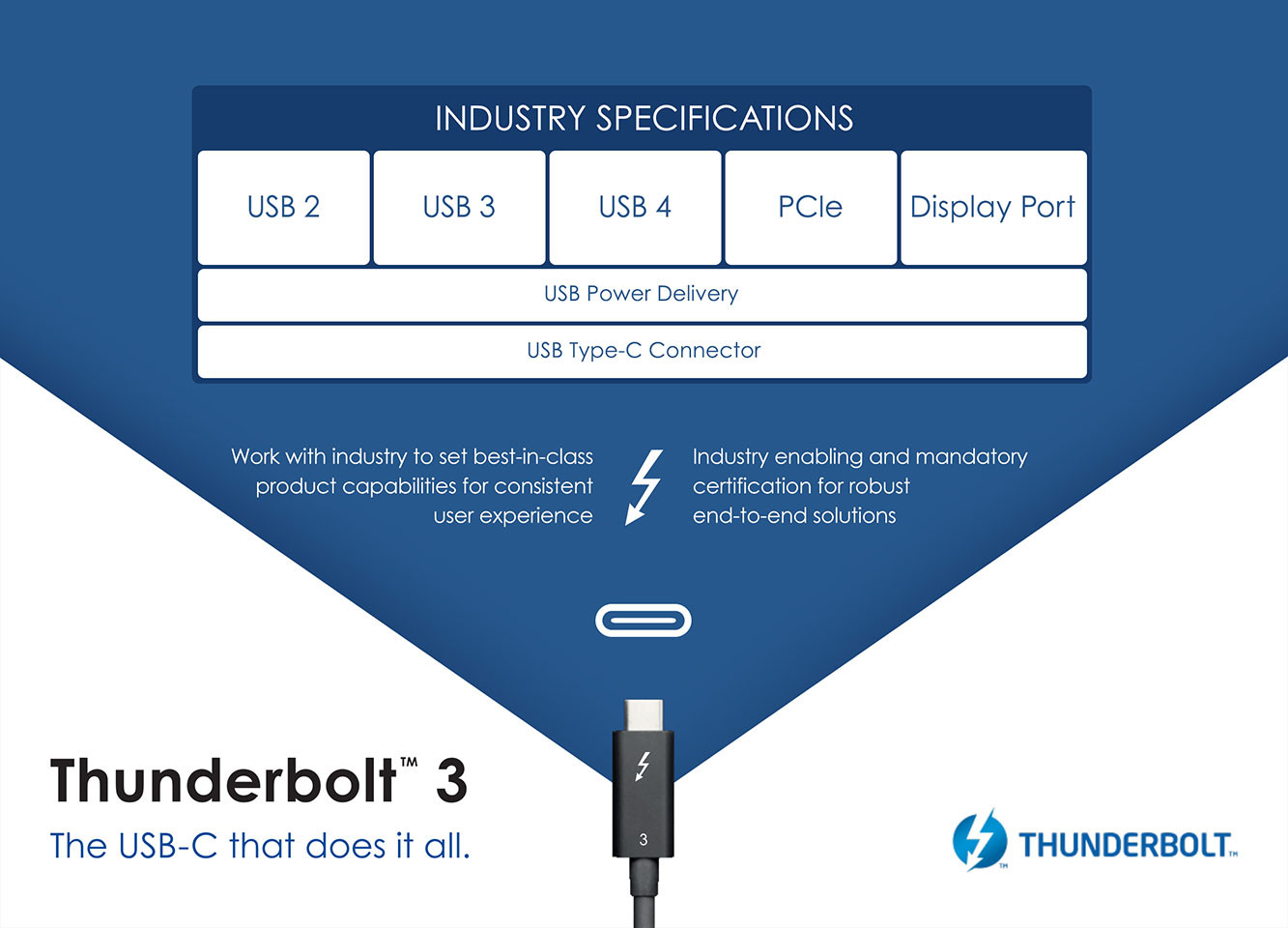
Intel is well on its way to making the innovation delivered with Thunderbolt 3 available to everyone. Today, Intel announced that it contributed the Intel Thunderbolt protocol specification to the USB Promoter Group, enabling other chip makers to build Thunderbolt compatible silicon, royalty-free. In addition, the USB Promoter Group announced the pending release of the USB4 specification, based on the Thunderbolt protocol. The convergence of the underlying Thunderbolt and USB protocols will increase compatibility among USB Type-C connector-based products, simplifying how people connect their devices.

"Releasing the Thunderbolt protocol specification is a significant milestone for making today's simplest and most versatile port available to everyone. This, in combination with the integration of Thunderbolt 3 into upcoming Intel processors is a win-win for the industry and consumers," said Jason Ziller, general manager, Client Connectivity Division at Intel.

USB Promoter Group Announces USB4 Specification

While we just recently covered the USB 3.2 specification. The USB Promoter Group has today announced the pending release of the USB4 specification, a major update to deliver the next generation USB architecture that compliments and builds on the existing USB 3.2 and USB 2.0 architectures. The USB4 architecture is based on the Thunderbolt protocol specification recently contributed by Intel Corporation. It doubles the bandwidth of USB and enables multiple simultaneous data and display protocols.

The new USB4 architecture defines a method to share a single high-speed link with multiple end device types dynamically that best serves the transfer of data by type and application. As the USB Type-C connector has evolved into the role as the external display port of many host products, the USB4 specification provides the host the ability to optimally scale allocations for display data flow. Even as the USB4 specification introduces a new underlying protocol, compatibility with existing USB 3.2, USB 2.0 and Thunderbolt 3 hosts and devices is supported; the resulting connection scales to the best mutual capability of the devices being connected. "The primary goal of USB is to deliver the best user experience combining data, display and power delivery over a user-friendly and robust cable and connector solution," said Brad Saunders, USB Promoter Group Chairman. "The USB4 solution specifically tailors bus operation to further enhance this experience by optimizing the blend of data and display over a single connection and enabling the further doubling of performance."
Return to Keyword Browsing
Nov 11th, 2026 04:19 CST change timezone

New Forum Posts

Popular Reviews

TPU on YouTube

Controversial News Posts