News Posts matching #inference

Return to Keyword Browsing

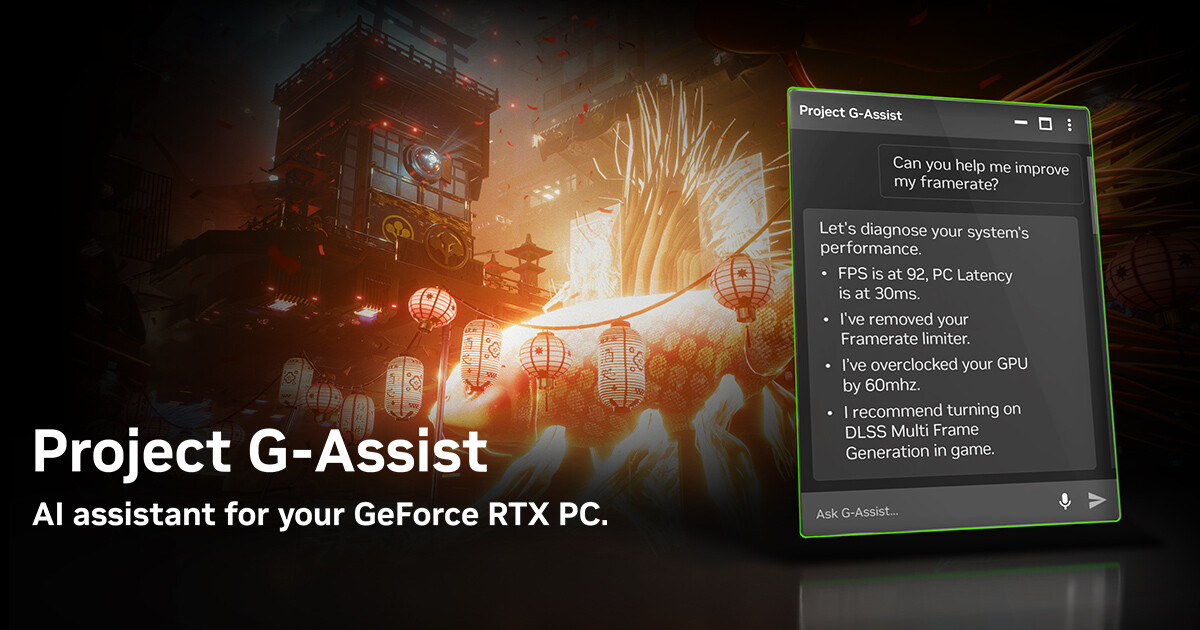
NVIDIA's Project G-Assist Plug-In Builder Explained: Anyone Can Customize AI on GeForce RTX AI PCs

AI is rapidly reshaping what's possible on a PC—whether for real-time image generation or voice-controlled workflows. As AI capabilities grow, so does their complexity. Tapping into the power of AI can entail navigating a maze of system settings, software and hardware configurations. Enabling users to explore how on-device AI can simplify and enhance the PC experience, Project G-Assist—an AI assistant that helps tune, control and optimize GeForce RTX systems—is now available as an experimental feature in the NVIDIA app. Developers can try out AI-powered voice and text commands for tasks like monitoring performance, adjusting settings and interacting with supporting peripherals. Users can even summon other AIs powered by GeForce RTX AI PCs.

And it doesn't stop there. For those looking to expand Project G-Assist capabilities in creative ways, the AI supports custom plug-ins. With the new ChatGPT-based G-Assist Plug-In Builder, developers and enthusiasts can create and customize G-Assist's functionality, adding new commands, connecting external tools and building AI workflows tailored to specific needs. With the plug-in builder, users can generate properly formatted code with AI, then integrate the code into G-Assist—enabling quick, AI-assisted functionality that responds to text and voice commands.



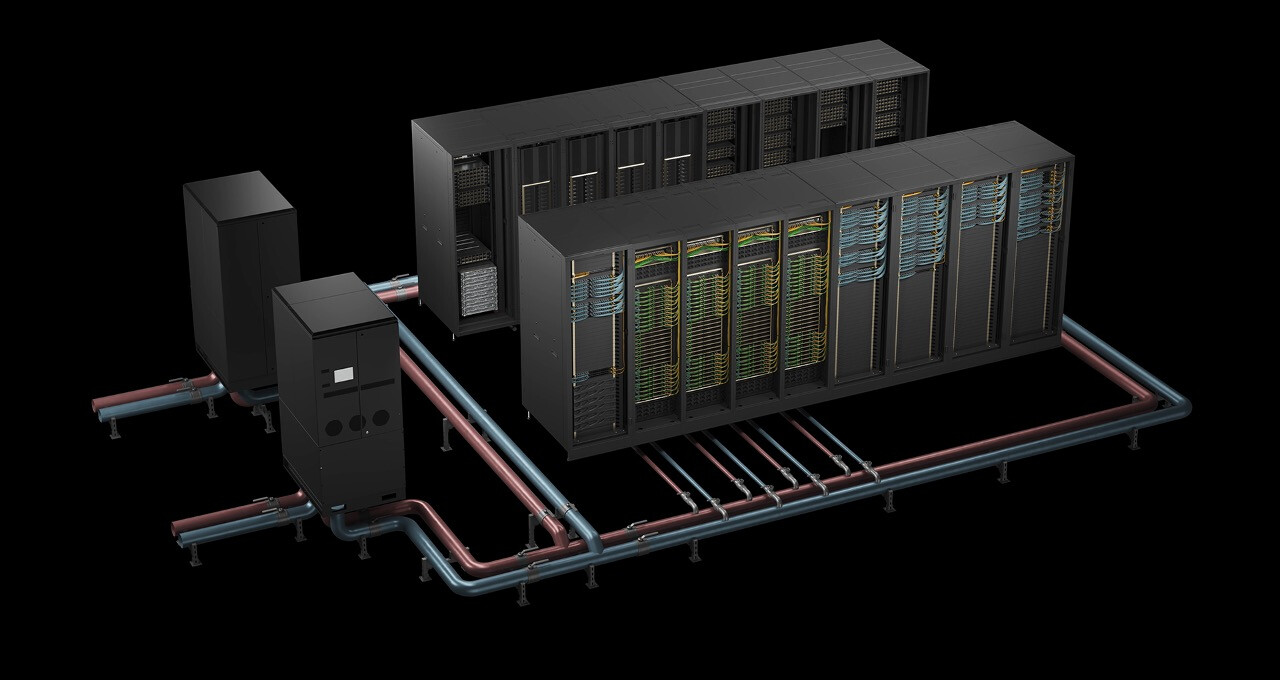
NVIDIA Blackwell Platform Boosts Water Efficiency by Over 300x - "Chill Factor" for AI Infrastructure

Traditionally, data centers have relied on air cooling—where mechanical chillers circulate chilled air to absorb heat from servers, helping them maintain optimal conditions. But as AI models increase in size, and the use of AI reasoning models rises, maintaining those optimal conditions is not only getting harder and more expensive—but more energy-intensive. While data centers once operated at 20 kW per rack, today's hyperscale facilities can support over 135 kW per rack, making it an order of magnitude harder to dissipate the heat generated by high-density racks. To keep AI servers running at peak performance, a new approach is needed for efficiency and scalability.

One key solution is liquid cooling—by reducing dependence on chillers and enabling more efficient heat rejection, liquid cooling is driving the next generation of high-performance, energy-efficient AI infrastructure. The NVIDIA GB200 NVL72 and the NVIDIA GB300 NVL72 are rack-scale, liquid-cooled systems designed to handle the demanding tasks of trillion-parameter large language model inference. Their architecture is also specifically optimized for test-time scaling accuracy and performance, making it an ideal choice for running AI reasoning models while efficiently managing energy costs and heat.

NVIDIA Will Bring Agentic AI Reasoning to Enterprises with Google Cloud

NVIDIA is collaborating with Google Cloud to bring agentic AI to enterprises seeking to locally harness the Google Gemini family of AI models using the NVIDIA Blackwell HGX and DGX platforms and NVIDIA Confidential Computing for data safety. With the NVIDIA Blackwell platform on Google Distributed Cloud, on-premises data centers can stay aligned with regulatory requirements and data sovereignty laws by locking down access to sensitive information, such as patient records, financial transactions and classified government information. NVIDIA Confidential Computing also secures sensitive code in the Gemini models from unauthorized access and data leaks.

"By bringing our Gemini models on premises with NVIDIA Blackwell's breakthrough performance and confidential computing capabilities, we're enabling enterprises to unlock the full potential of agentic AI," said Sachin Gupta, vice president and general manager of infrastructure and solutions at Google Cloud. "This collaboration helps ensure customers can innovate securely without compromising on performance or operational ease." Confidential computing with NVIDIA Blackwell provides enterprises with the technical assurance that their user prompts to the Gemini models' application programming interface—as well as the data they used for fine-tuning—remain secure and cannot be viewed or modified. At the same time, model owners can protect against unauthorized access or tampering, providing dual-layer protection that enables enterprises to innovate with Gemini models while maintaining data privacy.

Google Unveils Seventh-Generation AI Processor: Ironwood

Google has rolled out its seventh-generation AI chip, Ironwood, which aims to boost AI application performance. This processor focuses on "inference" computing—the quick calculations needed for chatbot answers and other AI outputs. Ironwood stands as one of the few real options to NVIDIA's leading AI processors coming from Google's ten-year multi-billion-dollar push to develop it. These tensor processing units (TPUs) are exclusively available through Google's cloud service or to its internal engineers.

According to Google Vice President Amin Vahdat, Ironwood combines functions from previously separate designs while increasing memory capacity. The chip can operate in groups of up to 9,216 processors and delivers twice the performance-per-energy ratio compared to last year's Trillium chip. When configured in pods of 9,216 chips, Ironwood delivers 42.5 Exaflops of computing power. This is more than 24 times the computational capacity of El Capitan, currently the world's largest supercomputer, which provides only 1.7 Exaflops per pod.

5th Gen AMD EPYC Processors Deliver Leadership Performance for Google Cloud C4D and H4D Virtual Machines

Today, AMD announced the new Google Cloud C4D and H4D virtual machines (VMs) are powered by 5th Gen AMD EPYC processors. The latest additions to Google Cloud's general-purpose and HPC-optimized VMs deliver leadership performance, scalability, and efficiency for demanding cloud workloads; for everything from data analytics and web serving to high-performance computing (HPC) and AI.

Google Cloud C4D instances deliver impressive performance, efficiency, and consistency for general-purpose computing workloads and AI inference. Based on Google Cloud's testing, leveraging the advancements of the AMD "Zen 5" architecture allowed C4D to deliver up to 80% higher throughput/vCPU compared to previous generations. H4D instances, optimized for HPC workloads, feature AMD EPYC CPUs with Cloud RDMA for efficient scaling of up to tens of thousands of cores.

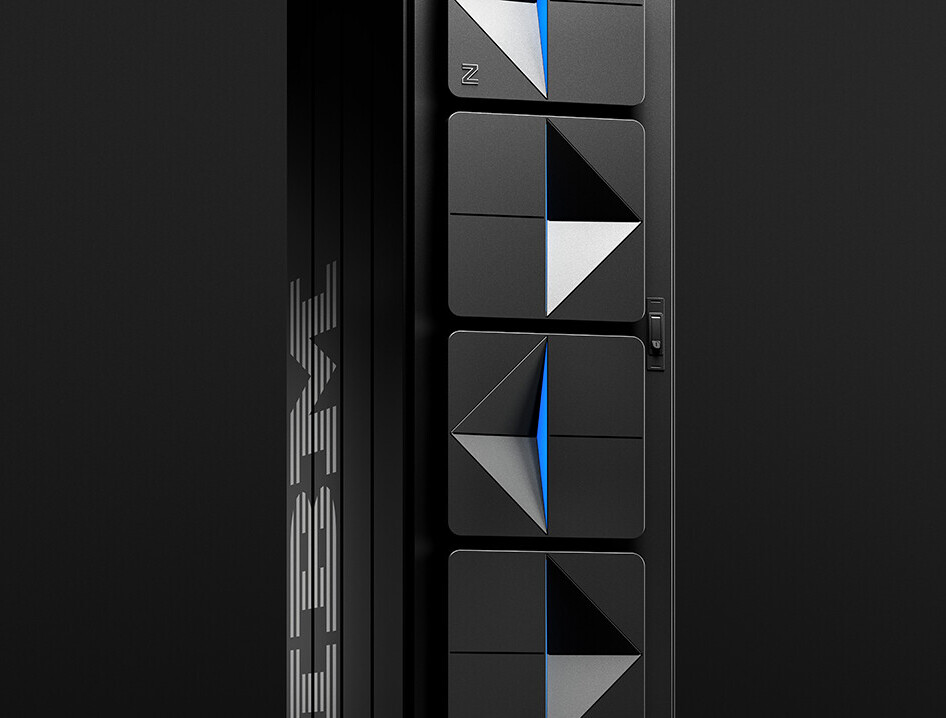
IBM Announces z17, The First Mainframe Fully Engineered for the AI Age

IBM today announced the IBM z17, the next generation of the company's iconic mainframe, fully engineered with AI capabilities across hardware, software, and systems operations. Powered by the new IBM Telum II processor, IBM z17 expands the system's capabilities beyond transactional AI capabilities to enable new workloads.

IBM Z is built to redefine AI at scale, positioning enterprises to score 100% of their transactions in real-time. z17 enables businesses to drive innovation and do more, including the ability to process 50 percent more AI inference operations per day than z16.2 The new IBM z17 is built to drive business value across industries with a wide range of more than 250 AI use cases, such as mitigating loan risk, managing chatbot services, supporting medical image analysis or impeding retail crime, among others.
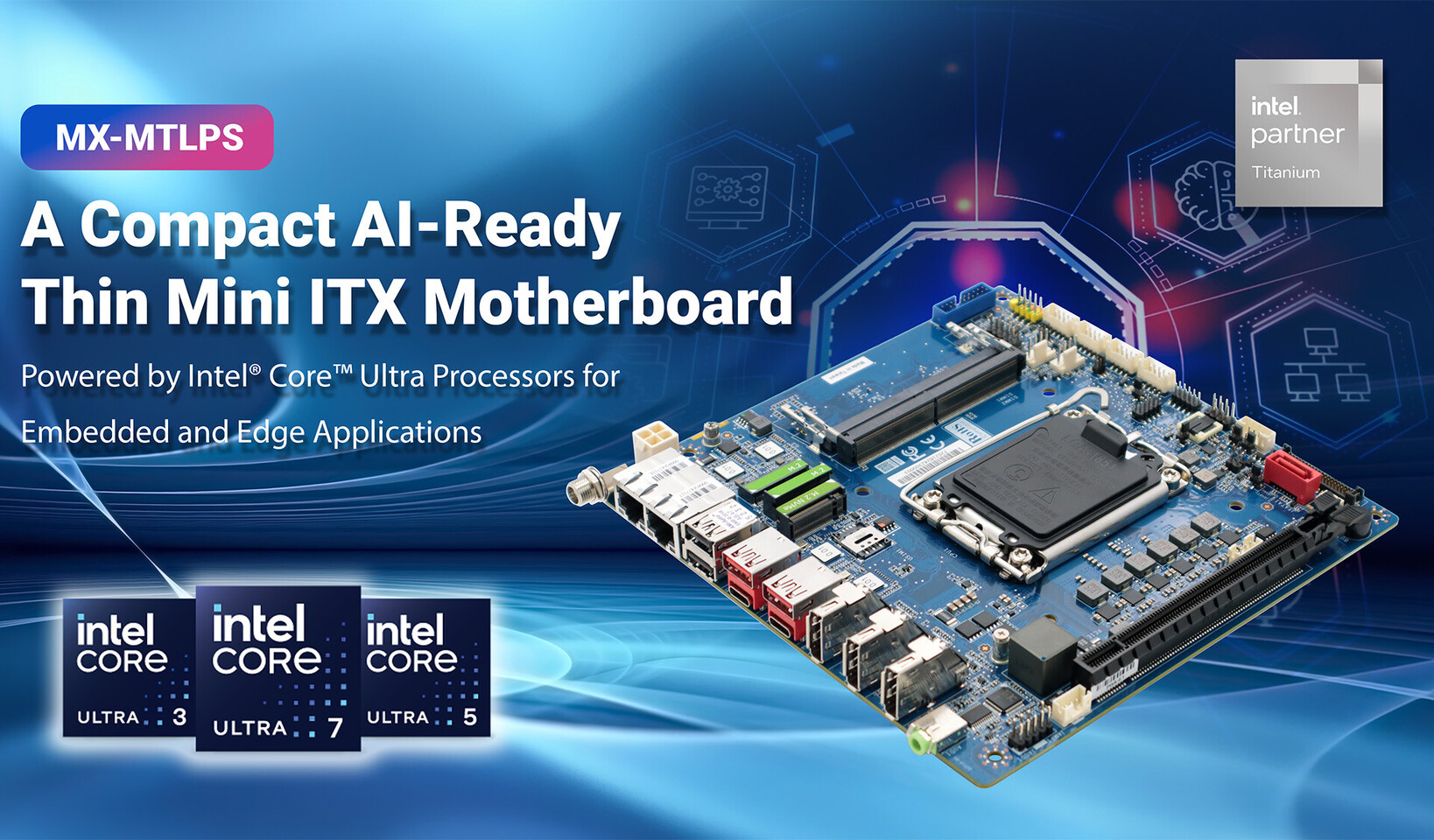
BCM Intros MX-MTLPS Thin Mini-ITX Motherboard Built on the Meteor Lake-PS (MTL-PS) Platform

The BCM MX-MTLPS is a Thin Mini-ITX motherboard designed to take advantage of Intel's latest Core Ultra 3/5/7 processors, built on the Meteor Lake-PS (MTL-PS) platform. As one of the first Mini-ITX form factor boards to support Intel's new socketed SoC design, the MX-MTLPS offers an ideal blend of AI acceleration, integrated graphics, and power-efficient compute—all in a low-profile, fanless-capable footprint.

With a strong focus on edge AI, multi-display, and embedded computing, the MX-MTLPS allows system developers to bring mobile-class performance to desktop-style deployments in space-constrained or thermally sensitive environments.

Meta's Llama 4 Can Process 10 Million Tokens as Input, Lives in Native Multimodality

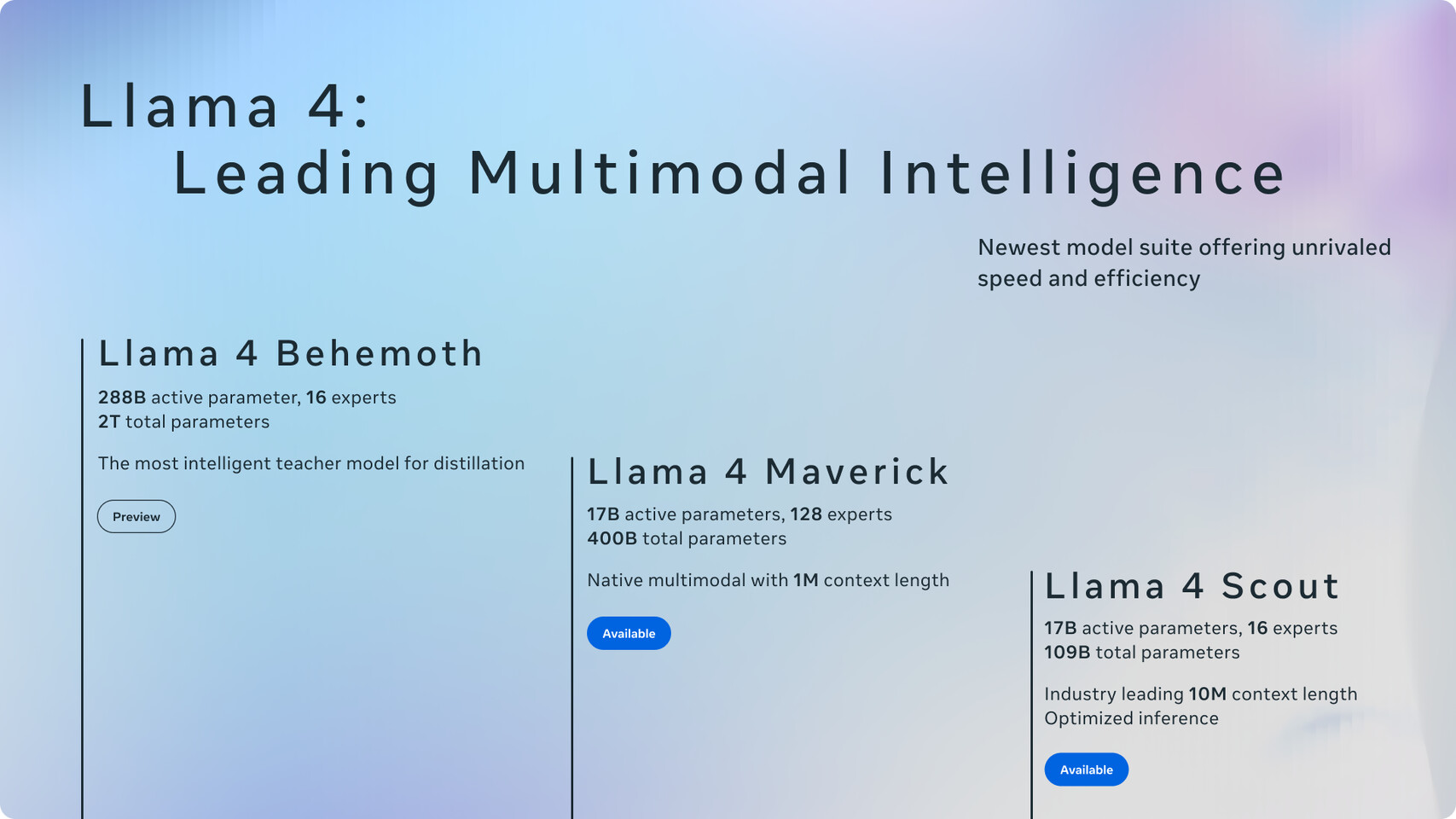
Meta has prepared a leap-forward update for its Llama model series with the v4 release, entering an era of native multimodality within the company's AI models. At the forefront is Llama 4 Scout, a model boasting 17 billion active parameters distributed across 16 experts in a mixture-of-experts (MoE) configuration. With FP4 precision, this model is engineered to run entirely on a single NVIDIA H100 GPU. Scout now supports an industry-leading input context window of up to 10 million tokens, a substantial leap from previous limits like Google's old Gemini 1.5 Pro, which came with 2 million token input content. Llama 4 Scout is built using a hybrid dense and MoE architecture, which selectively activates only a subset of each token's total parameters, optimizing training and inference efficiency. This architecture not only accelerates computation but also reduces associated costs.

Meanwhile, Llama 4 Maverick, another model in the series, also features 17 billion active parameters but incorporates 128 experts, scaling to 400 billion total parameters. Maverick has demonstrated superior performance in coding, image understanding, multilingual processing, and logical reasoning, even outperforming several leading models in its class. Both models embrace native multimodality by integrating text and image data early in the processing pipeline. Utilizing a custom MetaCLIP-based vision encoder, these models can simultaneously process multiple images and text, combining tokens into a single backend processor. This ensures robust visual comprehension and precise object anchoring, powering applications such as detailed image description, visual question-answering, and analysis of temporal image sequences.

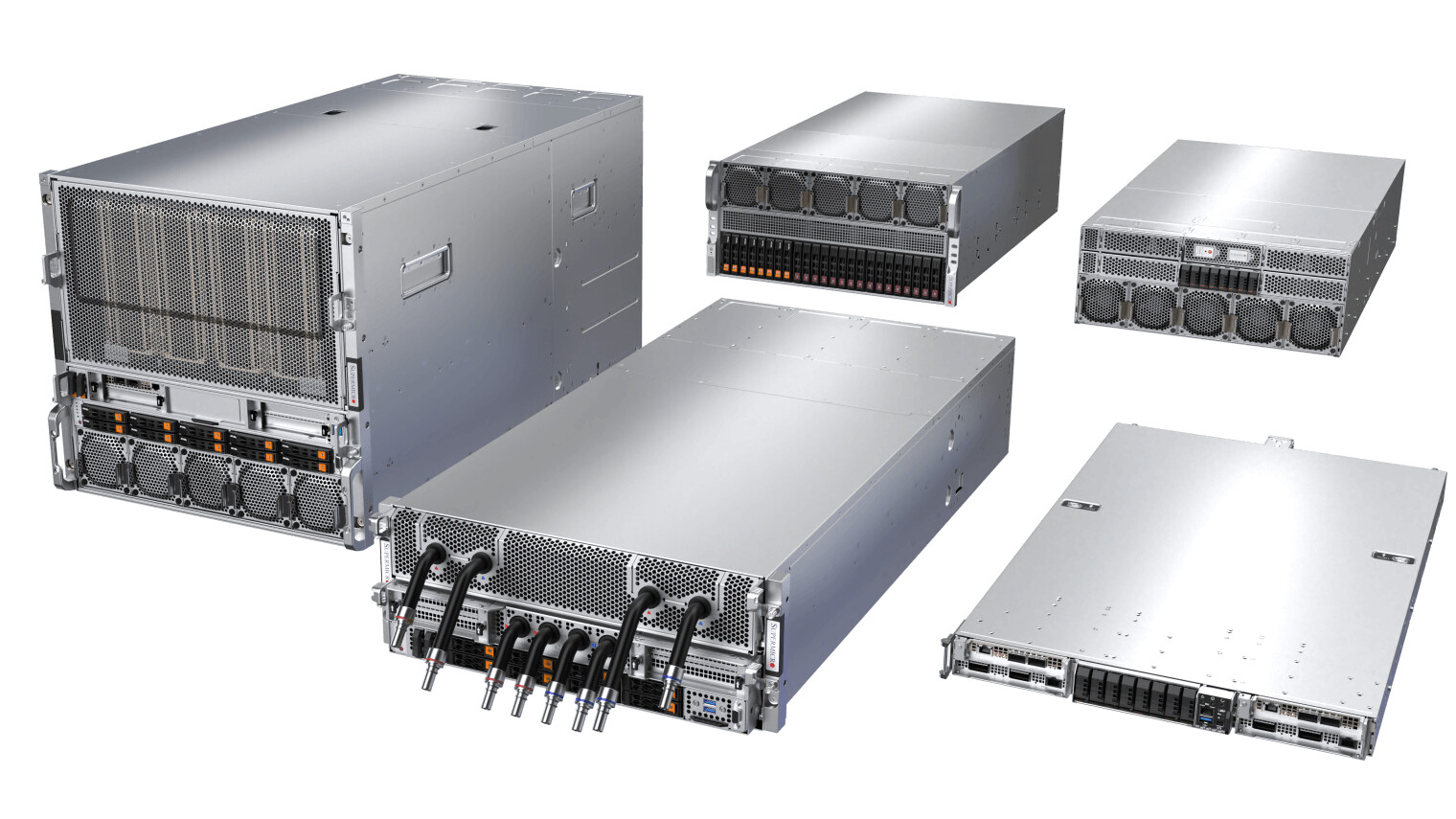
Industry's First-to-Market Supermicro NVIDIA HGX B200 Systems Demonstrate AI Performance Leadership

Super Micro Computer, Inc. (SMCI), a Total IT Solution Provider for AI/ML, HPC, Cloud, Storage, and 5G/Edge, has announced first-to-market industry leading performance on several MLPerf Inference v5.0 benchmarks, using the 8-GPU. The 4U liquid-cooled and 10U air-cooled systems achieved the best performance in select benchmarks. Supermicro demonstrated more than 3 times the tokens per second (Token/s) generation for Llama2-70B and Llama3.1-405B benchmarks compared to H200 8-GPU systems. "Supermicro remains a leader in the AI industry, as evidenced by the first new benchmarks released by MLCommons in 2025," said Charles Liang, president and CEO of Supermicro. "Our building block architecture enables us to be first-to-market with a diverse range of systems optimized for various workloads. We continue to collaborate closely with NVIDIA to fine-tune our systems and secure a leadership position in AI workloads." Learn more about the new MLPerf v5.0 Inference benchmarks here.

Supermicro is the only system vendor publishing record MLPerf inference performance (on select benchmarks) for both the air-cooled and liquid-cooled NVIDIA HGX B200 8-GPU systems. Both air-cooled and liquid-cooled systems were operational before the MLCommons benchmark start date. Supermicro engineers optimized the systems and software to showcase the impressive performance. Within the operating margin, the Supermicro air-cooled B200 system exhibited the same level of performance as the liquid-cooled B200 system. Supermicro has been delivering these systems to customers while we conducted the benchmarks. MLCommons emphasizes that all results be reproducible, that the products are available and that the results can be audited by other MLCommons members. Supermicro engineers optimized the systems and software, as allowed by the MLCommons rules.

MangoBoost Achieves Record-Breaking MLPerf Inference v5.0 Results with AMD Instinct MI300X

MangoBoost, a provider of cutting-edge system solutions designed to maximize AI data center efficiency, has set a new industry benchmark with its latest MLPerf Inference v5.0 submission. The company's Mango LLMBoost AI Enterprise MLOps software has demonstrated unparalleled performance on AMD Instinct MI300X GPUs, delivering the highest-ever recorded results for Llama2-70B in the offline inference category. This milestone marks the first-ever multi-node MLPerf inference result on AMD Instinct MI300X GPUs. By harnessing the power of 32 MI300X GPUs across four server nodes, Mango LLMBoost has surpassed all previous MLPerf inference results, including those from competitors using NVIDIA H100 GPUs.

Unmatched Performance and Cost Efficiency
MangoBoost's MLPerf submission demonstrates a 24% performance advantage over the best-published MLPerf result from Juniper Networks utilizing 32 NVIDIA H100 GPUs. Mango LLMBoost achieved 103,182 tokens per second (TPS) in the offline scenario and 93,039 TPS in the server scenario on AMD MI300X GPUs, outperforming the previous best result of 82,749 TPS on NVIDIA H100 GPUs. In addition to superior performance, Mango LLMBoost + MI300X offers significant cost advantages. With AMD MI300X GPUs priced between $15,000 and $17,000—compared to the $32,000-$40,000 cost of NVIDIA H100 GPUs (source: Tom's Hardware—H100 vs. MI300X Pricing)—Mango LLMBoost delivers up to 62% cost savings while maintaining industry-leading inference throughput.

Vietnamese Store Assembles AI Server, Uses Seven GIGABYTE RTX 5090 GAMING OC Cards

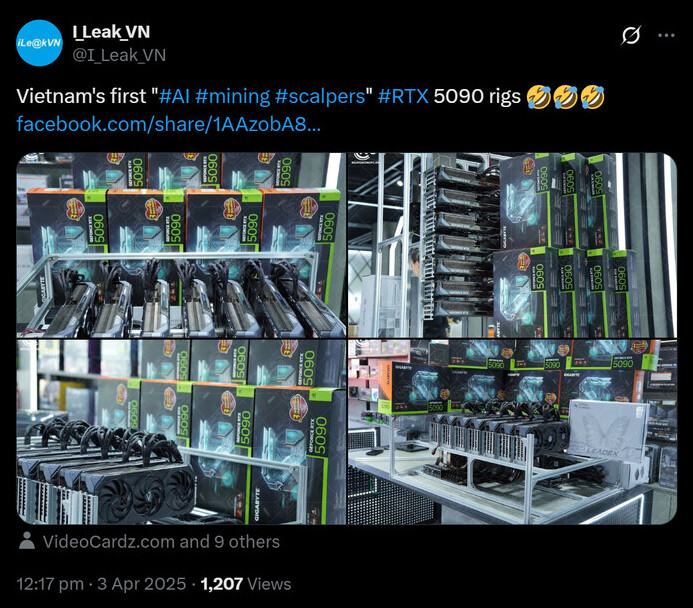
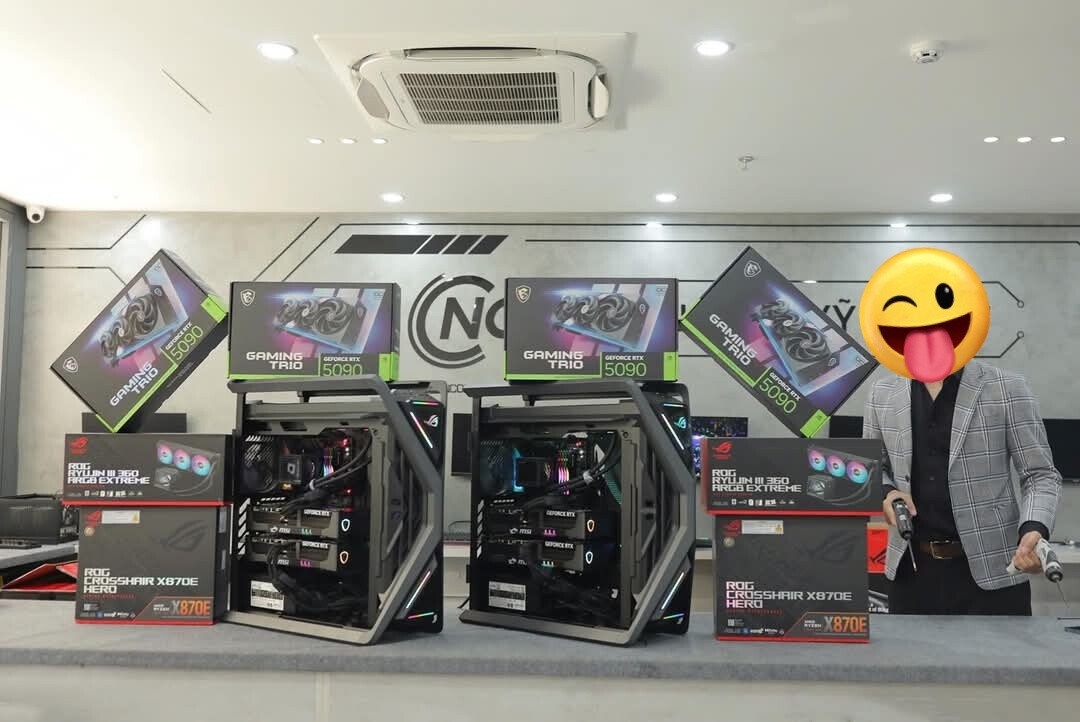
I_Leak_VN, a Vietnamese PC hardware influencer/leaker, reckons that the region's first GeForce RTX 5090 GPU-based "AI/mining/scalper" rig has just emerged. Earlier today, their social media post provided an informative look at a local shop's "Training AI: X7 RTX 5090 32G" build. Apparently, the retail outlet has assembled this monstrous setup for an important customer. A Nguyễn Công PC employee sent personal thanks to GIGABYTE Vietnam; for the supply of seven GeForce RTX 5090 GAMING OC graphics cards. As showcased in uploaded photos (see below), these highly-prized units were placed neatly in a row—as part of an airy open plan system. After inspecting the store's heavily watermarked shots, Western media outlets have (visually) compared the "Training AI: X7" rig to crypto mining builds of a certain vintage.

Tom's Hardware spotted multiple Super Flower Leadex 2000 W PSUs—providing sufficient juice to a system that: "can easily be valued at over $30,000, considering these GPUs go for $3500-$4000 on a good day." Wccftech's report extended coverage to Nguyễn Công PC's other AI offerings; mainly "more traditional" PC builds that utilize dual MSI GeForce RTX 5090 card setups—a "dual rig" likely costs ~$10,000. The shop's selection of gaming-grade hardware is not too surprising, given the performance prowess of NVIDIA's GB202-300-A1 GPU variant. Naturally, Team Green's cutting-edge enterprise hardware unlocks the full potential of "Blackwell" GPU designs—but the company can charge sky-high prices for this level of equipment. Going back to early 2024, Tiny Corp. started to make noise about its "tinybox" AI platform—consisting of multiple XFX Speedster MERC310 RX 7900 XTX cards, rather than AMD's freshly launched Instinct MI300X accelerator.

AMD Instinct GPUs are Ready to Take on Today's Most Demanding AI Models

Customers evaluating AI infrastructure today rely on a combination of industry-standard benchmarks and real-world model performance metrics—such as those from Llama 3.1 405B, DeepSeek-R1, and other leading open-source models—to guide their GPU purchase decisions. At AMD, we believe that delivering value across both dimensions is essential to driving broader AI adoption and real-world deployment at scale. That's why we take a holistic approach—optimizing performance for rigorous industry benchmarks like MLperf while also enabling Day 0 support and rapid tuning for the models most widely used in production by our customers.

This strategy helps ensure AMD Instinct GPUs deliver not only strong, standardized performance, but also high-throughput, scalable AI inferencing across the latest generative and language models used by customers. We will explore how AMD's continued investment in benchmarking, open model enablement, software and ecosystem tools helps unlock greater value for customers—from MLPerf Inference 5.0 results to Llama 3.1 405B and DeepSeek-R1 performance, ROCm software advances, and beyond.

AMD Introduces GAIA - an Open-Source Project That Runs Local LLMs on Ryzen AI NPUs

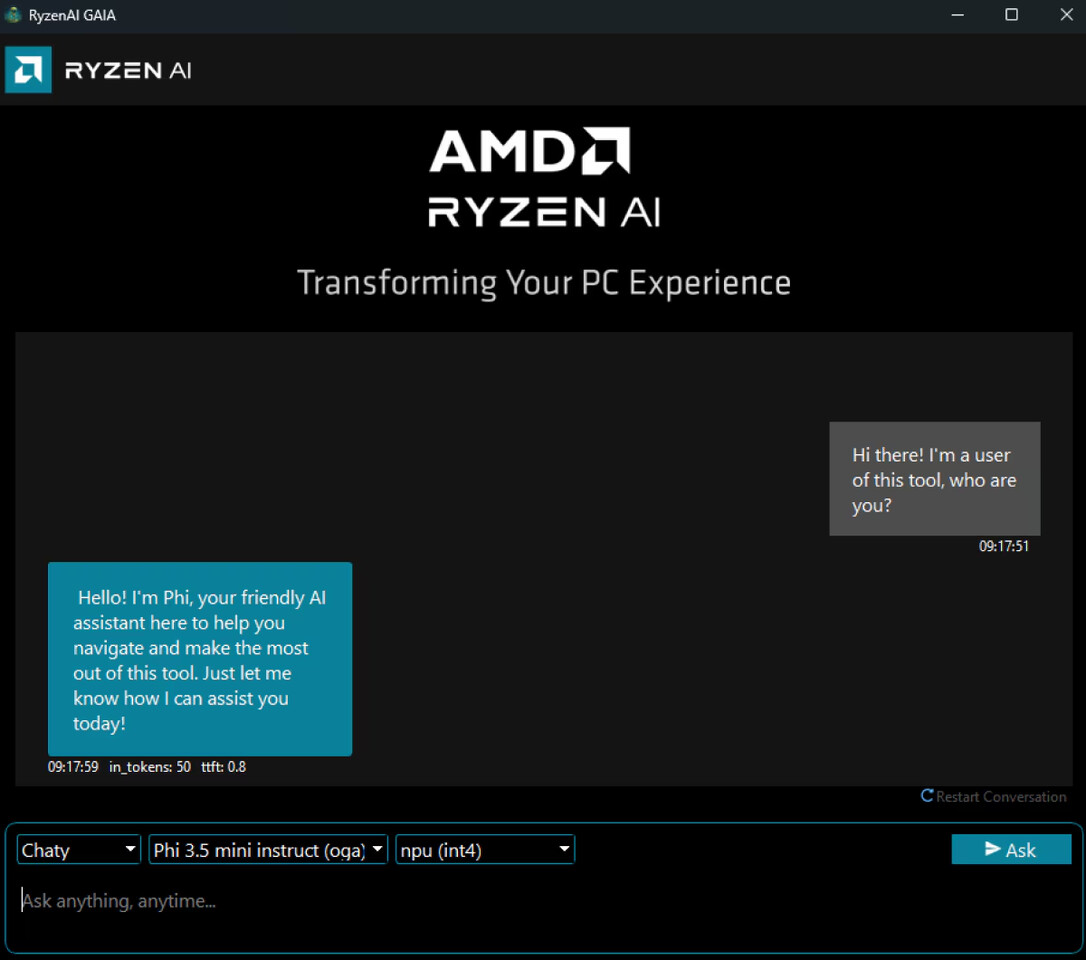
AMD has launched a new open-source project called, GAIA (pronounced /ˈɡaɪ.ə/), an awesome application that leverages the power of Ryzen AI Neural Processing Unit (NPU) to run private and local large language models (LLMs). In this blog, we'll dive into the features and benefits of GAIA, while introducing how you can take advantage of GAIA's open-source project to adopt into your own applications.

Introduction to GAIA
GAIA is a generative AI application designed to run local, private LLMs on Windows PCs and is optimized for AMD Ryzen AI hardware (AMD Ryzen AI 300 Series Processors). This integration allows for faster, more efficient processing - i.e. lower power- while keeping your data local and secure. On Ryzen AI PCs, GAIA interacts with the NPU and iGPU to run models seamlessly by using the open-source Lemonade (LLM-Aid) SDK from ONNX TurnkeyML for LLM inference. GAIA supports a variety of local LLMs optimized to run on Ryzen AI PCs. Popular models like Llama and Phi derivatives can be tailored for different use cases, such as Q&A, summarization, and complex reasoning tasks.

NVIDIA & Storage Industry Leaders Unveil New Class of Enterprise Infrastructure for the AI Era

At GTC 2025, NVIDIA announced the NVIDIA AI Data Platform, a customizable reference design that leading providers are using to build a new class of AI infrastructure for demanding AI inference workloads: enterprise storage platforms with AI query agents fueled by NVIDIA accelerated computing, networking and software. Using the NVIDIA AI Data Platform, NVIDIA-Certified Storage providers can build infrastructure to speed AI reasoning workloads with specialized AI query agents. These agents help businesses generate insights from data in near real time, using NVIDIA AI Enterprise software—including NVIDIA NIM microservices for the new NVIDIA Llama Nemotron models with reasoning capabilities—as well as the new NVIDIA AI-Q Blueprint.

Storage providers can optimize their infrastructure to power these agents with NVIDIA Blackwell GPUs, NVIDIA BlueField DPUs, NVIDIA Spectrum-X networking and the NVIDIA Dynamo open-source inference library. Leading data platform and storage providers—including DDN, Dell Technologies, Hewlett Packard Enterprise, Hitachi Vantara, IBM, NetApp, Nutanix, Pure Storage, VAST Data and WEKA—are collaborating with NVIDIA to create customized AI data platforms that can harness enterprise data to reason and respond to complex queries. "Data is the raw material powering industries in the age of AI," said Jensen Huang, founder and CEO of NVIDIA. "With the world's storage leaders, we're building a new class of enterprise infrastructure that companies need to deploy and scale agentic AI across hybrid data centers."

Tencent Will Launch Hunyuan T1 Inference Model on March 21

Tencent's large language model (LLM) specialist division has announced the imminent launch of their T1 AI inference model. The Chinese technology giant's Hunyuan social media accounts revealed a grand arrival, scheduled to take place on Friday (March 21). A friendly reminder was issued to interested parties, regarding the upcoming broadcast/showcase: "please set aside your valuable time. Let's step into T1 together." Earlier in the week, the Tencent AI team started to tease their "first ultra-large Mamba-powered reasoning model." Local news reports have highlighted Hunyuan's claim of Mamba architecture being applied losslessly to a super-large Mixture of Experts (MoE) model.

Late last month, the company released its Hunyuan Turbo S AI model—advertised as offering faster replies than DeepSeek's R1 system. Tencent's plucky solution has quickly climbed up the Chatbot Arena LLM Leaderboard. The Hunyuan team was in a boastful mood earlier today, and loudly proclaimed that their proprietary Turbo S model had charted in fifteenth place. At the time of writing, DeepSeek R1 is ranked seventh on the leaderboard. As explained by ITHome, this community-driven platform is driven by users interactions: "with multiple models anonymously, voting to decide which model is better, and then generating a ranking list based on the scores. This kind of evaluation is also seen as an arena for big models to compete directly, which is simple and direct."

Supermicro Adds Portfolio for Next Wave of AI with NVIDIA Blackwell Ultra Solutions

Supermicro, Inc., a Total IT Solution Provider for AI, Cloud, Storage, and 5G/Edge, is announcing new systems and rack solutions powered by the NVIDIA's Blackwell Ultra platform, featuring the NVIDIA HGX B300 NVL16 and NVIDIA GB300 NVL72 platforms. Supermicro and NVIDIA's new AI solutions strengthen leadership in AI by delivering breakthrough performance for the most compute-intensive AI workloads, including AI reasoning, agentic AI, and video inference applications.

"At Supermicro, we are excited to continue our long-standing partnership with NVIDIA to bring the latest AI technology to market with the NVIDIA Blackwell Ultra Platforms," said Charles Liang, president and CEO, Supermicro. "Our Data Center Building Block Solutions approach has streamlined the development of new air and liquid-cooled systems, optimized to the thermals and internal topology of the NVIDIA HGX B300 NVL16 and GB300 NVL72. Our advanced liquid-cooling solution delivers exceptional thermal efficiency, operating with 40℃ warm water in our 8-node rack configuration, or 35℃ warm water in double-density 16-node rack configuration, leveraging our latest CDUs. This innovative solution reduces power consumption by up to 40% while conserving water resources, providing both environmental and operational cost benefits for enterprise data centers."

Google Teams up with MediaTek for Next-Generation TPU v7 Design

According to Reuters, citing The Information, Google will collaborate with MediaTek to develop its seventh-generation Tensor Processing Unit (TPU), which is also known as TPU v7. Google maintains its existing partnership with Broadcom despite the new MediaTek collaboration. The AI accelerator is scheduled for production in 2026, and TSMC is handling manufacturing duties. Google will lead the core architecture design while MediaTek manages I/O and peripheral components, as Economic Daily News reports. This differs from Google's ongoing relationship with Broadcom, which co-develops core TPU architecture. The MediaTek partnership reportedly stems from the company's strong TSMC relationship and lower costs compared to Broadcom.

There is also a possibility that MediaTek could design inference-focused TPU v7 chips while Broadcom focuses on training architecture. Nonetheless, the development of TPU is a massive market as Google is using so many chips that it could use a third company, hypothetically. The development of TPU continues Google's vertical integration strategy for AI infrastructure. Google reduces dependency on NVIDIA hardware by designing proprietary AI chips for internal R&D and cloud operations. At the same time, competitors like OpenAI, Anthropic, and Meta rely heavily on NVIDIA's processors for AI training and inference. At Google's scale, serving billions of queries a day, designing custom chips makes sense from both financial and technological sides. As Google develops its own specific workloads, translating that into hardware acceleration is the game that Google has been playing for years now.

MSI IPC Introduces High-Performance ATX Motherboard MS-CF05, V2.0 for Industrial and Embedded Applications

MSI IPC, a global leader in industrial computing solutions, proudly unveils the MS-CF05, V2.0, a high-performance ATX motherboard engineered for industrial automation, edge computing, and embedded applications. Designed to support 14th, 13th, and 12th Gen Intel Core, Pentium, and Celeron processors, the MS-CF05, V2.0 delivers exceptional computing power, scalability, and I/O flexibility, including a PCI slot for legacy support, making it ideal for modern industrial needs.

AMD Recommends EPYC Processors for Everyday AI Server Tasks

Ask a typical IT professional today whether they're leveraging AI, and there's a good chance they'll say yes-after all, they have reputations to protect! Kidding aside, many will report that their teams may use Web-based tools like ChatGPT or even have internal chatbots that serve their employee base on their intranet, but for that not much AI is really being implemented at the infrastructure level. As it turns out, the true answer is a bit different. AI tools and techniques have embedded themselves firmly into standard enterprise workloads and are a more common, everyday phenomena than even many IT people may realize. Assembly line operations now include computer vision-powered inspections. Supply chains use AI for demand forecasting making business move faster and of course, AI note-taking and meeting summary is embedded on virtually all the variants of collaboration and meeting software.

Increasingly, critical enterprise software tools incorporate built-in recommendation systems, virtual agents or some other form of AI-enabled assistance. AI is truly becoming a pervasive, complementary tool for everyday business. At the same time, today's enterprises are navigating a hybrid landscape where traditional, mission-critical workloads coexist with innovative AI-driven tasks. This "mixed enterprise and AI" workload environment calls for infrastructure that can handle both types of processing seamlessly. Robust, general-purpose CPUs like the AMD EPYC processors are designed to be powerful and secure and flexible to address this need. They handle everyday tasks—running databases, web servers, ERP systems—and offer strong security features crucial for enterprise operations augmented with AI workloads. In essence, modern enterprise infrastructure is about creating a balanced ecosystem. AMD EPYC CPUs play a pivotal role in creating this balance, delivering high performance, efficiency, and security features that underpin both traditional enterprise workloads and advanced AI operations.

Meta Reportedly Reaches Test Phase with First In-house AI Training Chip

According to a Reuters technology report, Meta's engineering department is engaged in the testing of their "first in-house chip for training artificial intelligence systems." Two inside sources have declared this significant development milestone; involving a small-scale deployment of early samples. The owner of Facebook could ramp up production, upon initial batches passing muster. Despite a recent-ish showcasing of an open-architecture NVIDIA "Blackwell" GB200 system for enterprise, Meta leadership is reported to be pursuing proprietary solutions. Multiple big players—in the field of artificial intelligence—are attempting to breakaway from a total reliance on Team Green. Last month, press outlets concentrated on OpenAI's alleged finalization of an in-house design, with rumored involvement coming from Broadcom and TSMC.

One of the Reuters industry moles believes that Meta has signed up with TSMC—supposedly, the Taiwanese foundry was responsible for the production of test batches. Tom's Hardware reckons that Meta and Broadcom were working together with the tape out of the social media giant's "first AI training accelerator." Development of the company's "Meta Training and Inference Accelerator" (MTIA) series has stretched back a couple of years—according to Reuters, this multi-part project: "had a wobbly start for years, and at one point scrapped a chip at a similar phase of development...Meta last year, started using an MTIA chip to perform inference, or the process involved in running an AI system as users interact with it, for the recommendation systems that determine which content shows up on Facebook and Instagram news feeds." Leadership is reportedly aiming to get custom silicon solutions up and running for AI training by next year. Past examples of MTIA hardware were deployed with open-source RISC-V cores (for inference tasks), but is not clear whether this architecture will form the basis of Meta's latest AI chip design.

SOPHGO Unveils New Products at the 2025 China RISC-V Ecosystem Conference

On February 27-28, the 2025 China RISC-V Ecosystem Conference was grandly held at the Zhongguancun International Innovation Center in Beijing. As a core promoter in the RISC-V field, SOPHGO was invited to deliver a speech and prominently launch a series of new products based on the SG2044 chip, sharing the company's cutting-edge practices in the heterogeneous fusion of AI and RISC-V, and contributing to the vigorous development of the global open-source instruction set ecosystem. During the conference, SOPHGO set up a distinctive exhibition area that attracted many attendees from the industry to stop and watch.

Focusing on AI Integration, Leading Breakthroughs in RISC-V Technology
At the main forum of the conference, the Vice President of SOPHGO RISC-V delivered a speech titled "RISC-V Breakthroughs Driven by AI: Integration + Heterogeneous Innovation," where he elaborated on SOPHGO's innovative achievements in the deep integration of RISC-V architecture and artificial intelligence technology. He pointed out that current AI technological innovations are driving market changes, and the emergence of DeepSeek has ignited a trillion-level computing power market. The innovation of technical paradigms and the penetration of large models into various sectors will lead to an explosive growth in inference demand, resulting in changes in the structure of computing power demand. This will also reshape the landscape of the computing power market, bringing significant business opportunities to domestic computing power enterprises, while RISC-V high-performance computing is entering a fast track of development driven by AI.

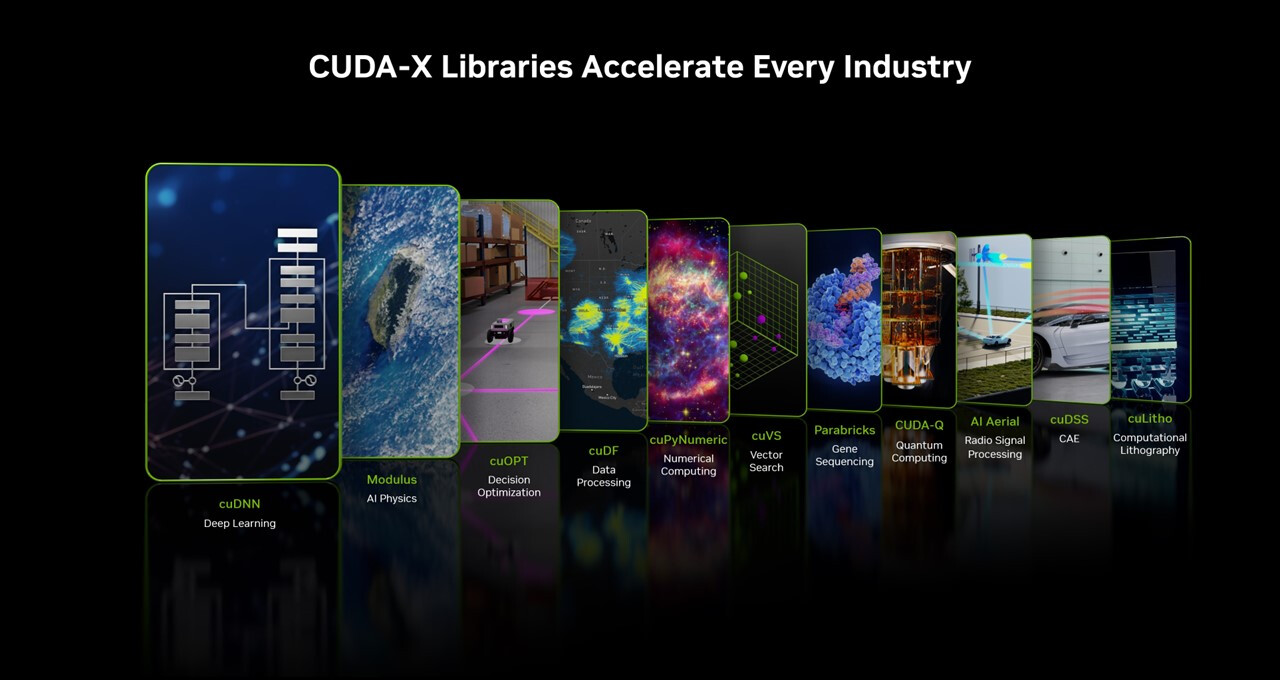
NVIDIA Explains How CUDA Libraries Bolster Cybersecurity With AI

Traditional cybersecurity measures are proving insufficient for addressing emerging cyber threats such as malware, ransomware, phishing and data access attacks. Moreover, future quantum computers pose a security risk to today's data through "harvest now, decrypt later" attack strategies. Cybersecurity technology powered by NVIDIA accelerated computing and high-speed networking is transforming the way organizations protect their data, systems and operations. These advanced technologies not only enhance security but also drive operational efficiency, scalability and business growth.

Accelerated AI-Powered Cybersecurity
Modern cybersecurity relies heavily on AI for predictive analytics and automated threat mitigation. NVIDIA GPUs are essential for training and deploying AI models due to their exceptional computational power.

Advantech Unveils New AI, Industrial and Network Edge Servers Powered by Intel Xeon 6 Processors

Advantech, a global leader in industrial and embedded computing, today announced the launch of seven new server platforms built on Intel Xeon 6 processors, optimized for industrial, transportation and communications applications. Designed to meet the increasing demands of complex AI storage and networking workloads, these innovative edge servers and network appliances provide superior performance, reliability, and scalability for system integrators, solutions, and service provider customers.

Intel Xeon 6 - Exceptional Performance for the Widest Range of Workloads
Intel Xeon 6 processors feature advanced performance and efficiency cores, delivering up to 86 cores per CPU, DDR5 memory support with speeds up to 6400 MT/s, and PCIe Gen 5 lanes for high-speed connectivity. Designed to optimize both compute-intensive and scale-out workloads, these processors ensure seamless integration across a wide array of applications.

MSI Announces New Server Platforms Supporting Intel Xeon 6 Family of Processors

MSI introduces new server platforms powered by the latest Intel Xeon 6 family of processors with the Performance Cores (P-Cores). Engineered for high-density performance, seamless scalability, and energy-efficient operations, these servers deliver exceptional throughput, dynamic workload flexibility, and optimized power efficiency. Optimized for AI-driven applications, modern data centers, and cloud-native workloads, MSI's new platforms help lower total cost of ownership (TCO) while maximizing infrastructure efficiency and resource optimization.

"As data-driven transformation accelerates across industries, businesses require solutions that not only deliver performance but also enable sustainable growth and operational agility," said Danny Hsu, General Manager of MSI's Enterprise Platform Solutions. "Our Intel Xeon 6 processor-based servers are designed to support this shift by offering high-core scalability, energy-efficient performance, and dynamic workload optimization. These capabilities empower organizations to maximize compute density, streamline their digital ecosystems, and respond to evolving market demands with greater speed and efficiency."

OnLogic Reveals the Axial AX300 Edge Server

OnLogic, a leading provider of edge computing solutions, has launched the Axial AX300, a highly customizable and powerful edge server. The AX300 is engineered to help businesses of any size better leverage their on-site data and unlock the potential of AI by placing powerful computing capabilities on-site.

The Axial AX300 empowers organizations to seamlessly move computing resources closer to the data source, providing significant advantages in performance, latency, operational efficiency, and total cost of ownership over cloud-based data management. With its robust design, flexible configuration options, and advanced security features, the Axial AX300 is the ideal platform for a wide range of highly-impactful edge computing applications, including:
  • AI/ML inference and training: Leveraging the power of AI/ML at the edge for real-time insights, predictive maintenance, and improved decision-making.
  • Data analytics: Processing and analyzing data generated by IoT devices and sensors in real-time to improve operational efficiency.
  • Virtualization: Consolidating multiple workloads onto a single server, optimizing resource utilization and simplifying deployment and management.
Return to Keyword Browsing
Nov 28th, 2026 07:23 CST change timezone

New Forum Posts

Popular Reviews

TPU on YouTube

Controversial News Posts