News Posts matching #inference

Return to Keyword Browsing

AI-Fueled Supercycle Propels Memory Market Revenue to More Than Twice That of Foundry Industry

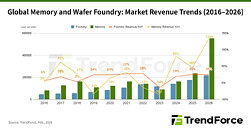
The current AI surge is anticipated to boost both the memory and wafer foundry sectors to record-breaking revenues by 2026, based on TrendForce's recent data. Limited supply and rapidly increasing prices are likely to grow the memory market's total worth to $551.6 billion. Meanwhile, the global foundry market is also expected to reach a new peak of $218.7 billion, but the memory industry's scale will have more than doubled that of wafer foundries.

A new memory supercycle: Demand resilience and pricing power far stronger than in 2017
The previous memory supercycle from 2017 to 2019 was primarily driven by cloud data center expansions and resulted in a significant gap between memory and foundry revenues.
M5Stack Releases AI Pyramid Edge AI PC for Developers

Chinese firm M5Stack has released its new AI Pyramid series, a small-form-factor edge AI PC aimed at developers and makers working with local inference workloads that stands out with its unique pyramid shape design. The lineup consists of two variants: AI Pyramid and AI Pyramid-Pro. Both models are built around the Axera AX8850 SoC, which combines an octa-core Arm Cortex-A55 CPU running at up to 1.7 GHz with a 24 TOPS INT8 NPU. The platform targets fully local AI processing, covering use cases such as computer vision, multimodal input, and on-device model inference, without depending on cloud acceleration.

Memory configurations differ between the two versions, with the standard AI Pyramid shipping with 4 GB of LPDDR4x, while the Pro model offers 8 GB. Storage is provided by 32 GB of onboard eMMC. The AX8850 supports hardware-accelerated H.264 and H.265 encoding and decoding at resolutions up to 8K at 30 FPS, as well as up to 16 concurrent 1080p decode streams. The specs are completed with dual Gigabit Ethernet and USB 3.0 ports, HDMI output, with the AI Pyramid-Pro adding HDMI input support. The device also integrates onboard audio hardware, an OLED status display, RGB lighting, and an active cooling solution. Pricing starts at $199 for the 4 GB AI Pyramid Computing Box, with the 8 GB Pro variant listed at $249 on the M5Stack website.

Arm Delivers Fourth Consecutive Billion-Dollar Revenue Quarter

Today (Feb. 4, 2026) Arm (NASDAQ: ARM) published a letter to its shareholders containing the company's results for the third quarter of fiscal year 2026 ended December 31, 2025. The infographic below provides the key highlights:

Here are what the results mean and how they were achieved:
  • Revenue grew 26% year-on-year to $1.24 billion, representing Arm's fourth consecutive billion-dollar revenue quarter.
  • Royalty revenue grew 27% year-over-year to a record $737 million, driven by growth across Arm's target end markets, including AI and general-purpose data center, smartphones, physical AI and edge AI.
  • License and other revenue of $505 million increased 25% year-over-year, as more leading companies sign high-value licenses for next-generation Arm technologies.
  • Demand for Arm Compute Subsystems (CSS) continues to exceed expectations as adoption grows in light of increasingly complex chip designs. This represents a significant tailwind to royalty growth, as Arm expands both the value delivered and economics captured per chip.
    • During the quarter, Arm signed two CSS licenses for use in both edge AI tablets and smartphones, bringing the total number of CSS licenses to 21 across 12 companies.
    • Additionally, five customers are now shipping Arm CSS-based chips, including two shipping its second-generation platform, while the top four Android smartphone vendors are all shipping Arm CSS-powered devices.

Arm Flexible Access Helps Startups Build Chips Faster

Arm Flexible Access is evolving, unlocking broader startup eligibility, expanded edge AI capabilities, and a more flexible way to design, test, and bring silicon to market. Innovation in silicon design thrives on iteration. For startups and established design teams alike, the ability to explore, test, and refine without financial friction is essential. That's why Arm Flexible Access is evolving to make that journey even easier.

Arm Flexible Access already offers up-front, low-cost or no-cost access to a wide portfolio of Arm technology, tools, and training. This "try before you buy" model allows teams to build and test designs freely, only paying licensing fees for the technologies used in production silicon. It's helped launch over 400 chips across more than 100 companies.

Qualcomm and AMD to Adopt SOCAMM2 Memory in AI Products

Qualcomm and AMD are reportedly considering the integration of SOCAMM2 memory into their AI product lines to enhance memory capacity and speed. Following NVIDIA's "Vera" CPU, which features LPDDR5X memory on the SOCAMM factor, offering 1.2 TB/s of memory bandwidth and supporting up to 1.5 TB of LPDDR5X memory, Qualcomm and AMD aim to pursue a similar strategy to achieve high-speed, high-capacity AI systems. These systems require fast memory close to AI accelerators, and SOCAMM can complement the extensive HBM memory on the accelerators. It acts as a fast memory pool with sufficient capacity to store entire models in memory, reducing the need for data transfer to SSD flash storage.

NVIDIA's SOCAMM approach involves surrounding the CPU with multiple SOCAMM modules, a strategy Qualcomm and AMD are expected to adopt in their AI solutions. AMD's Instinct MI accelerators, paired with EPYC CPUs, might be the next candidates for this integration, or AMD may develop a completely new system. Qualcomm already offers AI solutions like the AI200 and AI250 inference accelerators, which include up to 768 GB of LPDDR5 per card. These could soon be complemented by SOCAMM, allowing for standardized memory expansion based on the SOCAMM standard rather than soldering individual memory modules. This approach would enable manufacturers to offer various system versions and solutions by simply adding or removing SOCAMM modules, without the need for extensive PCB soldering work.

AMD AI Group Introduces Ryzen AI Software 1.7 Release

Ryzen AI Software 1.7 release introduces several updates aimed at improving model coverage, reducing friction in local development workflows, and delivering more predictable performance on AMD Application Processing Units (NPU + iGPU). This release adds new architecture support, expands context length for LLMs, integrates Stable Diffusion into the unified Ryzen AI installer, and improves BF16 inference latency.

NVIDIA & CoreWeave's Strengthened Collab to Accelerate Buildout of AI Factories

NVIDIA and CoreWeave, Inc. today announced an expansion of their long-standing complementary relationship to enable CoreWeave to accelerate the buildout of more than 5 gigawatts of AI factories by 2030 to advance AI adoption at global scale. In addition, NVIDIA has invested $2 billion in CoreWeave Class A common stock at a purchase price of $87.20 per share. The investment reflects NVIDIA's confidence in CoreWeave's business, team and growth strategy as a cloud platform built on NVIDIA infrastructure.

"AI is entering its next frontier and driving the largest infrastructure buildout in human history," said Jensen Huang, founder and CEO of NVIDIA. "CoreWeave's deep AI factory expertise, platform software and unmatched execution velocity are recognized across the industry. Together, we're racing to meet extraordinary demand for NVIDIA AI factories—the foundation of the AI industrial revolution."

AMD Intros ROCm v7.2 - Smarter, Faster, & More Scalable for Modern AI Workloads

Modern AI workloads demand more than raw compute—they require a tightly integrated software stack that can extract maximum performance, scale efficiently across systems, and operate reliably in production environments. With the latest ROCm 7.2 release, we're delivering a broad set of optimizations and software enhancements designed to improve developer productivity, runtime performance, and enterprise readiness.

In this blog, we highlight the latest ROCm 7.2 enhancements for AMD Instinct GPUs, designed to boost AI and HPC performance. Learn how hipBLASLt and GEMM optimizations, FP8/FP4 support in rocMLIR and MIGraphX, and topology-aware communication with GDA and RCCL deliver higher throughput and lower latency. We also cover AI model tuning for AMD Instinct MI300X and MI350 GPUs and Node Power Management (NPM) for efficient multi-GPU operation—together enabling faster, more scalable, and reliable AI workloads.

AI Architecture Evolution Set to Drive Memory Market Revenue to a New Peak in 2027, with Annual Growth Exceeding 50%

TrendForce's latest research indicates that AI innovation is causing a fundamental shift in the memory market. As data access volumes continue to grow, AI systems depend more on high-bandwidth, high-capacity, low-latency DRAM to handle large-scale model parameters, long-sequence inference, and multi-task parallel processing. Additionally, NAND Flash has become essential for fast data transfer, making memory a key component in AI infrastructure and a strategic focus for CSPs.

Memory prices have continuously increased due to limited capacity and rising demand for allocations, pushing industry revenue to new record levels. TrendForce projects the memory market to be worth $551.6 billion in 2026 and to surge to a peak of $842.7 billion in 2027, reflecting a 53% YoY growth.

Corvex Secures Long-Term NVIDIA H200 GPU Deployment

Corvex, Inc., an AI cloud computing company specializing in GPU-accelerated infrastructure for AI workloads, today announced a long-term GPU lease agreement with an established AI-driven provider of high-performance battery technologies. The deployment, a dedicated cluster of NVIDIA H200 GPUs, will underpin the customer's core AI development and research initiatives, including proprietary algorithms. The customer selected Corvex for its superior overall value, confidential AI enablement to unlock market expansion, and hyperscaler-class operations as compared to alternative AI cloud infrastructure providers.

Corvex's architecture of GPU clusters will provide the customer with high price-performance by maximizing compute density while maintaining elasticity and allowing flexibility for burst capacity during peak demand periods. Corvex is also enabling the customer to extend its enterprise AI offerings into the most security-conscious environments through a secure, managed on-premise solution. By architecting next-generation on-premise GPU clusters with hardware-enforced encryption, remote attestation, and payload-free telemetry, Corvex's technology allows the customer to run sensitive model training and production inference workloads while meeting strict data-sovereignty, compliance, and IP-protection requirements, and to expand its market to enterprise customers that cannot be served by public cloud infrastructure.

Sparkle Launches Intel Arc Pro B60 24 GB Blower and 48 GB Passive GPUs

SPARKLE, a leading manufacturer of AI computing platforms and professional graphics solutions, today announced the launch of the SPARKLE Intel Arc Pro B60 Series graphics cards on January 12, 2026. The initial release introduces the Arc Pro B60 24 GB Blower Edition, delivering stable and efficient performance for professional workstations and AI inference workloads. In parallel, the Arc Pro B60 Passive 24 GB and Passive 48 GB models are also introduced, targeting industrial, server, and enterprise project-based deployments.

Following the launch on January 12, 2026, the SPARKLE Intel Arc Pro B60 24 GB Blower Edition is planned to be introduced through select retail partners, including Micro Center and Newegg. Product availability will vary by region and channel, subject to local distribution schedules. Designed for modern AI and professional applications, the Intel Arc Pro B60 Series supports up to 48 GB of GDDR6 memory (Passive Edition), 456 GB/s memory bandwidth, and 160 XMX AI engines, enabling reliable performance for LLM inference, 3D modeling, engineering visualization, and high-resolution content creation.

Global AI Server Shipments Forecast to Grow Over 28% YoY in 2026, with a Rising Share of ASIC-Based Systems

North American CSPs' continued investments in AI infrastructure are expected to increase global AI server shipments by more than 28% YoY in 2026, according to the latest market research from TrendForce. The rapid growth of AI inference services is boosting demand for general-purpose servers, supporting both replacement and expansion efforts. Consequently, TrendForce predicts that total global server shipments, including AI servers, will accelerate from 2025, with a 12.8% YoY growth in 2026.

The server market from 2024 to 2025 primarily centered on training advanced large language models (LLMs), utilizing AI servers with GPUs and HBM for parallel computing. However, starting in the second half of 2025, the growth of AI agents, LLaMA-based applications, and Copilot upgrades shifted CSP's focus toward inference services as a monetization strategy. AI inference workloads are now deployed not only on dedicated AI server racks but also on general-purpose servers that handle pre- and post-inference computing and storage.

Quadric Inference Engine Attracts $30 million Series C Funding

Quadric, the inference engine that powers on-device AI chips, today announced an oversubscribed $30 million Series C funding round, bringing total capital raised to $72 million. ACCELERATE Fund, managed by BEENEXT Capital Management, led the round. Uncork Capital returned with one of the largest insider commitments through its opportunity fund, joined by insider Pear VC. New investors include Volta, Gentree, Wanxiang America, Pivotal, and Silicon Catalyst Ventures. The funding comes as Quadric hits a revenue inflection: product revenues more than tripled in 2025 vs. 2024. Quadric is entering 2026 with accelerating design-win momentum, driven by growing adoption of the General Purpose NPU (GPNPU) processor IP across edge LLM, automotive, and enterprise vision applications.

"We've been deeply impressed by Quadric's innovative architecture, its disruptive approach to AI inference at the edge, and their strong market traction particularly in Asian markets," said Hero Choudhary, Managing Partner at BEENEXT. "Those attributes indicate a very clear path for further growth with a strong potential to be a generational business. We believe Quadric is poised to revolutionize the edge AI hardware sector, and we look forward to supporting their journey as they continue to push the boundaries of what is possible."

Infortrend Launches Edge AI Server, Bringing AI to The Edge Without Complex Setup

Infortrend Technology, Inc., a leading provider of enterprise storage and AI solutions, today announced the launch of the KS 3000U edge AI server. The platform enables mid-sized organizations and distributed sites to deploy AI inference at the edge with high availability and simplified setup.

While AI workloads move closer to where data is generated, organizations that continue to rely on cloud services face challenges, including latency, high operational costs, and data privacy. According to IDC, by 2030, 50% of enterprise AI inference workloads will be processed locally at the edge. For companies with limited on-site IT resources, this shift highlights the need for reliable, easy-to-deploy on-site edge AI infrastructure.

AMD Details Single Node & Distributed Inference Performance on Instinct MI355X GPU

The rapid growth of GenAI and LLM workloads, from agentic workflows and multi-step tool use to retrieval-augmented reasoning, demands inference infrastructure that is fast, adaptable, and highly optimized. While AMD continues to invest in general-purpose inference frameworks such as vLLM and SGLang, ATOM provides the most direct path to peak Instinct MI355X GPU performance for modern reasoning and MoE-heavy workloads, which increasingly dominate frontier LLM architectures.

Over the past months, AMD have implemented numerous optimizations to improve both single-node performance and multi-node distributed inference for DeepSeek-R1 on the MI355X GPU.

Infortrend Unveils Its Most Advanced U.2 NVMe SSD Storage Solution

Infortrend Technology, Inc. (TWSE: 2495), a leading provider of enterprise storage and AI solutions, today announced the launch of EonStor GS 5024U, its highest-performing storage system to date. It delivers exceptional performance, reliability, and scalability, effectively meeting the growing demands of AI workloads—from model training and inference to real-time analytics.

EonStor GS 5024U, the new flagship of EonStor GS unified storage family, is powered by Intel Xeon 6 processor and delivers 125 GB/s throughput, which is 2.5× higher than the previous highest-performing model, and 2.4 million IOPS. Enhanced with PCIe 5.0 SSDs support, the system is engineered for next-level speed and responsiveness. To address the increasing demand for ultra-fast data transfers, the solution integrates 200GbE and NVMe-oF high-speed networking technologies. It also features GPUDirect Storage technology, helping maximize GPU utilization. With support for parallel file systems such as Lustre, GS 5024U can easily deliver hundreds of gigabytes of throughput, which makes it an ideal fit for AI workloads.

ASUS Showcases ExpertCenter Pro ET900N G3 at CES 2026

ASUS today announced the showcase of ExpertCenter Pro ET900N G3 at CES 2026, underscoring its commitment to delivering enterprise-grade AI infrastructure in accessible, deskside form factors. The all-new ET900N G3—accelerated by the NVIDIA GB300 Grace Blackwell Ultra Desktop Platform—sets a new standard for deskside AI supercomputers, combining extreme performance, unified memory architecture, and data-center-class connectivity.

Solving the last-mile challenge of modern AI development
AI development has reached extraordinary heights through massive cloud and data-center infrastructure, yet many researchers, developers, and data scientists still face a 'last-mile' challenge. While cloud services offer immense scale, countless workflows require local, private, and immediate compute power—especially for training, fine-tuning, or running large AI models that exceed the limits of traditional workstations. What these professionals need is a system that delivers data-center-class performance in a familiar, easily deployable deskside form factor.

4K AI Video Generation Accelerated by NVIDIA RTX with LTX-2 and ComfyUI Upgrades

2025 marked a breakout year for AI development on PC. PC-class small language models (SLMs) improved accuracy by nearly 2x over 2024, dramatically closing the gap with frontier cloud-based large language models (LLMs). AI PC developer tools including Ollama, ComfyUI, llama.cpp and Unsloth have matured, their popularity has doubled year over year and the number of users downloading PC-class models grew tenfold from 2024.

These developments are paving the way for generative AI to gain widespread adoption among everyday PC creators, gamers and productivity users this year. At CES this week, NVIDIA has announced a wave of AI upgrades for GeForce RTX, NVIDIA RTX PRO and NVIDIA DGX Spark devices that unlock the performance and memory needed for developers to deploy generative AI on PC.

Broadcom Launches Unified Wi-Fi 8 Platform for Seamless AI Experiences in Homes

Broadcom Inc., a global leader in semiconductor and infrastructure software solutions, today announced the launch of its next-generation BCM4918 accelerated processing unit (APU) and two new dual-band Wi-Fi 8 devices, the BCM6714 and BCM6719, marking another milestone in its long legacy of Wi-Fi innovation. With the combination of higher throughput plus smart intelligence, Broadcom's unified Wi-Fi 8 platform allows operators to deliver new real-time agentic applications for residential consumers with built-in security and improved power efficiency.

Building on its first-to-market BCM6718 Wi-Fi 8 chipset, Broadcom continues to lead the industry in defining the next generation of wireless performance, intelligence, and efficiency. The new platform combines compute acceleration, advanced networking, and robust security, delivering the high throughput, low latency, and intelligent optimization needed for the emerging AI-driven connected ecosystem.

MSI Shows Off New AI Mini-PCs with Intel, AMD, and NVIDIA DGX Spark Platform

MSI has officially unveiled the specifications of its new AI-centric mini PC line-up that is being debuted at CES 2026. The new line-up offers something for everyone—as long as you're looking to run local LLMs or similar AI workloads—whether you're looking for a hyper-compact x86 system powered by AMD's RDNA 3.5, a more powerful NVIDIA RTX 5070, or something more exotic with NVIDIA's new Arm-based DGX Spark platform.

Perhaps the most interesting mini PC that MSI is showing off at CES is the EdgeXpert, which is targeted at AI developers and is built on NVIDIA's DGX Spark platform. In the EdgeXpert, which was announced earlier this year, that means 20 Arm CPU cores and an AI Blackwell GPU as well as NVIDIA's NVLink C2C tech, which claims to offer "five times the bandwidth of PCIe 5.0," for improved data transfer and sharing between the CPU and GPU. According to MSI, the EdgeXpert is capable of a petaFLOP of AI performance. It also features 128 GB of LPDDR5x unified system memory and a vapor chamber cooling system.

Origin PC Introduces the S-Class Edge AI Developer Kit

ORIGIN PC today revealed the S-Class Edge AI, a compact and turnkey developer kit built around the NVIDIA Jetson Orin NX 16 GB Super. The platform is designed for developers, researchers, and integrators who need a ready-to-use environment for robotics, computer vision, and edge AI workloads. It delivers up to 157 TOPS of performance and allows users to move from unboxing to real-time inference within minutes. S-Class Edge AI represents a new step in ORIGIN PC's expansion into advanced edge computing solutions.

A Compact and Developer Focused Form Factor
The S-Class Edge AI features a small enclosure that fits easily on a desk, lab bench, or classroom workstation. Front and rear ports include USB 3.2, USB Type C OTG, HDMI 2.0, audio I/O, DC power, and dual Ethernet connectivity. This layout supports peripherals, displays, and robotics equipment and allows developers to begin testing immediately. The thermally optimized chassis supports stable operation during extended workloads. The compact footprint reinforces the platform's role as a lab-friendly and classroom-friendly solution that provides workstation level capability without taking up significant space.

Memory Makers Prioritize Server Applications, Driving Across-the-Board Price Increases in 1Q26

TrendForce's latest investigations indicate that DRAM suppliers in 1Q26 will continue to reallocate advanced process nodes and new capacity toward server and HBM products to support rising AI server demand. This shift has significantly limited supply in other markets, causing conventional DRAM contract prices to increase by about 55-60% QoQ. Meanwhile, disciplined capacity management by NAND Flash suppliers, along with robust server demand that is displacing other applications, is likely to increase contract prices across all NAND Flash product categories by 33-38%.

Despite weaker notebook shipments and slower growth in memory demand due to potential specification downgrades, PC DRAM prices are still set to rise sharply in the first quarter. DRAM suppliers have simultaneously tightened supply to PC OEMs and module makers, forcing some OEMs to procure memory at higher prices through modules makers. This is expected to raise DRAM suppliers' module pricing and significantly drive up PC DRAM prices.

Apple's "Baltra" AI Chip Reportedly Launching in 2027, Could be Inference-only Design

About a year ago, industry insiders let slip early details regarding Apple's mysterious "Baltra" AI chip. At the time, Broadcom was reportedly assisting with the design's network technology. In addition, the "Baltra" project was linked to TSMC 3 nm N3E or N3P node processes. Recent leaks suggest an adjusted gestation schedule; instead of a predicted start of "mass production by 2026," timelines seem to be extended by another year. The reasons behind this rumored delay are not clear, but the North American giant has—officially, as of October 2025—bolstered its Apple Intelligence and Private Cloud Compute-oriented data centers with US-made advanced server equipment, likely running on familiar M2 Ultra processors. Industry moles reckon that M4-based variants are being readied for distribution.

Apple's futuristic in-house "Baltra" AI setup is expected to be inference-oriented, as predicted by Max Weinbach. The tech industry analyst imagined: "basically, I doubt they'll do a massive cluster, but maybe something closer to a GB300 style, with ~64 chips all to all with larger high bandwidth LPDDR memory. Should be significantly cheaper than most current chips, and match the needs." Last month, Mark Gurman claimed that Apple had signed up for a custom Google Gemini-powered LLM. The notorious tipster believes that the claimed $1 billion per year deal will drive next-gen personalized Siri and AI web search functions. As mentioned before, Apple's in-progress "Baltra" data center chip could be designed for efficiency and cost-effectiveness, rather than the raw processing power required for training.

NVIDIA Debuts Nemotron 3 Family of Open Models

NVIDIA today announced the NVIDIA Nemotron 3 family of open models, data and libraries designed to power transparent, efficient and specialized agentic AI development across industries. The Nemotron 3 models—with Nano, Super and Ultra sizes—introduce a breakthrough hybrid latent mixture-of-experts (MoE) architecture that helps developers build and deploy reliable multi-agent systems at scale.

As organizations shift from single-model chatbots to collaborative multi-agent AI systems, developers face mounting challenges, including communication overhead, context drift and high inference costs. In addition, developers require transparency to trust the models that will automate their complex workflows. Nemotron 3 directly addresses these challenges, delivering the performance and openness customers need to build specialized, agentic AI.

Intel to Acquire SambaNova AI Chip Startup

According to sources close to Wired, Intel has signed a new agreement with SambaNova, an AI chip startup, to acquire the company under undisclosed terms. The signed term sheet is non-binding, meaning it can be canceled under any condition, and a final deal has not yet been reached. Intel's current CEO, Lip-Bu Tan, has been serving as chairman of the board for SambaNova Systems, effectively giving him insider knowledge of the company's operations. The company has raised a total of $1.14 billion in funding as of early 2025, meaning that a lot of investors have shown confidence into its technology.

SambaNova develops AI chips based on its Reconfigurable Dataflow Unit (RDU), which takes a novel approach to enable trillion-parameter inference on its SambaRack rack-scale solutions. The latest 4th generation RDU features 1,040 RDU cores, 653 TeraFLOPS of BF16 (similar to FP16) compute, 520 MB of on-chip memory, 64 GB of HBM3, and is paired with a 1.5 TB external DDR memory pool to accommodate large language models for inference. Since it is a private company, we don't have sales figures officially published anywhere.

December 13, 20:35 UTC: Bloomberg reports that the deal is worth about $1.6 billion, including debt. Additionally, the deal is reportedly nearing its final stages.
Return to Keyword Browsing
Nov 28th, 2026 07:23 CST change timezone

New Forum Posts

Popular Reviews

TPU on YouTube

Controversial News Posts