News Posts matching #inference

Return to Keyword Browsing

Rebellions and Red Hat Introduce Red Hat OpenShift AI Powered by Rebellions NPUs

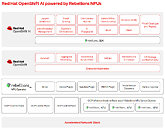
Rebellions and Red Hat, the world's leading provider of open source solutions, today announced Red Hat OpenShift AI powered by Rebellions neural processing units (NPUs), integrating Red Hat's scalable, flexible and open source AI inference capabilities with Rebellions' energy-efficient NPUs to deliver a validated full-stack enterprise AI platform. This collaboration fully supports Red Hat's goal to deliver "any model, any accelerator, any cloud" to customers globally by enabling more choice and optionality in the architectures underpinning AI workloads.

As organizations move AI initiatives into actual business use cases, challenges such as infrastructure costs, deployment complexity, and the need for flexible environments with enhanced security footprints are becoming more prominent. GPU-centric environments on their own can be insufficient to meet the performance and efficiency demands at scale. Red Hat OpenShift AI powered by Rebellions NPUs addresses these challenges by enabling organizations to operate AI workloads more efficiently across environments.

Just Launched OpenAI GPT-5.2 Trained & Deployed on NVIDIA Infrastructure

Unveiling what it describes as the most capable model series yet for professional knowledge work, OpenAI launched GPT-5.2 today. The model was trained and deployed on NVIDIA infrastructure, including NVIDIA Hopper and GB200 NVL72 systems. It's the latest example of how leading AI builders train and deploy at scale on NVIDIA's full-stack AI infrastructure.

Pretraining: The Bedrock of Intelligence
AI models are getting more capable thanks to three scaling laws: pretraining, post-training and test-time scaling. Reasoning models, which apply compute during inference to tackle complex queries, using multiple networks working together, are now everywhere. But pre-training and post-training remain the bedrock of intelligence. They're core to making reasoning models smarter and more useful. And getting there takes scale. Training frontier models from scratch isn't a small job. It takes tens of thousands, even hundreds of thousands, of GPUs working together effectively. That level of scale demands excellence across many dimensions. It requires world-class accelerators, advanced networking across scale-up, scale-out and increasingly scale-across architectures, plus a fully optimized software stack. In short, a purpose-built infrastructure platform built to deliver performance at scale.

NVIDIA Reaffirms Support for FP64, Next-Gen GPU to Bring HPC Improvements

NVIDIA's recent generations of GPUs, such as "Hopper" and "Blackwell," have been known for stalling their high-performance computing (HPC) oriented FP64 double-precision performance. However, the company is not inherently abandoning the HPC space and has confirmed for HPCWire that 64-bit floating point data is not going away. According to Dion Harris, the senior director of HPC and AI hyperscale infrastructure solutions at NVIDIA, the company is "definitely looking to bring some additional [FP64] capabilities in our future gen architectures. We are very serious about making sure that we can deliver the required performance to power those simulation workloads."

The acceleration of 64-bit floating-point data paths is crucial for the HPC community, particularly in the life sciences. When a workload demands sustained high-precision support, NVIDIA's recent generations have not met expectations. For comparison, NVIDIA's current most powerful B300 "Blackwell Ultra" accelerator achieves only 1.2 TeraFLOPS of FP64 performance. In contrast, the older H200 "Hopper" reaches an impressive 34 TeraFLOPS of FP64 compute at its peak. For FP8 low-precision, the B300 delivers 9 PetaFLOPS, while the H200 provides 3.958 PetaFLOPS.

Semiconductor Quarterly Revenue Surpasses $200bn for the First Time as Industry-Wide Growth Accelerates

New research from Omdia shows that the semiconductor market delivered a record breaking performance in 3Q25 with industry revenue reaching $216.3bn, up 14.5% quarter-over-quarter (QoQ). This marks the first time the global semiconductor market has exceeded $200bn in a single quarter, following an already strong 2Q25, which saw 8% QoQ growth. At this pace, the industry is on track to exceed $800bn in total revenue for 2025.

3Q25 far exceeds seasonal expectations
Demand for AI and memory products remains strong, with both segments continuing to outpace the wider market. While AI has dominated recent industry narratives, Omdia notes that more segments contributed to growth in 3Q25 than in previous quarters.

Google Prepares TPUv8ax for Training and TPUv8x for Inference

Google's custom AI infrastructure is beginning to draw external interest, and the company has reportedly developed two new TPU versions: one designed for AI inference and another optimized for training. With the eighth generation of TPU designs, Google has introduced the TPUv8ax "Sunfish" for training AI models like Gemini, and the TPUv8x "Zebrafish" for large-scale model inference. For "Sunfish," Google has partnered with Broadcom and its custom design team, which handles end-to-end design, memory, supporting hardware, and packaging, providing Google with a finished product ready for integration into its extensive server infrastructure.

For the inference-focused "Zebrafish" TPUv8x, Google has enlisted MediaTek's assistance, but only in a limited capacity. Google is sourcing wafers and memory directly from suppliers, while MediaTek contributes to supporting chips and packaging efforts, areas where Google has limited expertise. This means that a lot of chip design efforts are now processed in-house, easing reliance on external partners. However, since Google is not yet up to speed with the full-stack chip design, some help is still needed. The concrete performance figures and memory capacities are still unknown. However, we expect another leap over the TPUv7 "Ironwood," which carries 4,614 TeraFLOPS at FP8 precision and 192 GB of HBM memory.

DEEPX Launches DX-H1 V-NPU: The 30W Single-Card Solution That Challenges GPU Dominance

Ahead of CES 2026, DEEPX, a pioneer in ultra-low-power on-device AI semiconductors, today announced the official launch of the DX-H1 vision neural processing unit (V-NPU), a dedicated video intelligence chipset capable of processing hundreds of AI video channels at just 30 W.

Redefining Video AI Infrastructure
The DX-H1 V-NPU is an all-in-one video intelligence solution combining a multi-channel engine capable of decoding, encoding and transcoding with dedicated NPU architecture. Unlike traditional setups that require parallel configurations of GPU servers and hardware codecs, the DX-H1 V-NPU handles the entire pipeline on a single chip -- from stream input to preprocessing, AI inference, and re-encoding.

Scaleway and Fujitsu Launch European AI Inference Initiative Using MONAKA CPUs

Scaleway, Europe's leading cloud provider, and Fujitsu, a global leader in high performance computing, today announced a strategic collaboration to explore CPU-based AI inference as a sustainable and sovereign option for European organizations. By combining Fujitsu's advanced processor research with Scaleway's European cloud expertise, the two companies aim to evaluate new ways to support efficient, responsible and secure AI deployment at scale.

Europe's rapid adoption of AI has increased demand for infrastructures that reconcile performance, energy efficiency and data sovereignty. Many organizations now operate AI models continuously in production and require predictable performance, controlled operating costs and a reduced environmental footprint. CPU-based architectures are particularly well suited to these requirements as they offer stable performance, efficient energy use and simple integration within existing environments. MONAKA has been designed for this purpose and to complement the AI systems already used within Europe.

MSI IPC Unveils Powerful New Edge AI System MS-C910E

MSI IPC announces the launch of its latest edge AI system, the MS-C910E, a high-performance industrial computer engineered for robust AI inference, demanding I/O tasks, and real-world industrial deployments. The MS C910E is built on the LGA 1700 Intel R680E platform and supports up to Intel Core Processors (Series 2) for strong and scalable performance. It offers 2 DDR5 SO- DIMM slots for up to 96 GB memory with ECC for reliable data handling. The system supports 4 independent displays through 2 HDMI and 2 DP outputs and delivers fast networking with four 2.5 GbE LAN ports for demanding AI and industrial tasks.

The MS C910E is built for reliability with strong resistance to vibration and shock and supports wide range DC input from 12 to 48 volt. It operates in environments from -10 °C to 40 °C, making it ready for harsh industrial conditions.

Top 10 Most Intelligent Open-source Models Run 10x Faster on NVIDIA Blackwell NVL72

A look under the hood of virtually any frontier model today will reveal a mixture-of-experts (MoE) model architecture that mimics the efficiency of the human brain. Just as the brain activates specific regions based on the task, MoE models divide work among specialized "experts," activating only the relevant ones for every AI token. This results in faster, more efficient token generation without a proportional increase in compute. The industry has already recognized this advantage. On the independent Artificial Analysis (AA) leaderboard, the top 10 most intelligent open-source models use an MoE architecture, including DeepSeek AI's DeepSeek-R1, Moonshot AI's Kimi K2 Thinking, OpenAI's gpt-oss-120B and Mistral AI's Mistral Large 3.

However, scaling MoE models in production while delivering high performance is notoriously difficult. The extreme codesign of NVIDIA GB200 NVL72 systems combines hardware and software optimizations for maximum performance and efficiency, making it practical and straightforward to scale MoE models. The Kimi K2 Thinking MoE model—ranked as the most intelligent open-source model on the AA leaderboard—sees a 10x performance leap on the NVIDIA GB200 NVL72 rack-scale system compared with NVIDIA HGX H200. Building on the performance delivered for the DeepSeek-R1 and Mistral Large 3 MoE models, this breakthrough underscores how MoE is becoming the architecture of choice for frontier models—and why NVIDIA's full-stack inference platform is the key to unlocking its full potential.

NVIDIA & Mistral AI Partner Up, Collab Will Accelerate New Family of Open Models

Yesterday, Mistral AI announced the Mistral 3 family of open-source multilingual, multimodal models, optimized across NVIDIA supercomputing and edge platforms. Mistral Large 3 is a mixture-of-experts (MoE) model—instead of firing up every neuron for every token, it only activates the parts of the model with the most impact. The result is efficiency that delivers scale without waste, accuracy without compromise and makes enterprise AI not just possible, but practical. Mistral AI's new models deliver industry-leading accuracy and efficiency for enterprise AI. It will be available everywhere, from the cloud to the data center to the edge, starting Tuesday, Dec. 2.

With 41B active parameters, 675B total parameters and a large 256K context window, Mistral Large 3 delivers scalability, efficiency and adaptability for enterprise AI workloads. By combining NVIDIA GB200 NVL72 systems and Mistral AI's MoE architecture, enterprises can efficiently deploy and scale massive AI models, benefiting from advanced parallelism and hardware optimizations. This combination makes the announcement a step toward the era of—what Mistral AI calls 'distributed intelligence,' bridging the gap between research breakthroughs and real-world applications.

AMD & AWS Advancing the Cloud Together, Powered by 5th Gen AMD EPYC Processors

In today's cloud-first economy, enterprises are under growing pressure to achieve more with every workload. Cloud infrastructure is no longer just about scalability; it's about aligning technology with business outcomes. That's why AMD and AWS have forged a powerful collaboration that gives customers the freedom to innovate faster, run smarter, and operate more sustainably across the cloud.

At the center of this collaboration is a shared commitment to performance and choice. Together, AMD and AWS are helping organizations optimize cost, scale AI workloads efficiently, and accelerate innovation across industries—from digital services and financial institutions to manufacturers and public sector agencies. With AMD EPYC processor-powered Amazon EC2 instances, customers gain the flexibility and value to tailor their compute infrastructure to their business needs, whether they're modernizing legacy systems, scaling cloud-native applications, or building AI-driven services.

MiTAC Computing Unveils Advanced AI Cluster and Cooling Solutions at SC2025

MiTAC Computing Technology, a global leader in high-performance and energy-efficient server solutions, is proud to announce its participation at the Supercomputing (SC) 2025 (November 18-20, St. Louis, Missouri), booth 3916. Under the theme "AI Cluster Power - Cool Fast. Scale Faster.", MiTAC Computing will showcase its modular, highly scalable rack infrastructure designed for demanding AI and HPC workloads. The exhibition will demonstrate the company's full spectrum of capabilities, ranging from single AI servers to complete cluster-level integration, with a focus on cutting-edge liquid cooling and energy-efficient designs to maximize performance and sustainability.

Collaborating with key industry players such as AMD, Broadcom, CoolIT, Intel, KIOXIA, Micron, NVIDIA, Samsung, and Solidigm, MiTAC Computing is dedicated to accelerating the development of advanced computing and high-efficiency data centers.

AMD Unveils First MLPerf 5.1 Training Results on Instinct MI350 Series GPUs

The latest MLPerf 5.1 Training results mark an important milestone—the first MLPerf training submission using AMD Instinct MI350 Series GPUs. These new benchmarks demonstrate breakthrough generational performance gains and highlight broad ecosystem participation across some of today's most demanding AI training workloads.

Building on the strong MLPerf 5.1 Inference results released earlier this year, this submission represents the first time the AMD Instinct MI350 Series—including both the MI355X and MI350X GPUs—have been publicly benchmarked for AI training. The results show clear progress in scalability, efficiency, and compute performance, underscoring how the AMD Instinct MI350 Series is accelerating the development of next-generation generative AI models.

Baidu Announces M100 and M300 AI Processors

Chinese company Baidu has announced two new AI processors and several large-scale computing products at its annual Baidu World conference. The company's new M100 and M300 chips, developed by its Kunlunxin Technology unit, target inference and training workloads, Reuters and South China Morning Post reports. The M100 chip optimized for inference workloads, is expected to launch in early 2026. The M300, capable of training massive multimodal models with trillions of parameters will follow in 2027. Both aim to deliver "powerful, low-cost, and controllable AI computing power," according to Baidu Cloud president Shen Dou. Baidu has been developing its own processors since 2011 and now joins domestic chipmakers such as Huawei's HiSilicon, Cambricon, MetaX, and Biren in reducing reliance on NVIDIA hardware. Similar to Huawei's CloudMatrix 384 system based on Ascend 910C chips, Baidu is building new "supernode" clusters that combine hundreds of its in-house processors. The Tianchi256 system, integrating 256 Baidu P800 chips, is set to debut in the first half of 2026, followed by the Tianchi512 with 512 chips later in the year. Baidu said the configuration offers over 50% higher performance than its previous generation and plans to scale these clusters to "millions" of chips by 2030.

Baidu founder and CEO Robin Li called the current AI industry structure "unhealthy," criticizing how most profits concentrate at the chip and foundation-model level. He suggested a "reversed industry pyramid," where value shifts toward real-world AI applications. The company also introduced Ernie 5.0, a multimodal large language model with 2.4 trillion parameters, twice the size of Alibaba's Qwen3-Max and Moonshot's Kimi K2. Baidu says Ernie 5.0 improves in text, image, video, coding, and agent tasks through unified multimodal training.

Tachyum Intros 2 nm Prodigy Universal Procesor Targeting Improved AI Rack Efficiency

Tachyum today announced details and specifications for its 2 nm Prodigy Universal Processor, which will enable AI models with parameters many orders of magnitude larger than those of any existing solution at a fraction of the cost.

Prodigy Ultimate provides up to 21.3x higher AI rack performance than NVIDIA Rubin Ultra NVL576. Prodigy Premium provides up to 25.8x higher AI rack performance than Vera Rubin 144. Technical details of the 2 nm Prodigy, the first ever chip to exceed 1,000 PFLOPs on inference, will be published within a week. NVIDIA Rubin delivers 50 PFLOPs.

AMD Positions Instinct MI400 Against NVIDIA Vera Rubin, MI500 Coming in 2027

At its Financial Analyst Day 2025, AMD shared new details about its upcoming Instinct MI400 and MI500 AI accelerators. The Instinct MI400 series set to launch in 2026, will be based on the new CDNA 5 architecture. AMD claims it will deliver up to 40 FP4 and 20 FP8 PFLOPs, roughly twice the compute performance of the current MI350. The GPUs also move to HBM4 memory from HMB3e, increasing capacity from 288 GB to 432 GB and raising total bandwidth from 8 TB/s to 19.6 TB/s. Each GPU provides 300 GB/s of scale-out bandwidth and adds broader AI data format support along with expanded AI pipelines. Two models are planned: the Instinct MI455X for large-scale AI training and inference, and the MI430X for HPC and sovereign AI. The MI430X features FP64 hardware based support and hybrid CPU+GPU compute capability, while retaining the same HBM4 memory subsystem as the MI455X. The MI400 series also moves away from the CoWoS-S to the CoWoS-L (Local Silicon Interconnect) advanced packaging technology.

AMD compares the MI400 lineup to NVIDIA's upcoming Vera Rubin series, claiming similar compute performance and memory bandwidth, but 1.5× higher memory capacity and scale-out bandwidth. During her presentation, Dr. Lisa Su said that AMD's Instinct MI400 accelerators will be available to clients and partners from day one, while the next-generation MI500 is already in advanced design stages. AMD is also now moving to an annual refresh cycle for its Instinct products, confirming that its next-gen MI500 series will be launched in 2027.

Arm Q2 FYE26 Revenue Surpasses $1 Billion for Third Consecutive Quarter

Arm (NASDAQ: ARM) published a letter to its shareholders containing results for the second quarter of fiscal year 2026 ended September 30, 2025. The infographic below offers the key highlights.

Here are what the results mean and how they were achieved:
  • Surpassing $1 billion for the third consecutive quarter, as Arm reported second-quarter revenue of $1.14 billion, up 34% year-over-year. Revenue was above the high end of guidance, and non-GAAP EPS finished above the high end.
  • Royalty revenue rose 21% year-over-year to $620 million, driven by the continued adoption of Arm technology with higher royalty rates per chip, such as Armv9 and Arm Compute Subsystems (CSS), and increased usage of Arm-based chips in data centers.
  • Three new Arm CSS licenses signed in the quarter, one each in smartphones, tablet, and data centers, bringing the total to 19 licenses with 11 companies, with five customers already shipping CSS-based chips. Samsung will also leverage CSS for its Exynos family of chipsets, which means the top four Android phone vendors are now shipping CSS-powered devices.
    • In Q2, Arm launched the Lumex CSS platform, our most advanced smartphone platform to date, delivering up to 5x faster AI performance on a new generation of Arm C1 CPUs with Arm Scalable Matrix Extension 2 (SME2) and up to 3x the energy savings, alongside up to 2x AI and graphics performance through the integration with the new Arm Mali G1-Ultra GPU compared to the prior generations. The ecosystem is already embracing Lumex, with leading applications, such as Alipay, Gmail, and YouTube, accelerating on-device inference and real-time personalization, and partners, such as MediaTek, designing Lumex configurations into its next-generation chips for new flagship smartphones from Oppo and vivo.

Amazon Secures $38 Billion Deal to Host OpenAI's NVIDIA GB200/GB300 AI Servers

Amazon Web Services (AWS) and OpenAI have signed a $38 billion deal spanning several years, seven to be more precise, to boost OpenAI's AI operations using AWS's high-end cloud setup. This agreement lets OpenAI use clusters with hundreds of thousands of NVIDIA GB200 and GB300 GPUs, the complete planned capacity is expected to be deployed for use by the end of 2026. These GPUs are set up across Amazon EC2 UltraServers linked by a fast, high-capacity network built to handle both inference and large-scale model training. AWS's previous experience managing clusters exceeding 500,000 chips has been a key factor in OpenAI's decision.

The new infrastructure is expected to serve a range of OpenAI applications, from ChatGPT inference workloads to training next-generation foundation models. OpenAI's move to AWS comes after a series of recent partnerships with NVIDIA, AMD, Microsoft, Broadcom, and Oracle making sure they can tap into a mix of high-end chips and cloud systems. OpenAI CEO Sam Altman stated that the company plans to invest $1.4 trillion to build 30 gigawatts of computing capacity, equivalent to the power consumption of roughly 25 million U.S. households. So far, OpenAI has partnered with NVIDIA for 10 GW, AMD for 6 GW, and Oracle for 4.5 GW of compute capacity, moving steadily toward its stated goal of building a 30 GW AI infrastructure network.

Giga Computing Showcases Scalable Next-Gen AI and Visualization Solutions at NVIDIA GTC DC 2025

Giga Computing, a subsidiary of GIGABYTE and an industry innovator and leader in AI hardware and advanced cooling solutions, today announced its participation in NVIDIA GTC DC (Oct. 28-29). With the importance of AI and scalable solutions, Giga Computing demonstrates how innovation in hardware and software can drive forth the transformation into the AI-driven era. These solutions will empower developers, researchers, and creators to achieve more, from the desktop to the data center, and discussions are being held at the GIGABYTE booth #528.

The booth features four flagship GIGABYTE systems: the AI TOP ATOM, the W775-V10 workstation, the XL44-SX2 (NVIDIA RTX PRO Server), and a liquid-cooled G4L4-SD3 AI server. Together, these GIGABYTE solutions built on the NVIDIA Blackwell architecture to enable efficient, high-performance AI and visualization workloads spanning every compute tier.

ASUS Launches XA NB3I-E12 AI Server Built with NVIDIA HGX B300

ASUS today announced the shipment of the XA NB3I-E12 AI server, built on the NVIDIA HGX B300 platform. Delivering next-generation AI performance and reliability, XA NB3I-E12 gives enterprises and cloud-service providers (CSPs) early access to cutting-edge computing capabilities for the AI era. Accelerated by eight NVIDIA Blackwell Ultra GPUs and dual Intel Xeon 6 Scalable processors, ASUS XA NB3I-E12 is engineered for intensive AI workloads. With eight NVIDIA ConnectX-8 InfiniBand SuperNICs, five PCIe expansion slots, 32 DIMMs, 10 NVMe drives, and dual 10 Gb LAN, it transforms data into intelligence for real-world automation. The system is ideal for enterprises and CSPs running large language models (LLMs), research institutions and universities performing scientific computing, and the financial and automotive sectors focused on AI model training and inference.

Qualcomm Unveils AI200 and AI250 Chip-Based Accelerator Cards and Racks

Qualcomm Technologies, Inc. today announced the launch of its next-generation AI inference-optimized solutions for data centers: the Qualcomm AI200 and AI250 chip-based accelerator cards, and racks. Building off the Company's NPU technology leadership, these solutions offer rack-scale performance and superior memory capacity for fast generative AI inference at high performance per dollar per watt—marking a major leap forward in enabling scalable, efficient, and flexible generative AI across industries.

Qualcomm AI200 introduces a purpose-built rack-level AI inference solution designed to deliver low total cost of ownership (TCO) and optimized performance for large language & multimodal model (LLM, LMM) inference and other AI workloads. It supports 768 GB of LPDDR per card for higher memory capacity and lower cost, enabling exceptional scale and flexibility for AI inference.

Google Cloud G4 VMs With NVIDIA RTX PRO 6000 Blackwell GPU Now Generally Available

NVIDIA and Google Cloud are expanding access to accelerated computing to transform the full spectrum of enterprise workloads, from visual computing to agentic and physical AI. Google Cloud today announced the general availability of G4 VMs, powered by NVIDIA RTX PRO 6000 Blackwell Server Edition GPUs. Plus, NVIDIA Omniverse and NVIDIA Isaac Sim are now available as virtual machine images (VMIs) on the Google Cloud Marketplace to unlock physical AI-driven applications for key industries like manufacturing, automotive and logistics. This powerful combination creates a versatile, multi-workload platform for enterprises to accelerate their most demanding challenges on Google Cloud.

NVIDIA RTX PRO 6000 Blackwell GPUs excel at high-performance AI inference for multimodal, generative and agentic AI deployments, while also powering complex visual and simulation workloads ranging from computer-aided engineering and content creation to robotics simulation. Customers like WPP are using G4 VMs with NVIDIA Omniverse to instantly generate photorealistic 3D advertising environments at global scale, while Altair is using the platform within Altair One to accelerate demanding simulation and fluid dynamics workloads.

Compute-In-Memory APU Achieves GPU-Class AI Performance at a Fraction of the Energy Cost

GSI Technology, Inc. (Nasdaq: GSIT), the inventor of the Associative Processing Unit (APU), a paradigm shift in artificial intelligence (AI) and high-performance compute (HPC) processing providing true compute-in-memory technology, announced the publication of a paper led by researchers at Cornell University. Findings confirmed that GSI Technology's APU CIM (Compute-In-Memory) architectures can match GPU-level performance for large-scale AI applications with a dramatic reduction in energy consumption due to high-density and high-bandwidth memory associated with the CIM architecture.

Key findings include:
  • GPU-class performance - The Gemini-I APU delivered comparable throughput to NVIDIA's A6000 GPU on RAG workloads.
  • Massive energy advantage - The APU delivers over 98% lower energy consumption than a GPU over various large corpora datasets, underscoring its efficiency and sustainability.
  • Faster and more efficient than CPUs - The APU's unique design allows it to perform retrieval tasks several times faster than standard CPUs, shortening total processing time by up to 80%.

OCP Launches AI Data Center Initiative to Standardize Power and Cooling

Today, the Open Compute Project Foundation (OCP), the nonprofit international organization bringing at-scale innovations and hyperscale best practices to all, announces an expansion to its Open Systems for AI, an umbrella initiative with the new Open Data Center for AI Strategic Initiative (SI), to increase efforts on key data center infrastructure challenges: power, cooling, mechanical, and management telemetry. The addition of this new strategic initiative is in response to a large increase in data center physical infrastructure projects and workstreams launched in the past year, learnings from the OCP Open Systems for AI SI workshop series, and the new open-letter call for collaboration.

With strong support from the OCP Board and stakeholders, the Foundation invites other organizations to sign this letter, which was initiated by Google, Meta, and Microsoft. This underscores the OCP Foundation's mission to support the entire open data center ecosystem, covering IT as well as physical data center infrastructure and facilities.

Giga Computing Joins OCP Global Summit and Debuts New OCP-based GIGABYTE Server

Giga Computing, a subsidiary of GIGABYTE and an industry leader in enterprise hardware and advanced cooling solutions, today announced its participation in the OCP Global Summit and the launch of its new GIGABYTE TO86-SD1 based on the NVIDIA HGX B200 platform. Built on the OCP ORv3 standard, the system combines breakthrough performance with an energy-efficient design to meet the demands of large-scale AI training, inference, and HPC workloads. With support for the powerful NVIDIA Blackwell GPU, this next-generation platform empowers enterprises and research organizations to accelerate innovation, scale seamlessly, and unlock new possibilities in AI.

What to Expect at GIGABYTE Booth #A57
The 2025 OCP Global Summit (Oct. 13-16) is the first opportunity to display and introduce this new OCP-based GPU server. The new GIGABYTE TO86 Series is designed to support 8-GPU OAM baseboards that are ideal for their performance and scalability and are used by hyperscalers, sovereign data centers, and specialized AI cloud providers. Also featured at the GIGABYTE booth is the NVIDIA GB300 NVL72 platform, a liquid-cooled, rack-scale design with dense performance in a platform optimized for test-time scaling inference. Alongside this platform for AI factories is the GIGABYTE XL44-SX2, an NVIDIA RTX PRO Server featuring NVIDIA ConnectX-8 SuperNICs. These products are a testament to the breadth of accelerated computing solutions using standardized designs, including ones inspired by OCP.
Return to Keyword Browsing
Nov 28th, 2026 07:23 CST change timezone

New Forum Posts

Popular Reviews

TPU on YouTube

Controversial News Posts