News Posts matching #optical drive

Return to Keyword Browsing

Valve Enables CD Drive Support in Steam Frame Kernel After a Single Request

Valve has switched on optical drive support in the Steam Frame's Linux kernel, a day after one owner asked for it on the Steam Community forums. On October 18, user Aiodensghost posted that the Frame couldn't power their detachable disc drive and lacked the drivers to read a disc, which killed their plans to watch movies on the road and install the 2006 racing game Need for Speed Carbon from its disc. Valve developer Gabe Rowe replied on October 19 that the team would look into it, and apparently minutes later, a commit landed in a public mirror of the Frame's kernel sources. It adds CD drive support "for parity with steamdeck/machine."

Rowe enabled three existing options as loadable modules in the Frame's ARM64 kernel config: the generic CD-ROM layer, the SCSI CD-ROM driver that USB optical drives use, and generic SCSI device access. These drivers have been in Linux for decades, so nothing new had to be written. However, a commit isn't an update on your headset. The Frame runs on Valve's own downstream SteamOS kernel builds, and Valve hasn't said when this will reach owners. Power is still a problem too, since the 60 W USB-C hub the poster tried wasn't enough. The Frame is mainly built for streaming from a PC, but it can also play games standalone, so a directly connected drive makes the most sense there. Owners who paid $1,059 or more and want this today would likely have to build a custom kernel from the commit themselves.

PS2 Discs Now Load on Jailbroken PS5 Consoles Through PS5SX2 Emulator

Developer Sword has added physical disc support to PS5SX2, a native port of the PCSX2 PlayStation 2 emulator for jailbroken PlayStation 5 consoles. The feature arrived as a beta in version 2.01 on October 10, a day after Sword showed it off on X with a clip of a PS2 disc going into a PS5. Contrary to how it may appear at first, the game does not seem to run straight off the disc. According to the release notes, PS5SX2 copies the disc to storage the first time it is inserted and then launches the game from that copy. Sword adds that this has only been tested on one original PS5.

That said, the PS5's optical drive apparently cannot read CDs, so PS2 games that shipped on CD are out, at least through the internal drive. Version 2.02, out later the same day, adds an experimental, off-by-default option that builds on a community contribution for reading PS2 discs from a USB DVD or Blu-ray drive, which should help Digital Edition owners. The emulator renders at up to 6x the PS2's native resolution, although the README warns that some games are too heavy for 6x on a regular PS5. Sword isn't stopping at the PS2 either, confirming that PS3 disc support is planned for an RPCS3 port that is in the works. The timing is notable, as Sony plans to stop producing discs for new PlayStation games from January 2028.

Modder Finally Cracks PS2's MechaCon Security Chip After Four Years of Reverse Engineering

The PlayStation 2's last big hardware secret has finally been cracked open after 26 years. Canadian retro hardware enthusiast DiscoStarslayer has successfully reverse-engineered the CXP102064 MechaCon chip, the security chip inside the original PS2 that governs the console's optical drive and its anti-piracy protections. It took four years of chemical decapping, optical dumping, and reading silicon circuitry under a microscope before an exploit turned up that finally let the chip's data be pulled out through software. DiscoStarslayer shared the milestone on X, crediting a collaborator named Libby with finding the actual exploit that unlocked the chip's contents.

The MechaCon also shows up in a handful of PS2-based arcade boards, including Namco's System 246 and System 256 and Konami's Python 1, so the reverse-engineering work could matter well beyond the console itself. With the chip's inner workings now documented, PS2 emulation projects and homebrew development should get noticeably easier going forward. Moreover, there's a decent chance this eventually enables a proper optical drive emulator (ODE) for the console, something fans have wanted for years.

SilverStone Expands FLP Series with the FLP03 Retro-Inspired microATX Chassis

SilverStone introduces the FLP03—a retro-inspired microATX chassis that brings classic PC aesthetics into a more compact and versatile form factor, combining nostalgic exterior details with support for modern storage, high-end graphics cards, and efficient cooling configurations.

The FLP03 continues SilverStone's mission to reimagine the golden age of personal computing for today's builders. With its familiar beige exterior, functional Turbo button, front 5.25" expansion bays, and secure key lock design, the FLP03 captures the spirit of classic desktop systems while offering the flexibility required for modern PC builds.

FSP Brings PC Cases, Workstations and Racks at Computex 2026

FSP brought several new case families to Computex 2026, covering gaming, SFF, workstation, and server form factors. The M Series flagship is the M581 model, a full ATX aquarium-style case with 270-degree curved tempered glass and back-connect motherboard support. The case has an underglow lighting system that shifts from blue to red based on chassis temperature. It also features an adjustable fan bracket and a rear fan with a built-in display showing real-time fan speed and system temperature. The M381 is a smaller ATX case with semi-curved glass panels, 360 mm radiator support and preinstalled ARGB fans. The M221 is a mesh-focused ATX case with a tool-free side panel.

The S350 is a microATX SFF case with full mesh panels, support for a 240 mm radiator and two preinstalled 120 mm fans. The S210 microATX is the more notable model as it has the NVIDIA SFF-Ready certification. It features a carry handle and support for GPUs up to 340 mm with 240 mm liquid cooling support. FSP had an NVIDIA SFF-Ready-certified system on display built around the S210 case.

Chieftec Intros DT-10B-300 SFF Micro-ATX Case

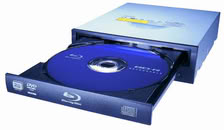
Chieftec today introduced the DT-10B-300, a slim form-factor microATX case, with a volume of 8 liters. The case offers room for microATX (or smaller) motherboards, and even comes with a slimline optical disc drive bay. The case includes a pre-installed 300 W ATX 2.53 PSU that meets 80 Plus Bronze efficiency rating. Front panel connectivity includes three 5 Gbps USB 3.2 Gen 1 type-A, and a USB 3.2 type-C port. The case has vents along the front and rear panels, and a prominent intake along the left side panel that lets top-flow CPU coolers up to 70 mm in height take in air.

A detachable flexible storage caddie lets you mount a 2.5-inch SSD, a 3.5-inch HDD, and a 5.25-inch slimline optical drive. The case enables low-profile (half height) add-on cards of up to 14 cm in length, with this drive caddy out of the way. You get four such low-profile expansion slots. The case measures 294 mm x 92 mm x 341 mm (DxWxH), and is made of 0.7 mm-thick SGCC steel. The company didn't reveal pricing.

Durabook Launches the Z14I-HG Fully Rugged Mobile AI Workstation

Durabook, the global rugged mobile solutions brand owned by Twinhead International Corporation, today announced the launch of its new Z14I-HG fully rugged mobile workstation. Powered by Intel Core Ultra processors with integrated AI Boost NPU and NVIDIA RTX Ada Generation GPUs, the Z14I-HG delivers up to 682 TOPS of AI performance and workstation-class graphics acceleration directly at the edge. This enables demanding workloads such as real-time 3D rendering, AI inference, computer vision, digital twin simulation, and advanced data analytics to be performed on-site without reliance on cloud infrastructure.

The Z14I-HG is built to operate in environments where conventional laptops cannot function reliably. Combining rugged durability with workstation-level graphics and AI computing, the Z14I-HG is designed for defence operations, industrial automation, field engineering, AI-powered inspection, geospatial analysis, and mobile command applications.

Sony's PlayStation 6 to Offer Detachable Disc Drive at Launch

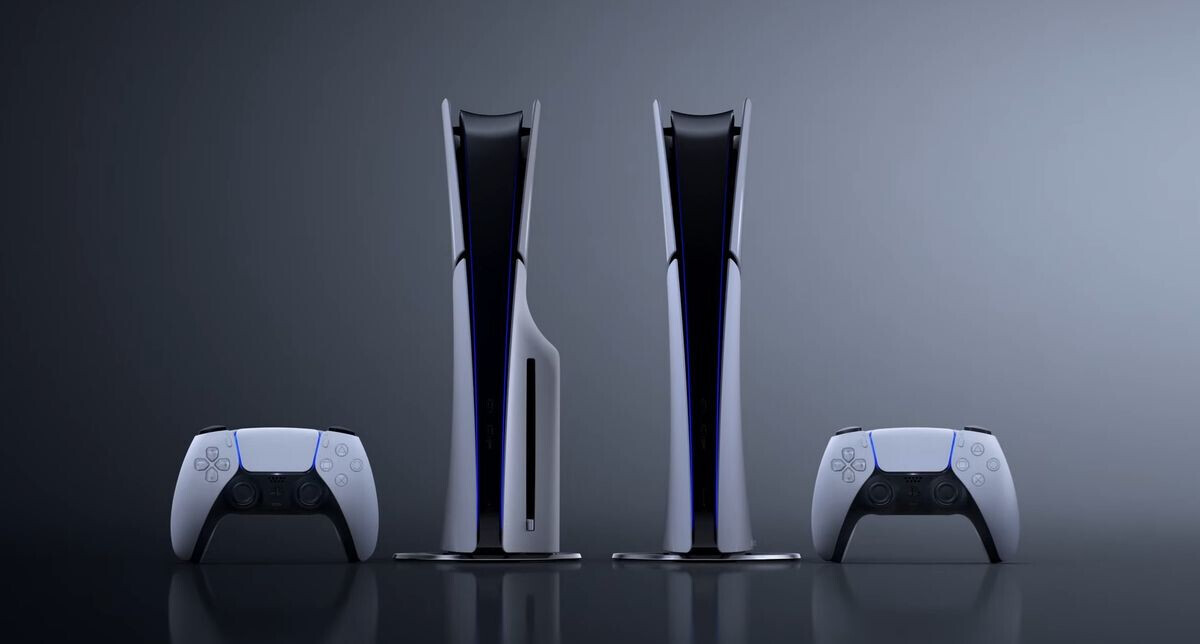
Sony's upcoming PlayStation 6 console will reportedly feature a detachable disc drive from launch, according to Insider Gaming. The PlayStation 5 originally shipped in 2020 as two separate models: one with a Blu-ray drive and one digital-only. Sony later introduced a detachable disc drive mid-generation. Now sources say the company plans to make that detachable drive an official part of the PlayStation family from day one, offering a single base console that can be bought as a digital-only unit, bundled with a drive, or upgraded later by purchasing the removable drive as an accessory.

A removable drive allows Sony to simplify and slim the core chassis, lower production complexity, and reduce shipping costs by shipping a lighter, smaller base unit, where demand is digital-first. It also allows some consumer flexibility, preserves the option for physical media collectors, and makes repairs easier because a faulty drive can be swapped without replacing the whole console. That said, the idea brings questions about accessory SKUs, compatibility, and warranty handling, and Sony will have to ensure the add-on feels integrated and reliable. If the plan holds, the PlayStation 6 could arrive as a cleaner, more modular console that keeps discs alive for another generation, away from the fully digitalized era.

Pioneer Has Ended Production of Computer Blu-ray Drives - Transfers PDDM Business to Shanxi Group

Pioneer has quietly confirmed that it has ended production of internal and external Blu-ray optical disc drives (ODDs), for computers. Rumors about the cessation of manufacturing activities emerged earlier this month; with a small number of Japanese news outlets publishing reports. Days later, an official company statement turned up in a low-key manner—via the brand's Japanese web portal. As of late April, shares of the Pioneer Digital Design and Manufacturing (PDDM) subsidiary were transferred to Shanxi Lightchain Technology Industrial Development Co., Ltd. Pioneer's optical disc-related businesses is now owned by the giant (Chinese) Shanxi Group. Commenting on shifting market conditions, a Pioneer Japan representative stated: "while we are moving forward with selection and concentration, centered on our car electronics business, we have come to the decision that it is preferable to advance the optical disc business with a new partner, rather than remaining within our group."

The Pioneer IT Japan webstore is due to close on May 30; as disclosed in a mid-April bulletin. In addition, NotebookCheck highlighted the complete lack of optical drive stock for North American webshop customers. At the time of writing, Pioneer's official Amazon.com presence still offers a small selection of portable slimline models. A chunkier external premium option—the BDR-X13U-S BDXL Blu-ray recorder—was launched only six months ago, so the firm's sudden change of heart is quite surprising. What Hi-Fi? noted that Pioneer's AV/home cinema division has not released any new 4K Blu-ray player products since 2019. Three months ago, Sony shuttered its last optical media factory, in Japan—signalling an end of an era. The vast majority of consumers have turned their backs on physical formats; instead favoring digital/streaming channels. In a refreshing (early 2025) PR piece, Verbatim and I-O DATA expressed their (joint) commitment to producing high-quality optical discs.

Former Sony Exec Believes PlayStation 6 Will Retain Optical Disc Support

A former chairman of Sony Interactive Entertainment USA—Shawn Layden—has shared his views regarding current and future PlayStation product landscapes. In an interview conducted by podcaster Reece Reilly (of KIWI TALKZ), the American businessman was asked about Microsoft's recent-ish release of all-digital Xbox home consoles. Layden believes that Sony will not copy its main rival's homework—the heavily rumored "PlayStation 6" could launch in two forms: with an optical drive, or without. The ex-SIE boss commented about a potential disc-less future platform: "I don't think Sony can get away with it now...I think Xbox has had more success in pursuing that strategy, but Xbox is really most successful in their business in a clutch of countries: the U.S., Canada, UK, Ireland, Australia, New Zealand, South Africa. Coincidentally enough—all English-speaking countries."

The current day PlayStation 5 family—consisting of standard, slim, and Pro models—is this generation's market leader; having established a huge international userbase (roughly 65 million units, back in September 2024). Layden cites these numbers as a guideline for the makeup of a new-gen model: "Sony, which is the number one platform in probably 170 countries around the world, has an obligation or a responsibility to say: 'If we go discless, how much of my market is not able to make that jump?' Can users in rural Italy get a decent connection to enjoy games?" He thinks that his former colleagues are making very careful considerations, given the complicated nature of catering to a diverse audience: "which part of your market will be damaged by going to disc-less market? I'm sure they're doing their research on it. And there will be a tipping point, where there's some percentage where you can say, 'Okay that's fine, we can turn our back on that part of the market.' But Sony's market is globally so huge, I think it would be hard for them to go fully disc-less, even with the next generation."

3D Nanoscale Petabit Capacity Optical Disk Format Proposed by Chinese R&D Teams

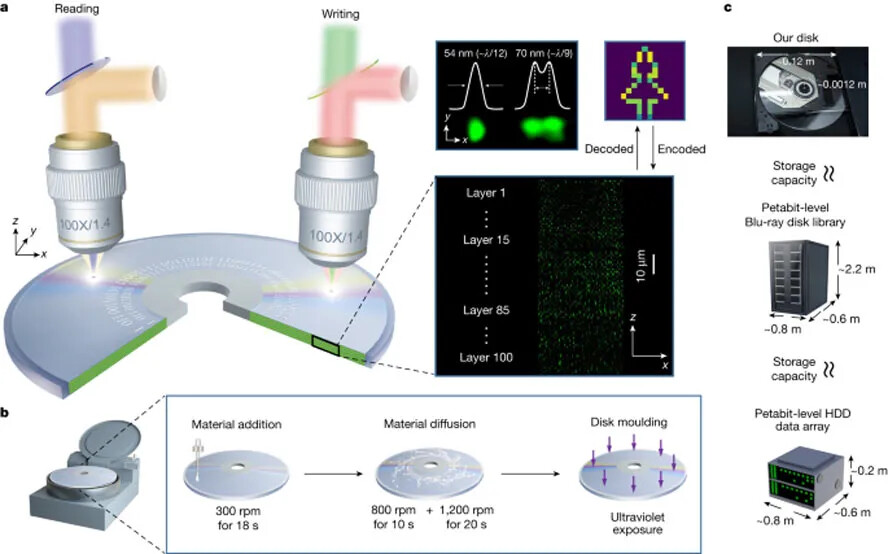
The University of Shanghai for Science and Technology (USST), Peking University and the Shanghai Institute of Optics and Fine Mechanics (SIOM) are collaborating on new Optical Data Storage (ODS) technologies—a recently published paper reveals that scientists are attempting to create 3D nanoscale optical disk memory that breaks into petabit capacities. Society (as a whole) has an ever-growing data demand—this requires the development of improved high-capacity storage technologies—the R&D teams believe that ODS presents a viable alternative route to traditional present day solutions: "data centers based on major storage technologies such as semiconductor flash devices and hard disk drives have high energy burdens, high operation costs and short lifespans."

The proposed ODS format could be a "promising solution for cost-effective long-term archival data storage." The researchers note that current (e.g Blu-ray) and previous generation ODS technologies have been: "limited by low capacities and the challenge of increasing areal density." In order to get ODS up to petabit capacity levels, several innovations are required—the Nature.com abstract stated: "extending the planar recording architecture to three dimensions with hundreds of layers, meanwhile breaking the optical diffraction limit barrier of the recorded spots. We develop an optical recording medium based on a photoresist film doped with aggregation-induced emission dye, which can be optically stimulated by femtosecond laser beams. This film is highly transparent and uniform, and the aggregation-induced emission phenomenon provides the storage mechanism. It can also be inhibited by another deactivating beam, resulting in a recording spot with a super-resolution scale." The novel optical storage medium relies on dye-doped photoresist (DDPR) with aggregation-induced emission luminogens (AIE-DDPR)—a 515 nm femtosecond Gaussian laser beam takes care of optical writing tasks, while a doughnut-shaped 639 nm continuous wave laser beam is tasked with retrieval. A 480 nm pulsed laser and a 592 nm continuous wave laser work in tandem to read data.

Sony Patent Suggests External Optical Disc Drive Prepped for Modular PS5 Refresh

Sony Interactive Entertainment has filed a patent that is now viewable to the public - as spotted by SegmentNext today - and the newly registered device could be designed to function as part of an updated variant of the PlayStation 5 home video game console. The 2020-era patent document showcases a type of detachable optical disc drive, and industry experts reckon that this mountable media reading device is destined, following past rumors, to feature in an upcoming PlayStation 5 hardware revision.

No reference is made to Sony's popular gaming console within the patent filing, but it is highly likely that the new optical drive will factor into the refreshed console's modular makeup - its overall shape shares design aesthetics with the PS5. Sony currently offers customers two variants of the PlayStation 5 - the more advanced model is fitted with an internal 4K Blu-Ray compatible disc drive, while the other one functions as a purely digital download device. The modular revamp is expected to arrive later this year, in a more compact form factor that industry insiders have called "D chassis" - it is not known whether this variant will outright replace the older models. A more powerful PlayStation 5 "Pro" model is expected to arrive after the modular redesign, with tipsters pointing to a launch window in mid-to-late 2024.
Return to Keyword Browsing
Nov 11th, 2026 04:07 CST change timezone

New Forum Posts

Popular Reviews

TPU on YouTube

Controversial News Posts