News Posts matching #specification

Return to Keyword Browsing

Ubisoft Reveals Prince of Persia: The Lost Crown PC Specs

Prince of Persia: The Lost Crown is a fast-paced action-adventure that challenges players with a wide variety of lethal monsters and traps, most of which take speed and precision to conquer—which means that smooth, responsive performance is especially important. To that end, Sargon's adventure through Mount Qaf will target at least 60 frames per second on all platforms when it launches on January 18 (or on January 15 for Ubisoft+ subscribers and owners of the Digital Deluxe Edition), whether you're playing on PC, Nintendo Switch, PlayStation 5, PlayStation 4, Xbox Series X|S, Xbox One, or Amazon Luna. First, let's take a look at the PC specs below.

The Story of Prince of Persia: The Lost Crown
Sargon, trained as a weapon to serve Persia, is on a mission to save its heir to the throne, Prince Ghassan. This perilous journey is sending him to Mount Qaf, where time no longer flows swift and sure in one direction. Sargon along with the other Immortals head to Mount Qaf to save the Prince, but it doesn't take long before he finds himself splitting paths, with some of the Immortals on a conflicting trajectory. Maybe that's because time seems to be mysteriously intertwined here and sometimes the past can happen after the present. No matter the cost, Sargon continues to strive when all odds are against him, gaining strength along the way.

Alibaba Readies PCIe 5.0 SSD Controller Based on RISC-V ISA

Alibaba's T-Head unit, responsible for the design and development of in-house IC design, has announced the first domestic SSD controller based on the PCIe 5.0 specification standard. Called the Zhenyue 510, the SSD controller is aimed at enterprise SSD offerings. Interestingly, the Zhenyue 510 is powered by T-Head's custom Xuantie C910 cores based on RISC-V instruction set architecture (ISA). Supporting the PCIe 5.0 standard for interfacing, the SSD controller uses DDR5 memory as a cache buffer. Regarding the performance, there are no official figures yet, but the company claims to have 30% lower input/output latencies compared to competing offerings. T-Head claims the SSD has an IO processing capability of "3400 Kilo IOs per second, a data bandwidth of 14 Gbytes/s, and an extremely high energy efficiency of 420 Kilo IO per second for every Watt".

This is an essential step towards Chinese self-sufficiency as T-Head has designed various ICs for processing different tasks. Still, now Alibaba's chip design unit has a domestic design for storage as well. Claiming low latency figures, the Zhenyue 510 is suitable for enterprise workloads like big data analysis, as well as AI inference/training systems workloads. The development of Zhenyue 510 started in 1H 2021, and it took the company more than two years to complete the design and validation of the chip to prepare it for deployment. This is the second Chinese-made SSD controller after Yingren Technology (InnoGrit) announced their chip in September.

EA Sports WRC PC Requirements Released

The wait is almost over. We are days away from the launch of EA Sports WRC, the biggest rally game Codemasters has made to date. EA Sports WRC is out November 3, let's go through everything you need to know before the big day. Jump straight into the action as soon as the game launches. Pre-load on the dates below.

November 3, the worldwide launch of EA SPORTS WRC at 04:00am UTC across all platforms. Get into the game earlier by, pre-ordering the digital version for up to 3 days early access starting on October 31 at 07:00 UTC across all platforms and EA Play Pro.

AMD, Arm, Intel, Meta, Microsoft, NVIDIA, and Qualcomm Standardize Next-Generation Narrow Precision Data Formats for AI

Realizing the full potential of next-generation deep learning requires highly efficient AI infrastructure. For a computing platform to be scalable and cost efficient, optimizing every layer of the AI stack, from algorithms to hardware, is essential. Advances in narrow-precision AI data formats and associated optimized algorithms have been pivotal to this journey, allowing the industry to transition from traditional 32-bit floating point precision to presently only 8 bits of precision (i.e. OCP FP8).

Narrower formats allow silicon to execute more efficient AI calculations per clock cycle, which accelerates model training and inference times. AI models take up less space, which means they require fewer data fetches from memory, and can run with better performance and efficiency. Additionally, fewer bit transfers reduces data movement over the interconnect, which can enhance application performance or cut network costs.

JEDEC and Open Compute Project Foundation Pave the Way for a New Era of Chiplet Innovation

In an extraordinary leap forward for the chiplet industry, the groundbreaking collaboration between the Open Compute Project Foundation (OCP) and JEDEC is set to usher in a new era of innovation. By merging the capabilities and open standards of OCP's Chiplet Data Extensible Markup Language (CDXML) and JEDEC's JEP30 PartModel Guidelines, this partnership, initiated in late 2022, promises to revolutionize chiplet design, manufacturing and integration. The result will be a unified structure that supports both chiplets and general electronic parts within the overarching purview of JEDEC.

In a significant development, the integration of OCP CDXML into JEP30 has reached a critical milestone, enabling chiplet builders to provide standardized chiplet part descriptions to their customers electronically. This advancement opens the door to automating System in Package (SiP) design and assembly using chiplets. The chiplet descriptions encompass crucial information for SiP builders, including thermal properties, physical and mechanical requirements, behavior specifications, power and signal integrity properties, testing in-package and security parameters.

Assassin's Creed Mirage PC Spec Requirements Revealed

Assassin's Creed Mirage launches on October 5 - and if you're looking forward to exploring ninth-century Baghdad on a PC, we've got a rundown of specifications to help you figure out the right settings to get the best possible experience out of your machine, as well as a list of additional features you can take advantage of provided you've got the right hardware.

As you experience the journey of Basim to become a Hidden One and undertake elaborate investigations and assassinations, you'll be able to immerse yourself in his world with an uncapped frame rate, even in 4K; simultaneously use a keyboard, mouse, and controller (or other inputs); and get a dazzling panoramic view with HDR as well as multi-monitor and widescreen support. You'll also be able to leverage features like Intel's AI-assisted XeSS Super Sampling, which upscales resolution while enabling hardware to pump out more frames per second; optimization for Intel Arc GPUs and 13th-generation CPUs; synchronize ambient lighting with the game's action using MSI's Mystic Light products; and even experience upper-body haptic feedback with the OWO Haptic Gaming System vest (which is also supported on consoles).

Intel Lists Testing Interposers for Arrow Lake-HX, Lunar Lake-M, and Battlemage

Intel recently updated its website to highlight interposers used for testing upcoming chips before their actual product integration. A specific webpage now showcases components used by various tools, notably the "Gen5 VR," which stands for CPU Voltage Regulator in this context. The highlight of the update reveals at least four yet-to-be-announced products: Battlemage (BMG), Arrow Lake (ARL), and Lunar Lake (LNL), slated for launch in 2024. Particularly interesting are the two Battlemage interposers: BGA2362-BMG-X2 and BGA2727-BMG-X3. This hints that a Battlemage GPU could have more pins than Intel's current top-tier GPU from the Alchemist series, known as DG2, which features 2660 pins (BGA2660-DG2-512EU).

This unveiling could indicate Intel's plans to introduce two GPUs in its new series or potentially two different package sizes. Manufacturers often use consistent package sizes for multiple GPUs, granting flexibility to interchange processors with similar specifications and presenting a feasible production strategy. Another notable mention is the Arrow Lake-HX, intended for premium desktop/laptop hybrids.. While there was some buzz about the ARL-HX series before, this update provides clear confirmation from Intel. Lastly, the reveal includes an interposer for the Lunar Lake-M series (LNL-M), which is expected to be Intel's most energy-efficient line. Drawing parallels from the Alder Lake series, such chips were designed for tablets with power consumption between 5 to 7 watts.

VESA Approves the use of New DisplayPort 2.1 Compliance Tests

Teledyne LeCroy, the worldwide leader in protocol test solutions, announced that it has received Video Electronics Standards Association (VESA) approval for testing DisplayPort 2.1 Link Training Tunable PHY Repeater (LTTPR) and Display Stream Compression (DSC) compliance with the quantumdata M42de Video Analyzer and Generator. These tests underwent extensive testing during industry workshops to ensure their accuracy and reliability and are now considered mandatory for compliance certification of DisplayPort 2.1 Ultra High Bit Rate (UHBR) capable devices.

The DisplayPort specification was updated to version 2.1 in October of 2022 and brought significant changes to link training and LTTPR operation. Design and test engineers are faced with incrementally more testing as DisplayPort chipsets add support for the new link training and other advanced features. "The need to drive higher video resolutions and frame rates raises the bar for vendors seeking VESA logo approval. Compliance testing is a key factor in delivering a robust DisplayPort technology ecosystem and outstanding customer experiences," said Bill Lempesis, executive director of VESA, which develops and administers the DisplayPort standard and compliance logo program. "Reaching this level of comprehensive test coverage so quickly after the DisplayPort 2.1 specification was released is only possible due to the close collaboration between test vendors like Teledyne LeCroy and our VESA member companies."

Ratchet & Clank: Rift Apart PC Version to Feature Ray-Traced Ambient Occlusion

Next week, Ratchet & Clank: Rift Apart is launching on PC! Many of you have asked for details about the technologies used and system requirements. Today we are answering those questions, and on top of that, we have some exciting new feature announcements. To ensure a smooth dimension-hopping experience, our team implemented DirectStorage 1.2 in Ratchet & Clank: Rift Apart on PC, including GPU decompression.

Richard van der Laan, Senior Lead Programmer at Nixxes Software, explains: "To enable quick loading and instant transition between dimensions, the game needs to be able to load assets quickly. DirectStorage ensures quick loading times, and GPU decompression is used at high graphics settings to stream assets in the background while playing. Traditionally, this decompression is handled by the CPU, but at a certain point, there is an advantage to letting the GPU handle this, as this enables a higher bandwidth for streaming assets from storage to the graphics card. We use this to quickly load high-quality textures and environments with a high level of detail."

Ratchet & Clank: Rift Apart PC Spec Requirements Published

Nixxes and Insomniac yesterday published their official PC specification requirements for the Ratchet & Clank: Rift Apart port (arriving on July 26). The announcement was made via a post on the game's Steam store page, but the two teams decided to remove it soon after (perhaps the information was released too early). Several news sites were quick enough to note that the PC version of Ratchet & Clank: Rift will be the first DirectStorage 1.2 game with support for GPU decompression. Senior Lead Programmer Richard van der Laan stated (in the now deleted update): DirectStorage ensures quick loading times and GPU decompression is used at high graphics settings to stream assets in the background while playing. Traditionally, this decompression is handled by the CPU, but at a certain point there is an advantage to letting the GPU handle this, as this enables a higher bandwidth for streaming assets from storage to the graphics card. We use this to quickly load high-quality textures and environments with a high level of detail.

His colleague, Principal Programmer Alex Bartholomeus, also chipped in with: "For Ratchet & Clank: Rift Apart on PC, we added adaptive streaming based on live measurement of the available hardware bandwidth. This allows us to tailor the texture streaming strategy for the best possible texture streaming on any configuration." The most surprising aspect gleaned from the PC specification sheet is the minimum performance requirement (720p @ 30 FPS) of a hard disk drive (HDD) acting as the main storage device, although they would prefer that you go with a more modern storage option. A solid-state drive (SSD) is deemed necessary for the "Recommended" tier at 1080p/60 FPS. This is quite amusing considering that Insomniac's creative director, Marcus Smith, once said (in an official PlayStation showcase video) that Ratchet and Clank: Rift Apart's dimensional rift hopping "would not have been possible without the Solid State Drive of the PlayStation 5."

12VHPWR Connector Said to be Replaced by 12V-2x6 Connector

According to Igor's Lab, who has gotten their hands on a PCI-SIG draft engineer change notice, it looks like the not entirely uncontroversial 12VHPWR connector won't be long lived. The PCI-SIG is getting ready to replace it with the 12V-2x6 connector, which will be part of the ATX 3.1 spec and the PCI Express 6.0 spec. The new connector doesn't appear to have any major physical changes though, but there have been mechanical modifications, such as the sense pins having been recessed further back, to make sure a proper contact is made before higher power outputs can be requested by the GPU. The good news is that at least in the draft spec, the 12V-2x6 connector will be backwards compatible with 12VHPWR connectors.

One of the bigger changes, at least when it comes to how much power the new connector can deliver, is that there will be new 150 and 300 Watt modes in addition to the 450 and 600 Watt modes for the sense pin detection. The 12V-2x6 connector is rated for at least 9.2 Amps per pin and the new connectors will carry a H++ logo, with th older 12VHPWR connectors getting a H+ logo. The PCI-SIG has also added stricter requirements when it comes to the cable design and quality, which should hopefully prevent some of the issues the 12VHPWR implementations have suffered from. We should find out more details once the PCI-SIG has finalised the 12V-2x6 connector specification. In the meantime, you can hit up the source link for more technical drawings and details.

NVIDIA Explains GeForce RTX 40 Series VRAM Functionality

NVIDIA receives a lot of questions about graphics memory, also known as the frame buffer, video memory, or "VRAM", and so with the unveiling of our new GeForce RTX 4060 Family of graphics cards we wanted to share some insights, so gamers can make the best buying decisions for their gaming needs. What Is VRAM? VRAM is high speed memory located on your graphics card.

It's one component of a larger memory subsystem that helps make sure your GPU has access to the data it needs to smoothly process and display images. In this article, we'll describe memory subsystem innovations in our latest generation Ada Lovelace GPU architecture, as well as how the speed and size of GPU cache and VRAM impacts performance and the gameplay experience.

AMD Radeon RX 7600 GPU-Z Screenshot Leaked

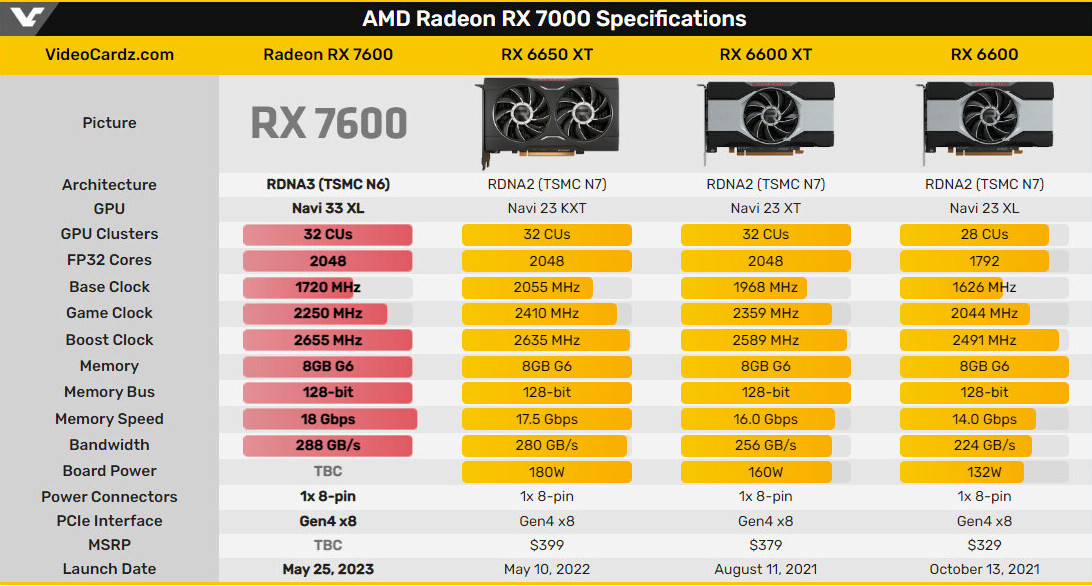
AMD Radeon RX 7600 GPU-related leaks continue to trickle out as we get closer to the late May launch window, when AMD's entry-level model is predicted to take on the upcoming NVIDIA GeForce RTX 4060 graphics card. Details of Sapphire and MSI RX 7600 (non-XT) custom cards have appeared online over the past week and a half, with basic GPU specifications spotted on retail packaging. VideoCardz has received yet another tip-off and has today released a screenshot from a GPU-Z session. We cannot confirm the accuracy of the specs due to our own NDA with AMD, but we can confirm that GPU-Z since version 2.53.0 does have early support the Navi 33 GPU.

The listed details of a "Navi 33 XL GPU" correlate with leaked information from the past week or two, confirming the presence of 32 Compute Units and 2048 Stream Processors. The standard allocation of 8 GB GDDR6 memory is verified once more, complete with a 128-bit wide memory interface. VideoCardz notes that the GeForce RTX 4060 Ti is quite similar in terms of memory technicalities - with a maximum bandwidth of 288 GB/s (Gen 4 PCIe interface restricted to 8 lanes). GPU-Z states that the Navi 33 XL/RX 7600 GPU has the following core clock speeds: 1720 MHz (base), 2250 MHz (performance game mode) and 2655 MHz (boosted) - tipsters have suggested that the chip is capable of hitting a maximum threshold of 2850 MHz.

Gigabyte Issues Statement Regarding SOC Voltage on AMD's AM5 Motherboads Under 1.3V

We would like to address the recent media reports regarding the SOC Voltage exceeding 1.3 V on GIGABYTE's AMD AM5 motherboards especially when EXPO is enabled in the latest beta BIOS.

GIGABYTE respects and appreciates media's support and favor to GIGABYTE motherboards for long time. In terms of the SOC Voltage measurement, the authentic measurement point and method is critical since the SOC Voltage will differ by that. The CPU internal SOC Voltage (SVI3 interface) is the most crucial indicator to motherboards, and, in general, the PWM Output Voltage will be higher than the CPU internal SOC Voltage (SVI3 interface) due to various physical factors.

Sapphire Radeon RX 7600 PULSE GPUs Photographed Ahead of Late May Launch

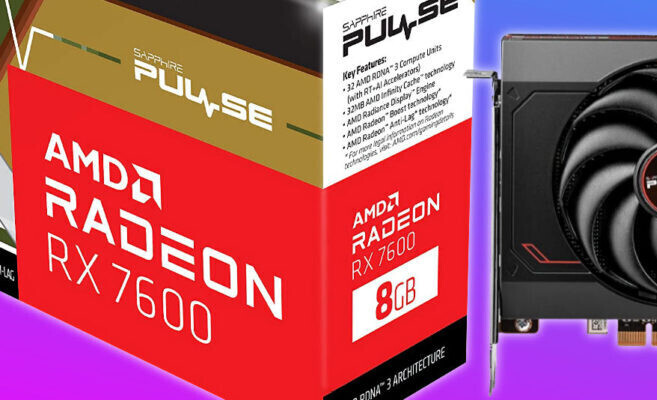
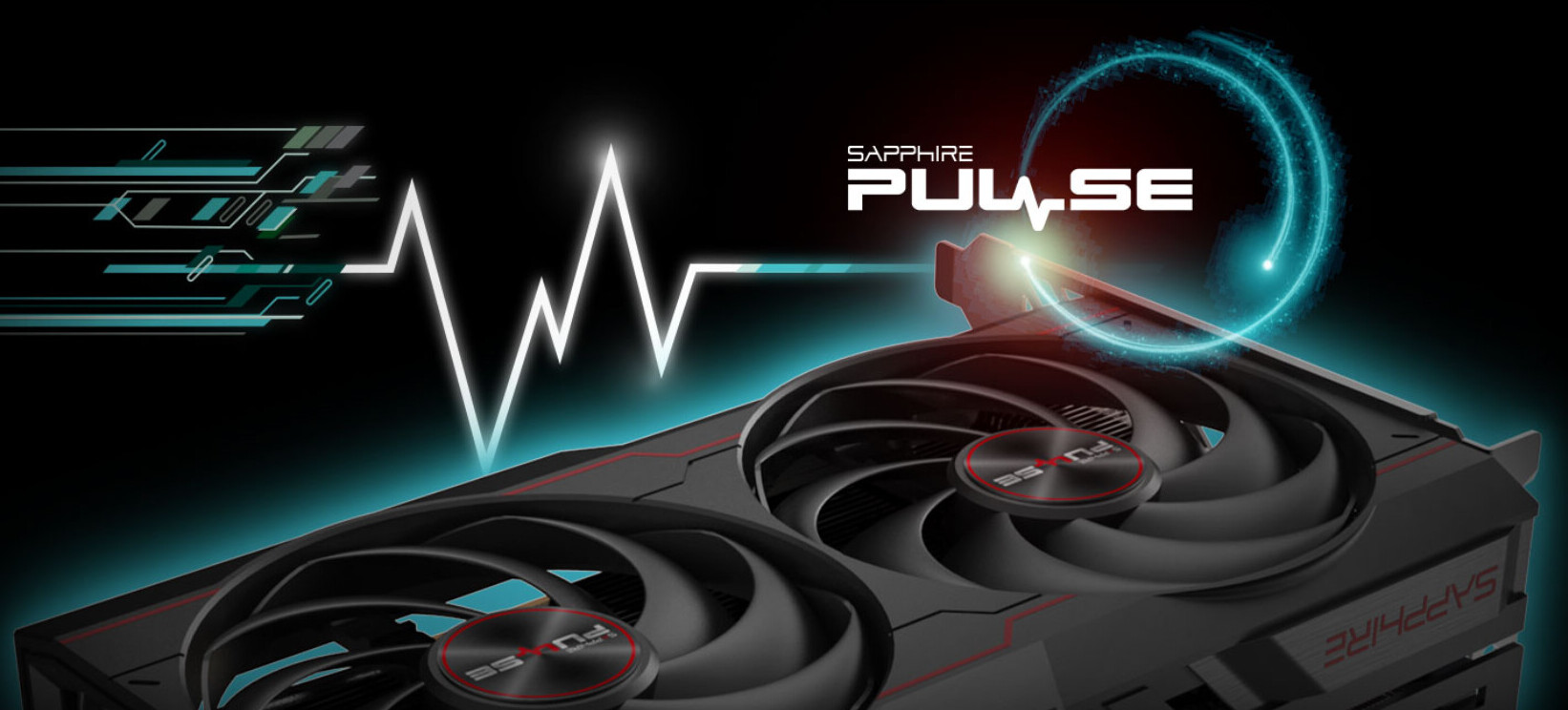
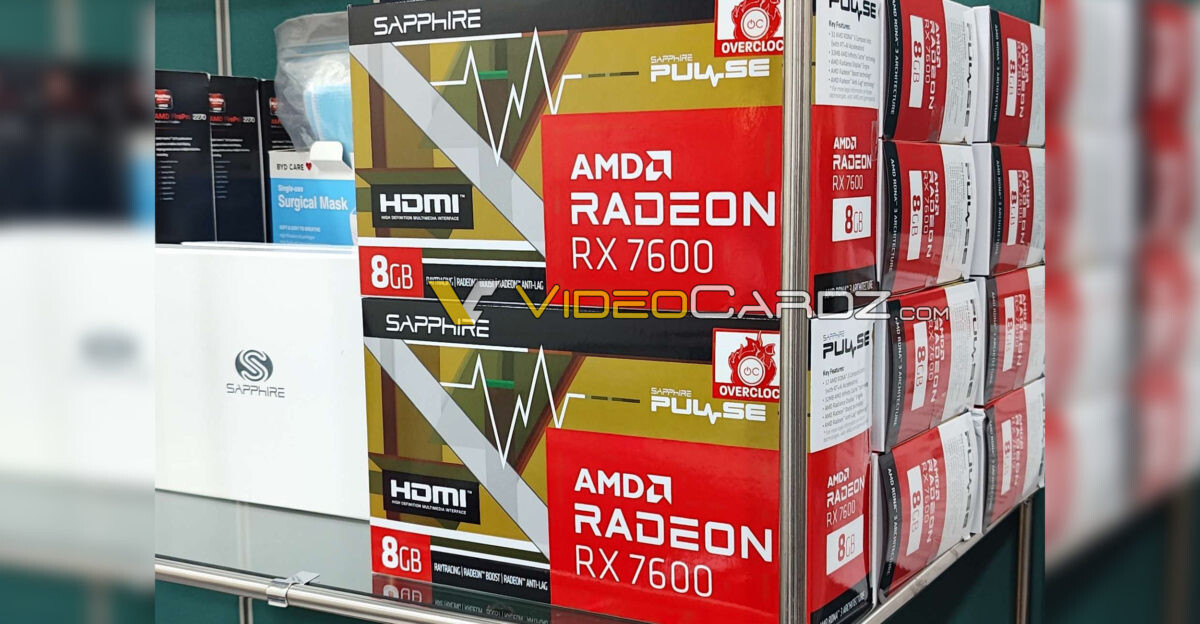
VideoCardz has today received a tip-off from an anonymous source about a batch of Sapphire Radeon RX 7600 PULSE graphics cards - boxed products have been photographed sitting in a hardware store located "somewhere" in Asia. It is not immediately clear whether the Sapphire cards were pictured in a store-front setting, or an employee has taken a snap of stock stored in a backroom and shared it with their internet buddies. Previous leaks relating to AMD Radeon RX 7600 and 7600 XT cards have pointed to a May 25 launch day - so today's tip indicates that products have been readied well in advance of the anticipated release window.

The insider source claims that the Sapphire Radeon RX 7600 PULSE graphics card will be sold for about $249 in that particular territory. Specifications on the outer packaging can be read (if you zoom in enough) - the Pulse custom variant is labeled as being overclocked out-of-the-box, so it is highly likely that it will be fitted with a custom cooling solution. The packaging's blurb lists the presence of 32 RDNA3 CUs - indicating a full configuration of AMD's Navi 33 GPU die, consisting of 2048 stream processors. The Pulse card gets an Infinity Cache allocation of 32 MB, and a specification of (now typical) 8 GB GDDR6 video memory is confirmed.

Apple and Google Join Forces on New Industry Standard Against Unwanted Bluetooth Tracking

Apple announced a joint partnership with Google in submitting a new industry specification to curtail unwanted tracking via Bluetooth location-tracking devices currently on the market. The new standard would provide tracker detection across both iOS and Android, regardless of the brand of the tracker being used. The proposal addresses the concerns surrounding the ease in which a person can be tracked by a sneaky location-tracker stuck to their person, possession, or vehicle by bad-faith actors using the technology to stalk individuals. Apple has previous released updates to their Find My service which will alert the victim if they are being tracked by an unknown AirTag, but this tech relies on the person having an iPhone. Third party detection apps exist on Android, but they're far from perfect and aren't currently officially supported by any of the parent companies making Bluetooth location trackers.

The proposal has received industry wide support from other manufacturers such as Samsung, Tile, Chipolo, eufy Security, and Pebblebee. Advocacy groups such as The National Network to End Domestic Violence and the Center for Democracy & Technology have also contributed to the specification draft. The draft has been submitted via the Internet Engineering Task Force (IETF) with a three month review and comment period open to interested parties that would like to weigh in on the proposed specification. After this period Apple and Google will work to address concerns and feedback before putting the specification into production by the end of 2023, unifying a tracking alerts system on all future versions of iOS and Android.

AMD Ryzen 7040HS and 7040H "Phoenix" Laptop CPUs Get Tested

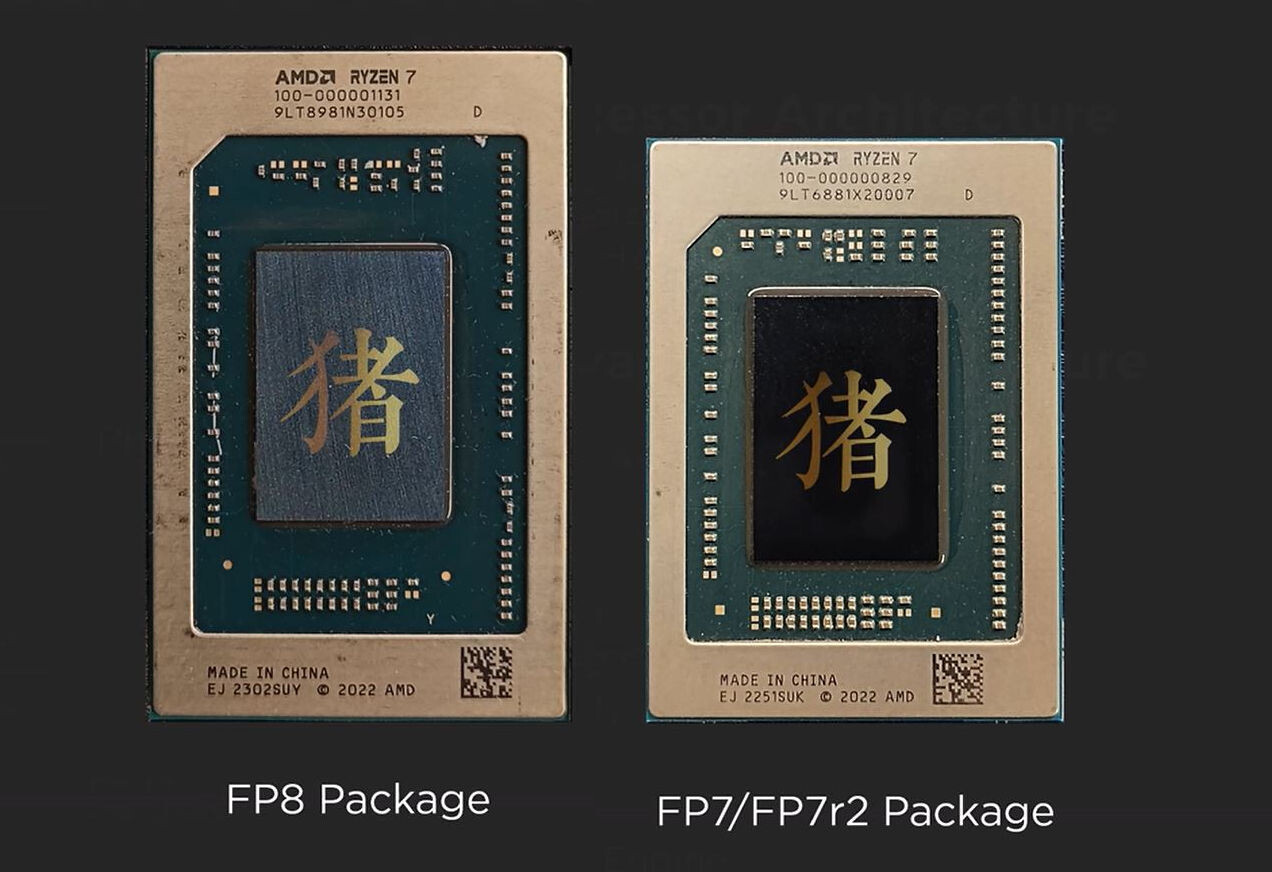
AMD is late in releasing its Phoenix Zen 4 lineup of mobile APUs - the original April launch has been missed, and laptops bearing Ryzen 7000HS & H-series are expected to arrive at some point this month. Preview hardware has made its way into the hands of testers, and one particular outlet - Golden Pig Upgrade, a content creator on the Chinese Bilibili video site - has performed benchmark tests. He seems to be the first reviewer to get hands-on time with AMD Ryzen 7040 Phoenix APUs, and his findings point to class leading performance results in terms of graphical capabilities - the 7840HS (packing a Radeon 780M RDNA3 iGPU) is compared to the Rembrandt-based 7735H, as well as a pair of Intel Raptor Lake CPUs - the 13700H and 13500H models.

AMD's newest Phoenix APU is the group leader in GPU performance stakes, but the jump up from the last-gen Rembrandt (RDNA2 iGPU) chip is not all that significant. VideoCardz reckons that the Radeon 780M integrated GPU is roughly equivalent to an NVIDIA GeForce MX550 dGPU and not far off from a GeForce GTX 1650 Max-Q graphics card (in terms of benchmark performance). According to AMD's internal documentation the RDNA 3 core architecture utilized in Phoenix APUs is referred to as "2.5" so this perhaps explains why the 780M is not doing laps around its older silbing(s).

Bethesda Reveals Redfall's Official PC Hardware Requirements, NVIDIA Releases Exclusive Launch Trailer

With the launch of Redfall set for early next week, Bethesda has kindly provided some prepwork to consider in advance - a breakdown of the crossover shooter's PC specification requirements (minimum, recommended and ultra) as well as all available accessibility settings and options. They fail to mention any resolution or framerate targets, so it will be up to PC gamers to investigate the nitty-gritty numbers on the day of Redfall's release (May 2). As part of the whole promo campaign NVIDIA has decided to unleash a gameplay trailer (see below) of the game running on a high end PC fitted with a (presumed) high-end GeForce RTX 40-series graphics card.

Redfall's PC audience will get to flex their graphical muscles more so when compared to unfortunate current gen Xbox owners - Bethesda and developer Arkane Studios have recently admitted that their supernatural shooter will be restricted to 30 FPS Quality Mode on Series X and S consoles at launch. A higher framerate performance mode is promised in the future - via a game update - but the Microsoft-owned publisher has not set a more specific release window for the upgrade. The middle and high-tier specifications on PC seem to be quite reasonable, so Redfall is not expected to be a stuttering mess on arrival.

ASUS ROG Ally's Ryzen Z1 Extreme Custom APU Verified by Benchmark Info

An intriguing entry has appeared on the Geekbench Browser site, the information was uploaded with a timestamp from this morning (11:07 am on April 20 to be specific) pointing to a mobile ASUS device that was tested in GeekBench 5. The archived info dump reveals that the subject matter of the benchmark was the ASUS ROG Ally handheld gaming console, which has received a lot of attention in recent weeks - with it being touted as a very serious alternative to Valve's Steam Deck, a handheld gaming PC that is quite popular with enthusiasts. The ROG Ally will need to offer a potent hardware package if it stands to compete directly with the Steam Deck, and the latest information confirms that this new contender is very promising in that department. Geekbench 5 awarded an impressive OpenCL score of 35498 to the RC71L variant of the ROG Ally, an RC71X-assigned model is known to exist but details of its exact nature have not been revealed. This particular ROG Alloy unit was running Windows 11 Home (64-bit) under the operating system's performance power plan.

The new entry on Geekbench Browser shows that the Ally is packing an AMD Ryzen Z1 Extreme APU, which appears to be a customized version of the Ryzen 7 7840U APU mobile platform chipset - previous rumors have indicated that the latter would be in the driving seat. Both Phoenix range SoCs share the basic 8 cores and 16 thread makeup, but the Z1 Extreme is capable of boosting up to 5.062 GHz from a base frequency of 3.30 GHz. AMD's Radeon 780M iGPU (RDNA 3) is expected to deal with the Ally's graphical aspect, but the benchmark info dump only provides scant details about the GPU (codenamed "gfx1103") - most notably the presence of six computer units, an 800 MHz max frequency, and access to 8.20 GB of video memory. Number crunching boffins have calculated that the Ally could field 768 FP32 cores, courtesy of the dual issue SIMD design inherent to RDNA 3.

Star Wars Jedi: Survivor PC Install Size is Daunting at 155 GB

Electronic Arts has updated the listings for PC system requirements for Star Wars Jedi: Survivor, and the gaming community has reacted to the refresh of the game's minimum installation storage requisite. It calls for a whopping 155 GB of disk space, for the base game alone, not including the expected routine of patches and extra story content (via DLC). The publisher suggests that an SSD is best used for an optimal in-game experience. The slightly older PC requirements specified a minimum of 150 GB for HDDs, and 130 GB for SSDs.

As it stands, the Respawn Entertainment developed action adventure game has one of the larger minimum storage requirements among modern titles - all the more surprising given that it will offer a relatively short and linear single player experience. Current installations of the PC version of Red Dead Redemption 2 will occupy 150 GB of disk space. Jedi: Fallen Order (2019), Survivor's preceding title in the series, demands a comparatively modest install base of 55 GB. It will be interesting to observe whether Jedi: Survivor will drive sales of larger storage solutions - in the recent past, gamers have scrambled to acquire higher capacity SSDs and HDDs in order to accommodate the ever-growing installations and content drops required to play the Call of Duty/Modern Warfare series.

Halo Infinite's Latest PC Patch Shifts Minimum GPU Spec Requirements, Below 4 GB of VRAM Insufficient

The latest patch for Halo Infinite has introduced an undesired side effect for a select portion of its PC platform playerbase. Changes to minimum system specification requirements were not clarified by 343 Industries in their patch notes, but it appears that the game now refuses to launch for owners of older GPU hardware. A limit of 4 GB of VRAM has been listed as the bare minimum since Halo Infinite's launch in late 2021, with the AMD Radeon RX 570 and Nvidia GTX GeForce 1050 Ti cards representing the entry level GPU tier, basic versions of both were fitted with 4 GB of VRAM as standard.

Apparently users running the GTX 1060 3 GB model were able to launch and play the game just fine prior to the latest patch, due to it being more powerful than the entry level cards, but now it seems that the advertised hard VRAM limit has finally gone into full effect. The weaker RX 570 and GTX 1050 Ti cards are still capable of running Halo Infinite after the introduction of season 3 content, but a technically superior piece of hardware cannot, which is unfortunate for owners of the GTX 1060 3 GB model who want to play Halo Infinite in its current state.
Return to Keyword Browsing
Nov 11th, 2026 04:19 CST change timezone

New Forum Posts

Popular Reviews

TPU on YouTube

Controversial News Posts