News Posts matching #ssd

Return to Keyword Browsing

Team Group Announces T-Force Cardea Zero M.2 SSD and T-Force Sable Mousepad

Team Group, world renowned memory solutions and accessory provider, is proud to announce today the addition of new products as to their prestigious T-FORCE gaming line of products. Announced today, the T-FORCE arsenal welcomes the T-FORCE CARDEA ZERO M.2 PCI-E solid-state drive and the T-FORCE FORCE SABLE gaming mouse pad. Both designed by Team Group, the T-FORCE CARDEA ZERO is a patented M.2 PCI-e M.2 SSD featuring graphene copper foil cooling on the SSD module allowing the SSD to maximize cooling benefits from both natural passive cooling and directed air cooling via fans to deliver excellent heat dissipation.

The T-FORCE CARDEA ZERO M.2 PCI-E SSD is the world's first super slim SSD on the market built specifically for gaming laptops and high-performance tablet PCs. The newly released T-FORCE GAMING mouse pad, the T-FORCE FORCE SABLE, features special 3D sensing technology to effectively enhance the performance of optical or laser-sensor gaming mice. The mouse itself is made from environmental-friendly fabric which provides better comfort and smoother control and is completely washable and easy to clean.

Mobiveil, Crossbar Partnership Aims to Bring ReRAM to SSDs

Looking to bridge the gap between current SSDs and resistive memory technologies for the consumers that can actually afford it, Mobiveil and Crossbar have recently announced that they are working in conjunction to bring Crossbar's ReRAM technology to an SSD form-factor. ReRAM is a new type of non-volatile memory (meaning it stores data even when it's not being powered). It's based on a simple three-layer structure of top electrode, switching medium and bottom electrode, where the resistance switching mechanism is based on the formation of a filament in the switching material when a voltage is applied between the two electrodes. Crossbar in particular (this type of resistive memory is also being pursued by other companies, such as HP) says their ReRAM cell is very stable, capable of withstanding temperature swings from -40°C to 125°C, 1M+ write cycles, and managing data retention of 10 years at 85°C. As an upside, it is 3D scalable, and its production can be achieved in standard CMOS manufacturing fabs.

This isn't the next evolution on SSD's - at least, not for the general consumer. ReRAM production and implementation costs will be leagues ahead of what current 3D NAND memory production entails, thus making this a niche product that is there for the customers that absolutely require the fastest throughput possible across a standard interface. In this case, NVMe is the choice - particularly, Mobiveil's NVMe, PCIe and DDR3/4 controllers can easily be adapted to accommodate the Crossbar ReRAM architecture, which is capable of six-million 512B IOPS below 10us latency.

Intel's First 10 nm Chips to the Market are 64-layer 3D NAND

Non-volatile memory often has the first pick of a new silicon fabrication process, as it is a low-risk development. A NAND flash chip is essentially a sea of transistors, with a fraction of R&D cost of something as specialized as a CPU die. It should come as no surprise, then, that the first chips to be built on Intel's swanky new 10 nanometer fabs will be a 64-layer 3D NAND flash memory, the first of its kind for data center applications.

With its 10 nm process, Intel is introducing FinFET Hyper Scaling, Intel will increase transistor densities by 2.7 times over the kind of densities one would traditionally expect from 10 nm. This lets the company scale up NAND flash storage densities by just that much more. The first 10 nm 64-layer 3D NAND flash chips will have high data densities, while at the same time, Intel will be able to push low volumes, characteristic of a new process. This explains why the first SSDs built with these chips are targeted at data-centers, so fairly expensive, high-capacity SSDs can be pushed to customers that can afford them.

Colorful Announces the iGame CN600 and CP600 SSDs

Colorful Technology Company Limited, a leading manufacturer of PC hardware, has announced the introduction of three new PCIE SSD models and are the world's first to feature the latest SiliconMotion controller 2262/2263/2263XTL: announcing the COLORFUL CN600 DRAM-less Series, CN600 DRAM series and CP600 iGame Series. All of the new SSDs will be available in volumes of 240GB up to 2TB.

"Although COLORFUL's SSD product lines were just released 3 years ago, thanks to the partnership between SiliconMotion and NAND flash vendors, COLORFUL's SSD products now hold the distinction of being in the top 3 in terms of market share in China. COLORFUL is going to build a storage brand in the future and this new PCIe Series SSD launching today will be the start." - Mr. Jerry Tsao, DGM of COLORFUL Storage talking about the release of the new storage products in a conference.

Kingston DCP1000 NVMe PCIe SSD Now Generally Available in EMEA Region

Kingston Digital, Inc., the Flash memory affiliate of Kingston Technology Company, Inc., the independent world leader in memory products, today announced the general availability (GA) of its DCP1000 NVMe PCIe SSD in the European marketplace. The company will demonstrate the performance capabilities of the DCP1000, the industry's fastest NVMe SSD for the Half Height Half Length PCIe form factor, at the 2017 International Broadcasting Conference (IBC), working with multiple partner vendors, featuring the solid-state solution in a variety of configurations.

These include accelerating the complete Adobe Creative Cloud 2017 Suite of applications; a 60 frame-per-second (FPS) 4K streaming video demonstration with Bluefish444; real-time color grading with 4K resolution video and higher with demonstration partners Eizo and Marquis Technologies; and several other deployments showcasing the consistent, industry-leading data acceleration capabilities of the Kingston DCP1000, regardless of use case.

Team Group Launches L5 LITE-3D Series SSD

Targeting consumer's growing demand for computer storage capacity and higher performance, the world's leading memory brand, Team Group today announces the launch of the L5 LITE-3D SSD with all new 3D NAND technology. The latest generation of 3D NAND flash memory has overcome the technical barrier of 2D NAND. Featuring great durability and low energy consumption, it has become the mainstream memory of choice for the latest generation, enhancing overall capacity of solid state drives along with performance and reliability. It not only provides better performance and endurance, but also breaks through the technical and capacity limitations of planar chips.

The L5 LITE-3D solid state drive is 4 times faster than traditional hard drives. Its excellent performance and read/write speed not only allow fast boot/shutdown time, but also speeds up the response time of all application, so consumers can enjoy the high speed performance immediately after the upgrade. It is lightweight and has an industry-standard 2.5-inch form factor and is only 7 mm in thickness, making it best suited for Ultrabooks on the market. Whether it is for a laptop or desktop, the upgrade can be done quickly. It uses a SATA III 6Gbps interface and capacities are available in 120 GB, 240 GB, 480 GB, etc. The read speed performance is above 470 MB/s which offers the best performance-to-price ratio in the market right now.

GIGABYTE Aorus Z370 Motherboard Series Pictured

Here are some of the first pictures of GIGABYTE's Aorus branded Z370 series motherboards. The lineup begins with the Aorus Z370 Gaming 3 and Aorus Z370 Gaming K3. These two boards are nearly identical to each other, and differ with only their onboard gigabit Ethernet controller, with the Gaming K3 featuring the latest Killer E2500 controller, while the Gaming 3 features Intel i219-V. Both boards feature just the one PCI-Express 3.0 x16 slot wired to the CPU, with the second slot being electrical x4 and wired to the PCH. GIGABYTE has been traditionally generous with its onboard audio solutions, and these boards are no exception. You get a Realtek ALC1220 (120 dBA SNR) CODEC strapped to a single headphones amp circuit, ground-layer isolation, and audio-grade capacitors.

Moving slightly up the ladder is the Aorus Z370 Ultra Gaming, pictured below. You get a similar CPU VRM implementation to the Gaming K3, but with two PCI-Express 3.0 x16 slots (x8/x8 with both populated) wired to the CPU, for multi-GPU setups. You also get a stylish I/O shroud. Positioned above the Ultra Gaming, is the Aorus Z370 Gaming 5. This board features a stronger CPU VRM, three M.2 slots as opposed to two on the Ultra Gaming, a higher grade onboard audio with a high-grade OPAMP, more USB 3.1 ports, 802.11 ac + Bluetooth WLAN; and a full-length I/O shroud. Leading the pack (for now) is the Aorus Z370 Gaming 7. Positioned further above the Gaming 5, this board features the highest-grade onboard audio solution from GIGABYTE, with an ESS Sabre AMP; M.2 SSD heatsinks, two gigabit Ethernet interfaces (Intel + Killer), and reinforcement braces around even more slots. These boards are expected to launch on the 5th of October, 2017.

MSI Announces Availability of X370 GAMING M7 ACK Motherboard

MSI is proud to announce the on-shelf availability of its latest high-end AM4 motherboard - the X370 GAMING M7 ACK. To satisfy even the most demanding gamers who are looking for the best performance and style, the new AM4 Enthusiast GAMING flagship, X370 GAMING M7 ACK, is in stores now and ready to cater to any type of gamer, PC enthusiast, or case modder. The X370 GAMING M7 ACK is also world's first AM4 motherboard to feature Killer DoubleShot PRO, combining Killer Ethernet with Killer WIFI AC.

The X370 GAMING M7 ACK is a prime example of why MSI leads the gaming industry in both innovation and performance. Gamers know and trust MSI because MSI always delivers the hardware they need to stay on top of their games. Providing the best networking experience is critical and by including the Killer Ethernet E2500 and Killer Wireless 1535 on the X370 GAMING M7 ACK motherboard, MSI ensures that their customers will have the best possible online gaming experience.

Crucial Announces the BX300 Solid-state Drive

Crucial, a leading global brand of memory and storage upgrades, today announced the availability of a new offering in its solid state drive product portfolio: BX300. It combines Micron 3D NAND with a value-conscious design to deliver the features DIY upgraders and builders are looking for. The new SSD includes 3D MLC NAND in a 2.5-inch form factor drive, and is available in 120GB, 240GB, and 480GB capacities.

Upgrading from a traditional hard drive to a solid state drive has never been easier. The Crucial Advisor tool helps users determine a compatible upgrade based on their system's manufacturer, make, and model. Supporting the BX300 is Crucial's mobile-friendly install guide so users of all technical ability levels are armed with the straightforward, step-by-step information they need to successfully install an SSD. Data migration is also simplified with free access to Acronis True Image HD software.

Alphacool Intros HDX5 Cooled M.2 RAID Add-on Card

The Alphacool HDX-5 is a combination of a RAID controller card and a massive cooler. It has two slots for M.2 SATA SSDs and two additional SATA slots, allowing you to set up a RAID 0 or 1 group. The PCI-Express 3.0 x4 card also provides a bandwidth of up to 3900 MB/s.

The new generation of HDX coolers from Alphacool is getting another addition. The HDX-5 is not just a cooler, but also lets you run a RAID 0 or 1 group. It boasts two M.2 SATA SSD slots and two classic SATA slots. The combination possibilities are considerable, since you can set up a RAID group over one M.2 SATA SSD and one normal SATA drive, or connect just the M.2 slots to form a RAID group. That leaves the classic SATA slots free to be used for normal connections.

Samsung Announces Portable SSD T5

Samsung Electronics America, Inc. today announced the introduction of the Samsung Portable SSD T5 - the newest portable solid state drive (PSSD) that raises the bar for the performance of external memory products. The T5, built with Samsung's latest 64-layer V-NAND technology, delivers industry-leading transfer speeds with encrypted data security in a compact and durable design, making it easier than ever for consumers to access their most valuable data anywhere, at any time.

"Samsung has been pushing the envelope of what is possible in portable storage and solid state drives for years, and the Portable SSD T5 continues our legacy of leadership and innovation," said Un-Soo Kim, Senior Vice President of Brand Product Marketing, Memory Business at Samsung Electronics. "We are confident that the T5 will exceed consumers' expectations for external storage by offering faster speeds and a solid design that is lightweight and conveniently pocket-sized. It is the ideal portable storage product for consumers and professionals who are in search of a fast, durable and secure device."

ADATA Releases the XPG SX9000 PCIe Gen3x4 NVMe 1.2 SSD

ADATA Technology, a leading manufacturer of high performance DRAM modules and NAND Flash products, today launched the XPG SX9000, its fastest consumer SSD yet. The SX9000 caters to gamers and PC overclockers. It arrives in an M.2 2280 form factor and uses the PCIe3x4 interface to deliver up to 2800MB/s read and 1450 MB/s write. ADATA has selected a new Marvell controller to ensure consistently optimized performance, while in-house ADATA manufacturing, assembly, and quality control result in up to a 1000TB terabytes/total bytes written (TBW) rating. The SX9000 uses MLC NAND Flash and ships in 256 GB, 512 GB, and 1 TB capacities.

The SX9000 goes even beyond the XPG SX8000 thanks to balanced ADATA design and the integration of a new Marvell controller. It reaches 2800MB/s read and 1450 MB/s write, leveraging the PCI Express Gen 3x4 interface and the NVMe 1.2 protocol. A compact M.2 2280 drive, the SX9000 also manages 310K/140K IOPS random 4K read/write. For fast boot, reduced cross-drive transfer times, shorter game loads, and quicker in-game asset delivery, the SX9000 offers an excellent foundation.

ADATA Launches the IM2S3338 and IM2S3334 Industrial-Grade M.2 SSDs

ADATA Technology, a leading manufacturer of highperformance DRAM modules and NAND Flash products,today launched the industrial-grade IM2S3338 M.2 2280 and IM2S3334 M.2 2242 SATA 6Gbps solid state drives. Both utilize the compact M.2 form factor for an easy fit in various installations and transfer data at up to 560MB/s read and 525MB/s write. They use durable and long-lasting 3D NAND, MLC/TLC for the IM2S3334 and TLC on the IM2S3338. The two drives are carefully tested for survivability in extreme temperatures and humidity as well as resistance to shocks and vibration. ADATA integrates LDPC error correction to promote data integrity plus DRAM and SLC caching to help sustain peak performance on both model ranges.

ADATA continues to place an emphasis on serving industrial and commercial applications such as manufacturing, surveillance, retail, transportation, and medical care. The IM2S3338 and IM2S3334 provide additional options, this time in the M.2 form factor. The IM2S3338 uses 3D TLC in capacities from 128GB to 1TB. It delivers 560MB/s read and 520MB/s write. The IM2S3334 carries highly durable 3D MLC NAND in 120GB to 512GB, and 3D TLC in 128GB to 512GB, and runs at up to 560 MB/s read and 525 MB/s write. Users therefore get a comprehensive range of models to choose from based on required capacity and planned budget.

Samsung Readies 970 and 980 Series NVMe SSDs

At its Flash Memory Summit booth, Samsung revealed plans to launch new consumer-segment SSDs which succeed its current 960 EVO and 960 Pro series. Over 2017-18, the company is expected to launch the new 970 series and 980 series NVMe SSDs. Tom's Hardware predicts that Samsung could dispose of the "EVO" and "Pro" brand extensions to a static model number (such as 960 or 950). Samsung could tap into its current 3-bit per cell (TLC) 64-layer 3D V-NAND flash memory for the 970 and 980 series. With the company busy capacity-building for 4-bit per cell (QLC), the new SSD lines may not feature it, although Samsung is capable of surprising with aggressive launch cycles. As drives supporting the NVMe protocol, the 970 and 980 series could ship in modern form-factors, such as M.2 and U.2.

Six Million Marvell-powered Kingston SSDs Ship, Companies Collaborate Further

Kingston Digital, Inc., the Flash memory affiliate of Kingston Technology Company, Inc., the independent world leader in memory products, today announced over 6 million SSD units between the Kingston and HyperX lines have shipped worldwide featuring Marvell controllers. The feat was accomplished in just over two years as the HyperX Predator PCIe SSD in February 2015 was the company's first SSD to ship utilizing a Marvell controller. Marvell's 88SS9293 controller provides lightning fast, next generation SSD performance making HyperX Predator PCIe SSD a must have for system-builders and enthusiasts.

Wanting to offer users of all levels the benefits of high performance from an SSD, Kingston released UV400, powered by Marvell's 88SS1074 four-channel controller in May of 2016. As the product family evolves later this year, Kingston will launch the UV500 series, its first 3D NAND-enabled SSD utilizing Marvell's newest 88SS1074 full turnkey (FTK) solution. UV500 will be available in 2.5", M.2 and mSATA form factors providing solutions for any consumer and system builder SSD needs. It is designed for mainstream client use but also has 256-bit AES encryption and TCG Opal 2.0 enabled for enterprise users as well.

Micron Announces 9200 Series PCIe NVMe SSDs

Micron Technology, Inc. (Nasdaq: MU) today introduced Micron 9200 Series of NVMe SSDs, the company's latest flagship performance solid-state storage family. The innovative architecture and industry leading performance of Micron 9200 SSDs allows organizations to access data faster and stay one step ahead of the growing diversity of business-critical workloads and surging data demands.

The new Micron 9200 SSD combines the cost-effective capacity of 3D NAND with the proven throughput and response time of the NVM Express (NVMe) protocol. Built from the ground up to remove legacy layers of hard drive interfaces, Micron's second generation of NVMe drives unleashes the speed of solid state nonvolatile memory to maximize data center efficiency for optimal total cost of ownership (TCO).

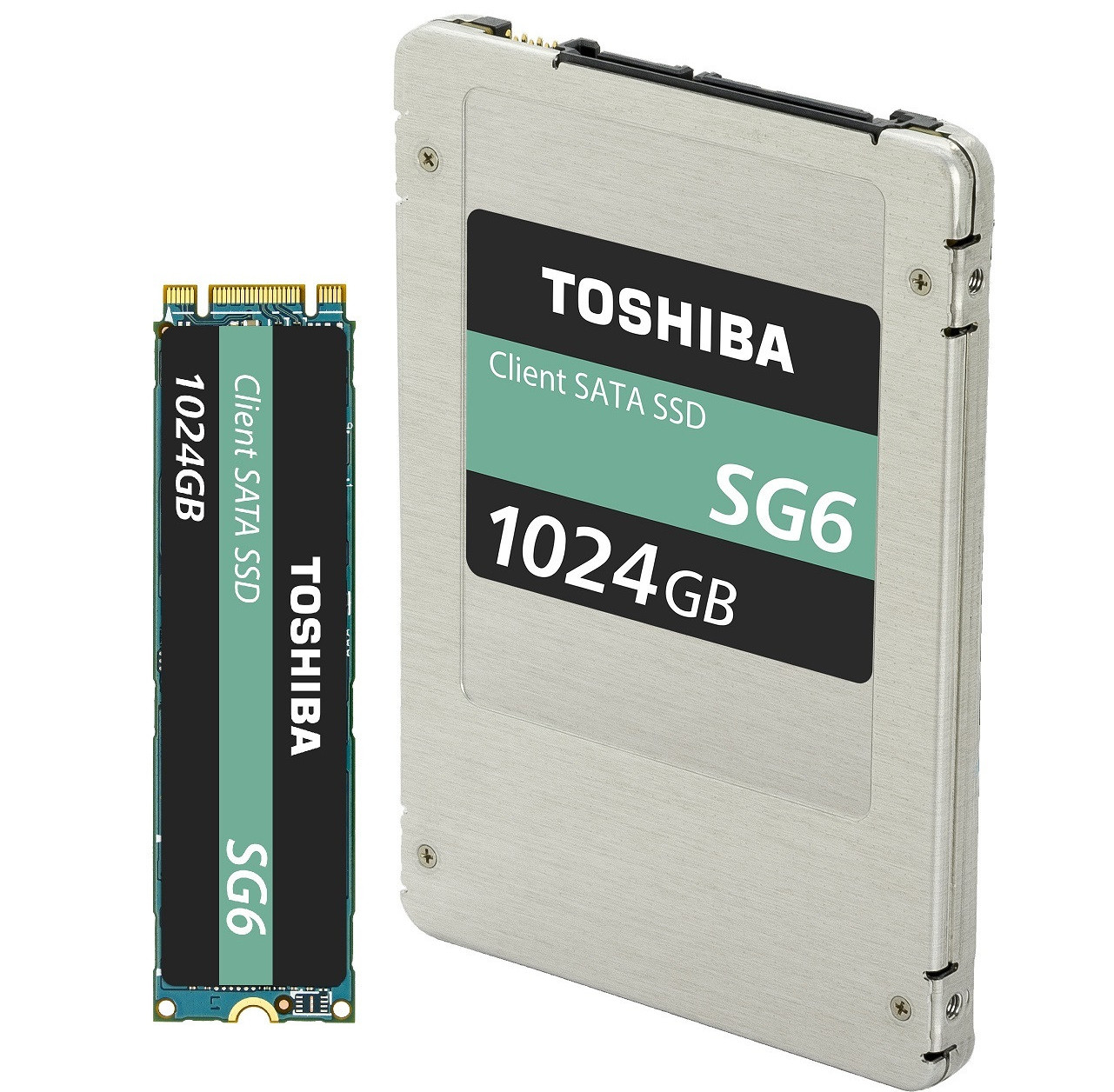
Toshiba Announces SG6 Series SATA Client SSD Utilizing 64-Layer 3D Flash

Toshiba Memory Corporation, the world leader in memory solutions, today announced the launch of the SG6 series, a new line-up of SATA client SSDs utilizing Toshiba Memory Corporation's cutting-edge 64-layer, 3-bit-per-cell (TLC) BiCS FLASH. Sample shipments to PC OEM customers start today in limited quantities, and Toshiba Memory Corporation will gradually increase shipments from the fourth calendar quarter of this year.

The new SG6 series SSDs features a SATA Revision 3.3, 6.0Gbit/s interface, and delivers performance of up to 550MB/s sequential read and 535MB/s sequential write. Thanks to improved flash memory management and performance, active power consumption is cut by approximately 40% compared to previous generation products. This improvement can extend battery life, a plus for many applications including mobile computing.

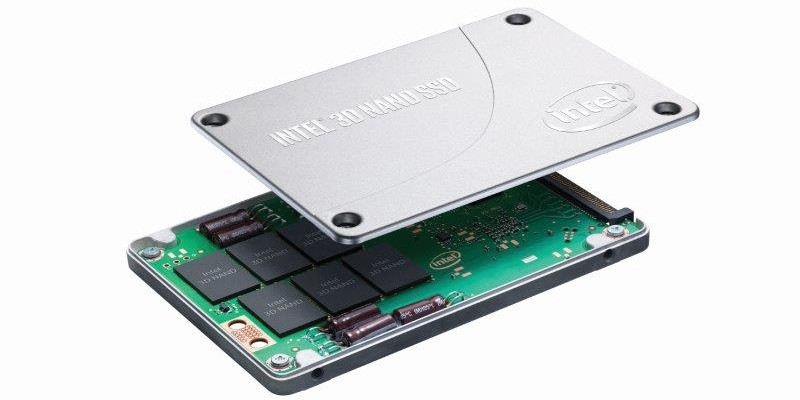
Intel Further Delivers on Storage Transformation with New SSD Form Factor

Today, Intel announces major data center storage advances, reiterating Intel's memory technology leadership. The new technologies advance data center storage and deliver innovative solutions to meet the challenges presented by the growing reliance on data. They include:
  • "Ruler" form factor for Intel SSDs, an all-new solid state drive form factor enabling up to 1PB of storage in a 1U server rack in the future.
  • The world's most advanced dual port portfolio: Intel Optane technology dual port SSDs and Intel 3D NAND dual port SSDs for mission-critical applications.
  • An updated SATA family of SSDs for data center, targeted at HDD replacement.
"We are in the midst of an era of major data center transformation, driven by Intel. These new "ruler" form factor SSDs and dual port SSDs are the latest in a long line of innovations we've brought to market to make storing and accessing data easier and faster, while delivering more value to customers," said Bill Leszinske, Intel vice president, Non-Volatile Memory Solutions Group (NSG), and director, strategic planning, marketing and business development. "Data drives everything we do - from financial decisions to virtual reality gaming, and from autonomous driving to machine learning - and Intel storage innovations like these ensure incredibly quick, reliable access to that data."

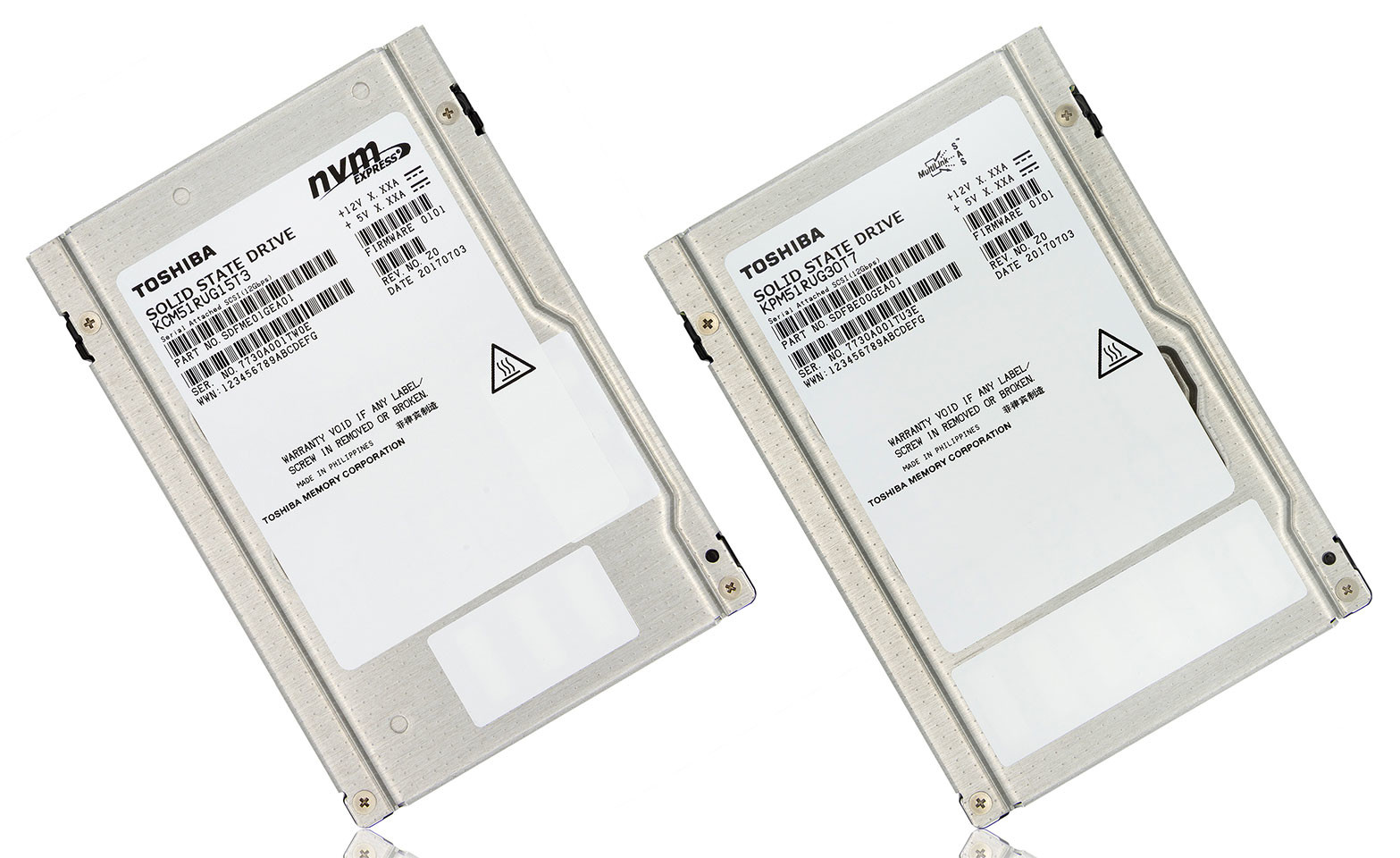
Toshiba Introduces World's First Enterprise-Class SSDs with 64-Layer 3D Flash Me

Toshiba America Electronic Components, Inc. (TAEC), a committed technology leader, today unveiled the development of two new flagship enterprise solid state drive (SSD) solutions, the TMC PM5 12 Gbit/s SAS series and the CM5 NVM Express (NVMe) series. Development is expected to be completed in the fourth quarter. Both product lines are built with TMC's latest 64 layer, 3-bit-per-cell enterprise-class TLC (triple-level cell) BiCS FLASH2, making it possible for today's demanding storage environments to expand the use of flash with cost-optimized 3D flash memory. With all-new, advanced features, the innovative CM5 and PM5 series raise the bar in performance capabilities and create new opportunities for businesses to leverage the power of flash storage.

Offering up to 30.72TB in a 2.5-inch form factor, the TMC PM5 series introduces a full range of endurance and capacity SAS SSDs enabling data centers to effectively address big data demands while streamlining storage deployments. With the industry's first MultiLink SAS architecture, the PM5 series is able to deliver the fastest performance the market has seen from a SAS-based SSD with up to 3,350 MB/s of sequential read and 2,720 MB/s of sequential write6 in MultiLink mode and up to 400,000 random read IOPS in narrow or MultiLink mode. The PM5 series' 4-port MultiLink design is an additional technology to achieve high performance, close to PCI EXPRESS (PCIe)8 SSDs, enabling legacy infrastructures to increase productivity without having to be re-architected from the ground up. Furthermore, PM5 SSDs support multi-stream write technology, a feature that intelligently manages and groups data types to minimize write amplification and minimize garbage collection, translating into reduced latency, improved endurance, increased performance and Quality of Service (QoS).

ASUS Announces ROG Zenith Extreme, ROG Strix X399-E, Prime X399-A X399 Mobos

There are two kinds of desktop CPU platforms. The mainstream tier runs from two cores up to eight, and it's great for gaming and general use. Its high-end sibling takes everything up a level with more cores, more memory channels, and more bandwidth for graphics and storage. A considerable upgrade in every regard, this high-end desktop platform appeals to power users, content creators, and prosumers who want to blur the line between desktop and workstation. AMD's Threadripper CPU is the latest addition to the desktop's heavyweight division, and it walks into the ring with an entourage of SocketTR4 motherboards in tow. This guide explains the ASUS and ROG family to help you pick the best X399 motherboard for your high-end desktop or gaming PC.

All of our X399 boards share core DNA that includes one-touch overclocking, refined cooling control, and improved RGB lighting. Yet they each have their own distinct flavor as well. The ROG Zenith Extreme brings Threadripper into the world of premium dream PCs with provisions for custom liquid cooling and 10G networking. With the Strix X399-E Gaming, hardcore gamers can build stylish rigs with power to spare for high-quality streaming. And then there's the Prime X399-A and its well-rounded foundation channeling the professional side of the platform's prodigious power. Which X399 motherboard should you buy for your build? Let's find out.

Toshiba Announces the TR200 SATA SSDs with 64-layer 3D TLC NAND

Toshiba's first retail SSDs to use the company's 64-layer BiCS3 3D NAND technology have been announced by Toshiba. The successors to the company's Trion 100 and Trion 150 SSDs still carry some vestiges of OCZ branding in the product logo and TR (short for Trion) moniker. This is Toshiba's first generation of mainstream, mass-market-suitable 3D NAND flash.

These drives make use of a DRAM-less controller design, and will be available in capacities ranging from 240 GB up to 960 GB. Toshiba advertises 550 MB/s read and 525 MB/s write speeds. 4K Random Read IOPS stand at 87K, while 4K Random Write IOPS go up to 87K. The endurance on the models will range from 60 to 240 TB according to capacity, and these carry the same three-year warranty as previous Trion SSDs. Pricing has not yet been announced, although the TR200 series will start shipping to retailers this fall.

PNY Launches the CS1311b Budget SSD

PNY Technologies considered one of the worldwide leaders in consumer electronics market and flash memory products, is proud to announce the launch of the new CS1311b solid state drives. Targeting the sweet spot of price against performance, the CS1311b SSDs are 20 times faster than traditional hard drives, promising an affordable solution to boost your PC performance without breaking the bank.

The 2.5-inch form factor SSDs weighing only 35gms and having dimensions of 100 mm (L) x 70 mm (W) x 7 mm (H), can be installed in not only almost every notebook computer and Ultrabook, but even in regular desktop PCs, thus supporting an easy performance upgrade in a very wide range of computers. The absence of moving parts not only guarantees the safety of your data against mechanical shocks, but it also means cool and quiet operation. The very low power consumption easily translates into better battery life for notebook and Ultrabook computers.

Alphacool Intros Eisblock HDX 2 and HDX 3 M.2 SSD Coolers

After developing the compact, very successful Alphacool HDX M.2 SSD cooler, Alphacool is now expanding its product range with the Eisblock HDX-2 and HDX-3 coolers. Both coolers come with a 4x PCIe card, on which the cooler and SSD are mounted. This has many advantages over mounting directly to the motherboard.

Cooling can be difficult on a motherboard due to space constraints and the location of the graphics card, which is often mounted directly above or beside the motherboard. A PCIe card and cooler give you lots of room to set up a good cooling solution. But why do you need to cool your M.2 SSD? When an M.2 SSD is used continuously and for substantial data transfers, it can heat up so strongly that the drive slows itself down and decreases its performance significantly. This can happen after even a few seconds. The only way to solve this problem is with a good cooling solution.

ADATA Launches ISSS314 Industrial-Grade SSDs in 3D MLC and 3D TLC NAND Versions

ADATA Technology, a leading manufacturer of highperformance DRAM modules and NAND Flash products,today launched industrial-grade ISSS314 solid state drives in 3D MLC and 3D TLC versions. All models can withstand a wide temperature range, extreme shocks and vibrations, as well as humidity to meet the needs of industrial users. Using hardened and carefully sorted components, ISSS314 SSDs consume just 2.5W to lower operating costs while providing speedy 560 MB/s read and 520 MB/s write. They are offered in 3D MLC and 3D TLC NAND plus capacities ranging from 32GB to 512 GB in order to better cover and serve as many budgets and needs as possible.

The increased durability and power efficiency of stacked NAND Flash compared to older planar NAND offers very appealing advantages in applications that require non-stop and long term use. The ISSS314 range has an MTBF of 2 million hours, which is 25% more than comparable 2D NAND drives. At the same time, they consume just 2.5W per drive while reaching 512 GB in capacity. Modest power draw translates into major electricity savings over the life of the drive, especially in large installations where many units are needed. Across the range, ISSS314 drives reach 560 MB/s read and 520 MB/s write.

Colorful Intros a Trio of Budget SSDs

Colorful today rolled out a trio of budget SSD lines. These include the CN600 series, the CN500 series, and the SL500 series. The CN600 series is built in the M.2-2280 form-factor with PCI-Express 3.0 x2 wiring, and is characterized by a heatspreader over the controller and NAND flash chips; the CN500 is also built in the M.2-2280 form-factor, but features SATA 6 Gbps wiring; whereas the SL500 is a conventional 7 mm-thick 2.5-inch drive with SATA 6 Gbps interface. All three drives are available in 240 GB capacities.

The CN600 series drives combine a Realtek RTS5760 controller with TLC NAND flash memory, and offers sequential transfer speeds of up to 800 MB/s, with up to 700 MB/s writes, and up to 50,000 IOPS random reads, with up to 100,000 IOPS random writes. The CN500 series drives, on the other hand, pair a Silicon Motion SM2246EN controller with MLC NAND flash, offering up to 530 MB/s reads, with up to 250 MB/s writes, and up to 70,000 IOPS random reads, with up to 60,000 IOPS random writes. Lastly, there's the SL500 series, which combine Silicon Motion SM2256 controllers with TLC NAND flash, serving up 530 MB/s reads, with up to 450 MB/s writes, and up to 80,000 IOPS random access. The company didn't reveal pricing or availability information.
Return to Keyword Browsing
Nov 19th, 2026 00:34 PST change timezone

New Forum Posts

Popular Reviews

TPU on YouTube

Controversial News Posts