Saturday, May 7th 2016

NVIDIA GeForce GTX 1080 Specifications Released
After launching its shockingly fast (claimed) GeForce GTX 1080 and GTX 1070 graphics cards, NVIDIA posted specifications of the former. The two are based on NVIDIA's swanky new 16 nm "GP104" silicon, derived from its "Pascal" GPU architecture. The architecture is detailed in our older article, here. The GeForce GTX 1080 leads the pack, featuring four graphics processing clusters, holding 2,560 CUDA cores. The core runs at a scorching 1607 MHz, with a GPU Boost frequency of 1733 MHz. In one of its demos, NVIDIA overclocked this chip to over 2100 MHz, on its reference air cooling, and the GPU barely scraped 67 °C under stress. The GTX 1080 features a 256-bit wide GDDR5X memory interface, holding 8 GB of memory. The memory is clocked at 2500 MHz (10 GHz effective), working out to a memory bandwidth of 320 GB/s.
API support includes DirectX 12 (feature-level 12_1), OpenGL 4.5, and Vulkan. Display outputs include three DisplayPort 1.4 connectors, one HDMI 2.0b, and one dual-link DVI. The reference-design card is 10.5-inch long, and double-slot. It draws power from a single 8-pin PCIe power connector, and its typical board power is rated at 180W. With the GeForce "Pascal" family, instead of caving in to DirectX 12 native multi-GPU, NVIDIA developed its SLI technology further, with the new SLI HB (high-bandwidth) bridge standard. It's essentially a 2-way bridge in which both SLI fingers of the card are used. This doubles bandwidth between the two cards, allowing higher display resolutions, and multi-display setups between high-resolution monitors. The GeForce GTX 1080 will be available from May 27, 2016, starting at US $599. The $379 GTX 1070 specifications will be revealed closer to its June 10, 2016 market availability.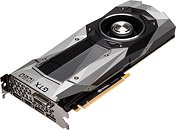
API support includes DirectX 12 (feature-level 12_1), OpenGL 4.5, and Vulkan. Display outputs include three DisplayPort 1.4 connectors, one HDMI 2.0b, and one dual-link DVI. The reference-design card is 10.5-inch long, and double-slot. It draws power from a single 8-pin PCIe power connector, and its typical board power is rated at 180W. With the GeForce "Pascal" family, instead of caving in to DirectX 12 native multi-GPU, NVIDIA developed its SLI technology further, with the new SLI HB (high-bandwidth) bridge standard. It's essentially a 2-way bridge in which both SLI fingers of the card are used. This doubles bandwidth between the two cards, allowing higher display resolutions, and multi-display setups between high-resolution monitors. The GeForce GTX 1080 will be available from May 27, 2016, starting at US $599. The $379 GTX 1070 specifications will be revealed closer to its June 10, 2016 market availability.
103 Comments on NVIDIA GeForce GTX 1080 Specifications Released
Just out of interest, where precisely do you see Nvidia sourcing all this extra HBM2 from even if it were feasible to do so? Nvidia is prepping HPC orders that run into literally tons of HBM equipped cards. Should they divert HBM2 from multi-four-figure Tesla cards to consumer $600 items? Doesn't seem like the best return on investment if you ask me.Yep, you never know - maybe AMD will surprise everyone and jam HBM2 onto a bunch of 128 and 256-bit cards in the sub-$350 markets - that'll show the bean counters in Santa Clara how things should be done.
Capacity of RAM seems far more important (despite the arguments) than speed at this point because it determines whether or not you are sitting there for twenty seconds when a game map loads, waiting for the textures to get shoved into VRAM and/or when you move around and pan the camera in normal gameplay.
If GDDR5x is better, great, but with small bit bus and knowing that past memory benefits little from overclocks, I'd rather have less costly GDDR5 and a lesser priced product.
980 Ti with the same CPU:
videocardz.com/59558/nvidia-geforce-gtx-1080-3dmark-benchmarks
www.3dmark.com/search?_ga=1.82105365.2096704204.1462675606#/?mode=advanced&url=/proxycon/ajax/search/cpugpu/fs/X/1419/1033/15653?minScore=8959&gpuName=NVIDIA GeForce GTX 980 Ti&cpuName=Intel Core i7-3770K Processor
Not much point arguing the whole thing, the reviews will sort out the comparison and sales will sort out its level of popularity. If the doom mongers are as on the money as they usually are, the cards should sell by the million if the previous threads are any indication.Yes, so successful AMD couldn't wait to ditch it and divert production to the overpriced Pro Duo. Maybe the fact that AMD didn't discount the hell out of the cards - pricing them on performance based on the lower tier cards, would provide an inkling to the production costs.
BAh.I returned my 980TI waterforce today. I was really digging it - but when I saw the announcement for May launch (June third party?) I thought it best to send it back now while I still can.
So back to 970 G1 SLI for now, which sadly I haven't been able to sell!
No point selling my card yet. I need to see the big chip. I know if I upgrade (or side grade) to 1080, I'll want to upgrade again to the big chip Pascal.