Saturday, May 7th 2016

NVIDIA GeForce GTX 1080 Specifications Released
After launching its shockingly fast (claimed) GeForce GTX 1080 and GTX 1070 graphics cards, NVIDIA posted specifications of the former. The two are based on NVIDIA's swanky new 16 nm "GP104" silicon, derived from its "Pascal" GPU architecture. The architecture is detailed in our older article, here. The GeForce GTX 1080 leads the pack, featuring four graphics processing clusters, holding 2,560 CUDA cores. The core runs at a scorching 1607 MHz, with a GPU Boost frequency of 1733 MHz. In one of its demos, NVIDIA overclocked this chip to over 2100 MHz, on its reference air cooling, and the GPU barely scraped 67 °C under stress. The GTX 1080 features a 256-bit wide GDDR5X memory interface, holding 8 GB of memory. The memory is clocked at 2500 MHz (10 GHz effective), working out to a memory bandwidth of 320 GB/s.
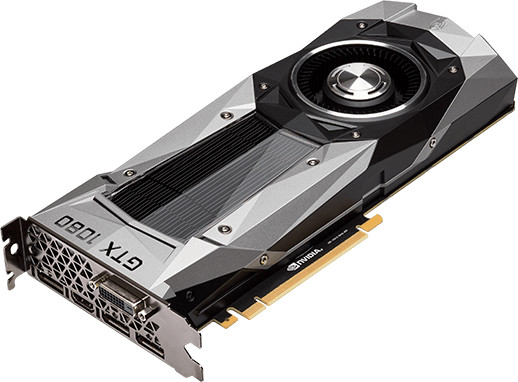
API support includes DirectX 12 (feature-level 12_1), OpenGL 4.5, and Vulkan. Display outputs include three DisplayPort 1.4 connectors, one HDMI 2.0b, and one dual-link DVI. The reference-design card is 10.5-inch long, and double-slot. It draws power from a single 8-pin PCIe power connector, and its typical board power is rated at 180W. With the GeForce "Pascal" family, instead of caving in to DirectX 12 native multi-GPU, NVIDIA developed its SLI technology further, with the new SLI HB (high-bandwidth) bridge standard. It's essentially a 2-way bridge in which both SLI fingers of the card are used. This doubles bandwidth between the two cards, allowing higher display resolutions, and multi-display setups between high-resolution monitors. The GeForce GTX 1080 will be available from May 27, 2016, starting at US $599. The $379 GTX 1070 specifications will be revealed closer to its June 10, 2016 market availability.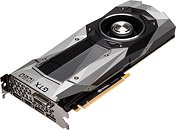
API support includes DirectX 12 (feature-level 12_1), OpenGL 4.5, and Vulkan. Display outputs include three DisplayPort 1.4 connectors, one HDMI 2.0b, and one dual-link DVI. The reference-design card is 10.5-inch long, and double-slot. It draws power from a single 8-pin PCIe power connector, and its typical board power is rated at 180W. With the GeForce "Pascal" family, instead of caving in to DirectX 12 native multi-GPU, NVIDIA developed its SLI technology further, with the new SLI HB (high-bandwidth) bridge standard. It's essentially a 2-way bridge in which both SLI fingers of the card are used. This doubles bandwidth between the two cards, allowing higher display resolutions, and multi-display setups between high-resolution monitors. The GeForce GTX 1080 will be available from May 27, 2016, starting at US $599. The $379 GTX 1070 specifications will be revealed closer to its June 10, 2016 market availability.
103 Comments on NVIDIA GeForce GTX 1080 Specifications Released
OC3D - GTX 1080 Ashes of the Singularity benchmarks
EDIT: It seems like someone has trawled though the db and found Polaris entries as well.
It's not happening. And I seriously doubt a single 1080ti will do the magic of 4k@60 for every game out today and in 2017. Wait, hell no, I'm certain it will not. Because why would we then upgrade to anything else, ever?
4K is the new enthusiast benchmark, but it is far, far away from mainstream still. If anything, 1440p is slowly becoming the new mainstream. Especially because higher FPS is also getting into the picture and you don't just push 4k@120hz, but 1440p is reachable. High FPS is a growing niche, due to the new API's that drastically improve CPU efficiency it also becomes more and more attainable for a greater number of games. In addition, VR needs the high FPS as well - it becomes economically viable to build games and engines around a higher FPS target. If you're serious about your gaming, as in competitive in any way, 4K should be miles away for you, but 1440p@120-144hz is a very nice new sweet spot. 4K is also still plagued by a PPI issue which will move many users back to a 1080p or intermediate resolution. It either requires a very large panel, which forces you to sit further away and essentially lose the detail you paid for due to view distance, or it has scaling issues in games and with text, it being too small to read.
In addition, the 'other' new enthusiast benchmark is VR, which is, on average, 1080p x2 @ 90 fps. Most VR games run at lower resolutions internally to *hopefully* reach that magical 90 fps per eye. Nvidia uses technology (viewports), not raw power, to tackle the VR benchmark. 4K however, is where they have dropped the ball and this is not surprising, because the target market for 4K is fár smaller than the potential market for VR. Why would they cripple their release scheme of +30% per release on similar tier GPU, just to enable a small minority of the market (if it's 5-7%, I'd say that is optimistic)? They won't. Having the GPU do a little trick to enable VR, a far greater potential market share, is more than enough to create incentive.
The 980ti at stock clocks is probably going to end up within a +-10% margin of the actual in-game performance of the 1080 at stock clocks.
1080ti will probably be about 25-35% faster than the 1080. Do the math. You are definitely going to dip below 60 on multiple occasions at 4k. If you like to be optimistic, perhaps add another 10% from your 24/7 overclock, but I'd bank on 5-8% in-game performance from that.
Thanks
and more interesting:
PS
Man, that Polaris bench does look depressing.
We (basically know) the GP104 memory controller can also run standard GDDR5. Will the standard spec 1080's at $599 just have GDDR5? I mean is the memory spec described in such a way that the highest spec can be GDDR5X, though optionally it could be lowered the whole GDDR5/DDR3 kind of thing? Is there enough GDDR5X as it seemed the ramp up was "out of sync" with the needs of High-End Graphics production and volume to have all 1080's that AIB want to release ready for their production? While is it me or is there something amiss with either architecture arrangement or TSCM processes that has such wonky variance of clocks? Probably the latter and will get there as TSCM process improves.
Could it be as GDDR5X production moves up more AIB will offer that spec in OC'd cards, but till then...
It's Nvidia's market strategy - complete opposite of AMD"s. AMD released stock coolers that were cheap and utter junk not too long ago and had multiple big card releases go sour on that. They clearly aimed for the bottom of the spectrum. Nvidia aims for the top end, better brand image etc. etc. etc. so we pay top dollar - and there are tons of people on this forum that will buy into it. Every AMD marketing slide: a lump of red/black plastic. Nvidia marketing slides: shiny metals and bling. AMD had some half-decent attempts at that too recently with the Fury X wcooler and the Wraith. Half decent.
Many vendors ally reduced cooling BoM with higher clocks (MSI's OCV series for example), while other vendors have never shied away from adding OC'ing and a reasonable cooling solution without elevating prices above MSRP (Zotac's AMP series for example). The vendor competition is simply to congested and cutthroat to make the simplistic pronouncement that all OC'ed cards will cost more than $699.
Saying the FE edition has a OC friendly bios leads to questions about the non FEs (not the AOE or LCE those are a given to be better). We have several people reporting they are the same. Pretty much everyone that went to the event and has a YouTube channel is saying they were told they are the same.They also report this.Nvidia needs a unified msg specially on the FEs
People are dreaming if they think they will be buying any 1080 for $599, for at least a few months after launch, and not before AMD has some competition. Then you might have one option like INNO3D at a cheaper price.
...and ffs are we still debating what the founders edition is? Theres still heaps of comments from people saying "wow $599 for 1080 and $379 for 1070 so cheap" and people still think the founders edition might be overclocked, might be this or that. The founders edition is the bog standard reference card.
Gotta give Nvidia credit for marketing, it has obviously worked.
Thought not.
1080, 2100mhz, 45609, 244W, 186.9
1080, 1733mhz, 37193, 180W, 206.6
980ti, 1076mhz, 28690, 235W, 122.1
980, 1250mhz, 22170, 165W, 134.4
Compared to the GTX 980:
stock 1080 vs stock 980: 53.7% improvement in efficiency
OC 1080 vs stock 980: 39.1% improvement in efficiency
stock 980ti vs stock 980: 10.1% decrease in efficiency
wccftech.com/nvidia-geforce-gtx-1080-3dmark-firestrike-benchmarks/
To get those "scores" you not only have to add ALL the Firestrike scores together, you also have to accept that the lowest level of benchmarking (Firestrike Performance) accounts for almost 60% of the total.