Wednesday, May 10th 2017

NVIDIA Announces Its Volta-based Tesla V100
Today at its GTC keynote, NVIDIA CEO Jensen Huang took the wraps on some of the features on their upcoming V100 accelerator, the Volta-based accelerator for the professional market that will likely pave the way to the company's next-generation 2000 series GeForce graphics cards. If NVIDIA goes on with its product carvings and naming scheme for the next-generation Volta architecture, we can expect to see this processor on the company's next-generation GTX 2080 Ti. Running the nitty-gritty details (like the new Tensor processing approach) on this piece would be impossible, but there are some things we know already from this presentation.
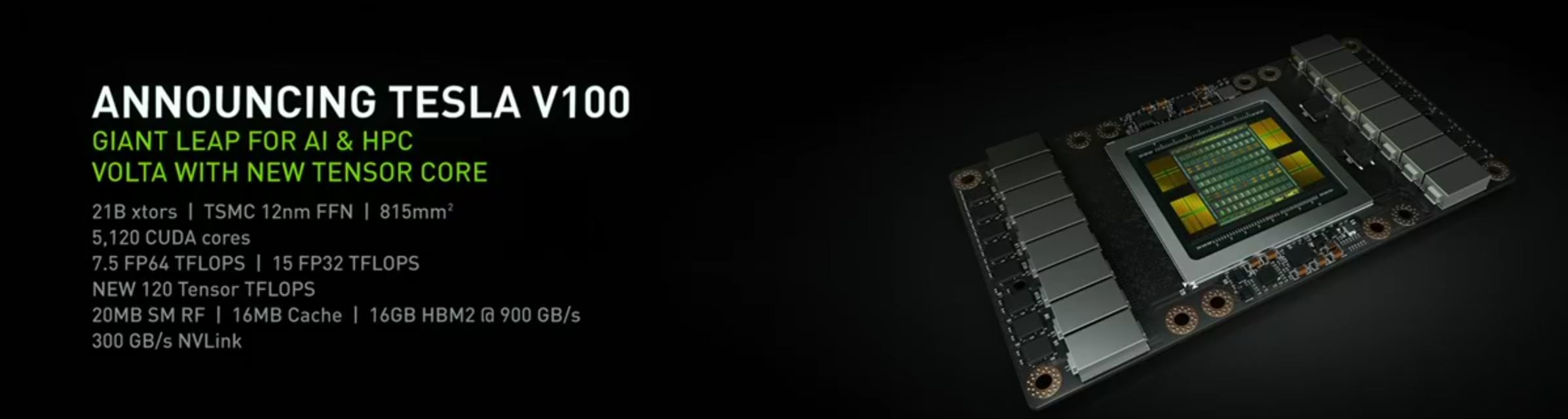
This chip is a beast of a processor: it packs 21 billion transistors (up from 15,3 billion found on the P100); it's built on TSMC's 12 nm FF process (evolving from Pascal's 16 nm FF); and measures a staggering 815 mm² (from the P100's 610 mm².) This is such a considerable leap in die-area that we can only speculate on how yields will be for this monstrous chip, especially considering the novelty of the 12 nm process that it's going to leverage. But now, the most interesting details from a gaming perspective are the 5,120 CUDA cores powering the V100 out of a total possible 5,376 in the whole chip design, which NVIDIA will likely leave for their Titan Xv. These are divided in 84 Volta Streaming Multiprocessor Units with each carrying 64 CUDA cores (84 x 64 = 5,376, from which NVIDIA is cutting 4 Volta Streaming Multiprocessor Units for yields, most likely, which accounts for the announced 5,120.) Even in this cut-down configuration, we're looking at a staggering 42% higher pure CUDA core-count than the P100's. The new V100 will offer up to 15 FP 32 TFLOPS, and will still leverage a 16 GB HBM2 implementation delivering up to 900 GB/s bandwidth (up from the P100's 721 GB/s). No details on clock speed or TDP as of yet, but we already have enough details to enable a lengthy discussion... Wouldn't you agree?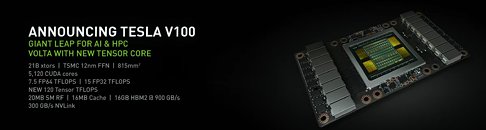
This chip is a beast of a processor: it packs 21 billion transistors (up from 15,3 billion found on the P100); it's built on TSMC's 12 nm FF process (evolving from Pascal's 16 nm FF); and measures a staggering 815 mm² (from the P100's 610 mm².) This is such a considerable leap in die-area that we can only speculate on how yields will be for this monstrous chip, especially considering the novelty of the 12 nm process that it's going to leverage. But now, the most interesting details from a gaming perspective are the 5,120 CUDA cores powering the V100 out of a total possible 5,376 in the whole chip design, which NVIDIA will likely leave for their Titan Xv. These are divided in 84 Volta Streaming Multiprocessor Units with each carrying 64 CUDA cores (84 x 64 = 5,376, from which NVIDIA is cutting 4 Volta Streaming Multiprocessor Units for yields, most likely, which accounts for the announced 5,120.) Even in this cut-down configuration, we're looking at a staggering 42% higher pure CUDA core-count than the P100's. The new V100 will offer up to 15 FP 32 TFLOPS, and will still leverage a 16 GB HBM2 implementation delivering up to 900 GB/s bandwidth (up from the P100's 721 GB/s). No details on clock speed or TDP as of yet, but we already have enough details to enable a lengthy discussion... Wouldn't you agree?
103 Comments on NVIDIA Announces Its Volta-based Tesla V100
I didn't even know this was possible.
It is not that great a graphics card for 21 billion transistors, a lot of which wouldn't run crysis.
Its a good piece of tech ,no doubt but its got that many different types of compute unit in, it will struggle to use it in a lot of use cases and most definately in games but it does have enough raw gfx power for maybe 20-30% on big Pascal maybe.
Hope doesn't come into it.
Basically there is not much need for such a powerful chip in the desktop market, remember that we are looking at a chip that could be as much as twice as powerful as a GP102...
And also from what I can tell, people outside of the enthusiast circle are wary of AMD and give them a bad rep on stuff like the 290(x) heat, driver problems, support, etc.
And to give a personal example: I use x-plane, I basically can't use an AMD card because it runs like garbage on their drivers...
GTX 1070 very close to a GTX 980 Ti and GTX 1080 beat it (Pascal vs Maxwell)
GTX 970 very close to a GTX 780 Ti and GTX 980 beat it (Maxwell vs Kepler)
GTX 670 very close to a GTX 580 and GTX 680 Beat it (Kepler vs Fermi)
But I'm expecting even more from Volta. Things are going to get exciting for gamers in Q1 2018 imo
Why bother using a similar product when the other gives you better performing APIs/programming models, tons of dedicated support-staff and developers for a little more money?
It's no surprise that they were not selling, which is what they are trying to change now.Machine learning and AI will be a no-go if they don't have something similar to the Tensor Cores though.
ATi/AMD's driver did improve quite a lot. They also incorported some pretty cool features(Wattman, ReLive and etc.)
At the same time their software support to developers is seriously lacking. AMD likes to showcase a lot of cool features during a GPU launch, most of which will never see the day light being actually implemented in the driver.
5870 (was as fast as dual GPU cards like 4870x2 and GTX 295) vs GTX285. Was more power effcient. Fermi arrived late, was hot and power hungry, although faster. 5800 series first to support eyefinity or multi-montor gaming.
R9 290/x vs 780/Titan
Pretty much the same through the midrange as well. The masses will buy nVidia, regardless of what AMD makes. Nvidia knows this, which is why they are selling midrange GPU's at higher prices. Like the 1080 launching at around $700 was it.To be fair, there was poor opengl performance way back in the early 2000's. One of the reason the FX series did better in Doom 3 vs the Radeon 97/800 series. This hasn't been the case for awhile, except maybe in linux where the OpenSource driver is really turning things around and is now much faster in most OpenGL scenarios than the proprietary drive.
Anyway nvidia has been doing the better overall product in the last ~10 years hands down, and it's not because people are stupid they're buying nvidia, or at least not all of them, as i said elsewhere, they both have the reputation they deserve more or less, it's not like ATi or AMD deserve more than what nvidia has now, they deserve less because they did worse, stop thinking that some kind of conspiracy or any sort of stuff, is the only reason AMD is in this position, it's actually hardly A reason to begin with.
so we can keep laughing...
Death of RX Vega based GPU.
So please share, how did AMD do so bad? Where they failed was marketing and getting game devs on board. Which they are working on correcting now. nvidia won early on, IMO, because of their The Way Its Meant to be Played marketing strategy and later on GimpWorks. You could see this loading at the start of many games back in the day. I remember seeing this at the begining of UT2003/4 as the skar busted through it, there was a mod to change it to an ATi, logo.
And speaking about the GPU: it has nothing to do with "Titan Xv" it's Tesla, comparable to P100, which will not be used for the Titan series or GTX series of gaming/"normal" workstation cards. A smaller version of it could be possible used for gaming, leaving the unnecessary bits aside, maybe with 4500 shaders then for the full GV102 (successor to GP102). The first Titan "X" which wie will again name by ourselves "Titan XV" will be the cut off version with 4200 shaders and then 1 year later they will bring the full version with 4500 shaders (named Titan Xv of course, resembling "Titan Xp", nvidia playing it "smart" again) and a GTX 1280 Ti with 4200 shaders like the "Titan XV" one year before it.
/speculation mode. But it makes a lot of sense, at least if everything goes to plans of nvidia. ;)