Wednesday, July 18th 2018

Antitrust: European Commission Fines Google for Record €4.34 billion for Illegal Practices
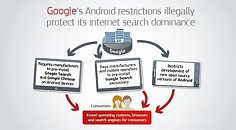
It's a record-setting fine: the European Commission has officially ruled that Google must pay a fine of €4.34 billion for breaking antitrust laws, specifically related to the implementation of its services within the Android ecosystem. The three key areas within which the EC has found wrongdoings pertain to bundling of its search engine and Chrome apps into the operating system; blocking phone makers from creating devices that run forked versions of Android (claiming, without proof, that these versions would offer more security risks), and "made payments to certain large manufacturers and mobile network operators" to exclusively bundle the Google Search app on handsets.
Google now has 90 days to comply with the EC's decision (notwithstanding payment of the fine), which Google, obviously, has already announced will appeal the decision. In a statement to The Verge, a Google representative said that "Android has created more choice for everyone, not less. A vibrant ecosystem, rapid innovation, and lower prices are classic hallmarks of robust competition," and that Google "(...) will appeal the Commission's decision." The idea here seems to be to stop Google from forcing manufacturers to bundle their app and search software stacks - many times in a seemingly unremovable way. You can check the press release in the source link, but some of the more interesting snippets have been collated after the break.
Sources:
European Comission Press Release, via The Verge
Google now has 90 days to comply with the EC's decision (notwithstanding payment of the fine), which Google, obviously, has already announced will appeal the decision. In a statement to The Verge, a Google representative said that "Android has created more choice for everyone, not less. A vibrant ecosystem, rapid innovation, and lower prices are classic hallmarks of robust competition," and that Google "(...) will appeal the Commission's decision." The idea here seems to be to stop Google from forcing manufacturers to bundle their app and search software stacks - many times in a seemingly unremovable way. You can check the press release in the source link, but some of the more interesting snippets have been collated after the break.


Pre-installation can create a status quo bias. Users who find search and browser apps pre-installed on their devices are likely to stick to these apps. For example, the Commission has found evidence that the Google Search app is consistently used more on Android devices, where it is pre-installed, than on Windows Mobile devices, where users must download it. This also shows that users do not download competing apps in numbers that can offset the significant commercial advantage derived through pre-installation.
(...)
The Commission also assessed in detail Google's arguments that the tying of the Google Search app and Chrome browser were necessary, in particular to allow Google to monetise its investment in Android, and concluded that these arguments were not well founded. Google achieves billions of dollars in annual revenues with the Google Play Store alone, it collects a lot of data that is valuable to Google's search and advertising business from Android devices, and it would still have benefited from a significant stream of revenue from search advertising without the restrictions.
(...)
Google granted significant financial incentives to some of the largest device manufacturers as well as mobile network operators on condition that they exclusively pre-installed Google Search across their entire portfolio of Android devices. This harmed competition by significantly reducing their incentives to pre-install competing search apps.
(...)
The effects of Google's illegal practices
The Commission decision concludes that these three types of abuse form part of an overall strategy by Google to cement its dominance in general internet search, at a time when the importance of mobile internet was growing significantly.
First, Google's practices have denied rival search engines the possibility to compete on the merits. The tying practices ensured the pre-installation of Google's search engine and browser on practically all Google Android devices and the exclusivity payments strongly reduced the incentive to pre-install competing search engines. Google also obstructed the development of Android forks, which could have provided a platform for rival search engines to gain traffic. Google's strategy has also prevented rival search engines from collecting more data from smart mobile devices, including search and mobile location data, which helped Google to cement its dominance as a search engine.
Furthermore, Google's practices also harmed competition and further innovation in the wider mobile space, beyond just internet search. That's because they prevented other mobile browsers from competing effectively with the pre-installed Google Chrome browser. Finally, Google obstructed the development of Android forks, which could have provided a platform also for other app developers to thrive.
Consequences of the decision
The Commission's fine of €4 342 865 000 takes account of the duration and gravity of the infringement.
53 Comments on Antitrust: European Commission Fines Google for Record €4.34 billion for Illegal Practices
We have Apple that is free to put up any fences they want, because they control their phones from top to bottom. We have Google that gives everyone the OS for free, but requires some apps be installed by default so they make some money back through ads. And we had Windows Phone that carried a licensing fee and like iOS didn't allow customization at all (afaik). How is Google the bad guy here? I'd really like to know.
The one which incidentally wants to have most of your private info, credit card number, and whatnot; has search history and scans your email for keywords (last one without visible notice, perhaps it was hidden somewhere in huge end user agreement) - or, to be paranoid, sells you a OS on device with camera and microphone where mic is always 'on' to hear 'OK, Google' - does it listens for something else, too? Does it listens only what owner says? And Google has highly developed voice recognition and translation software, too. Paranoid person can't feel safe as long as any Google-powered device is around. Non-paranoid one just doesn't care about those.
I stopped using smart-phones (tending to be paranoid) several years ago, but for everyone - it's (in my firm belief) not a question *what if it happens* if Google is hacked, but rather *when it happens* or *did it happened already*. There's no 100% unbreakable system - and having years of information all in one basket...
And I'm happy because of EC penalty and hope this is just a beginning - not only for Google, but all companies in similar position. Someone might remember at some time Microsoft was near to be separated into several companies (by US laws and on their initiative), because 'monopolistic behaviour'....
And the answer is, because EU laws were not clear in this area, nobody could tell whether Google's actions were legit or not. However, when you have rules that you yourself aren't sure how to enforce, a lengthy investigation that ends up in a huge fine seems to be just about the worst way to go about it.
Also, I'm still puzzled at people acting like gmail scanning emails was some shady thing Google does. I've had a gmail address since the thing was in beta and invitational only. And it was crystal clear for every user back then that the service was about targeted advertising by scanning emails. I don't know how almost 15 years later people act like this is surprising: it was crystal clear from day 1.
Your example: Company A is having Company A's Software on Company A's branded hardware that is sold/distributed by Company A/x/y/z.
Example in the article: Company A is having Company A's Software on Company B's branded hardware that is sold/distributed by Company x/y/z.
Wanna play spot the differences?
Legally, the EU can look at this however they want. But the truth is if Android was more "free for all", it would be a much worse ecosystem. Just at what giving manufacturers the freedom to install skins did.
Try installing an App from anywhere else but their closed shop and you get nowhere.
Admittedly you meant Android, but Apple pisses me off enough to warrant a mention.
So Google is threatening that google software may no longer be free after this lawsuit.
It's not like it's a bait and switch. They knew these details when they agreed to license the Play Store. Your choice is to not license it and go with another option - and if there are no appealing other options, create it yourself, and go through the all the R&D costs, and growing pains, then you can make your own decisions on how you share your own product, or not.
And yes, I agree about Play Store: there's no Play Store in China, so technically it can be done.
The decision to put Opera on my phone was that of ZTE....
Isn't it funny how every phone manufacturer customizes the OS to their standards and that of the carrier that it works on and yet Google is at fault.....
No this decision is quite stupid...
Methinks this is nothing but extortion to help pay for the Nanny state.