Wednesday, April 17th 2019

NVIDIA GeForce GTX 1650 Specifications and Price Revealed
NVIDIA is releasing its most affordable graphics card based on the "Turing" architecture, the GeForce GTX 1650, on the 23rd of April, starting at USD $149. There doesn't appear to be a reference-design (the GTX 1660 series lacked one, too), and so this GPU will be a partner-driven launch. Based on NVIDIA's smallest "Turing" silicon, the 12 nm "TU117," the GTX 1650 will pack 896 CUDA cores and will feature 4 GB of GDDR5 memory across a 128-bit wide memory interface.
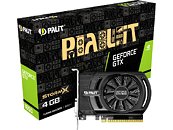
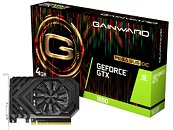
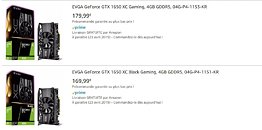
The GPU is clocked at 1485 MHz with 1665 MHz GPU Boost, and the 8 Gbps memory produces 128 GB/s of memory bandwidth. With a TDP of just 75 Watts, most GTX 1650 cards will lack additional PCIe power inputs, relying entirely on the slot for power. Most entry-level implementations of the GTX 1650 feature very simple aluminium fan-heatsink coolers. VideoCardz compiled a number of leaked pictures of upcoming GTX 1650 graphics cards.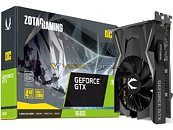
Sources:
VideoCardz, VonGuru
The GPU is clocked at 1485 MHz with 1665 MHz GPU Boost, and the 8 Gbps memory produces 128 GB/s of memory bandwidth. With a TDP of just 75 Watts, most GTX 1650 cards will lack additional PCIe power inputs, relying entirely on the slot for power. Most entry-level implementations of the GTX 1650 feature very simple aluminium fan-heatsink coolers. VideoCardz compiled a number of leaked pictures of upcoming GTX 1650 graphics cards.


109 Comments on NVIDIA GeForce GTX 1650 Specifications and Price Revealed
trog
e: Hell, I'm running an overclocked/overvolted R9 290 myself and I don't give a crap about power consumption, but when I once say something positive about low power consumption, then there's this "what's the need of a card like this" etc. :confused:
This also means the price for these is rather high if you look at the whole lineup (RX560 vs RX570, GTX1050 vs GTX1050Ti). That's simply because for a big part of target consumers these cards have no competition from the higher models. Hence, they're willing to pay a premium as if GTX1050 was the top performer (just like you would pay a premium for 1080Ti).
Even if you accept a larger form factor, moving from GTX1050 to GTX1050Ti could mean you have to replace the case, the PSU or improve airflow. It all costs.
RX570 pulls 190W under heavy load and over 170W in gaming. Even if you make a small one, it may not fit in a power budget that many SSF systems provide (~200-300W).Why not? Why wouldn't low-power PCs evolve like everything else?
With your logic, SFF would still perform as they did in the 90s.
Where I live (Poland) virtually all low-end office desktops end up on second market as cheap home PCs - often with a GPU that wasn't available originally. :-)
Here's an example:
allegro.pl/oferta/komputer-do-gier-dell-i5-gtx-1050ti-16gb-ssd-250gb-7814277348
i5 2400, 1050Ti, 16GB RAM, SSD, legal Windows Pro, 12 month warranty. Not bad for ~$500.
It's "minitower" rather than SFF, but actually quite small - similar to FR Define Nano S.
There are better deals on used HP, but I just can't stand the looks of their office cases. :-D