Monday, April 22nd 2019

AMD Ryzen 3 3200G Pictured and De-lidded
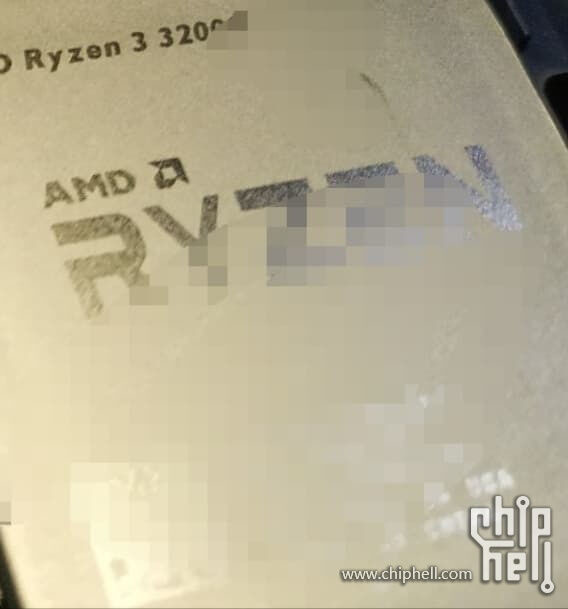
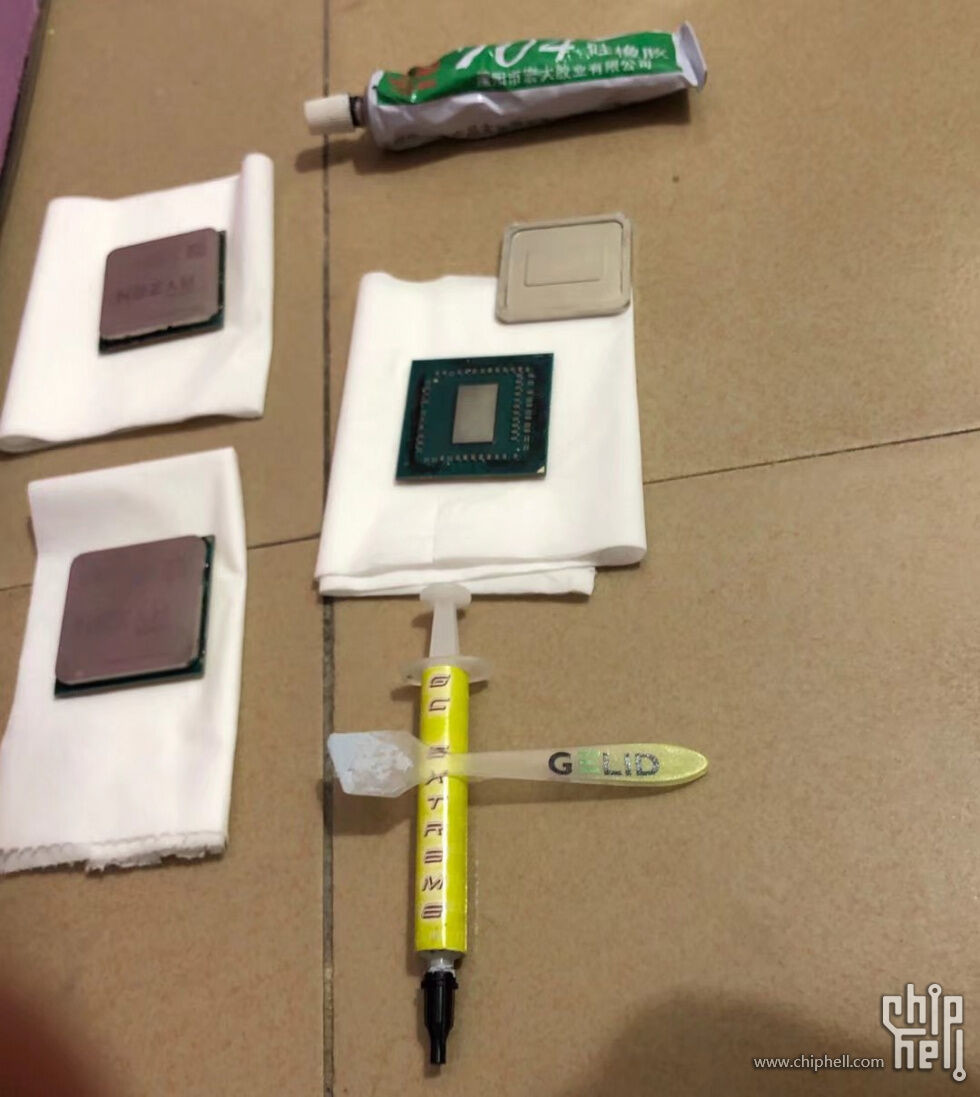
AMD Ryzen 3 3200G is an upcoming processor featuring integrated graphics, forming the tail-end of the company's 3rd generation Ryzen desktop processor family. A Chinese PC enthusiast with access to an early sample pictured and de-lidded the processor. We know from older posts that while the "Matisse" MCM will form the bulk of AMD's 3rd gen Ryzen lineup, with core counts ranging all the way from 6 to 12, and possibly 16 later, the APU lineup is rumored to be based on older "Zen+" architecture.
The Ryzen 3 3200G and possibly the Ryzen 5 3400G, will be based on a derivative of the "Raven Ridge" silicon built on the 12 nm process at GlobalFoundries, and comes with a handful innovations AMD introduced with "Pinnacle Ridge," such as an improved Precision Boost algorithm and faster on-die caches. The 12 nm shrink also allows AMD to dial up CPU and iGPU engine clock speeds, and improve DDR4 memory support to work with higher DRAM clock speeds. AMD has used thermal paste as the sub-IHS interface material instead of solder for its "Raven Ridge" chips, and the story repeats with the 3200G.
Sources:
ChipHell Forums, ComputerBase.de
The Ryzen 3 3200G and possibly the Ryzen 5 3400G, will be based on a derivative of the "Raven Ridge" silicon built on the 12 nm process at GlobalFoundries, and comes with a handful innovations AMD introduced with "Pinnacle Ridge," such as an improved Precision Boost algorithm and faster on-die caches. The 12 nm shrink also allows AMD to dial up CPU and iGPU engine clock speeds, and improve DDR4 memory support to work with higher DRAM clock speeds. AMD has used thermal paste as the sub-IHS interface material instead of solder for its "Raven Ridge" chips, and the story repeats with the 3200G.
49 Comments on AMD Ryzen 3 3200G Pictured and De-lidded
700-series had GPUs built on 3 architectures (Fermi, Kepler and Maxwell):
en.wikipedia.org/wiki/GeForce_700_series#GeForce_700_(7xx)_series
600-series was Fermi and Kepler.
Since 900-series generations have been homogeneous on desktops. We'll see how long this lasts.
As for mobile: high-end chips are using the latest tech, because that's were the performance is.
Low-end chips (MX) are often a generation behind to use the remaining inventory.
Nvidia is also (in)famous for selling vastly different chips under the same name. It happened in both MX250 and MX150 (big performance variance).
They also sold 920M based on both Fermi and Kepler chips.
What has to be said, is that the these low-power chips are put in low-end laptops and ultrabooks. They're tuned by the OEM depending on cooling, so there's usually a huge performance variance.
So one shouldn't really be worried that he got a "poor" MX150. The "full" variant would be limited anyway. :-)
Maybe you should just ask google if computers can be used for something other than gaming?I'd assume CPU and GPU divisions at AMD talk with each other and can develop products together.
Intel launched i7-8809G less than 5 months after Vega was announced.
Designs as fairly universal - holding features for both home and pro use or both PC and server, which are simply locked in particular products.
If you dig deep enough, it might quickly turn out that no CPU can be called "full Zen" or "full Kaby Lake". ;-)
For what it's worth, I don't care if it's 28nm, just give me moar cores and moar iGPU powa-a-a under $120, so I can finally get all my neighbors and their kids off my back by building a bunch of glorified HTPCs and satisfy their insatiable obsessions with WoT, Warframe, CS:GO and Dota.
How much synergy do you believe there is between Nvidia GPU & Tegra (CPU) division btw & when was the last time they updated their ARM cores?
Intel's revenue from CPUs bought for desktops w/o a graphics card is higher than AMD's revenue from all CPUs combined.
Maybe AMD can't provide the necessary supply. Maybe they simply want to focus on DIY gaming segment - it's their choice after all.
Speaking of choices, if you haven't decided what to do this evening, why not work on your understanding of CPU market...?
Reading some of the discussions on this forum, I get the impression that calling someone "PC enthusiast and expert" has depreciated somehow.
I may be old-school, but I'll stand by the idea that you're not an cooking expert if you can only cook spaghetti - even a very good one.A "workstation" notebook is a small niche on the expensive end of the notebook spectrum.
Vast majority of business notebooks and ultrabooks are using Intel HD. In these segments adding an MX150 affects the price considerably.What...?
For 2 years I've been hearing how 8 cores are awesome for "productivity" and now you're telling me high core count isn't needed in desktops? Seriously?
Lack of configurability and BIOSes lacking essential options are things that make me hate laptops since forever.
Dell Inspiron, Latitude and XPS lineups,
Lenovo ThinkPad lineup (E, L, T, X).
Most of these laptops can't be configured with a dGPU at all.
A good configuration of Latitude, XPS, ThinkPad T or X can easily go past $1500. If that's cheap in your eyes - well, congratulate. :-)
In fact I don't really know many laptops that aren't available without a dGPU (apart from the gaming ones, obviously).Even a $600 Dell Vostro can be bought with 4-year warranty (next business day on-site service). Dell's premium business products (Latitude and Precision) offer up to 5-year warranty.Which may be the reason why you don't really follow this market... ;-)
I stay away from discussing things that I do sporadically or know virtually nothing about.
What's your definition of a niche? The entire "ultra expensive (workstation) notebook" is a niche of a niche.
How much does an MX150 cost according to you? I have one with 8250u in under $600, either you're being disingenuous or you don't know what you're talking about. I also want to remind you what you said - 6, 8 core APU - which are super expensive in notebook space.
I said high core count APU with IGP, try to keep up. AMD can easily slap a low power Zen2 model in there if more cores is what you want, Intel is releasing their 8 core i9 & needless to say they're likely gonna throttle in those "notebook" abominations. Zen2 being nearly 2x as efficient as original Zen could easily garner lots of market share, provided OEM & ODM do their bit to try & make it work.
www.ultrabookreview.com/20056-core-i9-portable-laptops/
So it seems the necessity of >4 cores depends on the processor brand being discussed.I'm precisely talking about scientific/professional use of a PC.
4 cores is fine. 8 cores are better... assuming you could utilize the 4 you had.
This has been the whole Ryzen theme for 2 years. Productivity, creativity, science etc. etc.
So these hundreds of millions of people who spend 8 hours a day looking at Excel don't need anything above an IGP. And, to be honest, most of them can live with 4 cores (or even 2). But Excel can use as many cores as you have, so going from 4 to 8 will let them spend less time watching the progress bar. :)
Reading some comments here, it seems like some people assume that high-end computing (high-end business PCs and workstations) are powerful in both CPU and GPU components. So an 8-core Ryzen is fine, because they'll be an expensive GPU as well.
This is not true. Most tasks done on computers are CPU-exclusive - simply because that's how computers work. There is a very big demand for computers with powerful CPUs and minimal GPUs.
In fact many top500 supercomputers run thousands of Xeons and don't have a GPU at all, which shows that CPU-exclusive loads scale way beyond 8 cores. :)I'm not saying you can't use a CPU without a GPU (google: Xeon Platinum).
I'm precisely saying that there's a very large part of the market which is concerned about CPU performance, but can live with whatever GPU you put into the mix (as long as it can run two 4K monitors).
These people just won't pay for a dGPU, when IGP is good enough.
And since office desktops got really small lately, they also don't miss the big boxes that we used in the past.But you keep writing here...Possibly as much as a 1030. So?
dGPU is not the total cost here. In both laptops and desktops it affects the design.Which likely means you could have got an 8550u instead.
That's the whole point. One could use this money and get a more powerful CPU or something useful (larger disk, illuminated keyboard).
If you're fine with Intel HD, every dollar spent on MX150 is wasted. Why would people waste money?Actually wrong: a 6-core 8850H is CHEAPER than a 4-core 8650U. Both with HT.
$395 vs $409. Check it:
ark.intel.com/content/www/us/en/ark/compare.html?productIds=124968,134899That's the whole point of this discussion, isn't it? If AMD can do this, why don't they?
Intel did. And AMD was supposed to have the upper hand in core count.
cheapexpensive the i9 is, not to mention the extensive cooling as well as power adapter required for 45/65W parts?Because they're not out yet? Intel had at least a couple of major advantages over AMD in the notebook space, higher ST performance & wireless solutions. Now AMD can counter the former with zen2 but they also need to keep the rest of the costs down. AMD can have the performance advantage here but that'll not necessarily be enough, I'll go back to the Atom example - Intel lost not only because they had worse performance than ARM but largely because QC would crush their wireless solutions.Outside of the DIY market, the entire package & component costs matter. This is why, as you might've noticed, Intel is pushing for an entire Intel centric ecosystem. They've been majorly successful because they are the incumbents & they provide class leading performance in many segments.
AMD can however get their previous share back in two ways -
1) The buyers demand it - I'm not sure how that'll work but perhaps word of mouth?
2) They keep the prices down - their perennial "budget" brand image problem!
Yes, there is also an expensive i9, but you don't have to buy it to get 6-cores.
And it's aimed at high-end mobile workstations, so the total price will be huge anyway. Intel knows they can ask almost $600, so they do. Why not? Again: it's an opportunity AMD ignored.AMD could make a product similar to Intel's Kaby Lake-G. They haven't.
In fact AMD could design Zen to include a simple IGP similar to Intel's. They haven't.
Now AMD will launch a chiplet design with a huge I/O die that can easily house a Vega 3 (at least). We'll see what happens.And none of these has been addressed by AMD.Actually they don't. It's a business strategy they've chosen.
They could have gone for quality, features and ease of use. They haven't. And they pushed some costs on you - like the time you have to spend to choose a good RAM and set it up. With Intel, you pay extra for a plug&play experience.Which is exactly why AMD didn't have to go the "cost cutting" way. They could have made Zen a perfect product for laptops and business desktops.
You, as a DIY enthusiast, wouldn't benefit (you'd have another expensive option next to Intel). But AMD might have already had 20-30% market share. They don't and won't. They're not making a product that's attractive to 30% of clients.Intel is pushing an entire ecosystem simply because shareholders expect it to grow and there's no more potential in CPUs. Every business is expected to grow.
That's why they're trying luck in GPUs, modems, memory, IoT and so on. None of these market has the profit margin of CPUs, but Intel has no choice.
And if one day Intel dominates computers and makes every possible part, they'll start making shoes or ships.
It just should not be a factor anymore, it should not be something to even think about or worry about anymore.
It's a computer. It's just a tool needed to do stuff. In many areas it is not a frontier of technology. We control it, we've learned how to make some things simpler and cheaper.
Early PCs used to cost $2000 (in current money). Now they're under $500.
These APUs, like most processors available today, stay far from the max temperature they can survive even with stock cooler. It makes no sense to lower it further.
Now, I totally understand that you may be a fan of low temps and you would simply FEEL better if the readout on your screen said 50*C instead of 60*C. Fine. You can pay $1000 for awesome watercooling. You can pay to get the CPU modified to liquid metal. The choice is yours. Have fun with your money.
Seriously, you can't expect millions of people to pay $2 each, just because you're cheap.
static.techspot.com/images2/news/bigimage/2019/04/2019-04-20-image-8.jpg