Monday, March 9th 2020

Intel Core i5-10400 Pictured and Detailed, New Mid-range Gaming Champion in the Making?
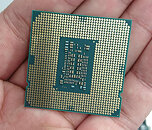
Here are two of the first pictures of Intel's upcoming Core i5-10400 processor, based on the company's 10th generation, 14 nm "Comet Lake-S" silicon. With its 10th generation, Intel is looking to bolster its Core i5 desktop processor series by introducing HyperThreading and increased L3 cache to existing price-points. The i5-10400 is hence a 6-core/12-thread processor with 12 MB of shared L3 cache at its disposal, compared to 9th and 8th generation Core i5 desktop chips being 6-core/6-thread with 9 MB of L3 cache.
The Core i5-10400 succeeds the popular Core i5-9400/F and its equally popular predecessor, the i5-8400. The iGPU-devoid i5-9400F in particular owed its popularity to Intel pricing it $15-20 less than the standard i5-9400. The upcoming i5-10400 is expected to be priced under the $200 mark, with the i5-10400F being similarly discounted. Both chips feature identical CPU specs: 2.90 GHz nominal clock speeds, up to 4.30 GHz maximum Turbo Boost, and 4.00 GHz all-core Turbo Boost. As the chip lacks an unlocked multiplier, its TDP is reportedly rated at 65 W. The chip will compete with AMD's Ryzen 5 3600 for sub-$200 supremacy. The 10th generation Core desktop processor family is built in the new LGA1200 package, and launches alongside the new Intel 400-series chipset, in April.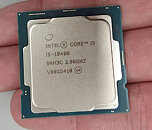
Sources:
PTT.cc, VideoCardz
The Core i5-10400 succeeds the popular Core i5-9400/F and its equally popular predecessor, the i5-8400. The iGPU-devoid i5-9400F in particular owed its popularity to Intel pricing it $15-20 less than the standard i5-9400. The upcoming i5-10400 is expected to be priced under the $200 mark, with the i5-10400F being similarly discounted. Both chips feature identical CPU specs: 2.90 GHz nominal clock speeds, up to 4.30 GHz maximum Turbo Boost, and 4.00 GHz all-core Turbo Boost. As the chip lacks an unlocked multiplier, its TDP is reportedly rated at 65 W. The chip will compete with AMD's Ryzen 5 3600 for sub-$200 supremacy. The 10th generation Core desktop processor family is built in the new LGA1200 package, and launches alongside the new Intel 400-series chipset, in April.


88 Comments on Intel Core i5-10400 Pictured and Detailed, New Mid-range Gaming Champion in the Making?
I think people want new tech not the same old stuff wiith different names. But you said it GAP FILLER and you're correct, sadly!
These gaps only get larger, not smaller over time. And when its about best choice for a gaming CPU... an AMD equivalent with the same clocks and the same core/thread count will perform worse. Not similar, but consistently worse for gaming. Despite higher IPC. Its not ballpark the same, its a gap.
But... that still doesn't make this 10400 a 'gaming CPU' by any stretch. Its just mainstream performance :p And yes, in the larger scheme of things, I do agree the gap is too small to favor either one over the other at the same price. Most people do have more purposes for CPUs than gaming.
www.sweclockers.com/test/27760-amd-ryzen-9-3900x-och-7-3700x-matisse/28#content
Everything about i5-10400 comes down to specific specs. Price, clocks and TDP.
If (and it is a big if) they will place this exactly on par with i5-9400 it will definitely be a contender. i5-9400/F is by-the-spec 65W CPU, runs at reasonable enough 3.9/4.1GHz clocks and is not far behind R5 3600(X) in gaming. With 10-series i5 having HT back, the difference will be even smaller. i5-9400 tends to be sold for over MSRP (RCP $187 but sells for a bit under $200) while i5-9400F is sold under MSRP (RCP $157 but sells for about $140). i5-10400, F or not, for $150 would be trouble for AMD. Knowing Intel though, they will probably overprice it anyway :)
This time, AM4 longevity will only be a boost for people upgrading from previous Ryzens. As far as new systems go, if Intel keeps the usual 2 generations per socket model, it is right on par with AM4.This is technically true but only serves to usher a buyer towards cheaper CPU. While cheap R5 3600 has outmatched i5 9400F for now - mainly thanks to extra threads - if Intel happens to put out a 6c/12t CPU like i5-10400 in the same price bracket, this will be a close call.
"Unlocked multi" on an AMD CPU is just a sales gimmick, an attempt to keep public confidence up that they still support overclocking. Which they don't.I agree, it would have been a "mid" range championship material chip had intel gone with an unlocked mutli. But I guess they don't want their 6 core chips to be performing as well as their high level i7 and i9 variants relative to gaming. Like how an overclocked 9600K closes the gap with Intel's 9900K to within a few percentage points...
Likely explanation:
[/QUOTE]
Right. The AMD chips suffer from incredibly "bad" latency as far as I am concerned. However, the end user sitting at the computer is likely not going to notice much of a difference between them unless they know what to look for. To give you an idea of the problems surrounding Ryzen and latency, take a look at the "how low can you go benchmark comp": It's almost all Intel i5-i7-i9 on top and almost all Ryzen on bottom. To add insult to injury, look at the two fastest AMD chips. One is a Phenom II and the other is a X2 6400!!! AMD cant even compete against decades old tech from their own company! Im not trying to rub AMD fans noses in the dirt, as I said, the difference is hardly noticeable, but, In my opinion, as a tweaker, this oversight, in trying to Frankenstein the very flawed FX IMC into Ryzen is simply unacceptable. Because the chip is otherwise, outstanding.
I'm actually excited about this chip for budget builds if it is priced right... Considering you can get a 3600 for around $165 lately if intel prices this at $150 it could be a really nice budget options I'm just glad they're ditching 6 thread i5 as they need to die.
Hexacores in my book offer the perfect blend of performance. First of all, less heat.
There are many, many people out there who will never tap in to the outermost cores X7 and X8 and heck, they might not even load up X6 and X7.
RTX GPU stream pretty damn good these days without a huge hit to performance so that's a good alternative.
At the same time the majority of people in this price range having potato gpu well under a 2060/5700 class card means it may not matter even if they have a Ryzen 1500X for the life of the platform and at that point you may as well still get the cpu with actual better general performance that a 12 thread cpu will give you especially at the same price.
Am4 is a different animal as amd supports more cpu generations per socket and lower price previous generation offerings giving budget shoppers more choice even if they had to go quad core at the start.
Unlike you and me who will likely ditch their motherboards and systems after 2-3 years if necessary making it irrelevant.
In any event, since we are talking about six cores, I thought this was an interesting comparison:
It's clear AMD is making great processors, and their six core 2600X variant takes down it's intel counterpart, a i5-9600KF even when overclocked to 5.0GHz...
I was overjoyed to find that I could actually unlock extra cores. That little bit of "hidden" knowledge and the ability to activate these hidden cores is what makes me value the Phenom II as my favorite processor of all time. I called it my Phenom II X6 1705T, with a 189W TDP.
And believe me, at the time I worked remotely, 7-8 hours a day I was online, the computer was used intensively. Over the years I upgraded parts and continued tweaking to get the most out of it that I could. At first glance, you might see a huge disparity, as in, why the hell would I do something like that? Truth be told, the only thing lacking in a Phenom II is current instruction sets. It's still a stout processor, almost a decade gone by. That's why I held on to it. Because with DDR3 1600, 1T command rate and an overclocked memory controller to 3Ghz really wakes it up - because L3 cache speed runs at the full 3000MHz. The platform is very flushed out and sorted, especially when you compare to LGA775.
So yeah, I held on to this as my main system for way too long. But in the last few years, I was conducting an experiment more to see if the Phenom II hexacore was still competent processor for basic use and even moderate gaming in the modern world. Obviously no "heavy" work loads, but in my world, I value per core performance and lower latency over multi core crunching power. So it's a trade off, and this is another reason I chose the 9600KF over the 9900K. The same gaming performance without the cost. No compromise.
I will be building a dedicated "benching" machine that will be decked out with suitable hardware. So I am very much interested in multi core crunching power, but not needed for my main machine.
There is a reason Phenom II hexacores still sell for well over $100 on eBay.
I did multiple ryzen 1600 builds for people in 2017 and they've almost all moved to 3600/3700X the same jump in performance on Intel would have required a whole platform change for example.
Also one of you is talking about a 12 thread CPU which I agree it's currently the smartest choice price vs overall performance the other is talking about a 6 thread CPU.
If you buy a 6/6 for gaming today, you'd better start saving for your next one. 6/12 is a great middle ground here in that sense, and might even be more flexible than 8/8. There are already some rare instances of games that dislike 6/6 today.
Intel gives us 2 generations at best which is fine for me as I never go 3 gens without a whole platform upgrade but for budget builders which is the majority faster 12 thread and higher processors at the popular sub $200 price point is awesome.
Sure, you can play with IPC by playing tricks with the cache or running heavily branching code, but for typical usage, Cinebench is enough to get an idea.