Monday, May 11th 2020

Intel Core i9-10900K Stressed, Package Power Reads 235W, Temperatures 93°C

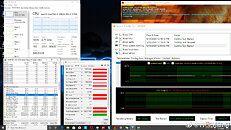
A stock Intel Core i9-10900K 10-core processor was subjected to FPU stress by Chinese PC enthusiast @WolStame. The power and temperature values of the processor are inside HEDT territory. With a Furmark GPU stress running on the side, under AIDA64 FPU stress, the i9-10900K measured a package power draw of up to 235.17 W, as measured using HWInfo64. The CPU package temperature shot up to 93 °C. A 240 mm AIO liquid CPU cooling solution was used in the feat. Interestingly, the processor is able to sustain clock speeds of 4.77 GHz, which is close to the advertised 4.80 GHz all-core turbo boost frequency, called for by the multi-core FPU stress.

To show that the values weren't obtained in a few seconds of test, the AIDA64 Stability Test window keeps a timestamp log and displays time elapsed into the stress. In this particular case, the all-core stress has been running for close to 48 minutes; and yet the processor is keeping up with its advertised all-core boost speed, making this an impressive feat.
Sources: @WolStame (Weibo), @9550pro (Twitter)
Add your own comment

110 Comments on Intel Core i9-10900K Stressed, Package Power Reads 235W, Temperatures 93°C

#26
EarthDog
I wonder why it throttled.... tjmax is 115C on these chips and it only reached 93C.

All core boost can also vary by board. Ive heard 4.8, some 4.9, others adhere hardcore to Intel spec by default and ends up running this at 4.3 Ghz...
Posted on Reply
#27
LTUGamer
That is what AMD done with FX-9590 to catch Intel :D

Since Aida FPU is giving maximum loads, these numbers will be smaller in real world operations, such as gaming. However 93C is still too much when it is cooled by 240 mm liquid cooler.
Posted on Reply
#28
moproblems99
Hmmm, not really sure why a hot running chip, not even hedt, pulling double the wattage of the competition is impressive. Am I missing something?
Posted on Reply
#29
Caring1
moproblems99Hmmm, not really sure why a hot running chip, not even hedt, pulling double the wattage of the competition is impressive. Am I missing something?
Yes a dictionary.
The word you were looking for is disappointing, not impressive.
Posted on Reply
#30
EarthDog
TheLostSwedeApparently with AVX enabled, these chips can hit 400W...
pretty sure this has avx enabled by default...in particular the fpu test.
btarunrAdvertised all-core boost of 10900K/KF is 4800 MHz. It's short by just 30 MHz.
Multi reads 48x. Likely just spread spectrum doing its thing on bclk.
Posted on Reply
#31
LTUGamer
moproblems99Hmmm, not really sure why a hot running chip, not even hedt, pulling double the wattage of the competition is impressive. Am I missing something?
Because chip performance is not good enough to compete against AMD chips, they just brutally increased core count, voltage and core speeds to give additional performance for the CPU. If AMD CPUs were as bad as Bulldozer was, this CPU would have fewer cores or lower clocks.
Posted on Reply
#32
moproblems99
Caring1Yes a dictionary.
The word you were looking for is disappointing, not impressive.
LTUGamerBecause chip performance is not good enough to compete against AMD chips, they just brutally increased voltage and core speeds to give additional performance for the CPU.
Um, wut? Where did I said it was impressive?
Posted on Reply
#33
EarthDog
LTUGamerBecause chip performance is not good enough to compete against AMD chips, they just brutally increased voltage and core speeds to give additional performance for the CPU.
?

Voltage is similar. They've added 25% more cores and threads and 100mhz base clock and max all c/t by 100/200 mhz. Is that brutal..no voltage changes and meager clock increases?
Posted on Reply
#34
LTUGamer
EarthDog?

Voltage is similar. They've added 25% more cores and threads and 100mhz base clock and max all c/t by 100/200 mhz. Is that brutal..no voltage changes and meager clock increases?
Yes, they added little bit of everything, but they "forgot" to move from 14 nm lithography to 7 nm lithography... That is why Intel was forced to increase clocks and core count to be competitive. It is needed to push 14 nm processor to the max, to achieve same performance as regularly operated 7 nm processor. BTW Core i7 9700K were pushed to very high clocks, where any additional clocks increase both consumption and heating quite strongly.
Posted on Reply
#35
BArms
tabascosauzThe 8700K had TIM and the usual terrible stuff at that...the 9900K was soldered and the 10900K not only continues that trend but is even experimenting with removing unnecessary layers off the top of the die to facilitate a thicker IHS, all in the name of handling the heat.

And it's a goddamn 240mm AIO; it's not going to perform worse "than a lot of air coolers". 93C degrees is not even close to attaining the 70C requirement for TVB to kick in for that max rated 4.9 boost.

There's no wiggle room left on this process, period. All you can hope for is rolling the dice on a good 10-core bin that can shave off a few millivolts at the top end and stay stable.
Well that's a shame then. But I still want to know which AIO they had, some of them perform worse than air coolers and nobody is going to put a 240 on an I9-10900K anyway. Just my 2c.
Posted on Reply
#36
EarthDog
LTUGamerYes, they added little bit of everything, but they "forgot" to move from 14 nm lithography to 7 nm lithography... That is why Intel was forced to increase clocks and core count to be competitive. It is needed to push 14 nm processor to the max, to achieve same performance as regularly operated 7 nm processor
I didn't ask any of that. I just clarified what happened compared to what you said. ;)

There was no "brutal" raising of voltage or clocks. The voltage is the same, clock speeds are raised, but not much... they added 25% more cores and threads (on the same process to compete, yes, derp). Now, feel free to continue your dropping your deuce on Intel. :)
Posted on Reply
#37
hat
Enthusiast
MxPhenom 216An AIO you mean with very little fluid and terrible fluid flow rates. A legit loop with a good, maybe double thick radiator 240 or 360 would probably be fine.
You may be right... but take a step back and consider for a moment that this chip requires a real water setup to even run at stock...
Posted on Reply
#38
trparky
My guess is that this chip is running on the razor's edge of stability. Just enough voltage to keep it stable while at the same time not too much voltage so as to have the thing cook itself. They're probably optimizing it down to the freakin' fourth number after the decimal point.

It's certainly impressive that Intel has been able to pull it off however at the same time it's just a joke.
Posted on Reply
#39
MxPhenom 216
ASIC Engineer
hatYou may be right... but take a step back and consider for a moment that this chip requires a real water setup to even run at stock...
Posted on Reply
#40
KarymidoN
MxPhenom 216An AIO you mean with very little fluid and terrible fluid flow rates. A legit loop with a good, maybe double thick radiator 240 or 360 would probably be fine.
why not just chill the crap out of this blazing volcano...
Posted on Reply
#41
Cranky5150
KarymidoNwhy not just chill the crap out of this blazing volcano...
Cause it was shite to begin with?...........
Posted on Reply
#42
Melvis
So not run on a stock cooler then? hmmmmm thats a shame.
Posted on Reply
#43
jmcosta
This seems to be about right, if you stress test lets say a Ryzen2 FPU it will thermal throttle as well, even at stock settings with a good cooling.
the FPU subtest drives the power draw and thermal state of the system to the maximum regardless of whether it is overclocked or not

Posted on Reply
#44
HTC
TomgangThis clearly shows the cons and pros of staying on 14 NM for several years.

Pros:
Very refined die process allows for high core clock even on cpu with a decent amount of cores.

Cons:
While it is refined, it is still 14nm and pushing high core clock out of a old uneficient process while slamming 2 ekstra cores in as well has a down side to it. High wattage use and that gives a hot running cpu as a side effect of high wattage use and clearly shows why it is about time intel moves to 10 or 7 nm now. 14nm is just to old now and way to uneficient.
Another con you missed: by having products on such a refined process, Intel makes it that much harder for products on a NEWER process to surpass the products they intend to replace: specially considering the "usual" 2% to 3% performance improvement VS previous gen.
Posted on Reply
#45
ilyon
In fact, the FX9590 is a kind of mobile processor when you think about it. Sort of.
Posted on Reply
#46
watzupken
MelvisSo not run on a stock cooler then? hmmmmm thats a shame.
No stock cooler provided for a reason. Otherwise when you open the case, you will see a melted cooler and motherboard. In fact, I believe 90% of air coolers will not be able to handle the heat output. Which is why I think Intel have to stop their madness of higher clockspeed + more core counts.
Posted on Reply
#47
Melvis
watzupkenNo stock cooler provided for a reason. Otherwise when you open the case, you will see a melted cooler and motherboard. In fact, I believe 90% of air coolers will not be able to handle the heat output. Which is why I think Intel have to stop their madness of higher clockspeed + more core counts.
Thats exactly my point ;)
Posted on Reply
#48
ARF
ilyonIn fact, the FX9590 is a kind of mobile processor when you think about it. Sort of.
TheLostSwedeApparently with AVX enabled, these chips can hit 400W...
GoldenXThe most DOA product since FX.
It's gonna be really hot, hot summer :pimp:

This is in the area where high-end Threadrippers operate.

Reminds of Nvidia's Fermi. Someone needs to modify this meme with Intel's CEO Bob Swan and Comet Lake CPU for grill.


Posted on Reply
#49
Vayra86
HTCAnother con you missed: by having products on such a refined process, Intel makes it that much harder for products on a NEWER process to surpass the products they intend to replace: specially considering the "usual" 2% to 3% performance improvement VS previous gen.
They already have a solution for that, they call it Alder Lake, combining their 14nm ++++++ with 10nm ----lackluster to achieve the feat of double the silicon for half the performance when absolutely required, to meet TDP budget :)

Brilliant eh
Posted on Reply
Add your own comment
Nov 19th, 2026 17:26 CST change timezone

New Forum Posts

Popular Reviews

TPU on YouTube

Controversial News Posts