Friday, May 15th 2020

AMD Ryzen 7 4700G "Renoir" Desktop Processor Pictured
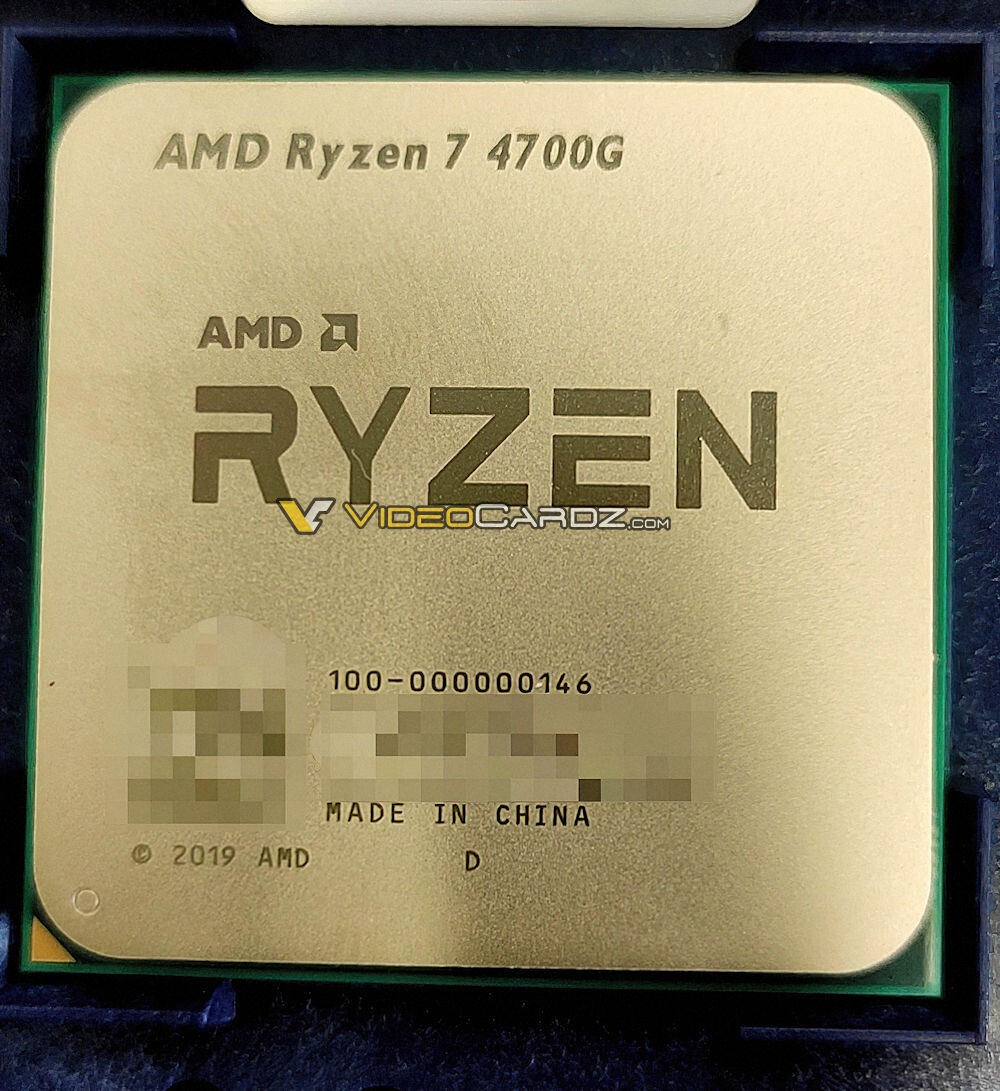
Here is the first picture of the AMD Ryzen 7 4700G, the company's upcoming socket AM4 APU based on the 7 nm "Renoir" silicon, courtesy of VideoCardz. The picture reveals a standard-looking socket AM4 chip with commercial name and OPN markings (100-000000146), matching the Igor's Lab OPN code leak from earlier this week. The Ryzen 7 4700G offers an 8-core/16-thread CPU based on the "Zen 2" microarchitecture, and an integrated graphics solution that combines the SIMD machinery of the "Vega" graphics architecture, with the updated display- and media engines of "Navi." The iGPU is configured with 8 CUs (512 stream processors), which on the 4700G has an impressive maximum engine boost clock of 2.10 GHz, according to the Igor's Lab story.
The 8-core/16-thread CPU of the Ryzen 7 4700G has a nominal clock speed of 3.60 GHz, and a maximum boost frequency of 4.45 GHz, with several Precision Boost power-states in both directions of the nominal clock. The CPU features 512 KB of L2 cache per core, and 8 MB of shared L3 cache (4 MB per CCX). The iGPU engine clock goes all the way up to 2.10 GHz, which could help it overcome some of the CU deficit vs. "Picasso," which has 11 CUs (704 stream processors), but clocked only up to 1.40 GHz. Since the Ryzen 5 3400G has an unlocked multiplier, it stands to reason that even the 4700G could. If the platform I/O of "Renoir" in its mobile avatar is anything to go by, then the 4700G could feature a limited PCI-Express x8 lane setup for its PEG port. AMD is rating the TDP of the 4700G at 65 W.
Source:
VideoCardz
The 8-core/16-thread CPU of the Ryzen 7 4700G has a nominal clock speed of 3.60 GHz, and a maximum boost frequency of 4.45 GHz, with several Precision Boost power-states in both directions of the nominal clock. The CPU features 512 KB of L2 cache per core, and 8 MB of shared L3 cache (4 MB per CCX). The iGPU engine clock goes all the way up to 2.10 GHz, which could help it overcome some of the CU deficit vs. "Picasso," which has 11 CUs (704 stream processors), but clocked only up to 1.40 GHz. Since the Ryzen 5 3400G has an unlocked multiplier, it stands to reason that even the 4700G could. If the platform I/O of "Renoir" in its mobile avatar is anything to go by, then the 4700G could feature a limited PCI-Express x8 lane setup for its PEG port. AMD is rating the TDP of the 4700G at 65 W.
64 Comments on AMD Ryzen 7 4700G "Renoir" Desktop Processor Pictured
Having said that, I feel the 4700G will be an odd chip because if AMD is to price it around a 3700X, people who buy CPU at this range typically will buy a graphic card as well. I feel people who will get this chip is because of the Vega iGPU so that they can still game on a budget. Currently, the 3200G and 3400G are sub 150 bucks APU, which makes sense for a budget gamer.AMD already mentioned that they will not provide Ryzen 4xxx support on any chipset older than X570. While there is a chance motherboard makers can still provide a BIOS update, but this is not guaranteed. This is the same when AMD decided that they will not allow PCI-E 4.0 support for X470 or older boards.
It's a 3700X that trades L3 cache for Vega graphics, so it's going to be roughly the same price as a 3700X, most likely.
Don't be surprised if it's considerably more expensive than a 3700X, either.
Remember that the 3700X is cheap to produce - it is two smaller dies, only one of which is on the more expensive 7nm process. This is a single, large die on 7nm. Anyone who doesn't understand the cost implications of that needs to read up on how semiconductors are made before commenting. TL;DR production cost increases exponentially with die size.
Don't forget, this isn't some budget, cut down offering - this is fully-enabled Renoir silicon with no defects in either the CPU or graphics.
It's flawless silicon of a large die on the latest process node. Each bolded term = $$$
The slide says Ryzen 5 3400G and Ryzen 3 3200G aren't supported on the 5 series chipset, the Ryzen 4700G is supported, yet it is based on the same 2nd Gen Ryzen.
The way I see it, the earlier 3400G and 3200G should be compatible too.
They've already created a 1600AF which is clearly 2nd Gen but has a 1000-moniker. At some point before all this blows up in their face they should just rename the APUs in the correct thousand-series and all of this stupidity and confusion goes away.
It's bad enough that they Called Zen+ second generation which means Zen 2 isn't second generation and screws up talking about products via the architecture/silicon.
The APU's randomly having +1000 added to the model numbers screws up talking about products via series.
All that's left is this convoluted mess where the name and the number together need to be matched to a compatibility matrix. Good luck trying to explain that fustercluck to Joe Average at the point of sale!You appear to have missed that there's more to mITX than just slapping a dual-slot GPU in there. Intel has a hugely successful line of NUCs, including premium and gaming models where 'people actually do shell out that sort of cash' and there's also a thriving market in very slim mITX cases where IGPs are required - not to mention miniSTX and nanoITX options from several popular case manufacturers.
Remember, the most popular Apple desktop PC is the Mac Mini. There is very definitely an established market for high-end compact desktops.
Intel makes the NUC and it has been successful enough across several generations to warrant its own dedicated silicon; The only way you can get the Intel/Vega hybrid (i7-8809G) is via the Hades Canyon NUC. That alone is enough to justify the existence of this 4700G as a premium competitor from AMD, but just to make a point that this is not a tiny market segment it includes:
Thin clients for business from every tier-1 manufacturer and several tier-2 manufacturers like Fujitsu, Shuttle, Wyse etc.
Consumer NUC clones:
- Acer Aspire Revo, Revo One/Cube/Pro/Mini/Build/Base/L-series/RL-series, and Veriton
- Asus MiniPC, ProArt, Vivomini, and ROG
- Asrock product families: Deskmini, Jupiter, Beebox, Beebox-S
- Clevo models resold via Sager, Medion, Chillblast, OriginPC, PCS, Xotic etc.
- Dell Studio Hybrid, Inspiron Micro, Alienware Alpha, Optiplex Micro
- Gigabyte Brix: These go all the way back to the original NUC and were the NUC's first real competition.
- HP Elitedesk, Prodesk, G-series, Pavillion Mini, Elite Slice, Pavillion Wave, Z2 Mini, Omen X
- Lenovo Thinkcentre M-series Nano, M-series Tiny, Ideacentre Q-series, Idecentre 620S
- MSI Trident, Creator, Prestige, Cubi
- Shuttle: Like Gigabyte, no intro necessary. They predate the NUC and compete with it at all sizes and specs.
- Zotac: Early NUC competitor. More models than Intel now, spanning more prices and specs.
For every name brand on that list there are two chinese copies from companies like Azulle, Beelink, Chuwa, Mii, Minix, Huaweii.
But feel free to keep pretending that this is a failing or invalid market segment. So what if every single PC vendor (and a few that don't usually make PCs) has a huge range of mini-PCs that are thin-format mITX or smaller, spanning multiple families and store shelves, webpages? - that doesn't mean it's successful. Clearly they are wrong and you are right; Those things do not sell, and aren't mainstream enough to matter or invest in multiple product families and refreshes over the better part of a decade.
It's 2nd-Gen Zen+ instead of 1st-Gen Zen, it's in a different box with a different cooler, It's Pinnacle Ridge instead of Summit Ridge and it's on the 12nm LP process instead of GlobalFoundries original 14nm. The only thing it has in common with the original Ryzen 5 1600 is the microcode - for OEM compatibility as far as I understand it.
Everything will looks like confusing if people start to take serial number as product name. Also AMD didn't start calling new serail number SKU as 1600AF, it is some youtuber and some people start calling that. So AMD didn't create confusion, it is created by some youtuber and some people. And because of that they are also getting more confused by the same cinfusion they created themselves.
APUs for premium systems are an incredibly small and insignificant portion of the market. They're primarily for cheap systems and as such that's the main target for these products, end of story. You can chose to believe otherwise and that's solely your business.
Desktops without dedicated graphics cards make up huge fraction of the market. I can't find figures but I wouldn't be surprised to hear that machines with integrated graphics are considerably more than half the total market. Both on etailers and in bricks-and-mortar retailers if you look at the listings, the "office/student/general-purpose PC that lacks a dGPU is extremely prevalent in search results and does seem to dominate the shelf space (what little is left for deesktop instead of laptops, anyway).I'm telling you it's not a fringe product, you're just being too narrow-minded to understand;
Both I and @dj-electric's are speculating that this will be a premium product - he guessed $399 and you immediately dismissed that with "an APU meant for a specific segment where people just wont shell out that sort of cash"
Newsflash: people buy i7 desktops without graphics cards in them ALL THE TIME and those chips are in the exact $350-400 ballpark we're both talking about. It's one of the most common product segments in the desktop market, period. AMD hasn't had much worth selling in that market for a decade, and now that they finally have something competitive you're dismissing the entire market? Jeez.
Here are all the desktop PCs selection from a large UK e-tailer: www.ebuyer.com/store/Computer/cat/Desktop-PC - that's 338 results and 246 of them use integrated graphics. Filter so that it's only i7 models and of the 55 i7 results, 45 of them have only IGPs.
Taking that single look at one retailer, it would seem that the integrated graphics market for desktops is 72 of the market, and of those IGP models, 22% of them are premium i7 versions with expensive CPUs in them. Feel free to look at other e-tailers/retailers but I'd be surprised if you find anywhere mainstream that has more gaming machines than office/student/mom&pop PCs.
You think people really buy 9900Ks to use them just with their iGPUs ? Come one, be realistic. Premium APUs are hardly a thing because the kind of people that would want that, they'd probably afford to use a dedicated GPU even in really small form factors. It's exceedingly rare that your use case absolutely prohibits the use of a dedicate GPU.
And to top it all off, 8 cores isn't really "premium" nowadays, that's kind of middle of the road. You can't really ask a lot for an 8 core Zen 2 chip with what is an aging GPU by now. Intel sure did try to ask a lot for that but they try to ask a lot for everything, including for things like NUCs which are severely overpriced for what they can do. Many manufactures have shown that you can build crazy small PCs with dedicated graphics.