Friday, June 12th 2020

Samsung 980 Pro PCIe 4.0 SSD Rumored to Launch Within Two Months
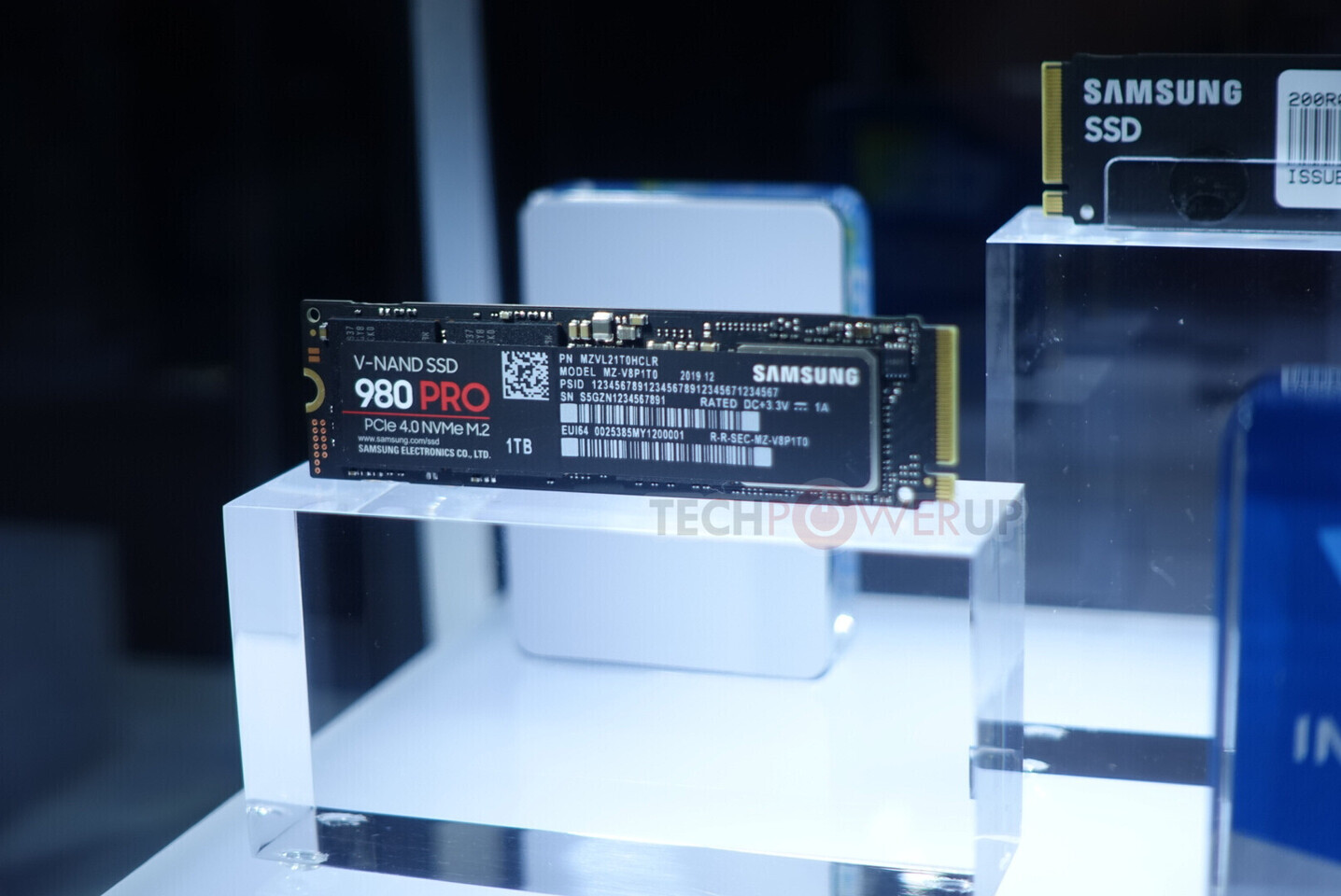
The Samsung 980 Pro SSD was first revealed at CES 2020, making it Samsungs first consumer PCIe 4.0 SSD. Hardware leaker Ice Universe is claiming that Samsung will release the SSD within the next two months, which puts the latest date for a release in late August if the leak is to be believed. The Samsung 980 Pro should destroy the competition if Samsung's claims are true with advertised maximum sequential reads of 6.5GB/s, and sequential writes of 5GB/s. This is a large jump over Samsung's 970 Pro PCIe 3.0 SSD with advertised speeds of 3.5GB/s and 2.7GB/s, these numbers also offer a significant bump over its fellow PCIe 4.0 competitors such as the Corsair MP600 with advertised speeds 5GB/s and 4.3GB/s.
Source:
@UniverseIce
53 Comments on Samsung 980 Pro PCIe 4.0 SSD Rumored to Launch Within Two Months
www.addonics.com/products/indm2.php
Let me recall, it was a glitch in the matrix :shadedshu:
pcmasterrace/comments/3wch78
www.tenforums.com/performance-maintenance/108422-128-gb-ram-install-windows-ram-discs-possible-2.html
Grabbed (4) of these 860 Pro SATA drives, went with smaller capacity 256GB since I use them for single work projects and just '"hot-swap" them in and out of a Supermicro 8-bay drive enclosure.
SATA 3 is superfast me thinks for simple storage. Can always go NVMe or Optane NVMe for primary and OS drives...
Nice Sammy SATA drives bro, they totally rock :rockout: @cucker tarlson
Plus the 256GB 860 Pro capacity are only $89, nice price. lol
M.2 or PCI-E SSDs don't offer any performance jump over the SATA3 SSDs when we speak of OS or game load times. Absolutely nothing. If you are not using it for specific fields (rendering, moving big files between SSDs, etc.), you will never see a difference between the cheapest 550 MB/s SATA3 SSD and a 3500 MB/s or even faster m.2 or PCI-E one. The only advantage for general use is you get rid of two slim cables. Their disadvantage is they are more expensive but the real disadvantage of those is that they run MUCH hotter. While a SATA3 is maybe around 30, probably 35 Celsius at full load (mine is around 21C at the moment while not doing anything in a 22-23C room), the other 2 has usually double (!!!) the temperature: at around 60-70C at full load). And that one really sucks when there is a hot summer day.
And that's an absolute winning point for the SATA3 SSD for me: I don't use the higher speed for rendering, etc, I don't care about 2 extra slim cables (we are not speaking of the really thick old power supply cables) but i DO care about the (near) double operating temperature.
I mean,even if the sequential speeds are higher,and you do move a lot of files,what would have to be the file size-cache buffer ratio for it to make sense if you think about it.
if you move smaller amount of data the real time difference is low.if you're moving a lot of data,well,you'll run out of cache before the difference in real time becomes considerable.you'll be transferring at nand-limited speeds on both.
Defender already gimps normal nvme ssds very close to SATA SSDs.
They aren't built for speed, they are small, and they cost an absurd amount.[Citation Needed]
Other problem that I foresee with Samsung drive is the price. They have been pricing themselves out of the market when there are so many SSD options that perform just as well if not better than their existing 970 Evo Plus series.
Do you guys just make this stuff up and run with it?Yup the controller the Corsair MP600 is based on will get an upgrade end of the year.
www.anandtech.com/show/14728/phison-previews-nextgen-ps5018e18-pcie-40-ssd-controller-up-to-7-gbs-nvme-14PCIe 4.0 drives are much slower than DRAM in performance and latency so no its not like having additional ram.
www.anandtech.com/show/15848/storage-matters-xbox-ps5-new-era-of-gaming
The PC platform has so many defects, that it's painful to read their poor "explanations" and "excuses".
Why not go for RAM disks, then ?
Because it's expensive.
Why not go for big SSDs to store data.
Because it's expensive.
One morning you all wake up and realise that we alone sabotage our own progress because we are greedy.
On the other hand, HDDs are unbeatable for mass storage. I could definitely never move my NAS over to SSD storage any time soon - that would cost more than my main PC and then some.
Previous X370 & X470 were limited to 64GB.
Using an SSD to act as RAM seems like a good way to destroy an SSD quickly, and only makes sense for fringe use cases, or if you have a lot of money to burn, in which case you'd probably want to burn that money on an HEDT platform & grab 256GB of RAM instead.
As for future game development, a dev would be better off upping the requirements for RAM than requiring an extremely expensive Samsung Pro PCIe 4.0 NVME drive, so like previous Samsung Pro's, these will be used for people that need them, professionals, video editors, etc., or alternatively by people with money to burn that want their games to load a few tenths of a second faster(maybe).
Do not worry about destroying it, I believe the new one will be around the same level of wear of the 1tb 970 pro, 1,200 TBW, so by my calculations will be years of writes and by then will have purchased many other ones to replace it.
So something about how that game loads is closely tied to drive speeds. There isn't a doubt in my mind. Mostly I think this comes down to sloppy coding, but I also think it may be possible that as data bandwidth goes up, we may see more developers looking to take advantage of that to do actual things that couldn't be done before. Especially in open world games.
The operating temperature is a different thing. I mean, different stuff likes different temps. Some components just run hot. It's not really hurting them. And even though the temperature is high, I think that mostly has to do with it being a very small part. It doesn't take a lot of heat energy to cook a piece of silicon the size of a stick of gum. Highly unlikely to translate to any noticeable temperature increase to the air in the case, mobo, or nearby components. It just saturates with heat very quickly.
An example. If I took a lighter to a paper-clip, how long would it take for it to get red hot? Probably not long right? And the temperature would be quite high. Now how about a 2' long, 1/4" thick flat iron bar? Could you even get it red hot with a lighter? Point is, the same energy that turns the paper clip red hot can't easily do the same to something with much more mass. If the nvme is a paper clip, then the mobo is an iron bar.
Another experiment. Lets heat both the paper clip and the bar up to a solid red glow... so well over 500C. They both measure the same temperature. Now, lets drop them into separate bathtubs full of room temperature water. What will happen when you toss in the paper clip? Not much, right? Maybe a "fshhhhh" sound with some steam and a little boiling around it. Within moments, the paper clip will be touchable with the water temperature being about the same. Now what about the red-hot iron bar? Probably going to boil all of the water in the bathtub right? Wouldn't want to reach in and touch either the water or the bar...
But the temperatures are the same, so what gives? The masses are different, and so the amounts of heat energy absorbed to reach the same temperature are also very different. A little nvme controller hitting 70C is not the same as your CPU or GPU hitting 70C. Being a smaller part, it's gonna heat up faster. But that also means that it cools faster when it is done.