Sunday, July 17th 2022

Intel Shows Off Arc A770, Pricing and Performance Tiering Leak
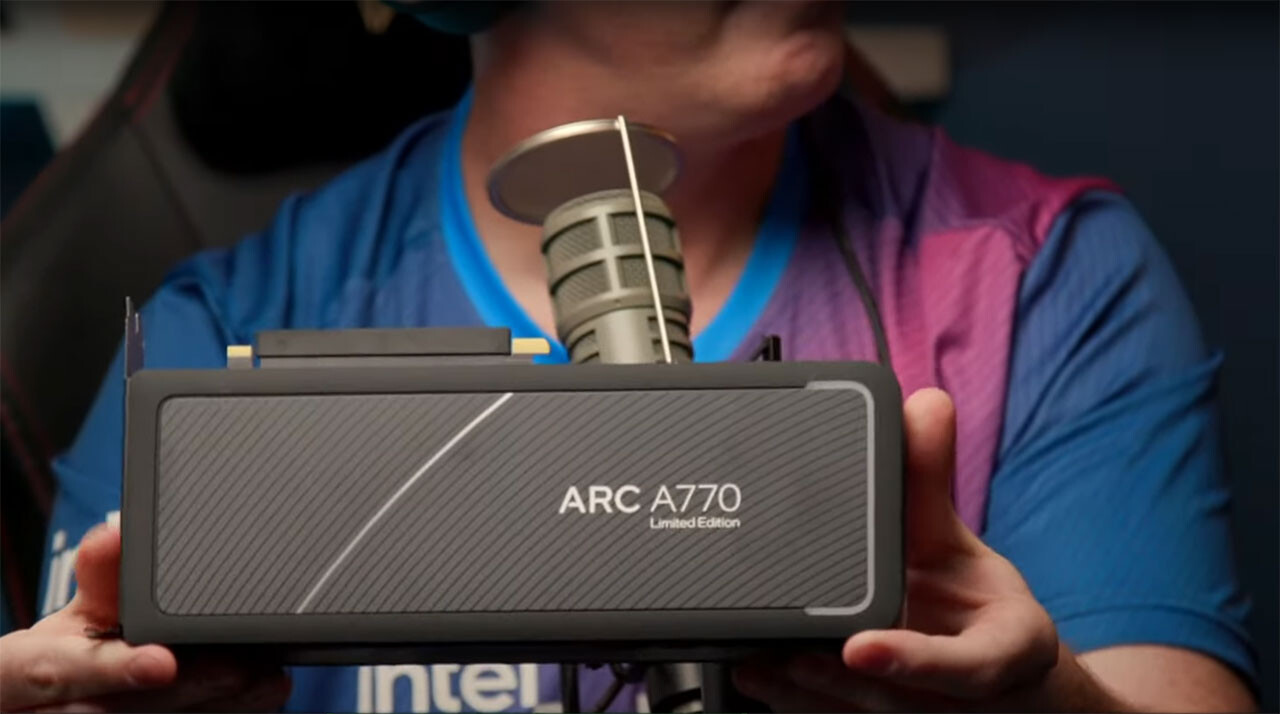
It's been a busy couple of days when it comes to Intel and its Arc graphics cards, as not only has the company showed off the Arc A770—which looks identical to the Arc A750—but the company has also refuted that it was ever planning to release an Arc A780 card, despite the existence of the A380 and supposedly an A580. A leak with price brackets and performance tiering has also leaked, which gives us a much better understanding of how Intel is planning on positioning its Arc graphics cards versus NVIDIA and AMD and it doesn't look like Intel is as confident as it sounded just a few months ago.
LinusTechTips got the honour to reveal the Arc A770 card, although there appear to be minuscule differences to the physical appearance between it and the Arc A750. The only thing noticeable is a 3-pin header, possibly for some kind of RGB syncing, next to the 8- and 6-pin power connectors, something not present on the A750 card that Gamers Nexus showed off earlier this week. The good news is that the Arc A770 seems to be running cool, as the card was reportedly only hitting 69 degrees C during some hands-on time, although this will apparently be covered in a separate video next week.


 However, far more interesting than some pictures of the cards, is Intel's new product and price tiering leak, where the company has placed its Arc A700-series lower than expected compared to the competition. The Arc A750 sits below the RTX 3060 and the Radeon RX 6600 in what looks like an official slide that was posted by Wccftech. The A750 is said to be an 8 GB card with a 225 Watt TDP, whereas the Arc A770 will be available in 8 and 16 GB SKUs and will end up competing with the RTX 3060 Ti and the Radeon RX 6650 XT. The only good news here is that the two cards sit firmly in the $300-399 price bracket, with the A750 possibly being somewhat below that, depending on how accurately one is willing to interpret the SKU placement relative to the price brackets.

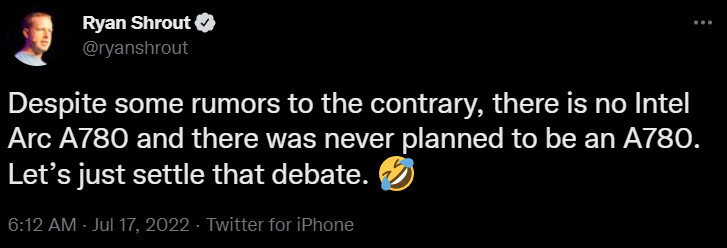
 In related news, Ryan Shrout went on record on Twitter, saying that "Despite some rumors to the contrary, there is no Intel Arc A780 and there was never planned to be an A780. Let's just settle that debate." This is hard to believe and it's more likely that the company has decided to cut its losses on this generation and wait until Battlemage arrives to launch a higher-end product SKU. In further related news, those that took part in the Intel Xe HPG Scavenger Hunt, Intel will be giving away 100 A770 and 100 A750 cards, but it's not clear yet how the winners will be able to get their hands on the cards.
Sources:
Wccftech, @ryanshrout, @TheMalcore, via Videocardz
LinusTechTips got the honour to reveal the Arc A770 card, although there appear to be minuscule differences to the physical appearance between it and the Arc A750. The only thing noticeable is a 3-pin header, possibly for some kind of RGB syncing, next to the 8- and 6-pin power connectors, something not present on the A750 card that Gamers Nexus showed off earlier this week. The good news is that the Arc A770 seems to be running cool, as the card was reportedly only hitting 69 degrees C during some hands-on time, although this will apparently be covered in a separate video next week.




70 Comments on Intel Shows Off Arc A770, Pricing and Performance Tiering Leak
On a side note, I wonder how well they are on compute/mining as they were supposed to be released earlier and there was talks of Intel wanting to cash in on the mining craze before it crashed :confused:
Personally I think their drivers and API support will let them down more than anything else. But intel could literally pump millions of these into OEM systems regardless and gain market share that way :eek:
Ryan Shrout was formerly the head of PCPER, he then made a seperate research company for paid analytics.
Intel hired him to do a white paper on Optane... he then used data from intel and not his testing in a public review without disclosing source of data and money from intel.
linustechtips.com/topic/889943-pc-perspective-accused-of-violating-journalistic-ethics-update-2-with-pcper-reply/
When the story broke PCPER lost 30% yoy unique views.
Then, Intel made it official.
Ryan Shrout Leaves PC Perspective, Joins Intel as Chief Performance Strategist
Ken Addison Leaves PC Perspective, Joins Intel as Performance Marketing Engineer.
Allyn Malventano Leaves PC Perspective, Joins Intel as Storage Technical Analyst.
Part 2....
Based on the videos with GN the 1:1 Matrix to Vector cores these GPUs may be very very good at non-gaming tasks.
It looks like Raja made another workstation gpu to sell to gamers ala vega.
It also seems to be very sensitive to system memory access loads, maybe a small cache or scheduler issue? Or they simply never tested it with Rebar turned off.
I kinda want to play with one for non-gaming workloads just due to the amount of matrix cores. Then again if Intel keeps delaying it we will get RDNA3 with matrix cores to play with.
Why should i even care about Ryan Shrout to devote time to research his history?
If i decide to research something probably will be tech based not research what history Ryan Shrout had.
In my question to the reporter i presented between the possible options the possibility «Intel rep not being reliable» from the start!
He answered and i didn't even debated anything about his opinion about the Intel rep.
My debate was threefold, about the validity of «if A380/A580 then A780" logic based on specs and about MLID reliability in general and who of the 2 had more reasons to lie in this particular case, do you believe that Intel actually had to gain anything substantial by debunking this rumor in order to risk lying?
If they changed the naming from A780 to A770, so what, why lie about it, the embarrassment of the performance level from the actual reviews can't be avoided anyway and it will be a drop in the ocean regarding negative rumors that float every now and then regarding Intel!
Since you didn't even understand my post, maybe next time before replying, read it again?
That's certainly one of the problems of ARC's architecture!
But many people don't seem to care much (i think is important) if we check comments and acceptance level of RX580/RX5700XT performance/W.
needreports of Intel dGPU to game at any level vastly exaggerated.With prices like these, I might buy an A770 just to play with it.
Why is this relevant to what is said?
Marketing teams always try to make their products to look better.
7% isn't exactly the highest misrepresentation that we have seen, and more or less depending on the period every company done it in the past.
AMD implied that in Blender 7950X is +45% faster than 12900K (12900K 31% slower) and also that it was representative for multithreading apps and the only reason that they used Blender was because is free and the community can replicate the results. Let's wait for TPU tests to see if the difference will be the same as to what AMD suggested ;)
But like i said above any misrepresentation coming from the marketing department has nothing to do with my point (I said Intel knew after testing the engineering samples and comparing the results against the simulated ones , meaning the technical/engineering team and the department heads of course)
It can be different what the technical/ engineering team knows based on their expertise, what the Marketing team knows based on their expertise and what finally is decided to be communicated to the consumer, don't you think?
But besides the year game, how much performance do actually you need? I was happy with 1080 - 1080 Ti level performance in 2019, and honestly, I still am up to this day.