Monday, January 30th 2023

AMD "Navi 31" Memory Cache Die Has Preparation for 3D Vertical Cache?
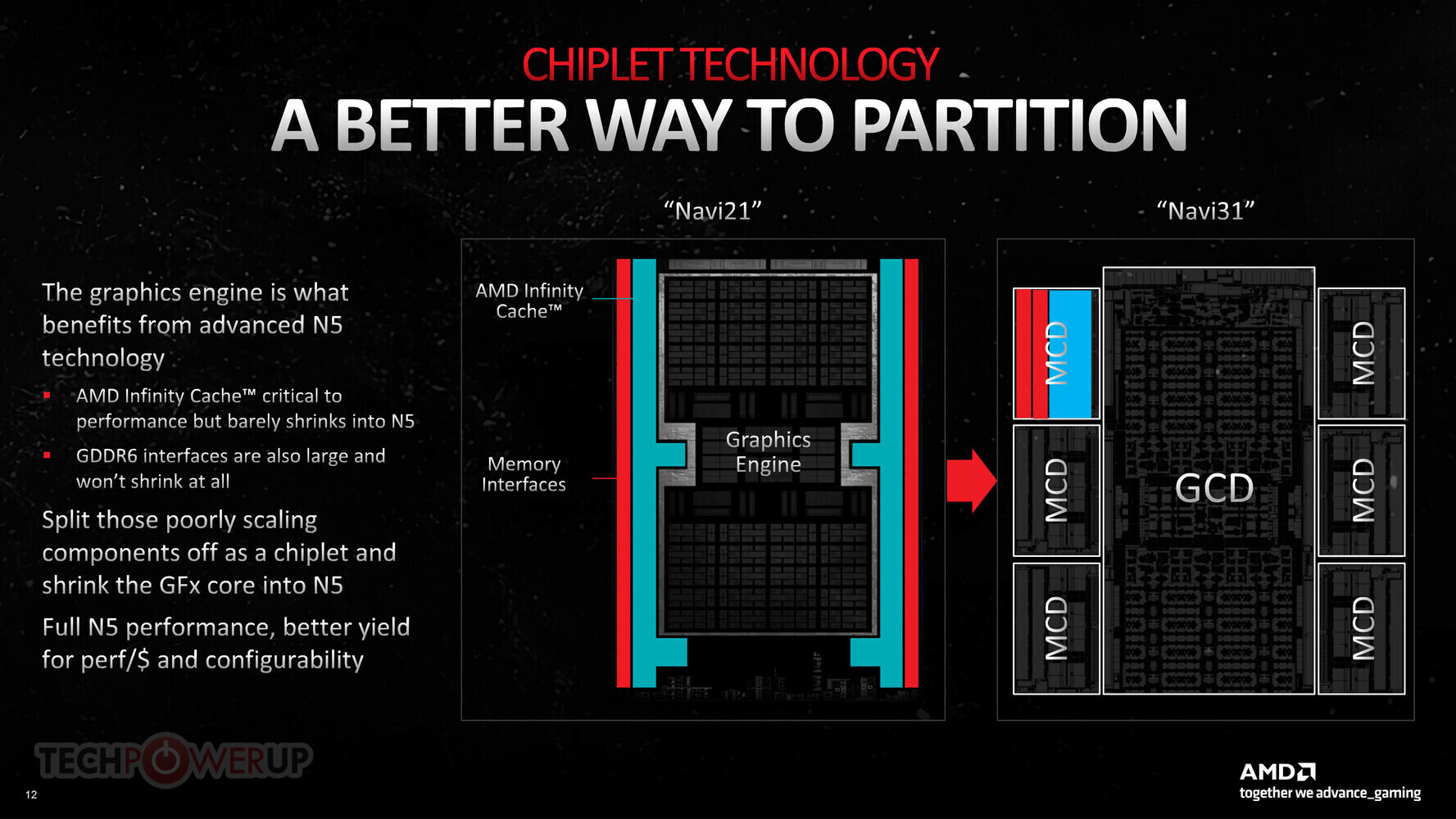
AMD possibly has a straightforward path to increasing the performance of the "Navi 31" RDNA3 GPU to power future high-end SKUs, according to semiconductor engineer Tom Wassick. The GPU's main SIMD machinery is located in the Graphics Compute Die (GCD) built on the 5 nm EUV foundry process, surrounded by six Memory Cache Dies (MCDs) built on 6 nm, which each contain GDDR6 memory controllers, and a 16 MB segment of the GPU's 96 MB Infinity Cache memory.
In microscopic observations, Wassick noticed structures on the MCD which he thinks look like an array of through-silicon vias (TSVs), of the kind used in "Zen 3" and "Zen 4" CCDs, to wire out stacked 3D Vertical Cache memory on the L3D (L3 cache die). If the theory holds up, it could be possible for AMD to increase the L3 cache segment size per MCD from 16 MB, and the GPU's overall Infinity Cache memory size. With its RDNA2 graphics architecture (RX 6000 series), AMD significantly enlarged on-die caches on its GPUs, particularly the last-level L3 cache, even giving them the special branding of "Infinity Cache," claiming that they had a big impact in lubricating the memory sub-system, letting GPUs with 256-bit memory buses compete with NVIDIA GPUs with wider 320-bit to 384-bit interfaces.
Sources:
Tom Wassick (Twitter), Tom's Hardware
In microscopic observations, Wassick noticed structures on the MCD which he thinks look like an array of through-silicon vias (TSVs), of the kind used in "Zen 3" and "Zen 4" CCDs, to wire out stacked 3D Vertical Cache memory on the L3D (L3 cache die). If the theory holds up, it could be possible for AMD to increase the L3 cache segment size per MCD from 16 MB, and the GPU's overall Infinity Cache memory size. With its RDNA2 graphics architecture (RX 6000 series), AMD significantly enlarged on-die caches on its GPUs, particularly the last-level L3 cache, even giving them the special branding of "Infinity Cache," claiming that they had a big impact in lubricating the memory sub-system, letting GPUs with 256-bit memory buses compete with NVIDIA GPUs with wider 320-bit to 384-bit interfaces.
76 Comments on AMD "Navi 31" Memory Cache Die Has Preparation for 3D Vertical Cache?
But you still didn't explain why you think it's better for AMD to do that vs Nvidia.My argument is pretty clear since it can be measured objectively : RT performance sucks on everything. But what's your argument for caring about it ?
Anyway, I think Intel has a safe position on that purely on their R&D resources. But as you said... they need a product before that...
He thinks it's not impossible that a OCD, double decker cache 7950XTX3D might turn up.
That might explain the 800watt 4090Ti rumour I also just heard,, ,, Again.
If an 800 watt GPU is released I think we definitely hit my limit of this is f£#@££ ridiculous amount of power just to play peggle.
I'm intrigued for sure, I think AMD will re roll the 7900 like Vega, IE next time it's refined And twice the memory, could end like Vega.
I tend to own all the stuff people call rotten and yet, I hold it as lofty as a 1080Ti that Vega64, oh I know the Vega was beaten by the 1080, but on newer games not often by much, I gamed at 4k on it fine for years, and that's the point, It served me very well.
Also I haven't changed opinions left and right as you are doing. Please don't try to accuse me for what you are doing. Avoiding giving a straight answer, calling my opinions assumptions, presenting your opinions as facts. Rasterization performance and Raytracing performance are presented in charts. Talking about charts and one company being constantly on top of those, do I have to throw a list of 100 individual charts? They are not random. When we are talking about charts, we are talking about performance charts. Very specific. The only thing that it is random here is your, let's say, arguments.
And yes people do make choices based on charts. It's not about IQ. It's about where someone wants to spend their time. I might spend 10 hours looking at performance charts about GPUs and then go out and buy a vacuum cleaner based on some marketing material and 20-30 minutes of quick YouTube review videos. That doesn't make me a high IQ person in GPUs and a troglodyte in vacuum cleaners. I just choose where to spend my time.Lost you here. Maybe if you start answering my questions, instead of jumping left and right avoiding them or disregarding them as assumptions, I could follow you.Your argument is based on your own expectations and measurements about what you can consider acceptable.
________________________________________________________
________________________________________________________Well, maybe or maybe not. For start let me say that in the (distant) past we didn't had to pay extra for extra features and performance. In the (distant) past companies had to offer MUCH MUCH MORE and AT (about) THE SAME PRICE to convince us to pay them again. Also beating the consoles with a PC is not something new. You could always do that. PC always had strong enough components to beat console hardware and it's optimizations. It's not new and it's not ridiculous to expect to beat PS5 and XBOX with even a mid range PC. What changed is that the current Mid Range PC costs more than the old Hi End PC.
Let's see some examples that could be completely wrong, or maybe correct. Increased complexity, performance, technology, features at the same price. No software tricks (DLSS, FSR) allowed here.
GPUs
NVIDIA GeForce2 Ultra, 2000, $499
NVIDIA GeForce FX 5900 Ultra, 2003, $499
NVIDIA GeForce GTX 680, 2012, $499
NVIDIA GeForce GTX 1080, 2016, $599
NVIDIA GeForce RTX 3070, 2020, $499
Let's have a quick look at a few motherboards. Look at the PCB, from being overcrowded to becoming simple and almost empty, with the exception being around the CPU socket.
Gigabyte 990xa-ud3, AM3+ socket, around $140 (2011 ? )
MSI X470 Gaming Plus Max, AM4 socket, $120, 2018
Asrock B650 PG Lightning, AM5 socket, $200 ? , 2022
I'm not criticizing your purchase choice, mine is just a call for objectivity, a 10 as well as even a 20 percent increase is not a big leap.
I'm sure there are researches proving that biases have a great impact on how we perceive things.
The 6600 was faster than the 3050, that's what the charts say, so it should have sold better than the 3050, except it didn't. So either accept that you're wrong, or admit that most people don't look at that stuff, it's either one or the other.
Because the alternative is that people look at the charts, they see product X on top and then they proceed to buy product Y. How else am I supposed to interpret that other than they're dumb ?I don't think so, thankfully TPU has charts that show the performance hit in % when RT is enabled, even the amazing Nvidia cards lose close to 50% of performance when it's enabled. That's huge by any subjective or objective measure.
Tell me who finds this acceptable, do you ? Mind you, this game is already 2 years old.
Get on topic.
And, stop your bickering/arguing.
I'll bet it's so they can keep the cache ratio the same, while adding another main GCD to the package
Other wise adding more cache for higher bandwidth. For something that's not straved for bandwidtch completely useless endevor, seen Vega 64 for an example.
I think the more cache is brilliant move to boost performance. I only hope it will not boost the price twice for cards having it.
Considering how crazy the GPU market is, companies will use whatever means necessary for a cash grab. I sincerely wish the 3Dvcach is not going to become a cash grab.
Also, if people buys the greens no matter what, it's an endgame for AMD. It's pointless to develop new archs and gpus for PCs.
They can focus on consoles and call it a day.
The 7900s are fast enough, raster and RT, but don't sell because of their prices.
If AMD creates a 7900XTX3D 10-15%+ faster, do you think it will sell?
I believe not.
The package is not attractive. I wrote again. RT performance, no CUDA alternative, no NVENC alternative, AV1 enc only on 7900s, image reconstruction tech inferior to competition or non existent, etc.
They have to be priced aggressively to make an impact.
RT over raster reminds me when graphics cards where going from 16bit color to 32bit color. In games probably no one could see the difference between 16bit graphics and 32bit graphics, considering the quality of 3D graphics 20 years ago and the fact that we where on 15-21'' CRT monitors, but the fact is that everyone was taking into major consideration the performance in 32bit color before buying a new graphics card. And 3DFX was the one suffering the worst performance drop when going from 16bit color to 32bit color. Nvidia was the best I think, with ATI second. Who didn't survived?We all are. I bet we, everyone, buy stuff after hours of checking to see what is the best option and stuff that we just go in a shop and blindly buy because we just don't care about that category of products and "anything will do just fine".I think it is a selling point. And I think people do NOT know that those cards are slow. I doubt people know to ask "Yes, but is it fast in RT?".
Many many years ago I was trying to convince someone to buy a 2GB GDDR5 model over a 4GB GDDR3 model(same GPU, I think R5 250 or something). He gone with the GDDR3 model. Not only I lose an afternoon presenting him performance charts, he was almost annoyed at the end for trying to convince him to go with the 2GB model.It's the main selling point, together with DLSS 2.0 and Nvidia is so certain that DLSS 3.0 will get accepted that, well, we see what they charge for their new cards. Nvidia by now should be obvious to everyone that they consider performance increase with software tricks like DLSS EQUAL to performance increase from faster hardware.Nope. Sorry. You have to understand when I am talking about performance charts in general where the verdict is "Nvidia first (in general), AMD second(in general)", it's different than excessive searching and reading to see which one of two specific cards, RTX 3050 and RX 6600, is better. It's not my problem if you can't/won't understand my point.Oh come on. Just look at the market numbers.YOU can interpret it whatever you like. Just don't put words in my mouth. Either keep it to yourself, or present it as YOUR interpretation.That chart sends people to Nvidia.
Pity TechPowerUp doesn't have 8K or 16K charts to make your argument.... stronger.
And that's it.
Games with RT enabled are often unplayable without DLSS on Nvidia cards and that's actually where Nvidia's marketing machine works the best.
It's dumb shit like this that draws people in : Woah, form 20 FPS to 80 FPS with ray tracing ? Sounds amazing.
Tech sites and reviewers have been shoveling this crap for years, YT channels like Digital Foundry, who are otherwise typically fairly respectable have been praising DLSS since day one despite the fact that even the most hardcore fanboys would agree DLSS1 looked like garbage. Nonetheless, it was presented as a wonderful solution to the catastrophic performance you're gonna get with RT on and not much as changed since then.
None of that stuff is a real disadvantage to AMD, the problem is that they've been too late with FSR and RT support so they missed out on the opportunity to present their RT performance as "passable" in the same way Nvidia did. I bet there is tons of people who still think RT doesn't work at all on AMD cards. The absolute performance figures are irrelevant, performance is shit on anything and games with RT support are only playable through the use of DLSS and FSR. That frame generation stuff is the next marketing battle AMD needs to face, they already announced FSR3 is going to have the same feature but we'll see if they get it out in time for it to be worthwhile otherwise Nvidia will plaster anything with "Get a billion times more FPS" once again.
AMD's problem is the same as always, they can't combat Nvidia's marketing machine.
Then they will consider DLSS 2.x or 3.x, because everyone + the dog told them that it is better than native.
I could quote the rest of your post, specially the part about reviewers and youtubers, because I am saying that for years. But the thing is that, whoever controls the media, controls the narrative.
I have to say something about me. I am an AMD fan, NOT an Nvidia fan.
I stopped focusing on what is logical long ago and just SEE where things are going, where the media and marketing are driving people.
It's not just GPUs. It's everything. Look at CPUs. 13900K is a 24 CORES CPU, right? Rightttttttttt................... All equal, right? Rightttttttttttttt.............
I mean don't try to convince me for something. Just look what IS happening.
And I have to stop here. I mean, this is a forum, not an exam for a degree or something. Can't go back and start reading again everything we both wrote, just to make my next post better. No time for this.
They are not fast enough, for the price, where it matters to me and for marketing purposes, in RT. They don't have features for the price. They don't have the package for the price.
The 3D cache will give only what they don't need. Performance.
I mean why do you or everyone need more performance in raster? Even my 2080Ti provides enough raster performance for any game today.
Let alone the 6800/6950XTs.
The RT performance is the one that matters and the 3D V cache won't solve that problem.
I don't use Adobe, but engineering software from Autodesk, Leica Geosystems, Bentley etc.
And yes, there are no alternatives to that kind of software. And yes, most of them take advantage of CUDA cores.
I suppose it was the same with the nvenc. At least the 7900s support AV1.