Thursday, February 23rd 2023
AMD GPU Sales Not That Far Behind NVIDIA's in Revenue Terms
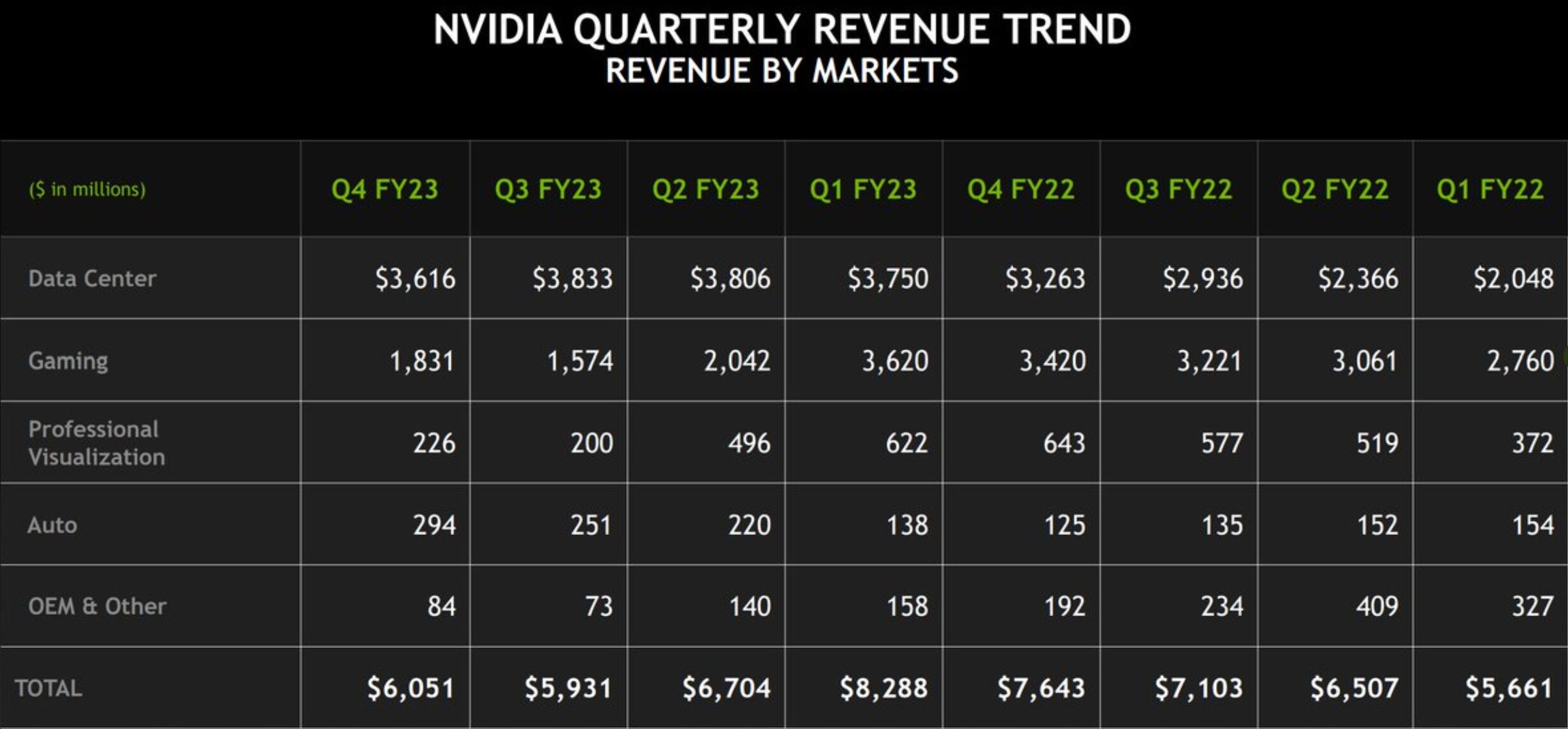
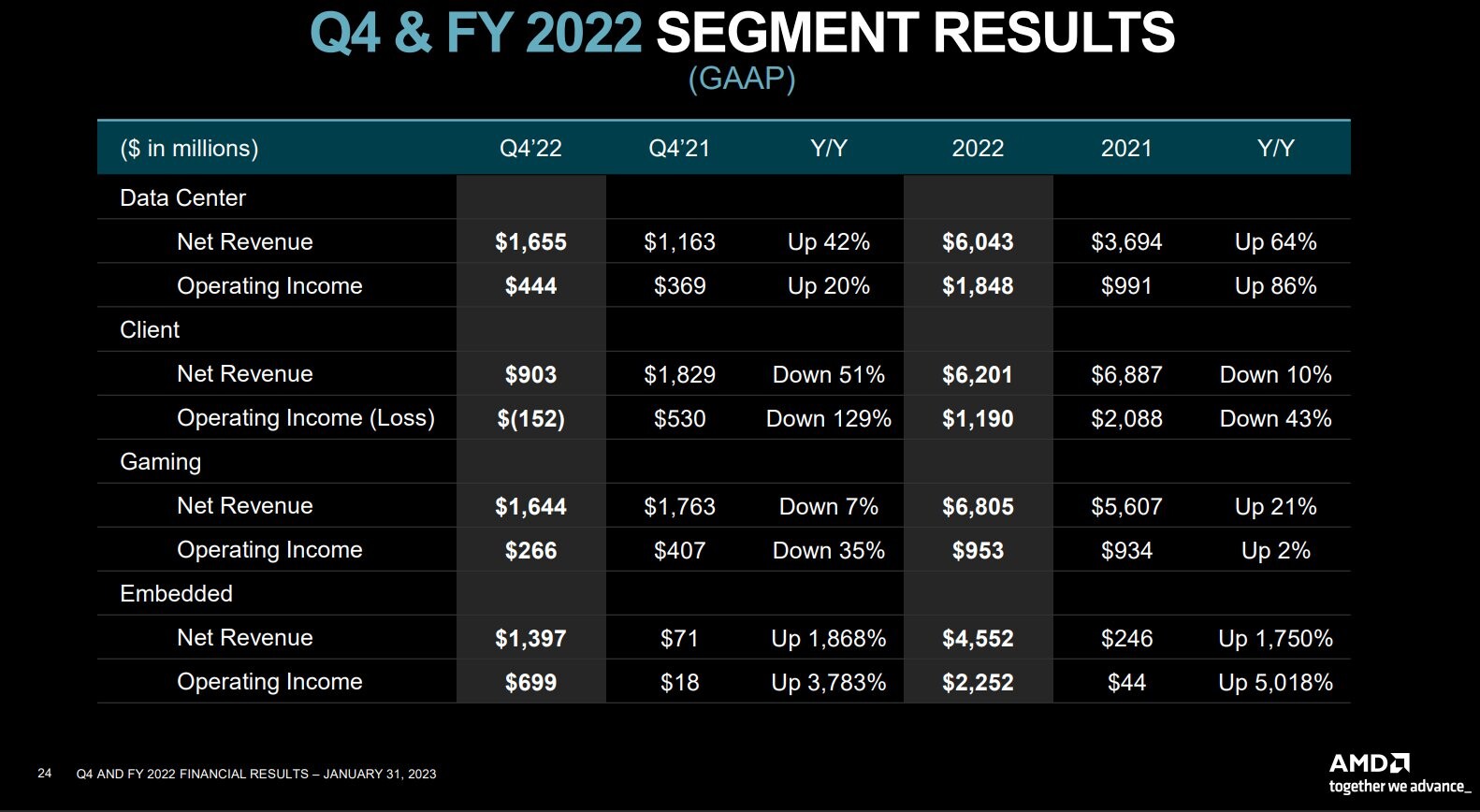
While AMD Radeon PC discrete GPUs have a lot of catching up to do against NVIDIA GeForce products in terms of market-share, the two companies' quarterly revenue figures paint a very different picture. For Q4 2022, AMD pushed $1.644 billion in GPU products encompassing all its markets, namely the semicustom chips powering Xbox Series X/S and PlayStation 5 consoles; and AMD Radeon products. In the same period, NVIDIA raked in $1.831 billion in revenues from semicustom chips powering Nintendo Switch console, GeForce NOW cloud-gaming service, and NVIDIA GeForce products. In purely revenue terms, AMD is bringing in 89% the revenue of NVIDIA from client graphics IP, which begins to explain how AMD is a major player in this market.

Source:
HXL (Twitter)
59 Comments on AMD GPU Sales Not That Far Behind NVIDIA's in Revenue Terms
Id guess took a huge hit on sales for mining. So maybe what we are seeing is real gaming revenue now, which isn't much higher than AMD.
The positive side of this is that they know that they have X millions of dollar of revenue every year as per their contracts to other corporations.
Oh and watch this first before bothering to reply:
What I care about is performance, specs like amount of cores, amount of ram etcetera is absolutely useless to me. I don't pay for specs, I pay for performance. Your 16gb amd card is incredibly slow - to the point of it being unusable in rt games. It could have 1TB of vram and it would still wouldn't make a difference.
You might not be interested in the number of cores, but you still want those cores to do the job, and fast. So, you are interested in the specs and you do pay for specs, otherwise you can't have the level of performance you need.He does, because he plays specific games that use a lot of VRAM. And therefore, whatever card he bought that is cheaper and provides features he needs is a better value. It is that simple.
We know that Nvidia has been pathetic on the amount of VRAM on several classes of GPUs in recent years. For example, 3080 10GB was and still is an absurdly low amount of VRAM on high-end and expensive card.Watch new video on Moore's Law Is Dead youtube channel to find answers to your questions. Tom's got almost all figures and breakdown.
We know AMD has been pathetic on the amount Of RT performance on several classes of gpus in recent years. For example, the 6800xt was and still is absurdly slow in RT for a high end expensive card.
7000 cards lifted RT performance to a level of Ampere cards, which is quite good on its own. Of course, Ada cards are even better in RT, which is fine for those who need this feature. For those who do not, it's a useless feature they would never look at or even consider, like me. I hope you understand this. Productivity workloads are diverse. Nvidia cards are brilliant for many of those workloads and 7000 cards have improved a lot in content creation, especially in AV1, which is also good."We know?" Who is we? You cannot be bashing and berating products if those products do not meet your personal gaming or productivity needs. It's silly and childish to do that. RT performance is just one of features that not everyone needs or cares about. Accept it. 7000 cards are of course not as high in RT performance as Ada cards, but it's quite decent in comparison to previous AMD generations. For those who need this feature. It's definitely not "pathetic", which is another emotive word we do not need here.
I have Sapphire 6800XT and 7900XTX cards. Both are great in pure raster and media content, and meet my needs. I do not use RT and therefore do not need the feature. If I needed it, I would have bought Nvidia card. Simple.
6800XT has 16GB of VRAM and is fantastic card for gaming on 4K/120Hz OLED TV. It is literally on par with 3080, but original 3080 10GB suffers from insufficient VRAM and is not future-proof in that regard. That's why I did not buy Nvidia card. My Flight Simulator used ~15GB of VRAM in 2021 already.
7900XTX with 24GB of VRAM serves me really well in 4K gaming and media creation. It was significantly cheaper than 4080 16GB to buy, it has 8GB more of VRAM and future-proof connectivity with three DisplayPort 2.1 ports, each at 54 Gbps, for new monitors I intend to buy later this year. It's a perfect card for my needs and I would highly recommend it to anyone who needs a high-end product without paying more than ~$/€1000.
Please accept a basic fact that different cards meet different needs of their users. That's all to it.No. They genuinely did not sell cards to ordinary folks. Miners have moved to ASICs. GPUs are not as profitable for them anymore. There has been a multi-million GPU flood on secondary market last year and people bought tones of GPUs, e.g used 3090 for $750 on ebay.
Official Nvidia documents show that they have more than $5 billion in inventory in stock, which suggests a huge amount of unsold GPUs that they do not want to release on the market in bigger numbers and lower price. Which means that people showed a middle finger to high prices of cards and did not buy them.
The good thing about your reply is that your language has improved, a lot. You still have your sarcasm to work on and finetune when to use it.
In fact you said "we know" 3080 has pathetic vram. The same we also know that Amd is atrocious in rt
I was more criticising the company for being anti-consumer on vram spec on high-end cards. That was the card I originally intended to buy.
The thing is, you always have to make trade offs. Imo, a lower amount of vram for better RT, better upscaling and extra features like FG is totally worth it. For you it might not, but calling nvidia in particular anti consumer cause they don't offer the specific features you want (vram) is just wrong.