Thursday, January 30th 2025

Intel Reports Fourth-Quarter and Full-Year 2024 Financial Results
Intel Corporation today reported fourth-quarter and full-year 2024 financial results. "The fourth quarter was a positive step forward as we delivered revenue, gross margin and EPS above our guidance," said Michelle Johnston Holthaus, interim co-CEO of Intel and CEO of Intel Products. "Our renewed focus on strengthening and simplifying our product portfolio, combined with continued progress on our process roadmap, is positioning us to better serve the needs of our customers. Dave and I are taking actions to enhance our competitive position and create shareholder value."
"The cost reduction plan we announced last year to improve the trajectory of the company is having an impact," said David Zinsner, interim co-CEO and chief financial officer of Intel. "We are fostering a culture of efficiency across the business while driving toward greater returns on our invested capital and improved profitability. Our Q1 outlook reflects seasonal weakness magnified by macro uncertainties, further inventory digestion and competitive dynamics. We will remain highly focused on execution to build on our progress and unlock value."


 Q4 2024 Financial Results
In the fourth quarter, the company generated $3.2 billion in cash from operations. Full-Year 2024 Financial Results
 For the full year, the company generated $8.3 billion in cash from operations and paid dividends of $1.6 billion.
Business Unit Summary
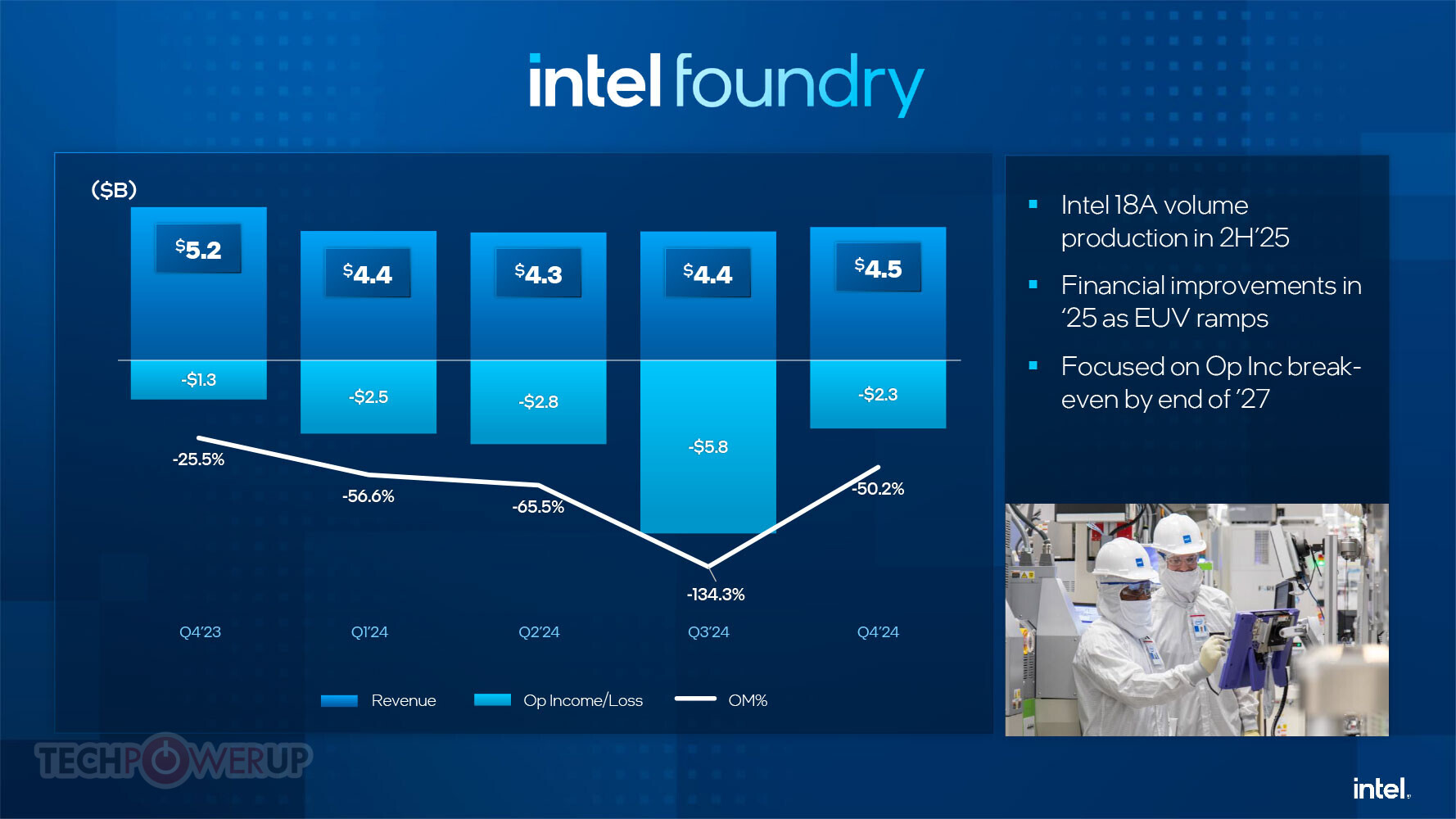
In October 2022, Intel announced an internal foundry operating model, which took effect in the first quarter of 2024 and created a foundry relationship between its Intel Products business (collectively CCG, DCAI and NEX) and its Intel Foundry business (including Foundry Technology Development, Foundry Manufacturing and Supply Chain, and Foundry Services, formerly IFS). The foundry operating model is designed to reshape operational dynamics and drive greater transparency, accountability, and focus on costs and efficiency. In furtherance of Intel's internal foundry operating model, Intel announced in the third quarter of 2024 its intent to establish Intel Foundry as an independent subsidiary. The company also previously announced its intent to operate Altera as a standalone business. Altera was previously included in DCAI's segment results and, beginning in the first quarter of 2024, is included in "all other." As a result of these changes, the company modified its segment reporting in the first quarter of 2024 to align to this new operating model. All prior-period segment data has been retrospectively adjusted to reflect the way the company internally receives information and manages and monitors its operating segment performance starting in fiscal year 2024. There are no changes to Intel's consolidated financial statements for any prior periods. Intel Products Highlights
On April 29, 2025, Intel Foundry will host its annual flagship event, Intel Foundry Direct Connect, in San Jose, California. The event will feature talks from Intel leaders, customers, industry technologists and ecosystem partners as they share details of Intel Foundry's strategy, process technology, and advanced packaging and test capabilities. The event will also include an ecosystem exhibition and networking opportunities. For information about the event, please visit this page.
Business Outlook
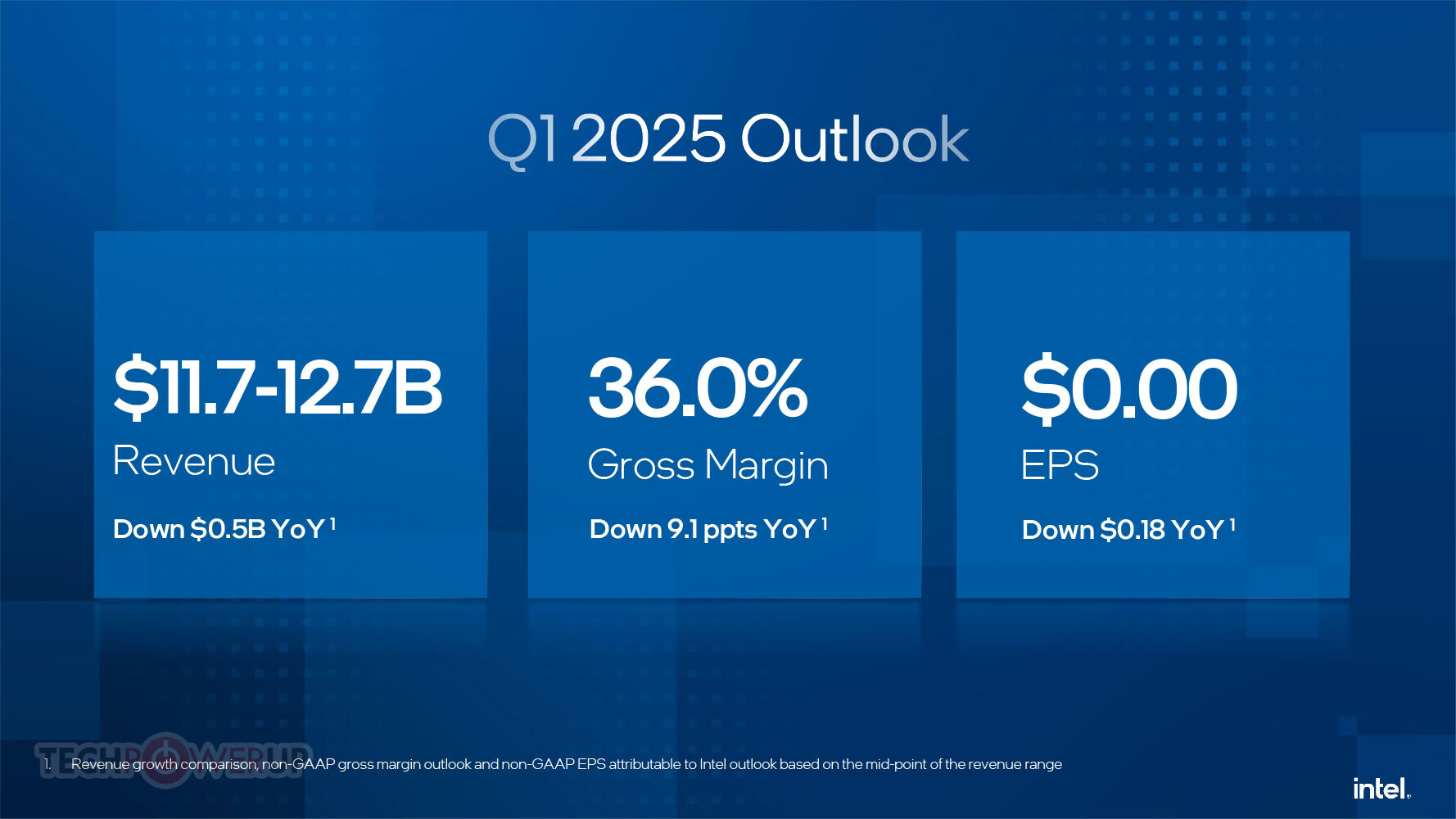
Intel's guidance for the first quarter of 2025 includes both GAAP and non-GAAP estimates as follows:
The complete slide deck follows.


"The cost reduction plan we announced last year to improve the trajectory of the company is having an impact," said David Zinsner, interim co-CEO and chief financial officer of Intel. "We are fostering a culture of efficiency across the business while driving toward greater returns on our invested capital and improved profitability. Our Q1 outlook reflects seasonal weakness magnified by macro uncertainties, further inventory digestion and competitive dynamics. We will remain highly focused on execution to build on our progress and unlock value."


In the fourth quarter, the company generated $3.2 billion in cash from operations.


Business Unit Summary
In October 2022, Intel announced an internal foundry operating model, which took effect in the first quarter of 2024 and created a foundry relationship between its Intel Products business (collectively CCG, DCAI and NEX) and its Intel Foundry business (including Foundry Technology Development, Foundry Manufacturing and Supply Chain, and Foundry Services, formerly IFS). The foundry operating model is designed to reshape operational dynamics and drive greater transparency, accountability, and focus on costs and efficiency. In furtherance of Intel's internal foundry operating model, Intel announced in the third quarter of 2024 its intent to establish Intel Foundry as an independent subsidiary. The company also previously announced its intent to operate Altera as a standalone business. Altera was previously included in DCAI's segment results and, beginning in the first quarter of 2024, is included in "all other." As a result of these changes, the company modified its segment reporting in the first quarter of 2024 to align to this new operating model. All prior-period segment data has been retrospectively adjusted to reflect the way the company internally receives information and manages and monitors its operating segment performance starting in fiscal year 2024. There are no changes to Intel's consolidated financial statements for any prior periods.

- CCG: Intel continues to lead the AI PC category. The company is on track to ship more than 100 million AI PCs by the end of 2025, and is working with more than 200 ISVs across more than 400 features to optimize their software on Intel silicon. At CES, Intel introduced the Intel Core Ultra 200V series mobile processors with Intel vPro, empowering businesses with AI-driven productivity and enhanced IT management. The company also unveiled the Intel Core Ultra 200H and HX series mobile processors, delivering industry-leading performance, efficiency and platform capabilities, alongside a landmark reduction in power usage. Intel expects to further strengthen its client roadmap with the launch of Panther Lake, its lead product on the Intel 18A process technology, in the second half of 2025.
- DCAI: Intel collaborated with Dell Technologies on the Dell PowerEdge XE7740 server, which uses dual Intel Xeon 6 with Performance-cores and up to eight double-wide accelerators, including Intel Gaudi 3 AI accelerators. Intel also showcased its MRDIMMs memory technology, the fastest memory system ever created, in Intel Xeon 6 data center processors, achieving a significant increase in bandwidth that would normally take multiple generations to reach.
- NEX: At CES, Intel launched a new line of Intel Core Ultra processors for edge computing, prioritizing scalability and performance across various AI applications.
- Intel and AMD are seeing strong engagement from the x86 Ecosystem Advisory Group. Following the group's inaugural meeting this month at Intel's headquarters, Intel and AMD initiated work to drive key architectural features that enable compatibility across platforms, simplify software development and support needs of developers.
- In December, Intel Foundry achieved full tape-out of an Intel 16-based design for an external customer, with plans for volume manufacturing later this year at Intel Ireland, the company's lead European wafer fabrication center.
- Process tool installation is underway in Fab 52 in Arizona in support of ramping Intel 18A production this year.
- Intel signed a definitive agreement with the U.S. Department of Commerce awarding the company up to $7.86 billion in direct funding under the U.S. CHIPS and Science Act. Intel achieved initial milestones, receiving $1.1 billion in the fourth quarter of 2024 and $1.1 billion in January 2025. The CHIPs agreement supports Intel's essential role in advancing domestic leading-edge semiconductor R&D and manufacturing that are critical to economic and national security.
- At IEDM 2024, Intel Foundry's Technology Research team demonstrated industry-first advancements in transistor and advanced packaging technologies that help meet future demands for AI.
On April 29, 2025, Intel Foundry will host its annual flagship event, Intel Foundry Direct Connect, in San Jose, California. The event will feature talks from Intel leaders, customers, industry technologists and ecosystem partners as they share details of Intel Foundry's strategy, process technology, and advanced packaging and test capabilities. The event will also include an ecosystem exhibition and networking opportunities. For information about the event, please visit this page.
Business Outlook
Intel's guidance for the first quarter of 2025 includes both GAAP and non-GAAP estimates as follows:




44 Comments on Intel Reports Fourth-Quarter and Full-Year 2024 Financial Results
Then again, neither did the Intel that I got in between.
No, Intel always wanted (and always at least tried) to directly and mercilessly outright kill each and any competitor and wanted to extinguish such forever. They really took the phrase of a ›competitive threat‹ to heart, and acted accordingly… As if it was a matter of life and death! Yet in a sense it always was, at least for Intel. Since Intel just can't handle competition and they never could.
The funny thing is, that the press always loved, and many still do so, to picture Intel as a juggernaut, and while it actually is true (in the meaning of a destructive force, less as a heavyweight), in reality Intel is and always was nothing but a bully, always trying to give everyone around them a bad or at least hard time…When Intel eventually will be wiped off the commercial trade register, there won't be a actual loss of competition.
Since every market where Intel was partaking and acted in, there was never actual competition anyway, but always only a sudden market-player, who loved to engage in corrupting the market heavily in its own favour through the back-door at the very market's root, using their beloved OEMs – Not only undercutting but outright work around the customer's actual genuine free choice between competitors and their respective products, undermined customers' choice completely and with that, actually cripple intentionally competition, knife innovation and secretly cut competitors off their revenue, only to starve them to death, no matter how competitive and actually innovative these were.
So no, Intel dying and eventually ending up going extinct, will actually foster competition, since there won't be a corrupt market-player anymore, who always hindered innovation from day one and purposefully stalled advancements for the sole sake of blatant enrichment – The decade of quad-cores comes to mind here!
I'm sorry, but they basically asked for it – Straight off their own earnings-presentation 1Q20, p 15;
Who knows if those who put it into it, were actually aware of the stunning irony of it, like not…
Thats when I got my last intel cpu and jumped off to AMD and Apple for good, plus the news of how they bribed Dell and others to do not use AMD cpus, especially on their lucrative corporate lines.
Also, Intel's management tried heavily pushing such huge wafers, for the sole reason of installing nothing but a capital industrial-barrier upon the way up especially for any smaller semiconductor-competitors (who wouldn't have had the monetary means to actually engage in those huge costs for it), to kill them through sheer costs and with that by proxy knife Intel's own competitors. Literally no-one else but those three fabs exclusively was actually eyeing with such big wafers in the first place.
That being said, AMD never ever at any point in time was pursuing 400mm-wafers, since by the time these were pushed in 2012–2017, AMD had already split off their semiconductor-division into the independent spin-off called GlobalFoundries. So you're just making stuff up for sh!tting on AMD for no reason here…
Have a read;
El Reg – How TSMC killed 450mm wafers for fear of Intel, Samsung
And if i look at things published before 2022 when that tsmc killed it was published I find plenty of articles talking about 450mm much earlier than 2012.
fabs should have been up by 2011
according to some www.pwc.com/gx/en/technology/publications/assets/pwc-faster-greener-smarter.pdf for example
never said amd was doing large wafers, the world economy broke during the gfc
The period that also brought amd to ruin Because their financials were horrible and everyone wanted their money back right away.
thats the link between the two I was going for, shit economy ruining many good thing.
450mm wafers 2.5 times more space for chips per wafer would have been great
Could that be why AMD has been having more success (ignoring AI for a moment)
Market ain't what it used to be.
Microsoft Windows has become progressively worse in quality (which imo has more to do with BSODs than anything else but maybe not all cases)...
The world just isn't the same as it was before. External 5.25" bays are becoming less relevant by the day and I am screaming into the void.
Relationships and dynamics with foundries ain't the same. Demands and needs are changing.
I hate saying that. Anyways curious if Intel would ever attempt to do some APU on par with what Ryzen has offered with their Xe cores. Just shove a bunch of Xe Cores without making the discrete cards irrelevant. Y'know?
Yes, these types of huge wafers were heavily pushed by Intel alone for years, namely only for installing said industrial competitive firewall and literal paywall before any smaller competing semiconductor foundries, which then would (in Intel's view) hopefully just die off along the road to the top, when breaking their monetary back to pursue such vastly expensive tools and equipment for even handling said wafer-sizes in the first place, for staying with the big players anywhere close to the top.
And yes, Intel alone and exclusively actually heavily pushed these wafers for years since 2008 – You're correct so far on that mark. Intel basically tried to shame the big players into submission for pursuing these types of wafer-sizes for half a decade, as always firmly backed by their myriad of media-outlets on payroll.
Yet Intel's babbling didn't even was actually registered by others like TSMC, Samsung, GlobalFoundries, UMC and the myriad of smaller contract-manufacturers before anything 2012, who just were right in-between to scale their foundry-works up by quite a notch for, due to and mostly solely backed by a billion ARM-cores being fabbed en masse – Actually establishing a sound and financially worthwhile businesses by that which lasts to this very day.
However, that very increased competition (or others actually also establishing a foundry-model) and establishing their businesses as viable foundry-options within the industry, was in turn precisely, what Intel actually tried to prevent from the get-go to begin with: Competition in the semiconductor-space for them as a foundry!
What Intel actually wanted to push through, was to have a barrier in front of them before any other competitor. Intel tried nothing short of effectively yet deliberately
splitdivide the semiconductor-industry into the big-players with, of course, Intel at the very top of it – Those who regularly could afford the enormous costs and sheer endless monetary means for maintaining the financial ecosystem for such wafer-sizes in the first place, which had nothing short but a price-tag of ∞,–).… and the rest of the industry – Those who just had to stay low and couldn't by any means monetarily afford the actual equipment and tooling for wafers beyond fairly new 12" 300mm-wafers, if even that: The majority of smaller contract-manufacturers was still already fully occupied by maintaining 8" 200mm-, 6" 150mm- or 5" 125mm-wafers.
So in went on for several years that way until around 2012, when the big ones were lulled enough by around 2015, to actually thinking about it – Equipment- & Tooling-manufacturers like Nikon, ASML and others were more or less waiting for the green light from the big ones for years by then, if anyone was trying to push through (and bear the incredible amount of expenses beign needed for 450mm-wafer equipment and associated tooling alone), even if ASML, Nikon, Canon and who knows else readily knew from the start, it would be nothing but a uphill-battle financially for everyone involved either way – The one being stupid enough to pursue these types of wafers first, would likely go bankcrupt over it anyway, that was basically a given.
Though luckily, especially TSMC's executives soon figured and by 2017 just plain knew, that a) the Intel-projections were far and away from the truth and reality (Shocker!) and b) that TSMC itself most definitely would end up killing themselves over it through the sheer costs, and c) eventually saw the writing on the wall: Especially that Intel distinctively actually intended exactly that and nothing else to happen from the outset of things! So TSMC notified Samsung and the rest of the industry, and called it a day.
tl;dr: Intel tried nothing but to corner the foundry-market or better, the semiconductor-market as a whole and tried shutting out others through mere costs associated with actual fabrication of wafers… In fact a walled semiconductor-garden for Intel themselves, and no-one else.
It wasn't even a lame game of who chickens out first: Intel didn't even wanted to actually pursue these 450mm wafer-sizes themselves, since the sole intention was, to just actually pretend to do so publicly, while actually let others bear the very costs of it, fragment and actually divide the semiconductor-market in half, only to retreat afterwards back to 300mm-wafers, when the stupid competitor was bankrupted over it and in essence effectively just lull smaller competitors into bankruptcy this way to clean the market.Fair enough. Though it surely looked that way at first glance.What brought AMD at the brink of financial collapse and everyday near-bankruptcy for years, can in largest parts be mostly attributed to unfair competition from Intel and Intel's straight-up illegal practices, and to way lesser amount the actual takeover-costs of ATi…
Few actually know that fact, but no less than a figure but Intel even had a hand in it and through their connections of Intel Capital actually bribed the contracted legal firms, corporate advisors and the very accounting firm who AMD contracted to manage the acquisition, in deliberately asses and set a actual evaluation of assets and valuation way higher, than what ATi would've been actually worth back then, in Intel's noble hope, that AMD might just die off over the actual way over-inflated acquisition and the take-over's cost, being purposefully bloated by several billion USD.
ATi's own evaluation estimated their patents' and technologies' worth to be actually only around $3.2Bn, not the $5.6Bn which was actually paid by AMD – That was never actually disclosed by the involved firms towards AMD, to intentionally inflate the price-tag for several billion, only to cripple and hopefully kill AMD in the process. Luckily, it didn't!See above, the global economy had way lesser to do with it, than shady practices behind closed doors actually did.
Also, the majority of projections for 450mm-wafers over economic viability were (intentionally) way too optimistic and showed net revenues, which never actually would've materialised in the first place – Guess who contracted these advisors in giving such skewed view-points, to hopefully yet intentionally lull others into bankruptcy to begin with!
I fear that AMD will not introduce more than 8 cores per CCD with Zen 6 (though I still hope they'll do), as they are not getting seriously pressured from Intel. What may be actually stressful a bit for AMD is Intel's GPU division, which makes huge advancements in quite short time.